
EV Infrastructure Design Report Template
Start with a free 30-day trial. No credit card required.
 100% fully editable EV Infrastructure Design Report
Export your design infrastructure report to PDF or CSV
Access Part S reports on mobile, tablet or computer
Thousands of templates including other environmental templates


~10,000 employees

~500 employees

~10 employees

~25,000 employees

~200 employees

~1,500 employees

~20 employees
What is an EV Infrastructure Design Report?
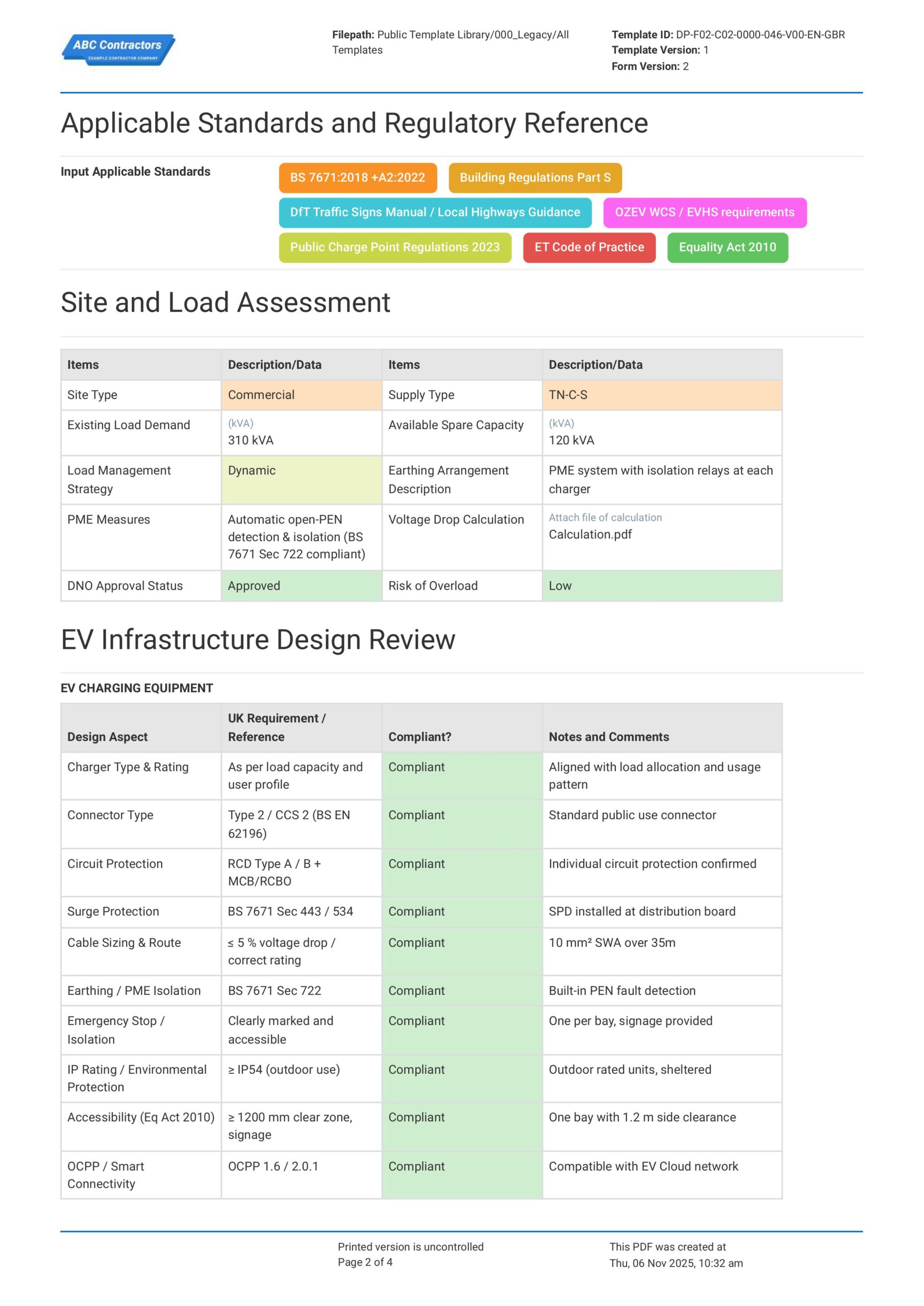
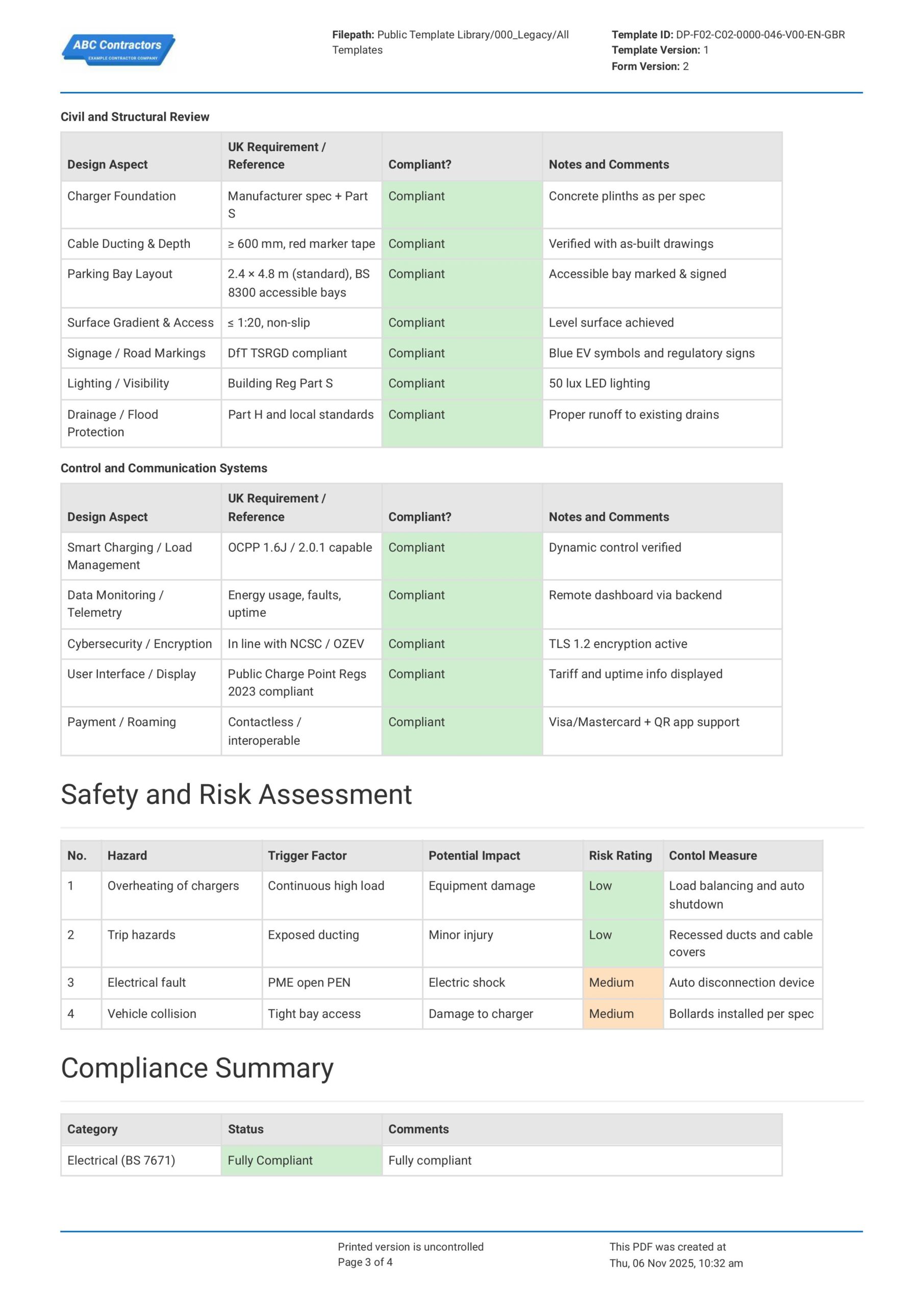
An EV Charging Infrastructure Design Report provides a thorough examination of the current condition of electric vehicle (EV) charging infrastructure. The assessment looks at everything about the charging point, such as how safe it is to use, whether it meets regulations, and the overall condition of the chargers and building infrastructures.
This report assures the public that the infrastructure is up to standards and that vehicles can safely and optimally charge when using its utilities.
Compare this EV Infrastructure Design Report to paper-based forms created from Word, Excel, or PDF
Use this EV Infrastructure Design Review Report template for free.
EV infrastructure planning: UK’s Vision for the future
In the Electric Vehicle Smart Charging Action Plan article published by the UK government, under the ministerial foreword, it says that by 2030, there will be up to 10 million electric vehicles on UK roads, as the UK speeds ahead on its journey to net zero. This vast volume of EVs will also obviously increase the demand for charging stations around the country.
To achieve this, the UK government has established an explicit vision for its future charging infrastructure. In another article the UK government published titled "Taking Charge: The Electric Vehicle Infrastructure Strategy," they stated that their goal is for every UK citizen to easily identify and access reliable public charging sites, regardless of their location. As a result, the UK government has set the following goals in reaching the demand for EV stations:
- The UK government wants to ensure that everyone can find and access reliable public charge points wherever they live.
- Effortless on- and off-street charging for private and commercial drivers.
- A reliable network of high powered chargepoints along major roads.
- Fairly priced and inclusively designed public charging, trusted by consumers.
- Market-led rollout for the majority of charge points, backed by competition.
- Infrastructure seamlessly integrated into a smart energy system.
- Continued innovation to meet drivers’ needs.
EV infrastructure deployment plan
As part of the Part S Building Regulations in the UK, newly built buildings and renovated establishments must provide designated electric vehicle charging stations. This aligns with the UK's goal of zero-emission transport and easy accessibility to EV charging stations.
However, building EV stations also has some necessary regulatory provisions to ensure that people can safely and efficiently charge their electric vehicles. To ensure that these provisions are met, conducting an EV infrastructure deployment plan is vital. The following are the key components necessary for creating an effective deployment plan:
Planning and designing electric charging stations
The project should begin with the design stage. During this phase, it's crucial to review regulatory provisions, like part S, and integrate them into the design. Designing the infrastructure should incorporate important details, such as electrical capacity, cable routes, number of charging stations, and provisions for future expansion.
The design phase plays a crucial role in the safety, efficiency, and accessibility of the actual EV charging stations, so making it compliant and thorough is essential.
Installation and Commissioning of EV charging stations
The installation and commissioning of the EV charging station are also crucial components of the deployment plan, as this is when the actual EV station is constructed and tested for use. Just like the design phase, there are a number of regulations that must be followed during these phases.
- The BS 7671:2018, IET wiring regulations, sets out provisions for electrical installations.
- IET Code of Practice for Electric Vehicle Charging Equipment Installation provides the minimum safety requirements for these charging stations.
- The Electric Vehicles (Smart Charge Points) Regulations 2021 makes sure that all domestic and industrial charging stations are smart and cyber secure.
All of these requirements and standards must be checked during the commissioning phase to ensure that charging stations are fully functional, safe, and compliant with regulatory requirements before they are handed over for use.
Review of EV charging stations
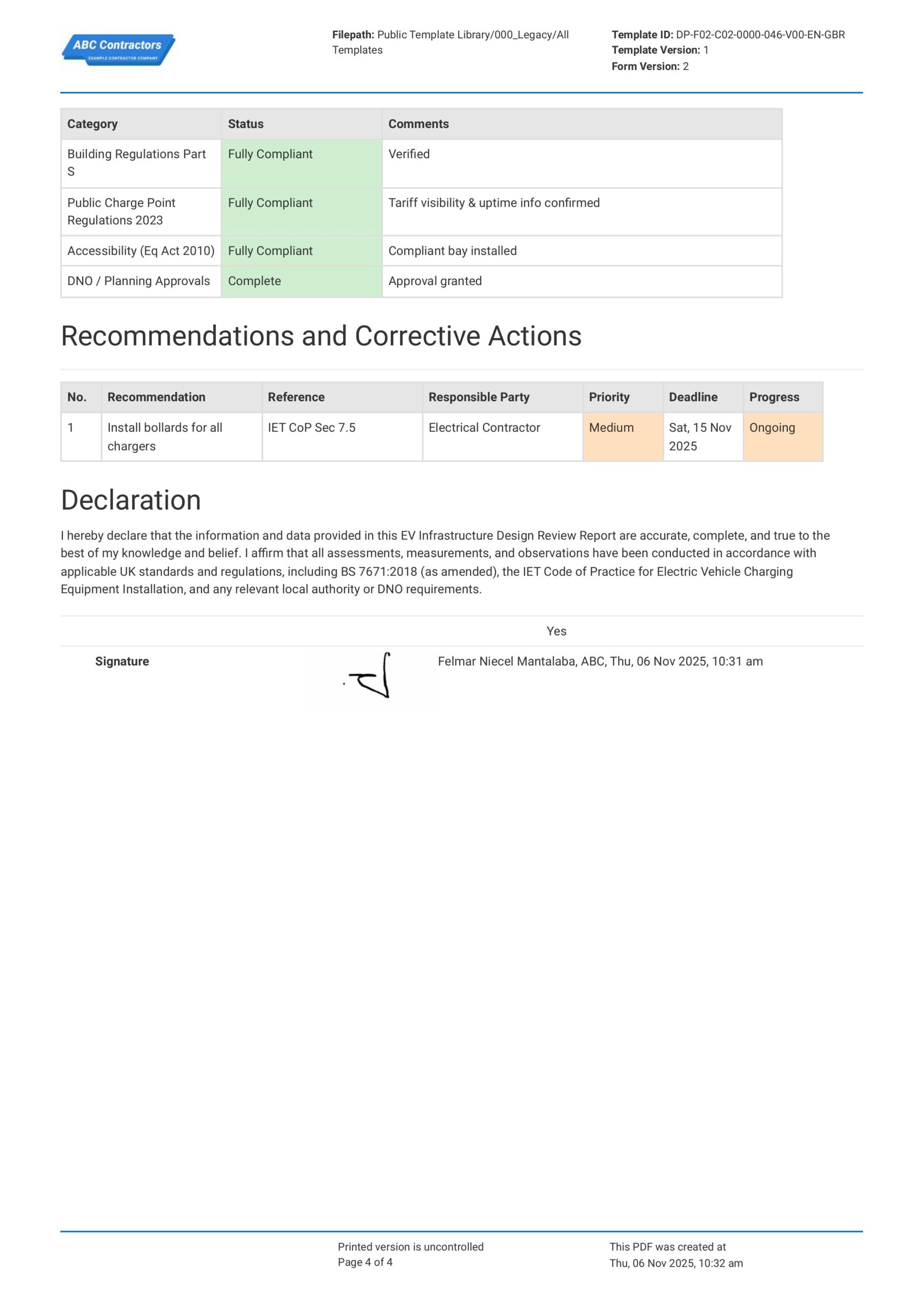
The last key item that must be present in the deployment plan is the review procedures. After completing the commissioning phase, establishments must continuously review the functionality, safety, and compliance of the charging stations. Reports, such as the EV infrastructure report, are one of the few examples that establishments can use to achieve this. This EV Infrastructure Design Review Report considers all aspects of the infrastructure, including its safety, compliance with standards, and the general condition of the charging stations and building infrastructure.
EV infrastructure design: Part S Requirements
As part of the UK’s vision to provide adequate charging stations for electric vehicles, Part S has made provisions on when it is required to install an EV charging station. Part S has explicitly made clear that new buildings and buildings undergoing renovation should include in their plan the installation of EV charging stations. Here are the following requirements:
New residential buildings
Part S requires new residential buildings with parking stations to have at least one electric vehicle charging station. The charging station must be built fully wired and functional upon the completion of the building.
Residential buildings planning to have a major renovation
Once an establishment undergoes a major renovation and the parking space or electrical system is heavily affected, each of the residential spaces that have parking must provide at least one EV charging station. However, if the renovation proves difficult to install a charging station, a cable route must be installed for future installation.
New non-residential buildings
For new nonresidential buildings, Part S requires these establishments to have one EV charging station for every five parking spaces. Additionally, a cable route must also be installed for one in every 5 parking stations to ready the establishment for future expansions.
Non-residential buildings planning to have a major renovation
Part S requires non-residential buildings undergoing a major renovation, which includes major works on parking (at least eleven spaces) or the electrical system, to install at least one EV charging station. A cable route must also be installed for one out of every five parking stations to prepare the establishment for future expansions.
Frequently Asked Questions
Why is this the best EV Infrastructure Design Review Report template?
Sitemate's EV Infrastructure Design Review Report is the best template for assessing and documenting EV charging designs because it’s been proven effective by thousands of construction, engineering, and electrical firms across the industry. It’s pre-built to align with UK EV infrastructure and building regulation best practices, ensuring that all critical design, safety, and compliance elements are covered. Plus, it’s intuitive, streamlined, and easy for any project stakeholder — from consultants to contractors — to use efficiently.
Is this template compliant with UK regulatory standards?
Yes – this template is fully aligned with UK Building Regulations Part S, the IET Wiring Regulations (BS 7671), and the Electric Vehicle (Smart Charge Points) Regulations 2021. It’s widely used by certified electrical and construction professionals across the EV infrastructure sector to demonstrate compliance, streamline documentation, and maintain regulatory certification with confidence.
Can I edit this EV Infrastructure Design Review Report for my project or company?
Yes – this template is fully editable through an intuitive drag-and-drop interface. You can build countless document layouts using a variety of field types — such as tables, formulas, sketches, photos, and more — to suit any kind of data capture. It also allows you to personalize the template with your company logo, custom headers, and unique formatting. All of this flexibility is seamlessly powered by Dashpivot’s powerful template builder, making configuration quick and effortless.
On what platforms can I use the EV Infrastructure Design Review Report?
This template is fully accessible on any device — whether you’re using a computer, tablet, or mobile phone. You can easily complete and update EV Infrastructure Design Review forms right from the field or at your desk. Once completed, records can be instantly generated or exported in PDF or CSV formats, giving you the flexibility of Word, Excel, and PDF combined — all powered by a modern, easy-to-use digital platform.

Other popular templates you can use and edit for free

Electric Car Charging Fire Risk Assessment
Complete and share risk assessments for EV charging to UK Building Regulations regulatory bodies and safety officers.

EV Charging Installation Checklist
Ensure that all installation activities are Part S compliant using a smart checklist.

EV Charging Infrastructure Report
Outline all EV charging infrastructure projects, progress, and assessments for Part S Regulation compliance.

This report was generated with Dashpivot
Charge your way to compliance. This EV charging infrastructure report will help streamline the whole reporting process and slide your way to ensuring a standard and safe EV charging station.
- Complete, edit, and review the EV charging infrastructure report on any device.
- Export reports as perfectly formatted PDF documents with your company logo.
- Securely store and manage your reports for easy searching and finding.
- Directly upload PDFs related to the report to back compliance.

Sitemate builds best-in-class software tools for built world companies.

 English (United States)
  English (Australia)
  English (UK)
  English (New Zealand)
  English (South Africa)
  German