Risk Assessment Forklift Template

Start with a free 30-day trial. No credit card required.
Want a ready-made Forklift Risk Assessment that still matches how your sites run? This template comes pre-built for fleet managers and safety professionals, with a structured flow for hazard identification, risk evaluation, and safety controls, plus formulas and logic, photo capture, and the option to automatically generate follow-up tasks. You can edit any part of it to match your company's forklift operations, maintenance routines, or work environments, and the assessment will still hold up against the regulations you'd be audited on.
This Forklift Risk Assessment is an easy-to-use form that your workers can use to identify, evaluate, and control the hazards associated with operating and maintaining forklifts. It helps protect the safety and health of personnel who use the equipment, while keeping data consistent across the different environments where forklifts are a necessity.
 100% fully editable Risk Assessment Forklift
Export your Risk Assessment Forklift to PDF or CSV
Access your Risk Assessment Forklift on mobile, tablet or computer
Trusted by companies, projects and teams of all sizes















What is Risk Assessment Forklift?
A Risk Assessment Forklift is a form used by safety personnel to control the associated hazards that come with using and fixing the forklift. It uses a systematic process for identifying all potential hazards and integrates a quantitative method for getting the risk score, which equates to how likely the hazard is and how severe the impacts are. Having these processes in place would help safety personnel identify proper control measures to effectively contain the hazards and keep all personnel safe from any danger.
Compare this Risk Assessment Forklift form to paper-based documents
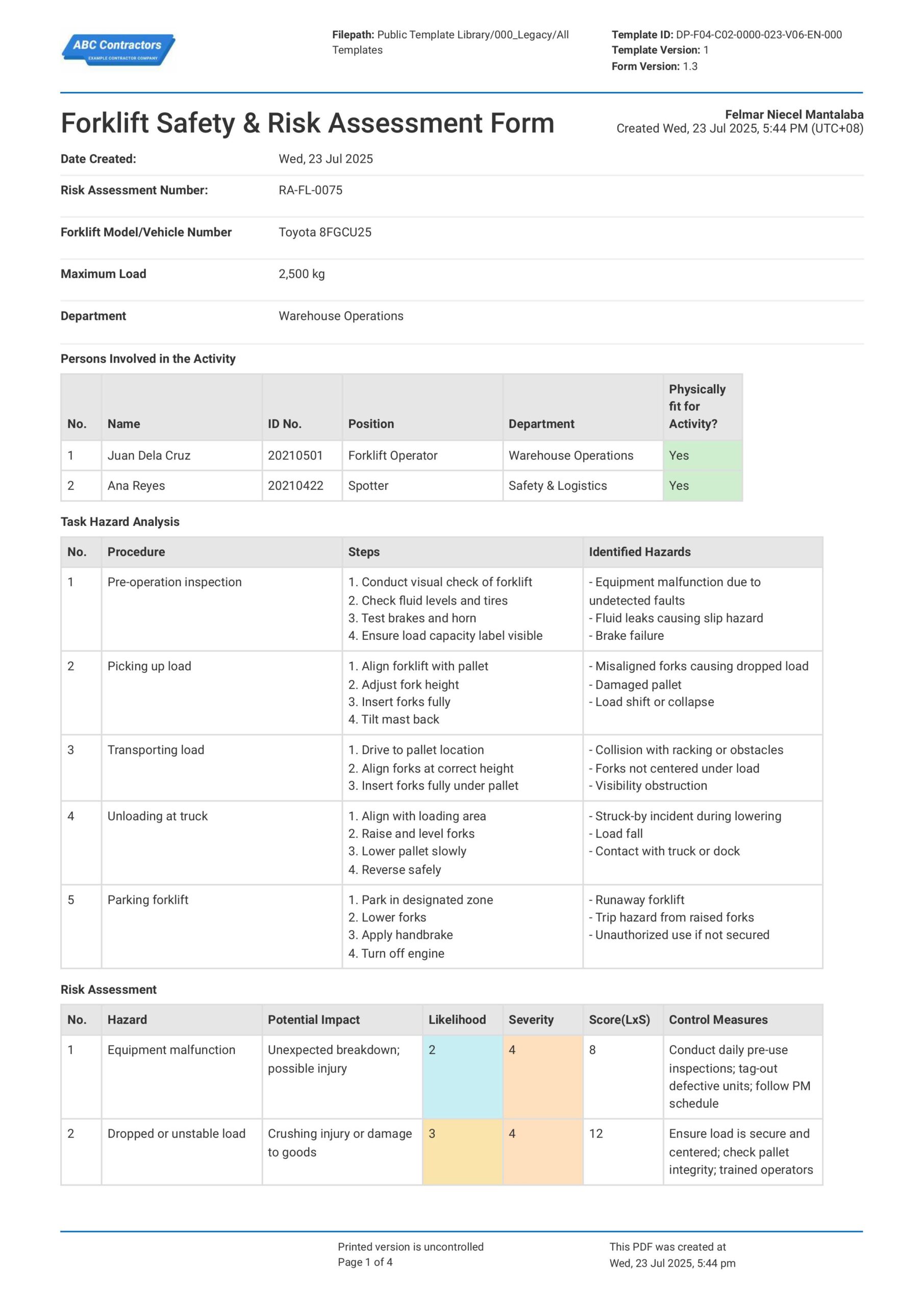
Curious how this Forklift Risk Assessment works? Check out the example below to see how built-in formulas, photo capture, and automatic follow-up tasks work together in one form. You can generate your own version, export it as a custom form with your company details, and fill in your site information to have a ready-to-use Forklift Risk Assessment in minutes.
Use this Risk Assessment Forklift template for free

Generate this template automatically with Storm
You don't have to build the Risk Assessment Forklift field by field. Let Storm, the AI Data Capture Agent inside Dashpivot, build the template for you in seconds.
Describe what you need
Tell Storm the form you want in plain language and it builds a structured digital template from scratch, with fields, tables, and signatures in place.
Upload what you already use
Drop in your existing PDF, Word, Excel, or even a photo of a paper form. Storm rebuilds it as a smart digital template with the structure intact.
 Storm
Storm
Generate a Risk Assessment Forklift form template that I can use for my business
Applicable Standards and Policies for Risk Assessment Forklift
The Risk Assessment Forklift form is not just a tool for identifying hazards in the workplace. It is also a mandatory requirement for relevant regulatory bodies. These are the standards established in different regions that require risk assessments for forklifts:
USA
- OSH Act of 1970 (General Duty Clause): The mandate requires employers to provide a safe and healthy environment for the employees.
- 29 CFR 1910.178—Powered Industrial Trucks: This standard has provisions for safe forklift operation, maintenance, and operator training.
- 29 CFR 1910 Subpart D—Walking-Working Surfaces: This standard covers workplace conditions that have effects on forklift safety.
Canada
- Canada Labour Code Part II: This legislation establishes a primary duty of employers to keep employees safe and protected.
- CSA B335—Safety Standards for Lift Trucks: This provision lays out the safe operation and maintenance of forklifts.
Australia
- Work Health and Safety (WHS) Act: A standard that provides the definition of duties to health and safety, which includes risk management.
- Model Code of Practice: This standard has regulations in the process of identifying and controlling risks.
New Zealand
- Health and Safety Work Act 2015: This provision has requirements regarding eliminating workplace hazards.
- Approved Code of Practice for Forklifts: A standard that provides guidance on the proper use of forklifts and required operator training.
UK
- Health and Safety at Work, etc. Act 1974: This standard establishes duties and responsibilities for maintaining a safe workplace.
- Provision and Use of Work Equipment Regulations (PUWER) 1998: This provision requires that all equipment be used for the correct task, be safe, be properly maintained, and be operated by trained personnel.
- Lifting Operations and Lifting Equipment Regulations (LOLER) 1998: This mandate provides standards for all lifting equipment and its operation.
Ireland
- Safety, Health, and Welfare at Work Act 2005: This is a mandate that requires employers to effectively manage workplace hazards and risks.
- Safe Use of Industrial Trucks Code of Practice: A regulation that provides a guide on industrial truck safety and operation.
Staff Members and Parties that use Risk Assessment Forklift
Personnel who oversee tasks and operations often use the Risk Assessment Forklift form. The following people commonly use the assessment form.
- Field/Warehouse Supervisors: These personnel are responsible for managing daily tasks and activities. Part of their duty as managers is to keep all employees safe and healthy. Forklift activities are inherently dangerous, so managers must lead hazard investigations and implement appropriate safety controls to ensure worker safety.
- Safety officers: Their primary duty is to fully establish safe work practices in the workplace. They provide the criteria of what is safe and what is not. They conduct evaluations of the control measures of activities that involve high-risk equipment, such as those involving forklifts. Safety officers would likely require the risk assessment to complete their evaluations and determine the current measures in place. These evaluations are crucial since the effectiveness of the controls relies on them.
- Operators: These are the employees who are at the forefront of the hazards when using the forklift. When conducting a risk assessment, these people could provide several important inputs, as they are the ones exposed to the hazards when operating the equipment. Furthermore, It is critical for them to be familiar with the proper safety protocols and safety measures to ensure safe operation of the forklift.
Business Risks Reduced by Risk Assessment Forklift
The primary use of a Risk Assessment Forklift form is to ensure that all observed and identified hazards involved in operating and maintaining a forklift in different working environments are properly controlled. Properly implementing and establishing these controls reduces the following business risks:
Lost-time injury (LTI)
Lost-time injury (LTI) refers to the time when personnel are unable to work due to sustained workplace injuries. Such cases affect work and operational efficiency, which impacts costs and productivity. Ideally, employers should always maintain a zero (0) LTI, especially when activities involve forklifts, which are one of the highest contributors to workplace injuries.
Lost workday rate (LWDR)
The lost workday rate (LWDR) refers to how often a lost-time injury occurs over a period of time. Like the LTI, LWDR should ideally be zero. High LWDRs reflect the poor safety planning and management in the workplace. Industries that employ an inherently dangerous piece of equipment, like forklifts, should ensure proper measures are in place to avoid increasing the LWDR.
Non-compliance with regulations
The risk assessment for forklifts is also a practice for employers to stay compliant with regulatory bodies and commit to their duty to keep employees safe. Non-compliance with regulations would incur additional costs and fines and also heavily affect the reputation of the company.
Business Opportunities Created by Risk Assessment Forklift
Conducting a forklift risk assessment ensures safety and helps drive the success of the business as well. Here are the following business opportunities that arise from conducting a proper risk assessment for forklifts:
Full-blown work efficiency
Conducting a risk assessment for forklifts helps identify all the hazards in the workplace and contain them with the appropriate safety control measures. Without any danger, employees can continuously and efficiently work on any given tasks, which helps achieve milestones, deadlines, and quotas.
Forklift life longevity
Forklift risk assessments also target proper maintenance of the equipment to ensure that it operates safely and efficiently when used in an activity. It also provides measures for the proper handling of the equipment, which helps increase its useful life and reduce costs for repair.
Good business relationships
Businesses are also evaluated based on how they take care of their employees, and one key factor for proving that is their commitment and dedication in maintaining a safe work environment. The risk assessment creates this environment by identifying relevant hazards and controlling them so that employees can carry out their daily tasks without fear of injury. Such practice builds a stronger trust and relationship for both employer and employee.
Risk Assessment Forklift: Operator requirements
- Current forklift certification and training records
- Operator experience level and competency assessment
- Understanding of safety procedures and emergency protocols
- Physical fitness and vision requirements verification
Forklift Operator Hazard Assessment Best Practices
Effective forklift operator hazard assessment requires regular evaluation of both individual competency and environmental conditions. Implement monthly operator assessments covering load handling techniques, traffic awareness, and emergency response procedures. Document near-miss incidents and use findings to enhance training programs and update risk control measures. Establish clear communication protocols between operators, supervisors, and pedestrians to minimize collision risks in shared work areas.
How to Create a Risk Assessment Forklift
Creating an effective forklift risk assessment requires systematic evaluation of operators, equipment, and workplace conditions. Follow these steps to develop a comprehensive assessment framework.
Before creating a Risk Assessment Forklift, gather the following information
- Current forklift fleet inventory and specifications
- Operator certification records and training history
- Recent incident reports and near-miss documentation
- Workplace layout plans and traffic flow diagrams
- Applicable safety standards and regulatory requirements
- Maintenance schedules and equipment inspection records
-
Define Assessment Scope and Objectives
- Identify specific forklift operations and work areas to assess
- Determine assessment frequency and review schedules
- Establish risk evaluation criteria and scoring methods
- Define roles and responsibilities for assessment completion
- Set compliance requirements and documentation standards
-
Conduct operator assessments
- Review current certifications and training records
- Observe operator performance during routine tasks
- Evaluate load handling techniques and safety practices
- Document competency gaps and training needs
-
Evaluate equipment conditions
- Inspect safety devices and warning systems
- Review maintenance records and service history
- Test operational controls and emergency features
- Document equipment deficiencies requiring attention
-
Analyze workplace environment
- Assess floor conditions and surface hazards
- Evaluate lighting adequacy and visibility factors
- Review traffic patterns and pedestrian interactions
- Identify environmental risks and control measures
-
Document findings and implement controls
- Record identified hazards and associated risk levels
- Develop specific control measures and timelines
- Assign responsibility for corrective actions
- Schedule follow-up assessments and monitoring
- Communicate findings to relevant stakeholders
Frequently asked questions
How to create your Risk Assessment Forklift in an App or Software System
Digital Risk Assessment Forklift tools transform traditional paper-based evaluations into dynamic, data-driven processes. Real-time scoring algorithms automatically calculate risk levels while photo documentation provides visual evidence of hazardous conditions. Integration with maintenance management systems ensures equipment deficiencies trigger immediate work orders, while operator training tracking links assessment findings to competency development programs.
Automated reporting capabilities enable fleet managers to identify trending safety issues across multiple locations while regulatory compliance dashboards provide real-time visibility into assessment completion rates and outstanding corrective actions.
45 minutes
Medium difficulty
-
How to create a Risk Assessment Forklift form in an app?
Using an app that employs digital forms rather than paper-based could help improve the form by:
- having lesser manual data entry
- having a single access point for all generated forms
- easy reformatting to align with new protocols or updated standards
- having easier integration of photos and files
- creating a more defined workflow
-
Creating the information section
The following information fields must be present in a Risk Assessment Forklift form:
- Date created
- Risk assessment number
- Forklift model/vehicle number
- maximum load the forklift can carry
- Department
-
Creating the persons involved in the activity section
This section lays out all the details for all the employees involved in the activity. The table should have the following column headers:
- Name
- ID number
- Position
- Department
- Confirmation for physical fitness. The confirmation column can be integrated with a yes-or-no list and assigned with colors for better visuals.
-
Creating the task hazard analysis section
This section helps users identify the hazards by investigating the possible hazards for each procedure in an activity.
- Create a 4-column table where users can indefinitely add rows.
- The first column should display the numeric order of each row.
- The second column should allow users to provide the procedures of the activity involving a forklift.
- The third column should allow users to input the steps of each procedure.
- The fourth column is where all identified hazards in the procedure are placed.
-
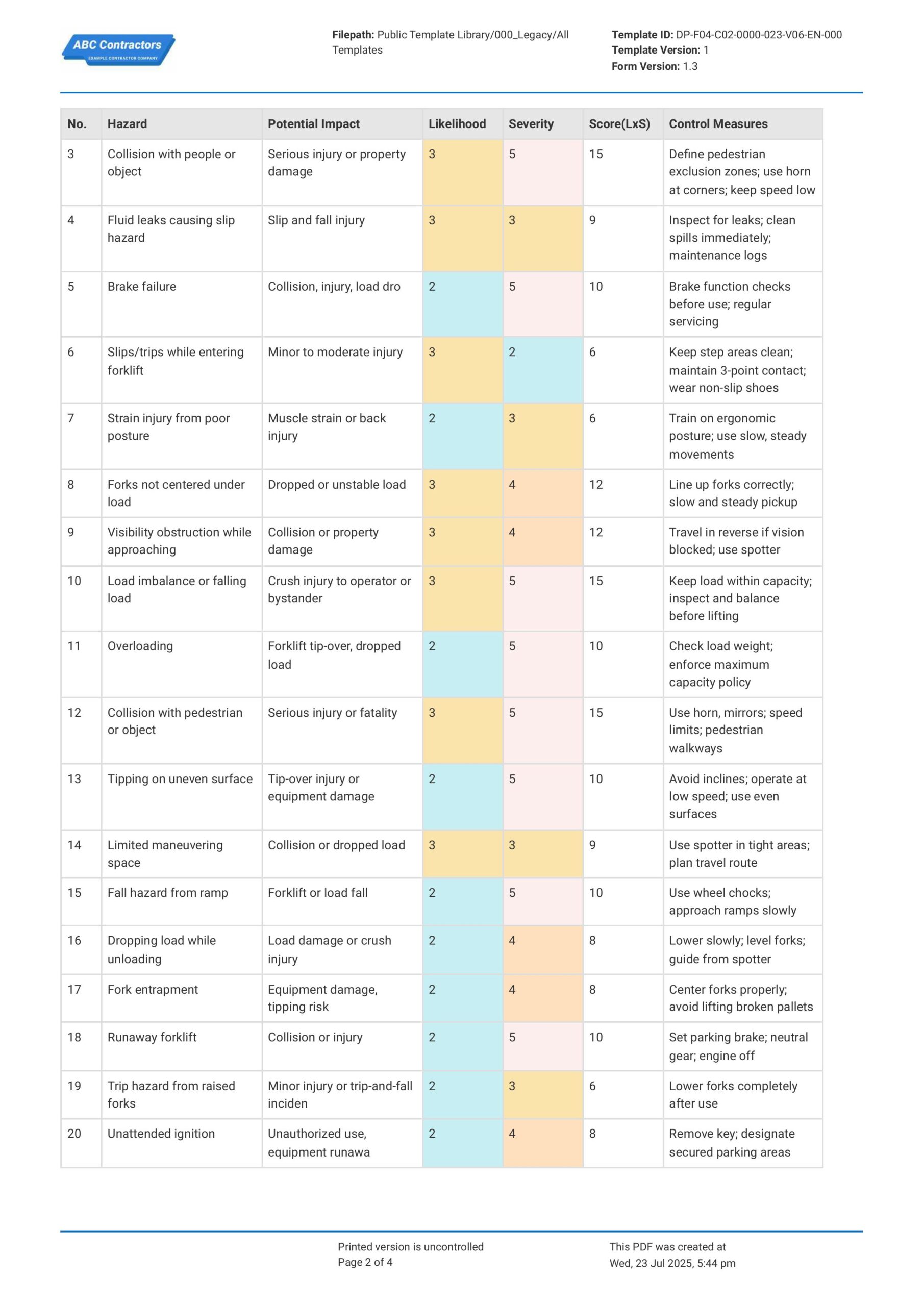
Creating the risk assessment section
Creating the risk assessment section of the form is the most crucial part, as this is where hazards are assessed and provided with the appropriate control measures.
- Create a 7-column table where users can indefinitely add rows.
- The first column should display the numeric order of each row.
- The second column should allow users to input the identified hazard.
- The third column should allow users to input the potential impact of the hazard.
- The fourth column should allow users to input the likelihood of the hazard. This column could be integrated with a list that contains the numbers 1-5. Each selection can be assigned a color to help with immediate recognition of how likely the hazard happens.
- The fifth column should allow users to input the severity of the hazard. This column could also be integrated with a list that contains the numbers 1-5. Each selection can be assigned a color to help with immediate recognition of the hazard’s criticality.
- The sixth column should reflect the equivalent risk score of the hazard. The column could be automated to directly calculate the risk score using the formula: Risk Score = Likelihood x Severity.
- The last column should allow users to input the appropriate control measure to manage the hazard.
-
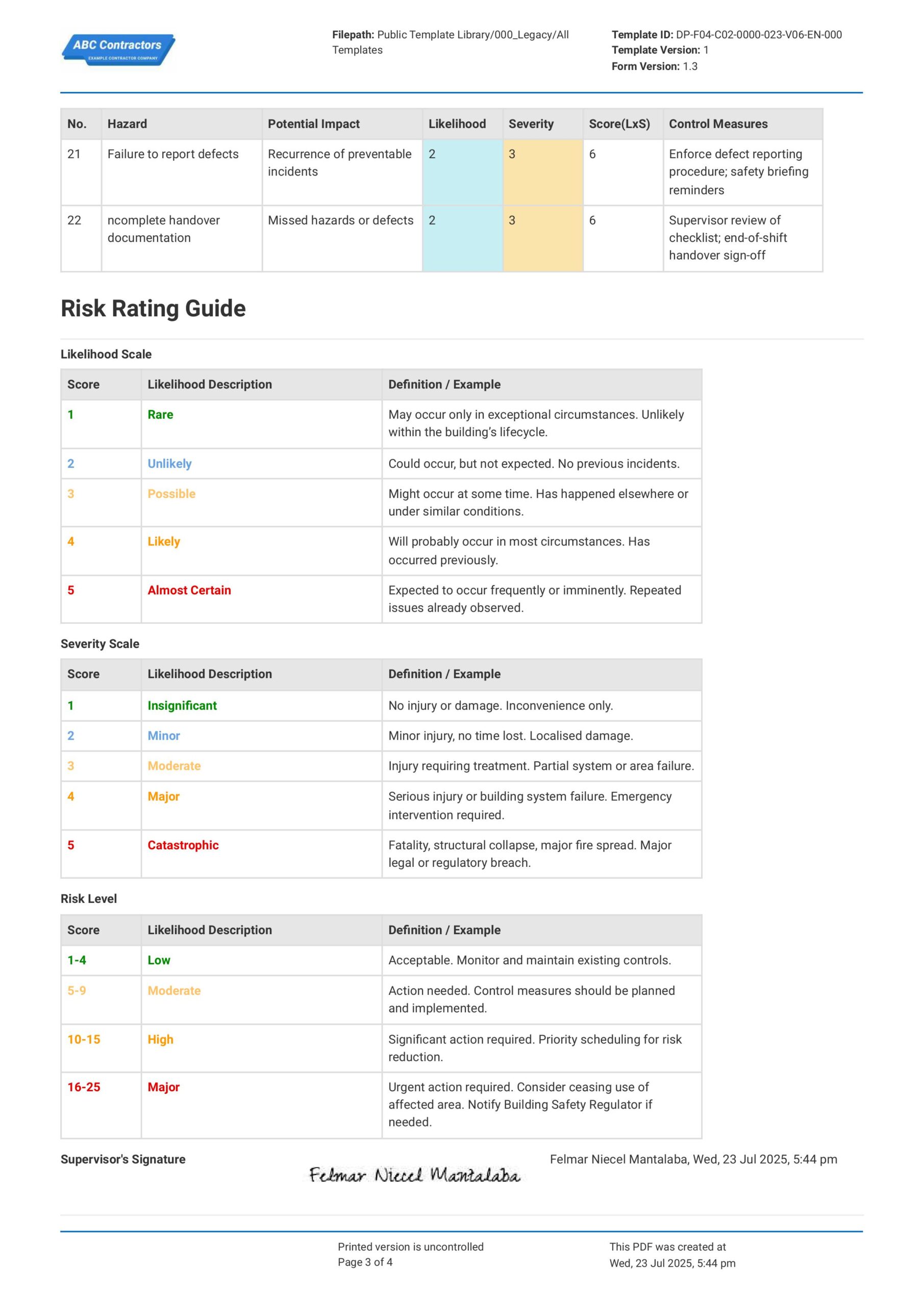
Creating the Guide
This section in the Risk Assessment Forklift form is a guide that will help users score the hazard. The legend should contain the following:
- Likelihood scale
- Severity Scale
- Risk Score Level
Creating the Likelihood and Severity Legend
- Make a table with 5 rows and 3 columns.
- The first column should display the likelihood or severity level of the scale, which is numbered 1-5 in each row.
- The second column should reflect the description of each level in the scale.
- The third column should provide a definition or example of each level in the scale.
Creating the Risk Score Level Legend
- Make a table with 4 rows and 3 columns.
- The first column should display ranges of equivalent scores. (1-4, 5-9, 10-15, 16-25)
- The second column should reflect the description of each range.
- The third column should provide a definition or example of each range.
-
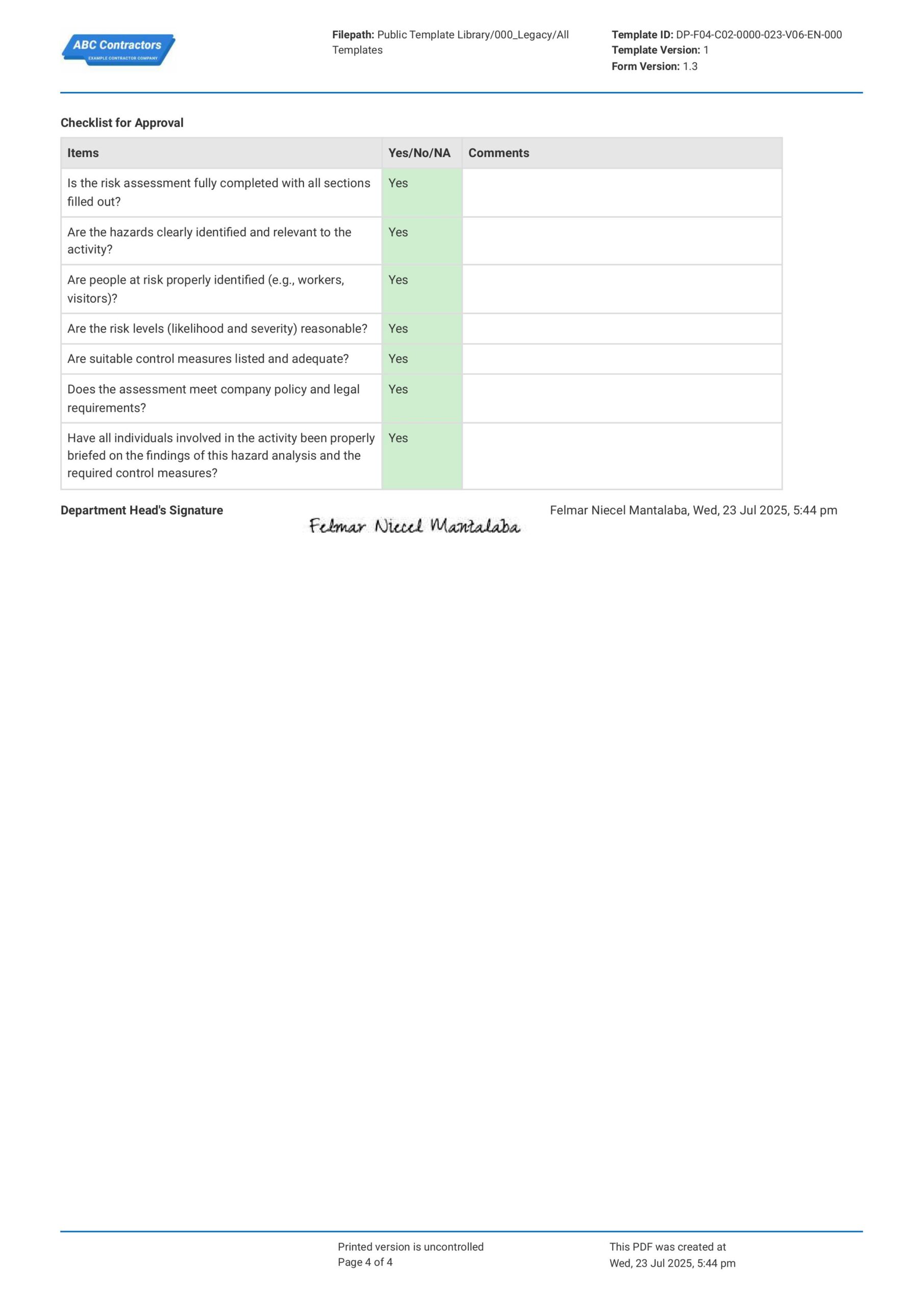
Creating the checklist for approval
This section verifies the accuracy and completeness of all processes in the risk assessment.
- Make a table with 3 columns.
- The first column should contain all the checklist items.
- The second column should be a yes-or-no list, where users can choose whether they have done the checklist item or not. This column can also be integrated with colors for easier recognition of affirmation.
- The third column should allow the form reviewer to provide comments.
-
Making the signatories section
This section validates the form. The following signature fields are needed in the Risk Assessment Forklift form:
- Supervisor’s Signature
- Manager’s Signature
About the author

Felmar Mantalaba
Content Engineer
 LinkedIn
Education
Cebu Institute of Technology - University - Mechanical Engineering with Mechatronics
Bio
Felmar is a mechanical engineer, whose four years of experience in the mining industry inspired him to write and share stories to progress the revolution of new technologies and create smarter, smoother ways of living.
Past Projects
Safety, Health, and Environment Management System (SHEMS) CoordinationSHEMS Coordinator at Atlas Consolidated Mining, ensuring organizational compliance with ISO 14001 and ISO 45001 standards, performing risk assessments, developing policies, and conducting audits and inspections to maintain a safe and environmentally responsible workplace.
Maintenance Management and OptimizationSenior Maintenance Manager (OIC) leading equipment maintenance and operational efficiency initiatives, reducing downtime by 10%, improving Mean Time Between Failure (MTBF) and Mean Time To Repair (MTTR) for major equipment, and managing maintenance schedules, manpower, and materials, while overseeing capital project optimization.
Inspection Engineering and Equipment ReliabilityInspection Engineer responsible for technical blueprint interpretation, vendor collaboration, preventive maintenance scheduling, and data collection for vibration and temperature readings, delivering actionable recommendations and comprehensive reports to improve equipment reliability and operational performance.
End-to-End Operational Oversight in Mining EngineeringContributed to multiple facets of operational management, including SHEMS compliance, maintenance optimization, inspections, and capital project evaluation, integrating safety, reliability, and efficiency improvements across all stages of copper production operations.
Version History:
Related apps and templates
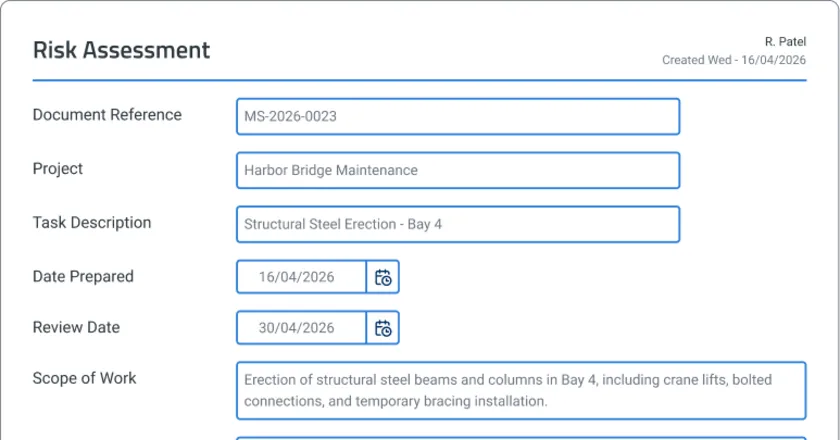
Risk Assessment Software
Risk assessment software template that captures voice notes and photos on-site, with AI drafting compliance reports instantly. Try Sitemate
View app
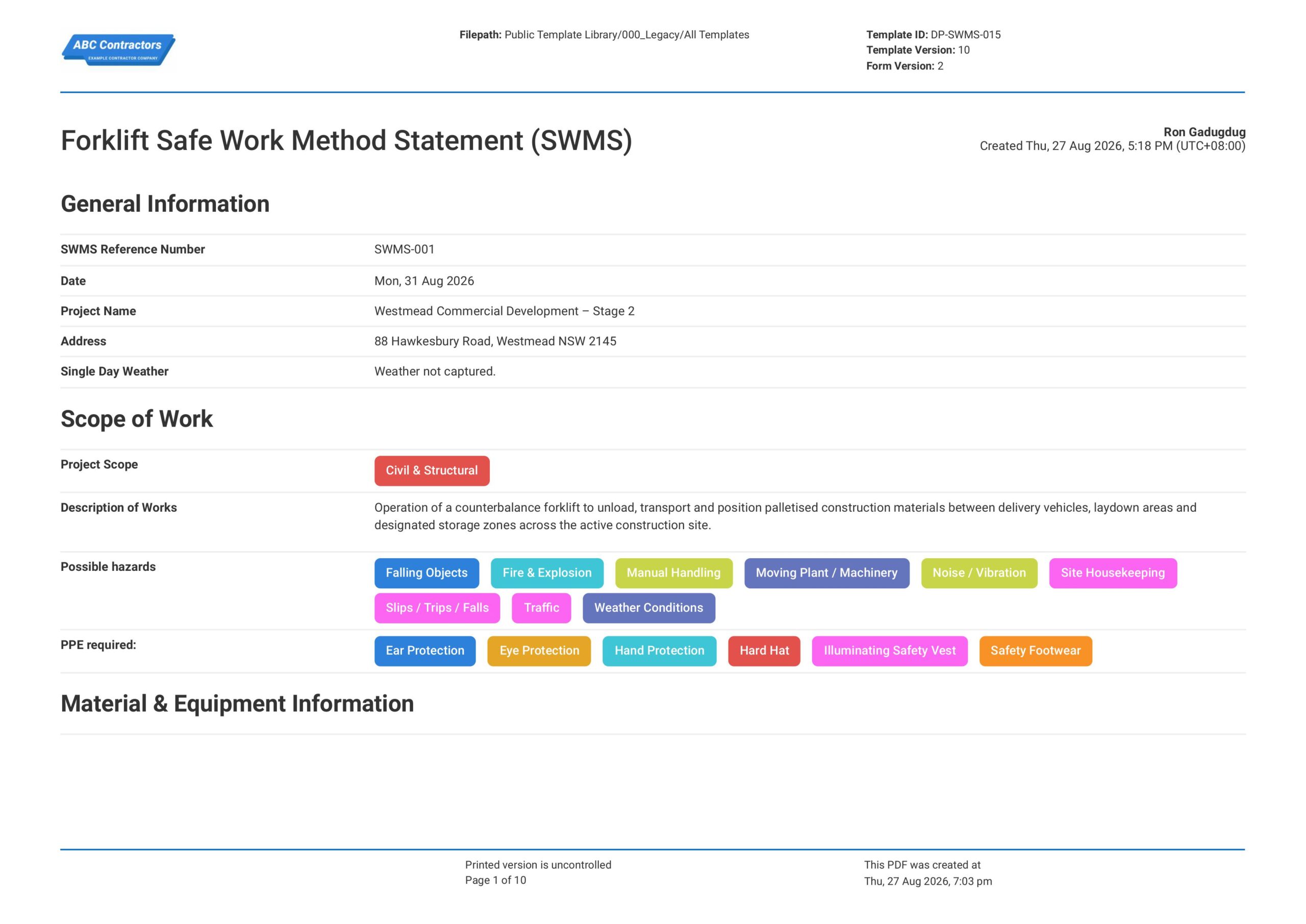
Forklift Safe Work Method Statement (SWMS)
This Forklift Safe Work Method Statement, or Forklift SWMS, gives operators and supervisors a structured way to assess and control forklift risks before any load is moved, lifted, or placed. Select the scope of work,
View template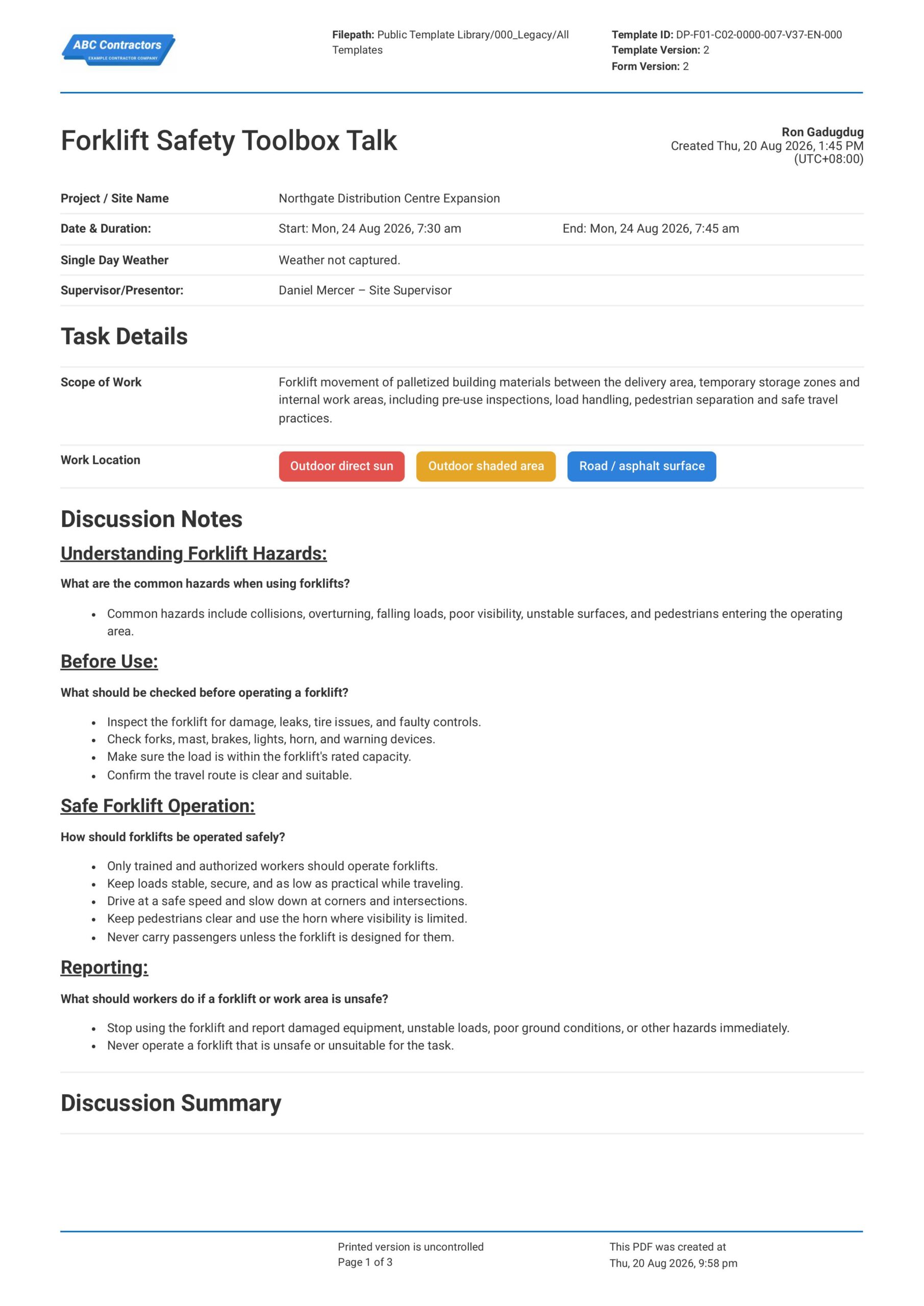
Forklift Safety Toolbox Talk
This Forklift Safety Toolbox Talk is an easy-to-use form that your workers can use to discuss forklift hazards, traffic controls, and safe operating practices before forklift work begins. Record important toolbox talk
View templateThis risk assessment was generated with Dashpivot software
- Access, edit and complete your Risk Assessment Forklift from any device - mobile, tablet or computer.
- Print, download or send your Risk Assessment Forklift as perfectly formatted PDF documents with your company logo.
- Store your Risk Assessment Forklift securely online, where they can be searched and found in seconds
- Invite internal and external parties to see, edit and sign off on Risk Assessment Forklift online.
