
EV Charging Installation Checklist Template
Start with a free 30-day trial. No credit card required.
 100% fully editable EV Charging Installation Checklist
Export your Installation Checklist to PDF or CSV
Access Installation Checklists on mobile, tablet or computer
Thousands of templates including other quality templates

~10,000 employees

~500 employees

~10 employees

~25,000 employees

~200 employees

~1,500 employees

~20 employees
What is an EV Charging Installation Checklist?
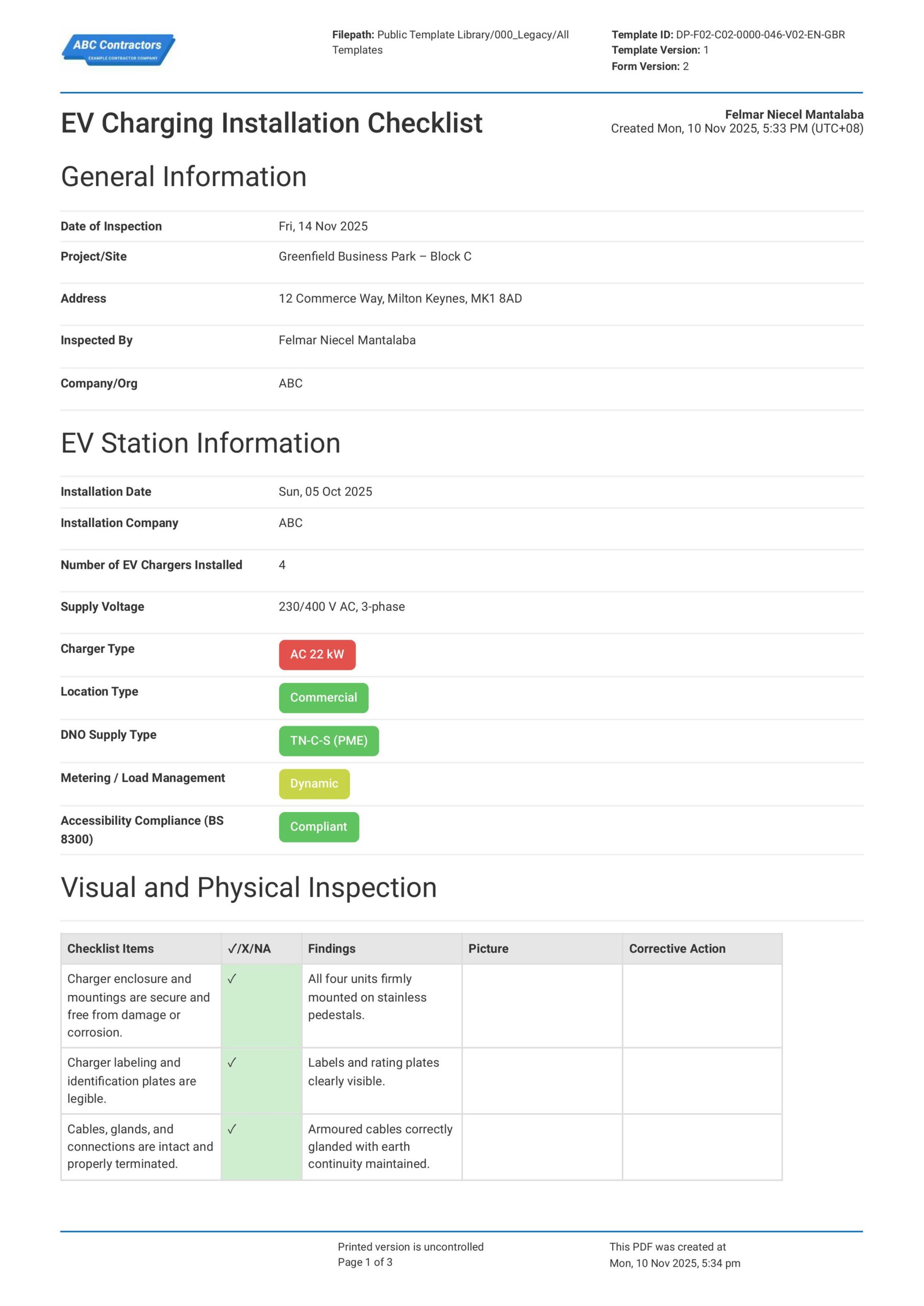
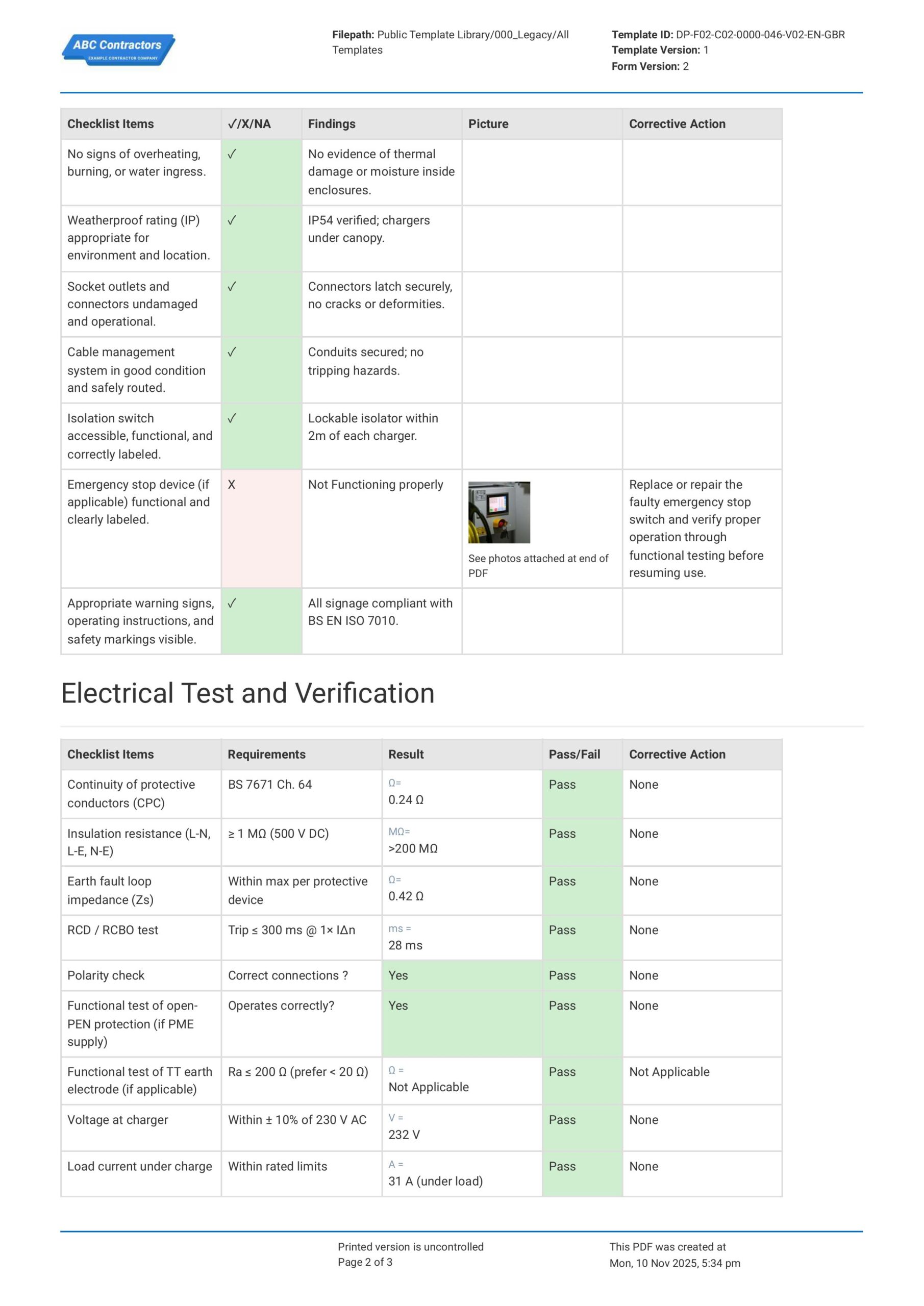
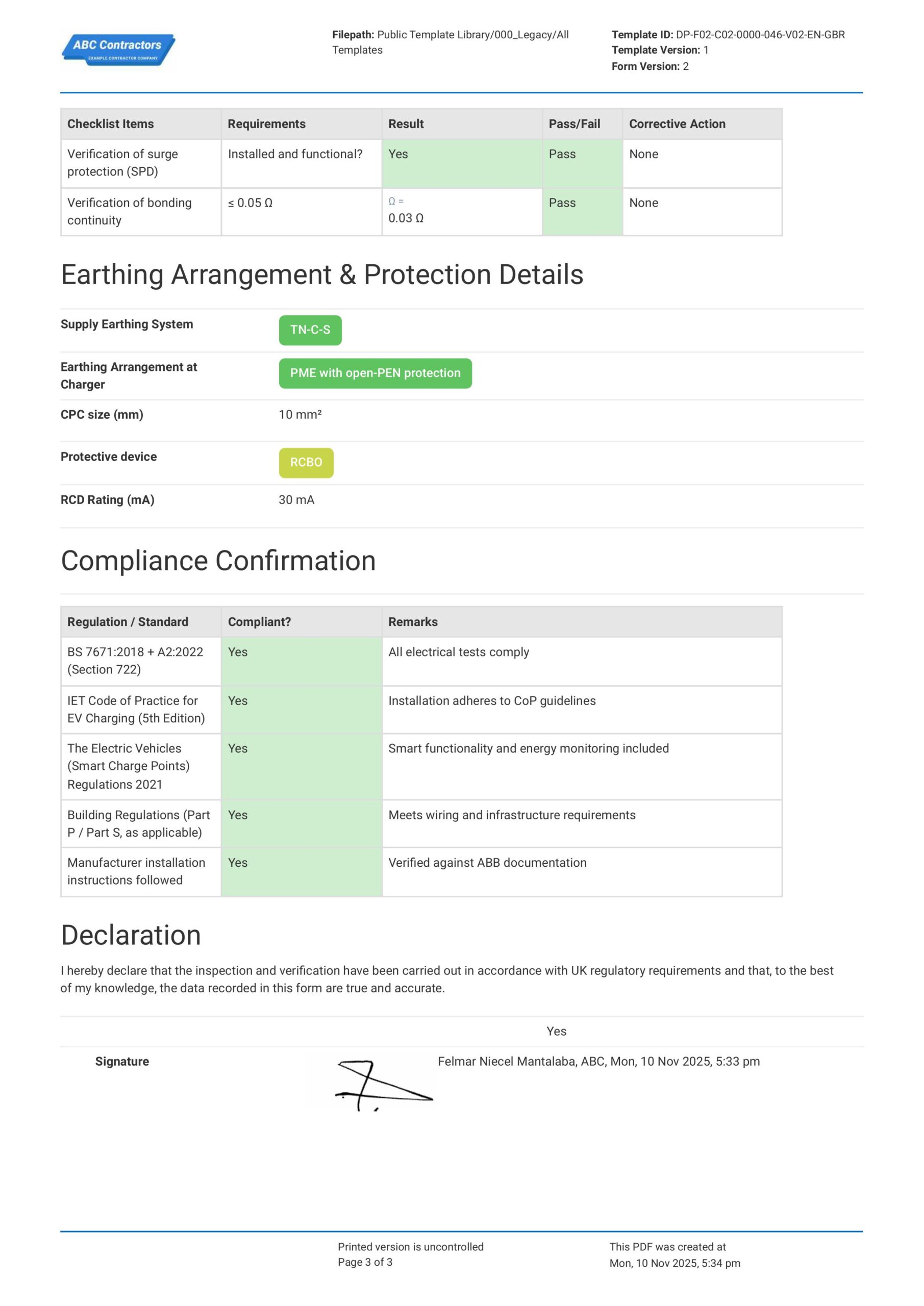
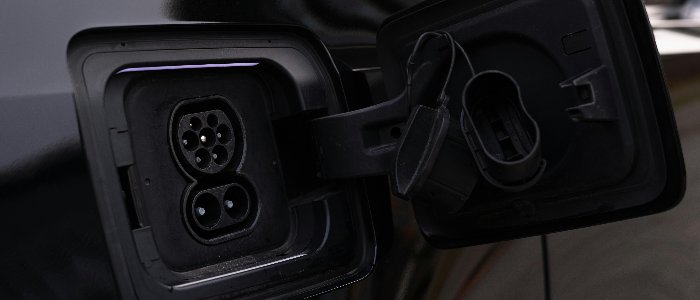
An EV Charging Installation Checklist is a document used to examine a newly installed EV charging station. It provides a checklist of all vital components, equipment functionality, compliance, and safety measures to determine if they are working in the way they are designed to. The purpose of this document is to efficiently check if the EV charging station performs as planned, meets regulatory standards, and is safe for public usage.
Compare this EV Charging Installation Checklist to paper-based forms created from Word, Excel, or PDF
Use this EV Charging Installation Checklist template for free.
EV charging station installation costs
With the rising demand for EVs in the UK, the need for charging stations also rose. People in the UK are now considering installing their personal EV charger at home. However, the situation raises the question, "How much to install an EV charger at home?” The cost depends on the type of EV charger. For a simple and slow charger with an output of 3.6 kW, the price could range between £650 and £900. For homes that want a 7kW smart charger, it could cost around £800 to £1,200. Lastly, the price for more complex EV charging point installations could exceed £2000.
EV charger wiring requirements
In the UK, the electrical wiring requirements for EV charging points are primarily based on the standards and regulations set forth in the British Standard 7671:2018 + A1:2020, which is also known as the IET Wiring Regulations 18th edition. Here are the requirements outlined in those regulations that must be integrated into the ev charging station checklist:
General Requirements
The IET provides two general areas that must be considered when selecting the voltage supply. Domestic areas can use a 240 V single-phase supply, while commercial sites can either use a 240 V single-phase or a 400 V three-phase supply. Supply frequency should be 50 Hz AC for both.
Dedicated Circuits
Each EV station must have its own dedicated circuit in its control panel. Cable sizing on these circuit boxes is dependent on the following: rated power, number of phases, expected voltage drop (3% is recommended), and continuous load factor. Inspectors conducting an installation assessment should verify these things to ensure compliance with regulations.
Earthing and Bonding
The Earthing arrangement for EV chargers depends entirely on the supply type. The PME (TN-C-S) supply requires two things. A protective bonding to the PME earth must be implemented, and open-PEN detection devices should be considered.
For TT supplies, the charger must adhere to earth-fault loop impedance limits, and a dedicated TT earth rod must be provided. All exposed metal parts of the charger—both PME and TT—should be grounded to the earth to prevent electric shock hazards.
Circuit Protection (MCB/Fuse)
When installing an MCB or fuse, it must match with the cable rating and operating current of the circuit. Derating factors must also be considered when selecting a circuit protection device, since EV chargers mainly function with a continuous load. For EV chargers operating on a three-phase supply, a dedicated protection device must be installed for each phase to obtain maximum protection and safety.
Residual Current Device Protection (RCD)
When installing an EV charging point, an RCD must be present. AC charging points should install a 30 mA type A RCD, while units that are capable of DC units should consider installing a Type B RCD. Typically, an RCD integrated with an MCB is recommended to protect the device from overcurrents and earth faults.
Routing Cables
Choosing the right cable depends entirely on the suitability of the area where the charger is installed. Charging units that are installed outside or exposed to outdoor conditions are recommended to use SWA, H07RN-F, and NYY types. However, installers must carefully select these cables, especially considering the frequent conditions they will encounter once installed. If cables are exposed to the possibility of mechanical damage, adequate protection devices on them must be provided.
Charger Location
The EV charging location also requires careful consideration. The area must be accessible to users and safe to operate. This means that chargers should be placed in areas free from direct water sources. If unavoidable, the charger must meet the IP54 ingress protection rating.
Furthermore, chargers should have enough clearance from walls, vehicles, and other obstructions to ensure safe use of the charger.
EV charging unit installation: Chargepoint grants
The UK government will provide a range of incentives to assist with the cost of purchasing and installing charging stations for electric cars. Here are the following grants provided by the UK government.
Grants for homeowners
A £350 grant is provided for homeowners with off-street and on-street parking. Off-street parking homeowners can apply for the grant if they own and live in a flat or rent and live in any residential property. On the other hand, on-street parking homeowners can apply for the grant if they live on a property that they own or rent, install a cross-pavement solution, and only have on-street parking.
Grants for educational establishments
State-funded education institutions and schools can apply for grants of up to £2,500 per chargepoint socket through the Workplace Charging Scheme. They can apply for grants for up to 40 sockets across all their sites.
Grants for businesses
This grant provides up to £350 per socket for the cost of installing chargepoints at workplaces. They can apply for grants for up to 40 sockets across all their sites. It is open to eligible businesses, charities, and public sector groups.
Grants for landlords
Landlords can apply for chargepoint grants of up to £350 per socket. Each year you can get up to 200 grants for residential properties such as flats and houses and 100 grants for commercial properties such as offices. Residential landlords can also apply for infrastructure grants to cover the costs of installing charging points, associated infrastructure, and preparing parking spaces for future installations. Grants of up to £30,000 per property are available, covering up to £350 per chargepoint socket installed and £500 per parking space enabled with supporting infrastructure.
Grant for staff and fleets
Small and medium-sized businesses can apply for grants towards the costs of installing chargepoints, associated infrastructure and preparing parking spaces for future installations. Grants of up to £15,000 per property are available, covering up to £350 per chargepoint socket installed and £500 per parking space enabled with supporting infrastructure.
Depot Charging Scheme
The Depot Charging Scheme provides funding towards the installation of charging infrastructure at fleet depots. The scheme covers 75% of chargepoint and civil costs incurred, up to a maximum of £1 million across all sites. The scheme allows one application per establishment, but there is no limit to the number of sites. The scheme is open to public and private sector fleets, local authorities, and non-profit groups located in England, Scotland, Wales, and Northern Ireland.
Frequently Asked Questions
Why use this EV Charging Installation Checklist template?
Sitemate’s EV Charging Installation Checklist is the ultimate tool for ensuring safe, compliant, and high-quality EV charger installations. Trusted by thousands of electrical and construction companies, it’s pre-built to align with industry best practices and regulatory standards. The template is simple, flexible, and easy to use — making it ideal for installers, contractors, and project managers who need to complete and document installations efficiently and accurately.
Does the template include the UK regulatory standards on EV charger installations?
Yes – this template is configured to align with UK regulatory standards including BS 7671 (IET Wiring Regulations), the Electricity Safety, Quality and Continuity Regulations, and the IET Code of Practice for Electric Vehicle Charging Equipment Installation. It’s already used by certified contractors across the electrical and EV infrastructure industry to either gain or maintain compliance and certification status.
Can I edit this EV Charging Installation Checklist for my project or company?
Yes – the template is fully editable with intuitive drag-and-drop functionality, making it easy to tailor for any EV charging installation assessments. You can create unlimited document setups using various field types — including tables, formulas, sketches, and photos — to capture everything from installation measurements and test results to site conditions and compliance checks. You can also add your company logo, custom headers, and other key details to match your documentation standards. All of this flexibility is powered by Dashpivot’s powerful template builder, ensuring your EV installation records are accurate, professional, and audit-ready.
On what platforms is the EV Charging Installation Checklist avialble?
This template works seamlessly across all devices — computer, mobile, and tablet — so you can complete and manage your EV installation checklists anytime, anywhere. Whether you’re editing forms in the office or filling them out on-site, all data is synced in real time. Once completed, any record can be instantly generated or exported as a PDF or CSV file, giving you the flexibility of Word, Excel, and PDF, combined with the speed and convenience of modern software.

Other popular templates you can use and edit for free
EV Charge Point Commissioning Form
Use this smart commissioning form for charge points – compliance with UK Building Regulations.

Electric Vehicle Charger Testing Checklist
Conduct EV charger tests efficiently with these smart checklists.
EV Infrastructure Design Report
Outline infrastructure designs for EVs to stay compliant with Part S UK Building Regulations.

This Installation checklist was generated with Dashpivot
Easily achieve that 100% functionality and safety of your EV chargers. This installation checklist already integrates the needed operation, regulatory, and safety requirements to attain the ideal performance of EV chargers.
- Complete, edit, and review the EV charging infrastructure report on any device.
- Export reports as perfectly formatted PDF documents with your company logo.
- Securely store and manage your reports for easy searching and finding.
- Invite internal and external parties to see, edit, and review the inspection forms online.

Sitemate builds best-in-class software tools for built world companies.

 English (United States)
  English (Australia)
  English (UK)
  English (New Zealand)
  English (South Africa)
  German