Confined Space Rescue Plan Template

Start with a free 30-day trial. No credit card required.
Looking for a ready-to-use Confined Space Rescue Plan that still fits how your team works? This template comes pre-written with sections for the confined space details, conditions around the point of entry, rescue team roles, communication methods, rescue equipment, emergency contacts, and sign-offs. You can edit any part of it to match your company's entry procedures, site conditions, or rescue arrangements, and the plan will still hold up against the common confined space safety requirements you'd be audited on.
This Confined Space Rescue Plan is an easy-to-use form that your workers can use to set out clear rescue procedures before anyone enters a confined space. Site teams, supervisors, and rescue personnel can agree on who does what, confirm the right equipment and contacts are in place, and then save and export the completed plan to PDF or CSV for easy sharing.
 100% fully editable Confined Space Rescue Plan
Export your Confined Space Rescue Plan to PDF or CSV
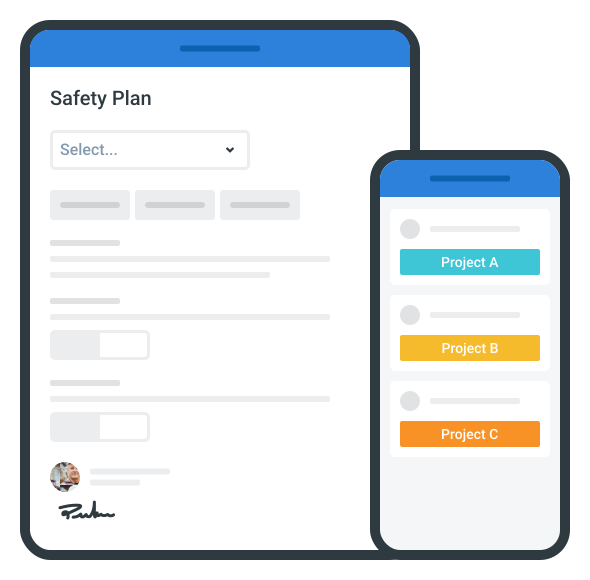
Access your Confined Space Rescue Plan on mobile, tablet or computer

Trusted by companies, projects and teams of all sizes















What is Confined Space Rescue Plan?
A Confined Space Rescue Plan is a document used by site personnel to set out how workers will be retrieved or rescued if an emergency occurs inside a confined space. It typically includes the details of the confined space, rescue roles, communication methods, required rescue equipment, access points, and emergency contact details.
A Confined Space Rescue Plan is especially important for industries such as construction, utilities, maintenance, tunnelling, and industrial work where workers frequently enter tanks, pits, chambers, ducts, vessels, or other enclosed areas. Additionally, it helps teams plan rescue procedures before the rescue even begins, so workers are not relying on improvised response procedures during an emergency.
Compare this Confined Space Rescue Plan to traditional Word/Excel documents
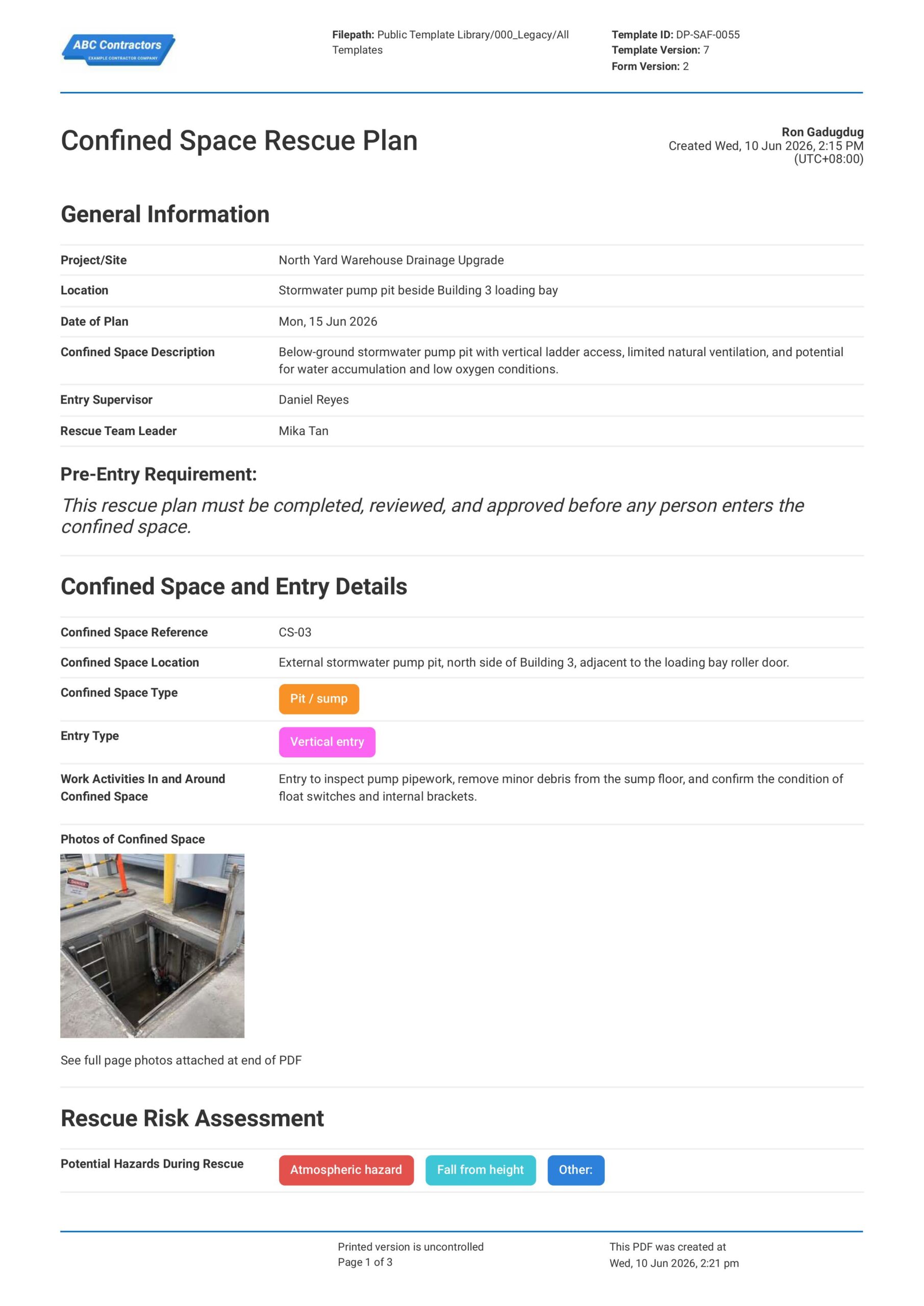
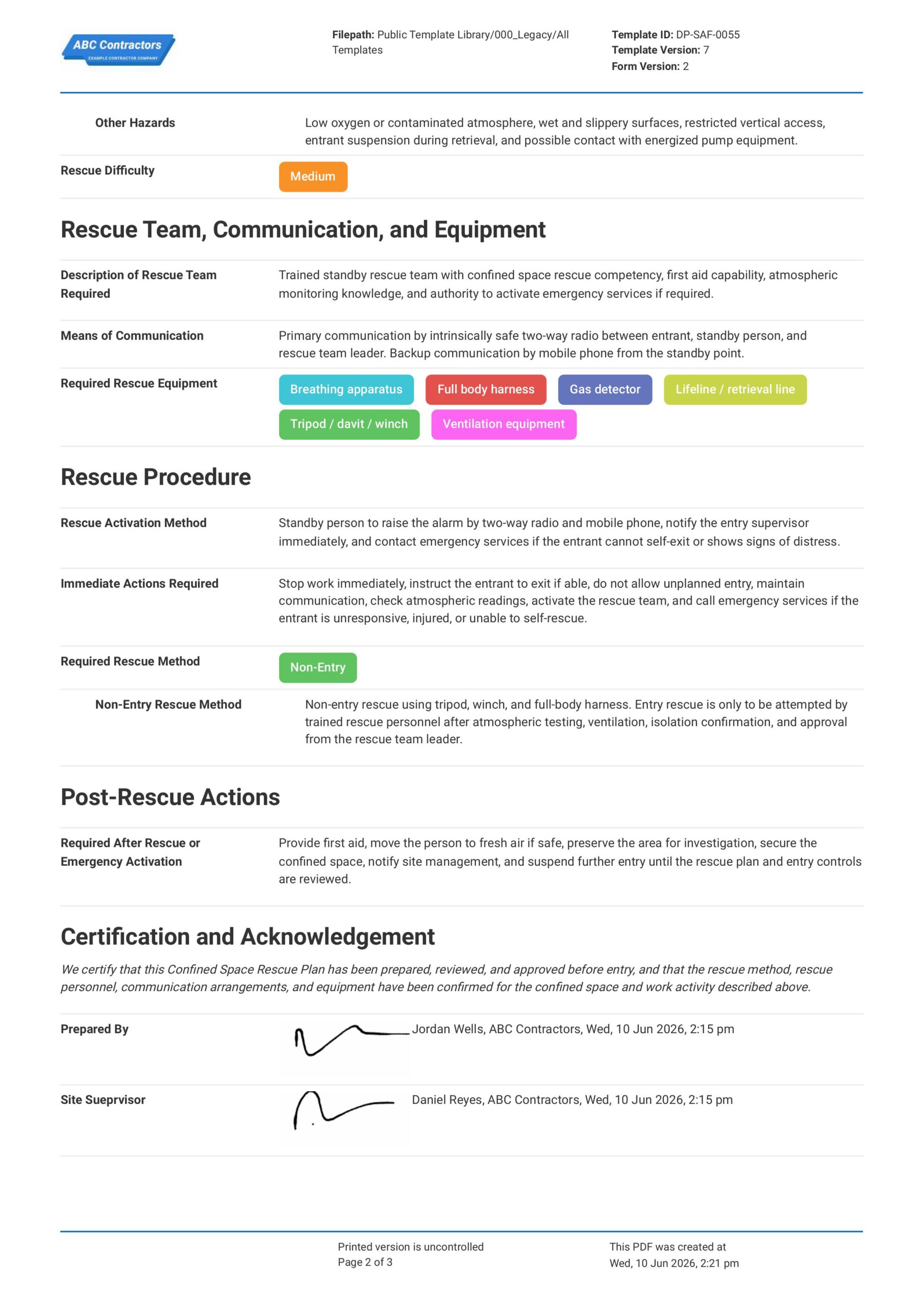
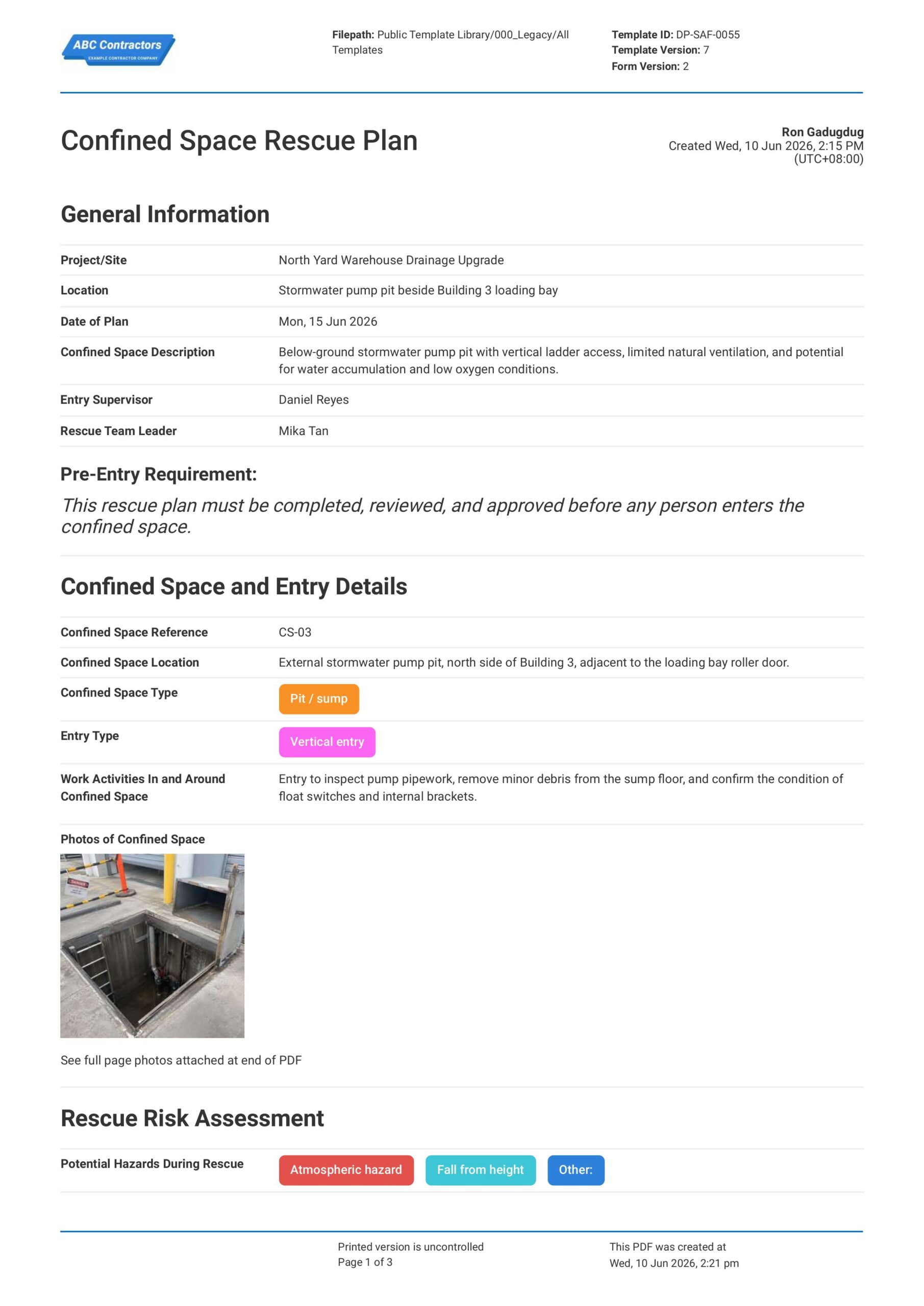
Curious how this Confined Space Rescue Plan works? Check out the example below to see how each section comes together, from entry conditions through to rescue roles and emergency contacts. You can generate your own version, export it as a custom form with your company details, and fill in your site information to have a ready-to-use Confined Space Rescue Plan in minutes.
Use this Confined Space Rescue Plan template for free

Generate this template automatically with Storm
You don't have to build the Confined Space Rescue Plan field by field. Let Storm, the AI Data Capture Agent inside Dashpivot, build the template for you in seconds.
Describe what you need
Tell Storm the form you want in plain language and it builds a structured digital template from scratch, with fields, tables, and signatures in place.
Upload what you already use
Drop in your existing PDF, Word, Excel, or even a photo of a paper form. Storm rebuilds it as a smart digital template with the structure intact.
 Storm
Storm
Generate a Confined Space Rescue Plan form template that I can use for my business
Applicable Standards and Policies for Confined Space Rescue Plan
Usually, the exact format of the Confined Space Rescue Plan varies by jurisdiction, most workplace safety laws require employers, contractors, or duty holders to assess confined space hazards and put rescue arrangements in place before workers enter the space. Here are examples of the most common requirements that are referenced:
- OSHA confined space standards require rescue arrangements for permit spaces.
- UK Confined Spaces Regulations require emergency arrangements before entry.
- Safe Work Australia guidance covers confined space emergency procedures.
- ISO 45001 supports emergency preparedness and response planning.
- Local WHS laws commonly require confined space controls and rescue plans.
Staff Members and Parties that use Confined Space Rescue Plan
A Confined Space Rescue Plan is primarily used by project managemers and businesses that deal with confined space work. Here are examples of common parties that you can expect to use a Confined Space Rescue Plan:
- Site supervisors and project managers
- Confined space entrants and standby attendants
- Rescue teams and emergency response personnel
- Health and safety teams
- Contractors and subcontractors carrying out confined space work
Business Risks Reduced by Confined Space Rescue Plan
Using a Confined Space Rescue Plan helps reduce the risk of hazards such as toxic atmospheres, oxygen deficiency, engulfment, restricted access, or limited communication during an emergency in a confined space. Ultimately, this can help businesses to:
- Reduce risk of injury, fatality, or failed rescue during confined space emergencies
- Avoid non-compliance with confined space entry and emergency response requirements
- Prevent unsafe rescue attempts by untrained workers
- Lower exposure to legal claims, enforcement action, and incident-related costs
- Reduce project delays caused by emergency incidents, investigations, or shutdowns
Business Opportunities Created by Confined Space Rescue Plan
A well-prepared Confined Space Rescue Plan helps businesses improve emergency readiness and strengthen control over high-risk work activities. Here are some ways a well-designed Confined Space Rescue Plan can help businesses:
- Improve worker confidence before entering confined spaces
- Strengthen contractor prequalification and tender-offer competitiveness
- Improve coordination between entrants, attendants, supervisors, and rescue teams
- Build trust with clients, regulators, insurers, and project stakeholders
What Should be Included in a Confined Space Rescue Plan?
A Confined Space Rescue Plan should explain how workers will be rescued if something goes wrong during work in a confined space. It should be prepared before entry work begins, so the rescue team, equipment, communication methods, and emergency steps are already planned, and include the following information:
- Details on the Confined space, its entry points, access limits, and known hazards
- Details on the rescue team members and emergency contacts
- Rescue equipment such as harnesses, retrieval lines, breathing equipment, and first aid supplies
- Communication methods between entrants, attendants, and rescue personnel
- Step-by-step rescue procedures, evacuation routes, and post-rescue medical support
What Equipment is Needed for Confined Space Rescue?
The equipment needed for confined space rescue depends on the size, layout, access points, atmosphere, and hazards inside the space. At a minimum, rescue teams usually need retrieval equipment, communication devices, first aid supplies, lighting, and equipment for checking or controlling the atmosphere before and during rescue work.
Common rescue equipment can include harnesses, lifelines, tripods, winches, gas detectors, breathing equipment, ventilation fans, stretchers, and rescue-rated ropes. The rescue plan should also confirm that equipment is inspected, available at the entry point, and suitable for the type of confined space before anyone enters.
How to Create a Confined Space Rescue Plan
Developing an effective Confined Space Rescue Plan requires systematic planning, hazard assessment, and coordination with rescue resources. This step-by-step process ensures all critical elements are addressed for comprehensive emergency preparedness.
Before creating a Confined Space Rescue Plan, gather the following information and resources:
- Complete confined space inventory and classification documentation
- Detailed hazard assessment reports for each confined space
- Available rescue equipment inventory and specifications
- Qualified rescue team member contact information and certifications
- Local emergency services contact details and response capabilities
- Site layout plans and confined space access routes
- Atmospheric monitoring equipment and procedures
- Previous incident reports and lessons learned documentation
-
Start with Site and Confined Space Information
You should always start by placing general information at the beginning of the rescue plan to help establish where the rescue may be needed and what type of space rescuers will be entering. For example, here are some information that you will need to provide:
- Project name and site location
- Confined space name, ID, or description
- Type of confined space, such as tank, pit, vessel, trench, or chamber
- Entry and exit points
- Planned work activity inside the confined space
-
Identify the Confined Space Hazards
Identifying confined space hazards helps determine what could affect workers during entry and what could make rescue more difficult. Here are some of the most common hazards that you should consider during your planning:
- Oxygen deficiency or oxygen enrichment
- Toxic gases, vapours, fumes, or dust
- Fire, explosion, or engulfment hazards
- Restricted access, poor visibility, or difficult retrieval conditions
- Mechanical, electrical, hydraulic, or stored energy hazards
-
Define the Rescue Method and Team Arrangements
This section should primarily explain whether the plan relies on non-entry rescue, entry rescue, external emergency services, or a combination of arrangements. Make sure your team decides on the following points:
- Non-entry retrieval method vs. Entry retrieval
- Rescue team members and assigned roles
- Communication method between entrants, attendants, and rescuers
- Triggers for starting rescue actions
-
List the Rescue Equipment and Emergency Resources
You will need to list all available equipment to ensure the right resources are available even before workers enter the confined space. Here are examples of equipment and emergency resources that you should include in your planning:
- Tripod, davit arm, winch, or retrieval line
- Full body harnesses and lifelines
- Gas monitor and atmospheric testing equipment
- Respiratory protection or supplied air equipment
- First aid kit, stretcher, lighting, and communication devices
-
Confirm Training, Testing, and Pre-Entry Checks
Confirming training and performing pre-entry checks helps make sure the rescue plan can be followed safely if an emergency occurs. For example, you will want to verify that both workers and rescuers have been trained in or are equipped with:
- Rescue drill or practice records
- Training and competency of rescuers, entrants, and attendants
- Equipment inspection results
- Atmospheric testing before entry
- Permit-to-work and isolation checks
-
Complete Review, Approval, and Sign-Off
This section helps show that workers, supervisors, and rescue personnel understand their roles and the planned emergency response. Be sure to add the following elements to your Confined Space Rescue Plan:
- Names and roles of reviewers and approvers
- Signatures of responsible personnel
- Date of review and approval
- Worker and rescue team acknowledgement
- Next review date or trigger for plan review
Frequently asked questions
How to create your Confined Space Rescue Plan in an App or Software System
A well-designed Confined Space Rescue Plan program will ensure your team stays on top of any potential confined space-related emergencies at site and ensure your workers have the safest working environment possible.
30 minutes
Easy difficulty
-
Start your Confined Space Rescue Plan with General Information
It is important to begin your Confined Space Rescue Plan with key project, site, and rescue personnel details so the document can be traced to the correct confined space and work activity. This section should use simple text and date fields for fields such as:
- Text fields for Project/Site, Location, Entry Supervisor, and Rescue Team Leader
- Date selector field for Date of Plan
- Multi-line text field for Confined Space Description
- Multi-line text field for Work Activities In and Around Confined Space
- Pre-filled text field for Pre-Entry Requirement
-
Create a Section for Confined Space and Entry Details
Next, create a section where users can list down the confined space reference, location, type, entry method, and supporting photos. For simplicity, we recommend using the following fields:
- Text fields for Confined Space Reference and Confined Space Location
- Dropdown field for Confined Space Type
- Dropdown field for Entry Type
- Photo upload field for Photos of Confined Space
-
Create a Section for Rescue Risk Assessment
Users will next need to input the rescue hazards, rescue difficulty, and team requirements so the rescue approach can be planned before entry. Be sure to add fields where users can capture the hazards and rescue team details, such as:
- Multiple-choice selector field for Potential Hazards During Rescue
- Conditional text field for Other Hazards
- Dropdown field for Rescue Difficulty
- Multi-line text field for Description of Rescue Team Required
- Multi-line text field for Rescue Activation Method
-
Create Sections for Rescue Procedure and Post-Rescue Actions
Next, create sections that explain how the rescue will be activated, what immediate actions are required, and what must happen after a rescue or emergency activation. These sections should be formatted in sequence for ease of use, with fields such as:
- Multi-line text field for Immediate Actions Required
- Dropdown field for Required Rescue Method
- Multi-line text field for Non-Entry Rescue Method
- Multi-line text field for Required After Rescue or Emergency Activation
-
Create a Section for Rescue Team, Communication, and Equipment
Next, create a section where users can confirm the communication method and rescue equipment required for the confined space. We recommend using selector fields for equipment so users can quickly choose the required rescue items from a pre-set list.
- Multi-line text field for Means of Communication
- Multiple-choice selector field for Required Rescue Equipment
- Conditional text field for Other Required Rescue Equipment
- Text field for Rescue Team Leader
- Text field for Standby or Rescue Personnel
-
End your Confined Space Rescue Plan with Certification and Acknowledgement
Finally, complete the Confined Space Rescue Plan with a certification statement and sign-off fields for the personnel preparing, supervising, and leading the rescue plan. If your app or software allows, use automatic e-signature fields and include fields like:
- Pre-filled text field for Certification and Acknowledgement Statement
- E-signature field for Prepared By
- E-signature field for Site Supervisor
- E-signature field for Rescue Team Leader
About the author

Ron Gadugdug
Content Engineer
 LinkedIn
Education
Cebu Institute of Technology - University - Civil Engineering
Bio
Ron is a Civil Engineer with 6 years of experience in the construction industry, primarily focused on quantity surveying, cost estimation, project management, quality control, contract administration, and property & engineering insurance. At Sitemate, he writes about practical applications of evolving technologies and digital solutions that support construction professionals in improving efficiency, compliance, and project delivery across the built world.
Past Projects
Quantity Surveying & Cost EngineeringPerformed quantity take-offs of several high-rise and horizontal structures using sheets and applications like Revit and Bluebeam Revu, and spearheaded trials with Building Information Modeling (BIM) software.
Project Management & ConsultancyCoordinated with project management teams during the construction of local projects such as a 4-tower hotel & resort, a 22 storey condominium project, and a school dormitory project.
Contract AdministrationAssisted during contract biddings and negotiations with general contractors and sub-contractors, and oversaw progress reporting, billings, and payment.
Property & Engineering InsuranceDedicated non-life claims handler, overseeing property and contractor all-risk insurance claims, risk management, and bonds.
Version History:
Related apps and templates
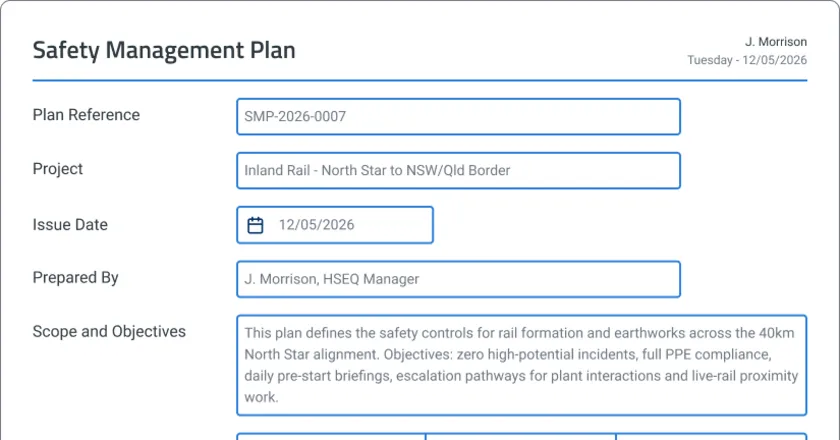
Safety Planning App
Safety planning app template that auto-generates site-specific safety management plans, hazard registers, and compliance documentation. Review,
View app
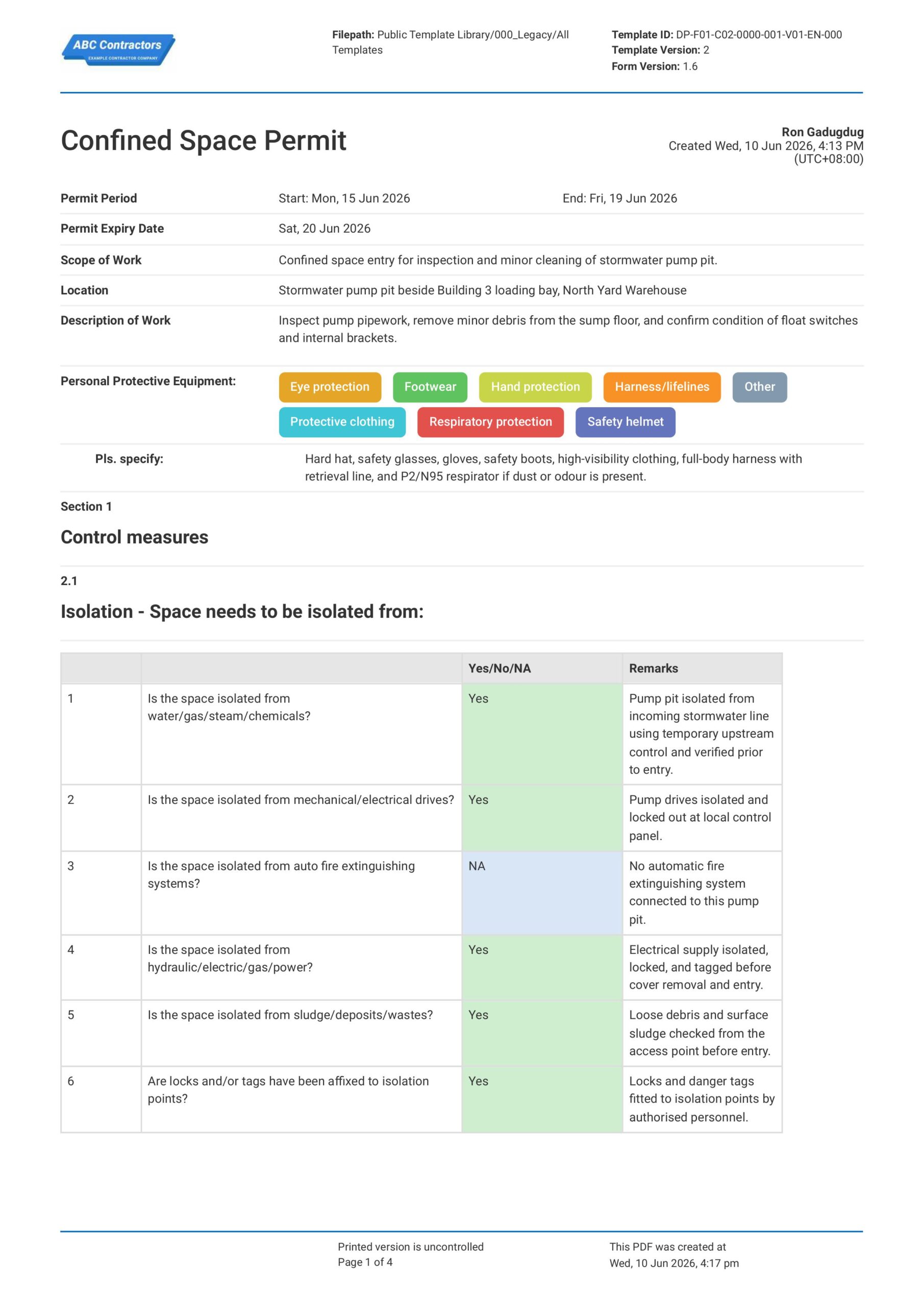
Confined Space Permit
This Confined Space Permit is a free and easy-to-use document designed to help site teams, supervisors, and site personnel control entry into confined spaces before work begins. Use this permit to record the confined
View template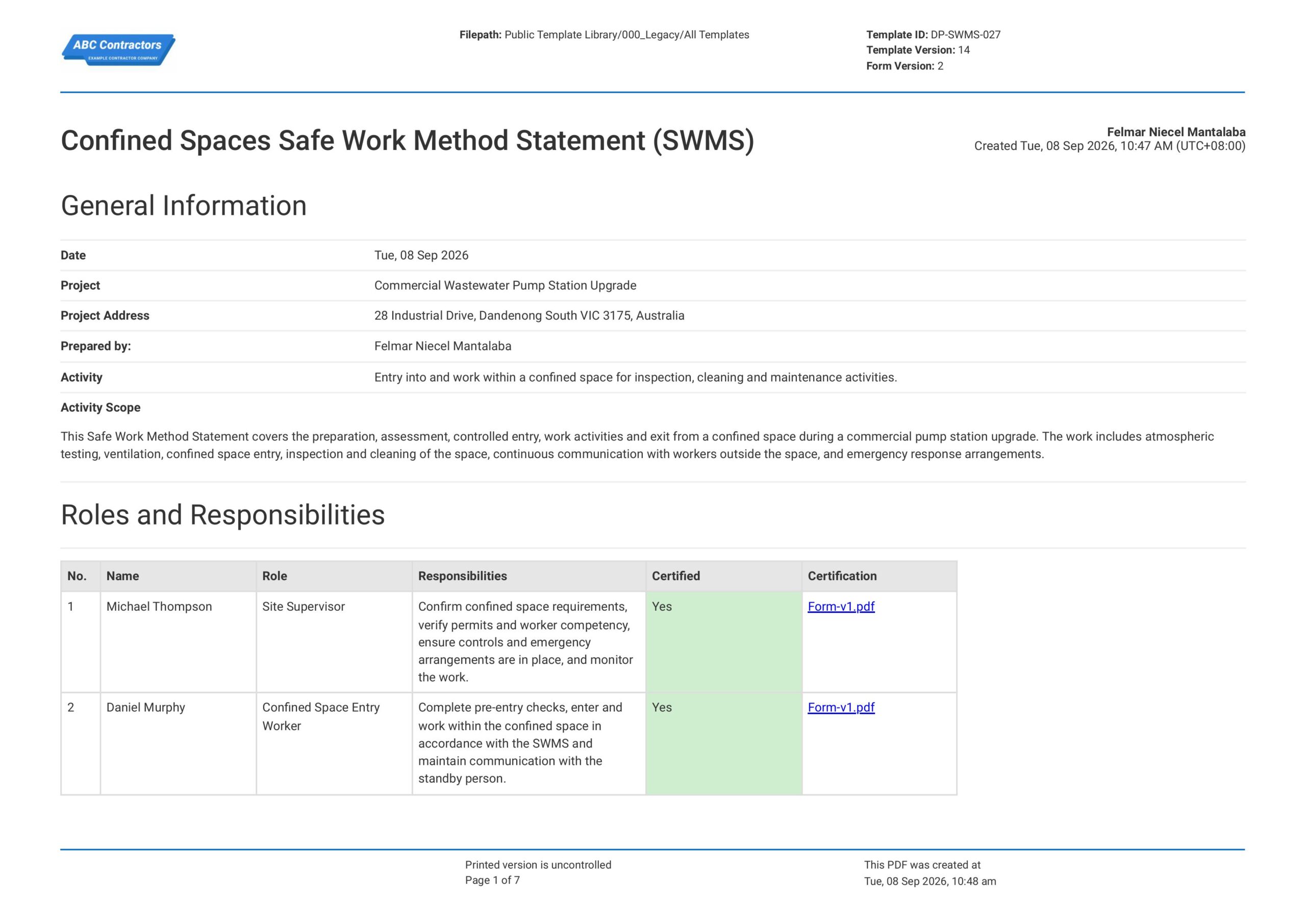
Safe Work Method Statement for Confined Space
This Safe Work Method Statement for Confined Space is free and readily available to record identified hazards, control measures, and safe procedures for all your confined space activities. The template already contains
View templateThis plan was generated with Dashpivot software
- Access, edit and complete your Confined Space Rescue Plan from any device - mobile, tablet or computer.
- Print, download or send your Confined Space Rescue Plan as perfectly formatted PDF documents with your company logo.
- Store your Confined Space Rescue Plan securely online, where they can be searched and found in seconds
- Invite internal and external parties to see, edit and sign off on Confined Space Rescue Plan online.