Lone Working Risk Assessment Template

Start with a free 30-day trial. No credit card required.
Need a complete Lone Working Risk Assessment you can still tailor to your team? This template comes pre-built to make sure no safety hazard is missed, covering individual issues, the location or premises where the work takes place, and the processes or work activities involved. It provides a clear framework for checking that all of your safety bases are covered. You can edit any part of it to match how your company manages lone workers, and the assessment will still hold up against the regulations you'd be audited on.
This Lone Working Risk Assessment is an easy-to-use form that your workers can use to assess the risks of working alone, record hazards linked to the individual, the location, and the work activity, and keep assessments professional and securely stored. When they're finished, they can export the completed assessment to PDF or CSV.
 100% fully editable Lone Working Risk Assessment
Export your Lone Working Risk Assessment to PDF or CSV
Access your Lone Working Risk Assessment on mobile, tablet or computer
Trusted by companies, projects and teams of all sizes















What is Lone Working Risk Assessment?
Lone working is one of the more common safety issues and hazards faced by many workers in industries like construction, oil and gas, mining. One of the ways workers and companies ensure they are prepared for lone working conditions is to conduct a lone working risk assessment. Like most risk assessments, this helps workers and other stakeholders brainstorm the potential dangers associated with that activity and then document the hazards, establish control measures and precautions against these hazards, create some required actions (where applicable), and establish who is responsible for these actions and when they need to be completed.
Compare this Lone Working Risk Assessment Form to manual Word, Excel, and PDF Formats
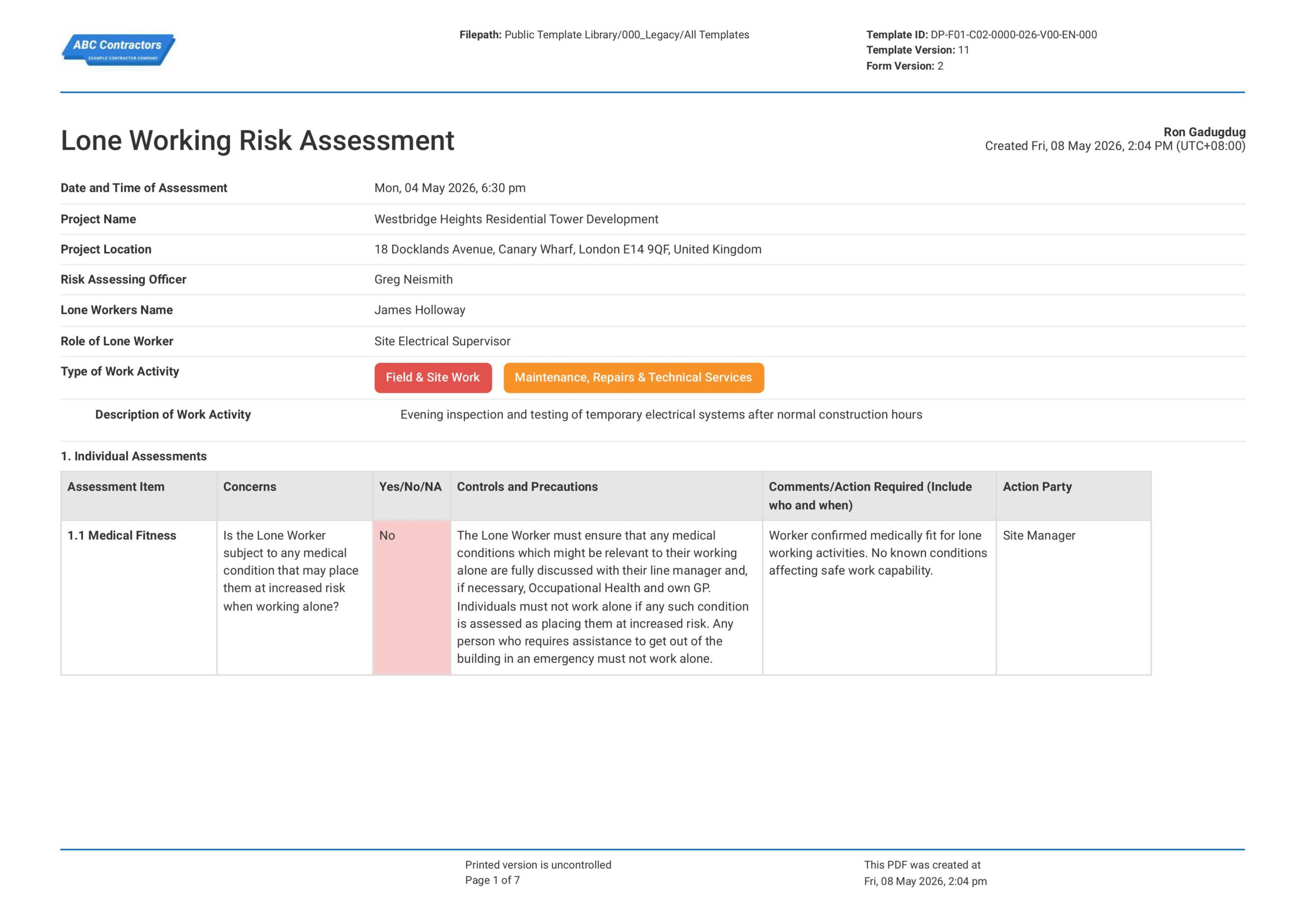
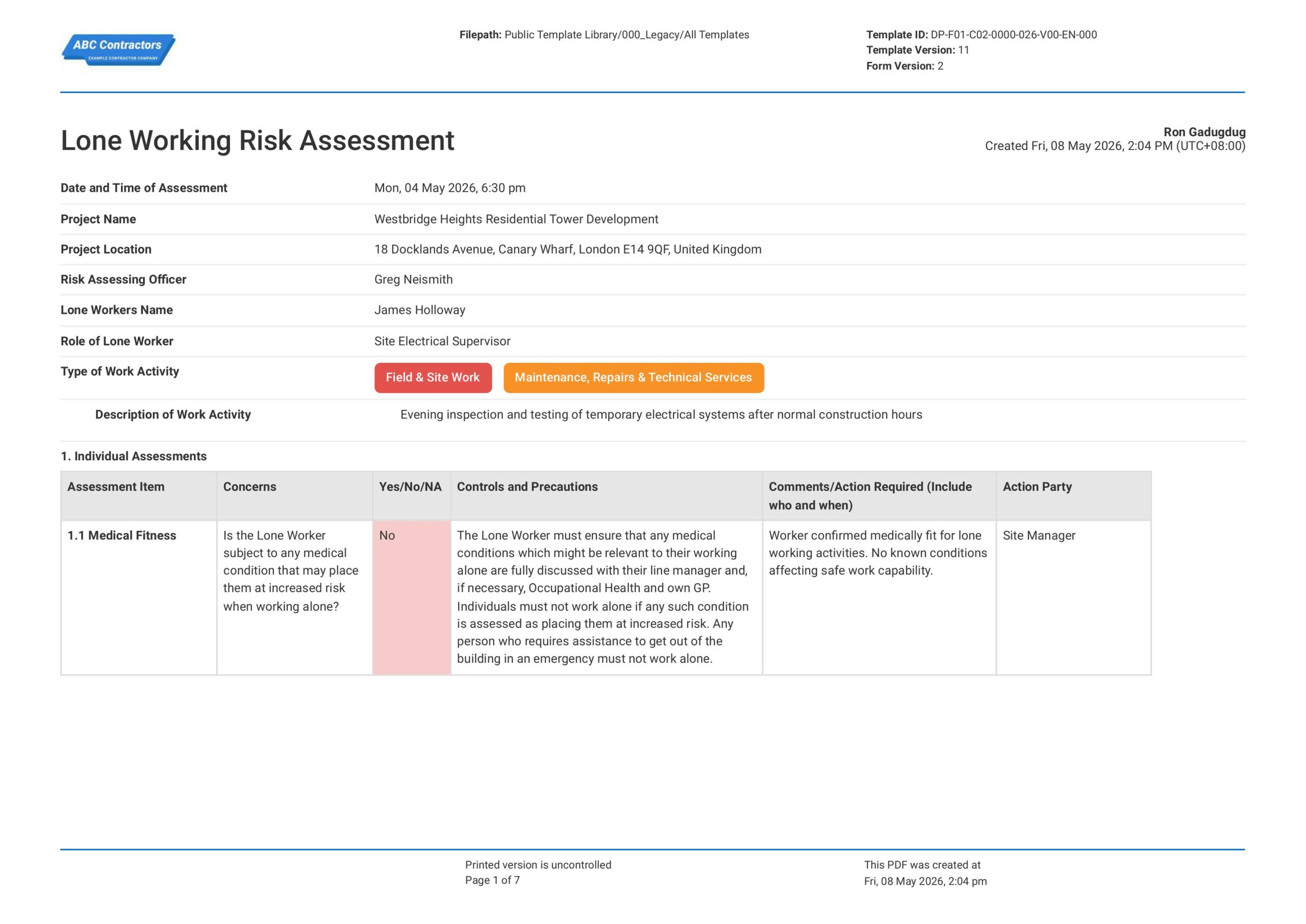
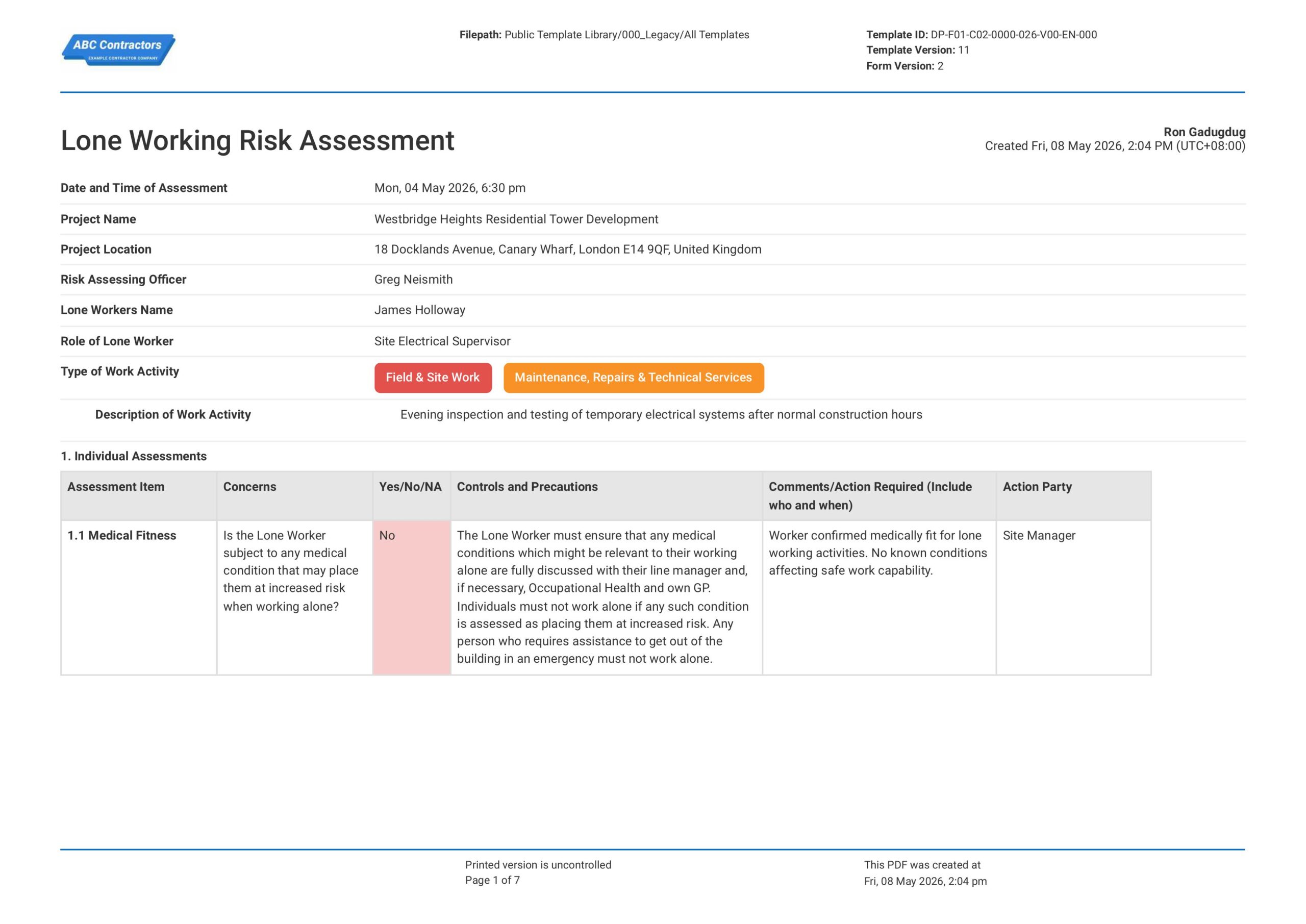
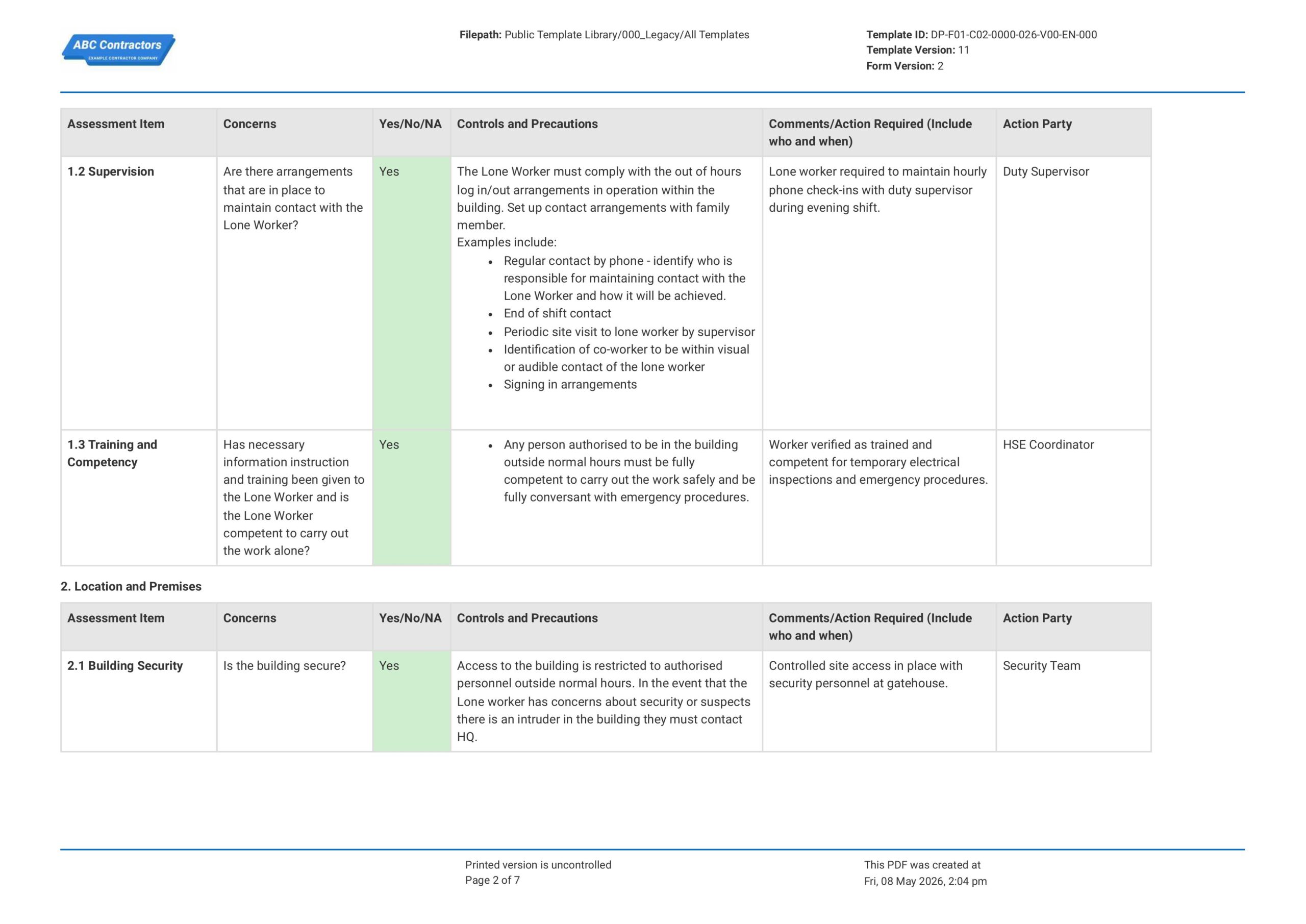
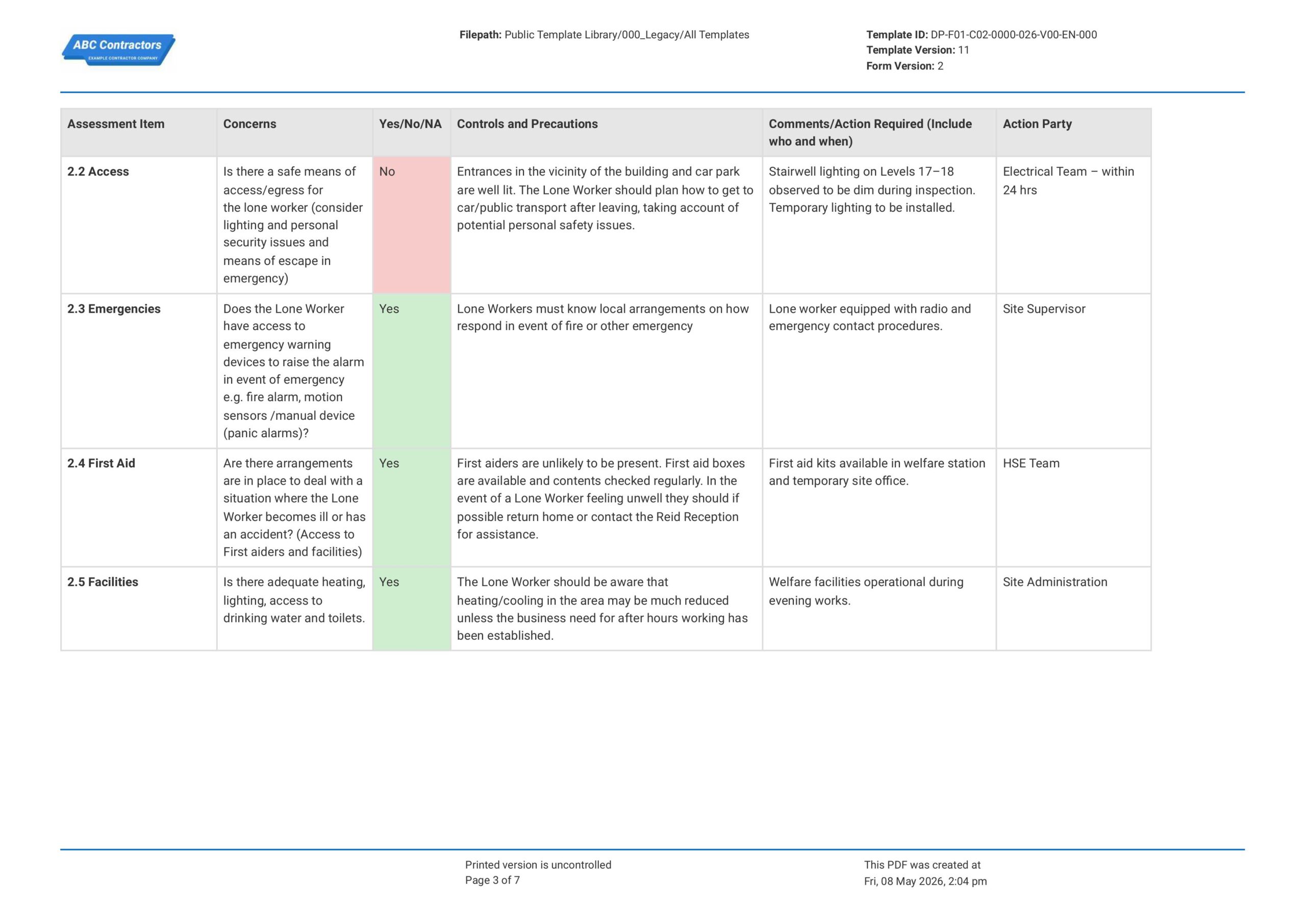
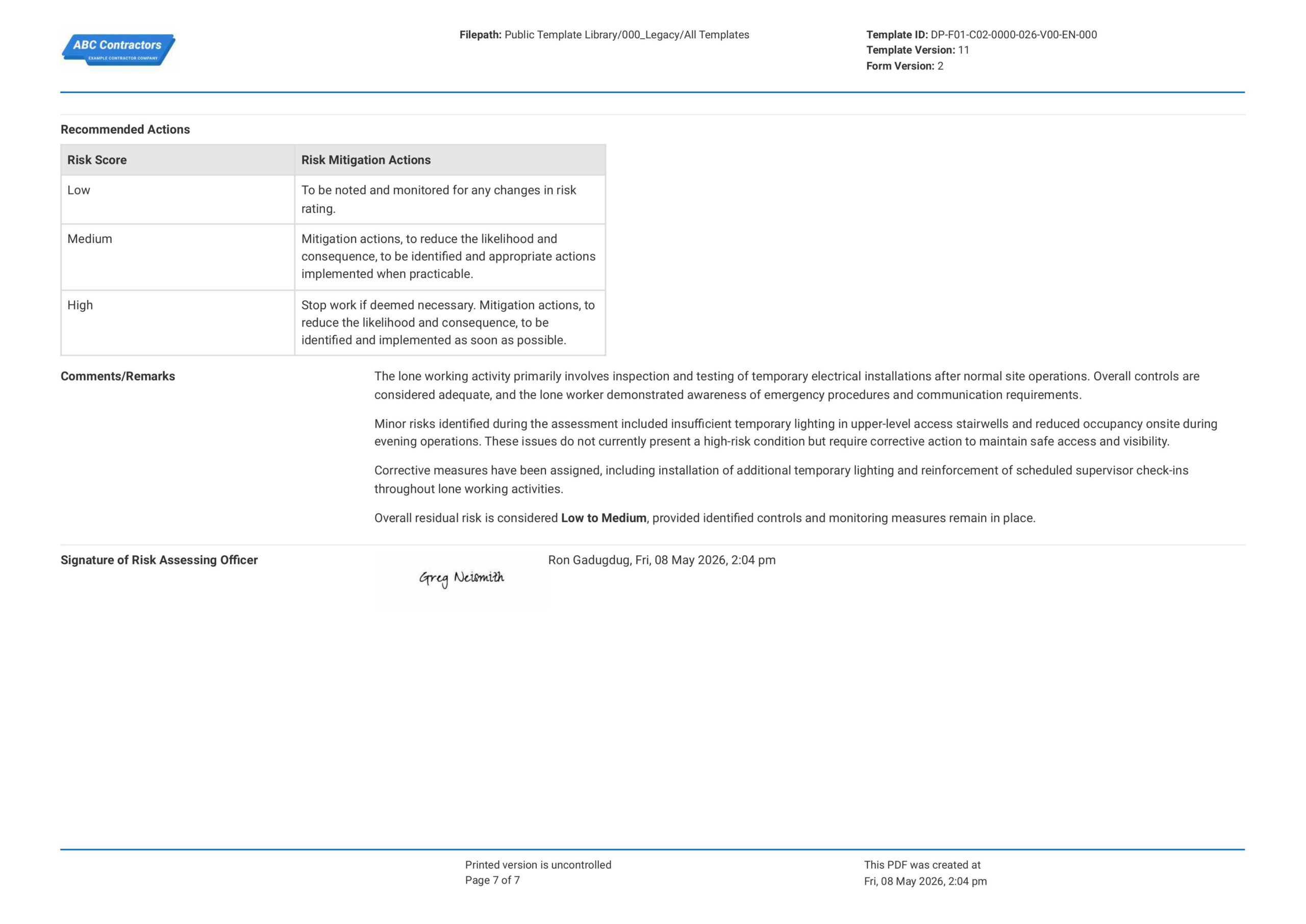
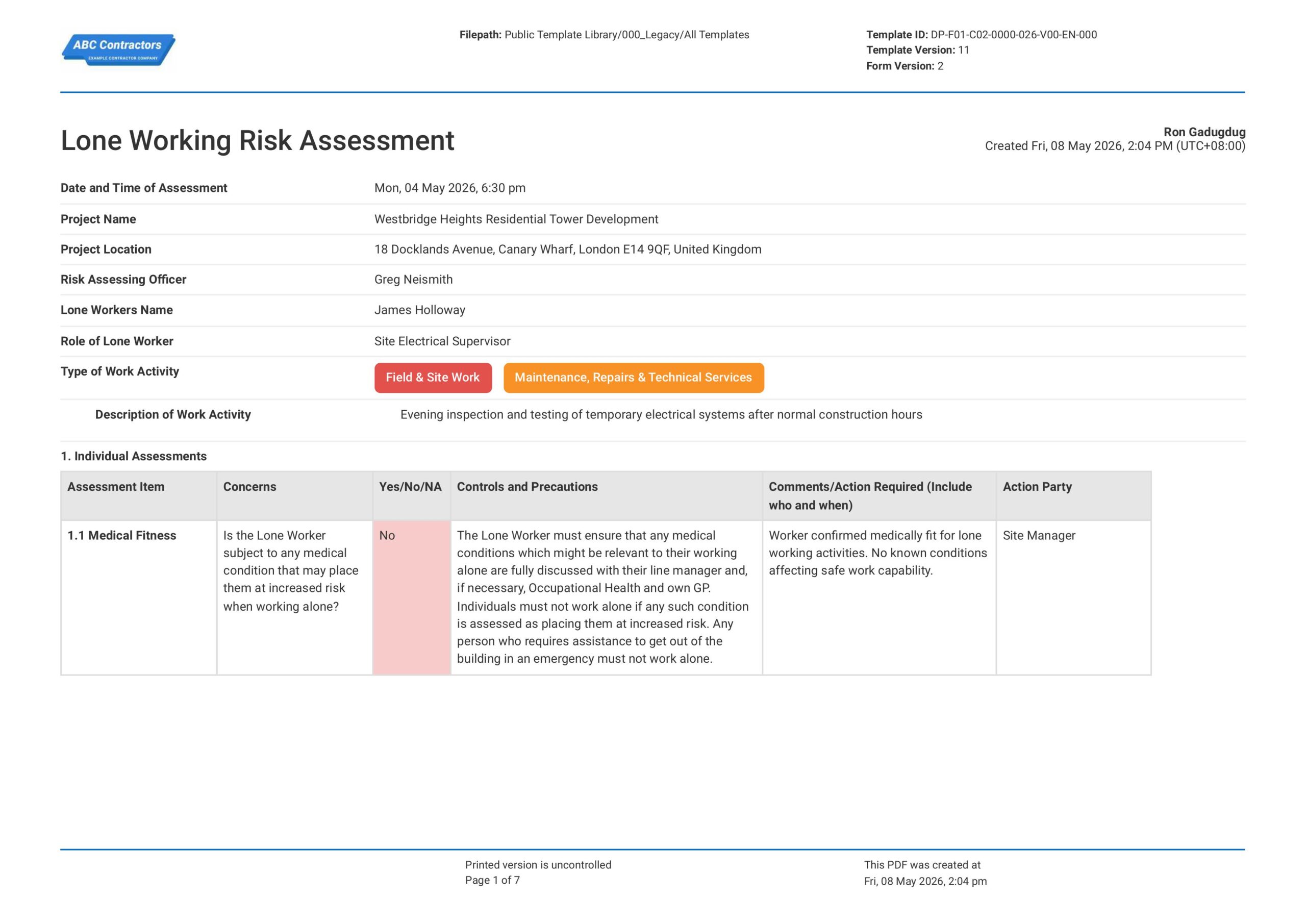
Curious how this Lone Working Risk Assessment works? Check out the example below to see exactly what a completed assessment looks like, from individual and location hazards through to the work activity review. You can generate your own version in a few clicks, export it as a custom form with your company details, and fill in the relevant information to have a ready-to-use Lone Working Risk Assessment in a matter of minutes.
Use this Lone Working Risk Assessment template for free

Generate this template automatically with Storm
You don't have to build the Lone Working Risk Assessment field by field. Let Storm, the AI Data Capture Agent inside Dashpivot, build the template for you in seconds.
Describe what you need
Tell Storm the form you want in plain language and it builds a structured digital template from scratch, with fields, tables, and signatures in place.
Upload what you already use
Drop in your existing PDF, Word, Excel, or even a photo of a paper form. Storm rebuilds it as a smart digital template with the structure intact.
 Storm
Storm
Generate a Lone Working Risk Assessment form template that I can use for my business
Applicable Standards and Policies for Lone Working Risk Assessment
In both the UK and the US, Lone Working Risk Assessments are covered by broader workplace health and safety frameworks. These frameworks require employers to identify risks, implement safety control measures, and ensure communication and emergency response measures are in place for workers isolated from supervision. Here are some examples of legislation and industry standards that cover this exact situation:
- Health and Safety at Work Act 1974 in the UK requires employers to ensure the safety of employees, including lone workers.
- HSE guidance on lone working provides practical expectations for supervision, communication, and emergency planning is also followed in the UK.
- In the USA, the OSHA General Duty Clause (Section 5(a)(1)) requires employers to provide a hazard-free workplace.
- OSHA standards (e.g., for confined spaces, healthcare, utilities) also includes provisions that are relevant to lone worker safety.
Staff Members and Parties that use Lone Working Risk Assessment
A Lone Working Risk Assessment is primarily used by engineers and safety officers in situations where employees must work in isolation without direct supervision or assistance. Here are some examples of parties that also make use of Lone Working Risk Assessments:
- Employers and business owners responsible for worker safety policies.
- Health and safety managers that develop and review safety procedures.
- The lone workers themselves
- Regulators and safety auditors who assess compliance with workplace safety requirements.
Business Risks Reduced by Lone Working Risk Assessment
Using a Lone Working Risk Assessment reduces the risk of harm to workers who may not have immediate support in case of incidents. In turn, this helps businesses manage legal requirements and avoid unnecessary losses associated with delayed emergency response. Here are some examples of how Lone Working Risk Assessment can help lower business risks:
- Reduces risk of injury or loss due to delayed assistance in emergencies.
- Lowers exposure to legal claims, regulatory penalties, and enforcement action.
- Prevents disruptions caused by lone worker incidents.
Business Opportunities Created by Lone Working Risk Assessment
Lone Working Risk Assessments enable businesses to deploy workers in remote or flexible roles confidently, all while maintaining the required safety standards. Specifically, Lone Working Risk Assessments can help:
- Enable flexible and remote working models across multiple industries.
- Improve employee confidence, morale, and retention.
- Strengthen compliance credentials in tenders and audits, as well as overall reputation for worker welfare and duty of care.
What Types of Activities Does a Lone Working Risk Assessment Cover?
A Lone Working Risk Assessment is a vital safety tool that should be used by anyone working without direct supervision or support. This is especially important for jobsite tasks that fall into the following categories:
- Field & Site Work
- Maintenance, Repairs & Technical Services
- High-Risk Construction & Industrial Activities
- Security & Monitoring
- Transport, Driving & Delivery
- Cleaning & Facilities Services
Why is a Lone Working Risk Assessment Important?
A Lone Working Risk Assessment is important because it helps identify and manage the risks faced by workers who operate without direct supervision or support. These workers are often exposed to higher risks of accidents or emergencies. By assessing these risks in advance, engineers and safety officers can implement safety control measures appropriate to those risks to protect worker safety and wellbeing.
Further, Lone Working Risk Assessments help ensure legal and regulatory compliance by demonstrating that an employer has, in good faith, taken reasonable steps to safeguard isolated workers. Ultimately, it supports a safer working environment and helps reduce delays or disruptions caused by incidents.
How to Create a Lone Working Risk Assessment
A Lone Working Risk Assessment is a detailed document that must be well-designed to assist in ensuring the safety of lone workers. In this section, we discuss industry best-practices to create your own Lone Working Risk Assessment.
Here are some important prerequisistes you need before creating a Lone Working Risk Assessment.
- A clear understanding of the tasks being performed and where lone working occurs
- Identification of hazards specific to the work and environment
- Details of the worker’s experience, training, and competency
- Knowledge of legal and regulatory requirements for lone working
- Established communication methods (e.g. phone, radio, check-ins)
- Emergency procedures and response plans
- Access to relevant safety policies, procedures, and previous incident data
-
Start with General Information
Begin by capturing general information to establish context and ensure the assessment is properly referenced. This helps align all stakeholders and provides a clear overview, so include:
- Date of Assessment
- Name of Lone Worker
- Job Role or Task Description
- Work Schedule and Duration
- Supervisor or Point of Contact
- Relevant Policies or Procedures Referenced
-
Assess the Lone Worker
Assessing the lone worker helps determine their capability to safely perform tasks without direct supervision. This ensures that individual factors are considered, so document:
- Experience and Competency Level
- Training and Certifications
- Physical and Mental Fitness for the Task
- Familiarity with the Work Environment
- Access to Communication Devices
- Emergency Contact Information
-
Evaluate the Site Location
Evaluating the site location provides insight into environmental and situational risks that may affect lone working conditions. This ensures hazards tied to the location are addressed, so include:
- Type of Location (remote, confined, public-facing, etc.)
- Accessibility and Travel Requirements
- Availability of Communication Signal
- Lighting and Visibility Conditions
- Presence of Other Personnel or Isolation Level
- Nearby Hazards or High-Risk Areas
-
Identify the Risks of the Work Activity
Identifying the risks of the work ensures that all potential hazards related to the task are assessed, and that work is done to set up safety control measures to help reduce them. Here are some examples of data that you will need to capture in this section:
- Any use of tools, equipment, or machinery
- Manual handling or physical strain risks
- Exposure to hazardous materials
- Potential for slips, trips, or falls
- Risk of violence or confrontation with third parties
-
Provide Recommendations, Approval, and Other Remarks
This section ensures that identified risks are acknowledged, and that recommended actions are made in response to those risks. Here are some examples of fields that any Lone Working Risk Assessment should include:
- Recommended Control Measures or Precautions
- Assessor’s Remarks and Observations
- Approval by Supervisor or Responsible Person
Frequently asked questions
How to create your Lone Working Risk Assessment in an App or Software System
A well-designed Lone Working Risk Assessment ensures that risks and hazards of the jobsite and the work activity are identified and accounted for in order to keep lone workers safe.
40 minutes
Medium difficulty
-
Begin your Lone Working Risk Assessment with General Information
It is important to place high-level information at the very beginning of your Lone Working Risk Assessment. Be sure to include the following information fields:
- Date and Time selector fields
- Text fields for Project Name and Location
- Text fields for Project Supervisor, Assessor, and Lone Worker names
- Multiple Choice field to identify Type of Work
- Multi-line text field for Description of Work
-
Create a Table for Worker Assessment
We recommend using tables for the assessment portion of your form. In the first table, we recommend highlighting the lone worker evaluation by using the following format:
- First row for Medical Fitness evaluation
- Second row for Supervision/Contact with the Lone Worker
- Third row for Skills or Competency evaluation
- Columns to determine whether worker passes assessment metrics
-
Create a Second Table for Job Site Assessment
In the second table, you should include data for the evaluation of the job site the lone worker will be in. It is important to determine the risks and hazards that arise from the workers direct working environment. We recommend you use the following format:
- First row for Building or Site Security requirements
- Second row for Accessibility requirements
- Third row for Emergency System requirements
- Fourth row for Emergency First Aid requirements
- Fifth row for other Auxiliary Facility requirements
- Columns to determine whether job site passes assessment metrics
-
Create a Third Table for Work Activity Assessment
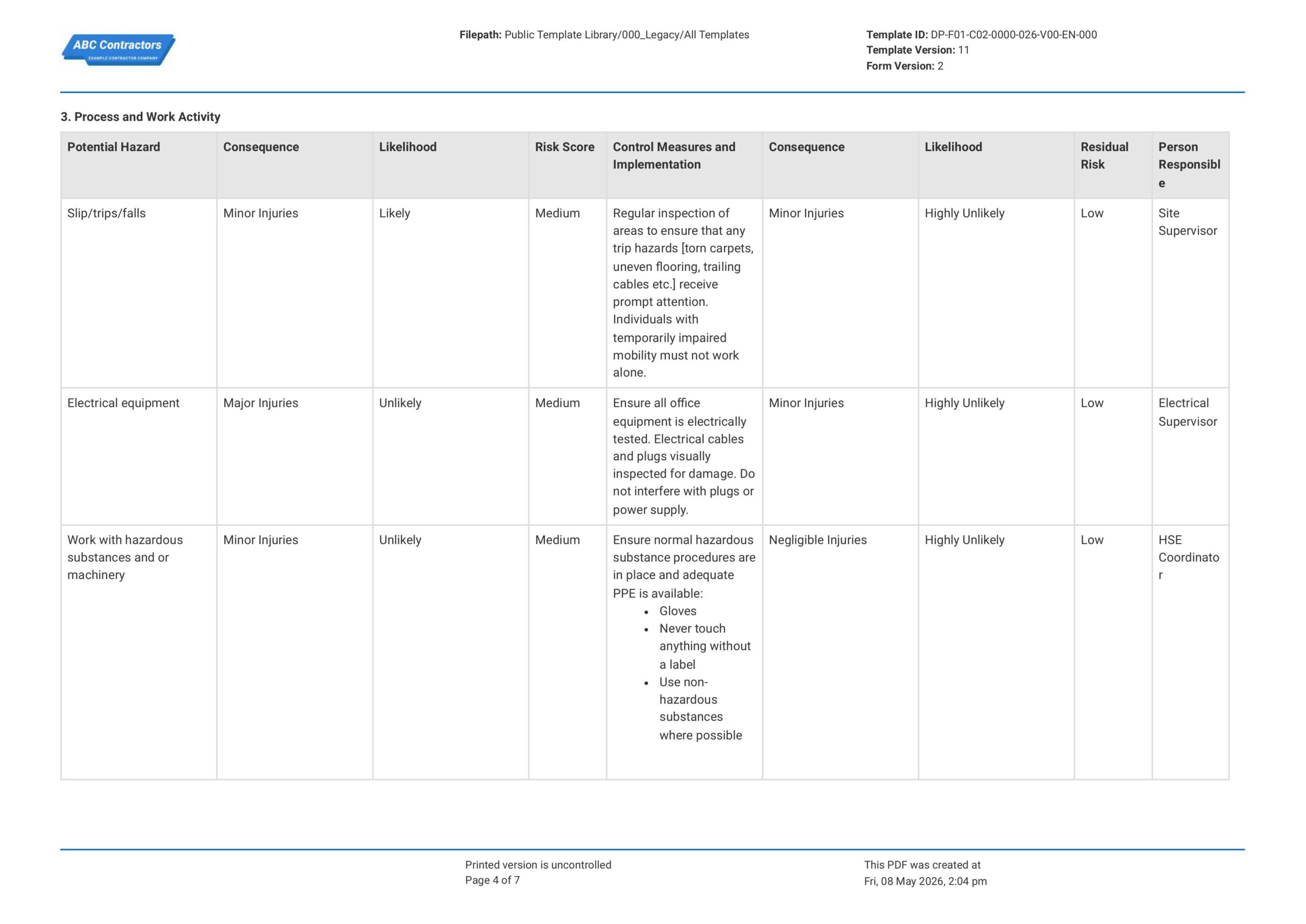
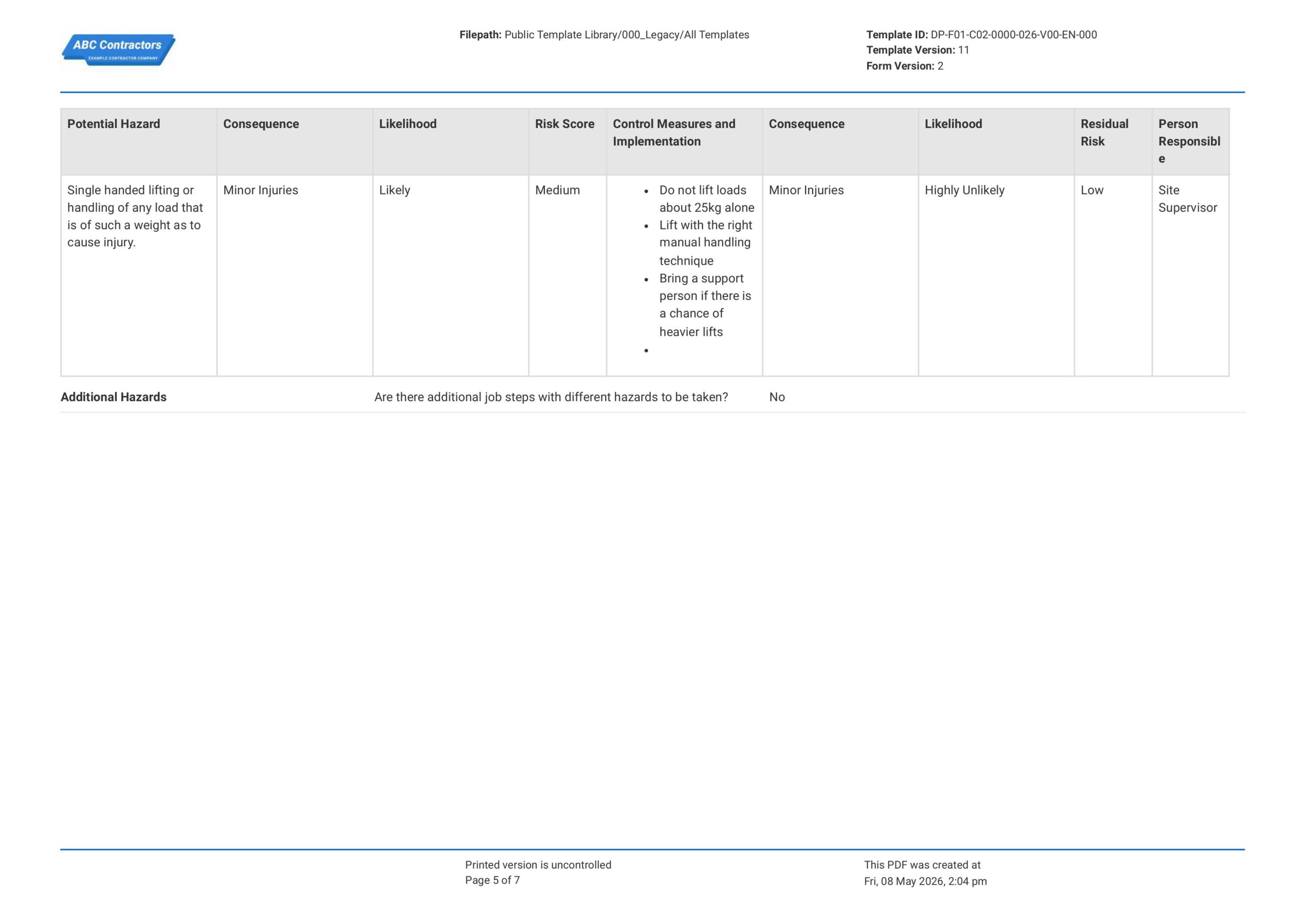
We recommend placing an assessment of the Work Activity itself in the third table. It is also important to evaluate the risks and hazards that the job task presents. Be sure to use the following format:
- First column to note the potential hazards
- Second and third column to identify potential consequences and likelihood of the hazard
- Fourth column to list down the Risk Score
- Fifth column to identify control measures to combat the hazard
- Sixth and seventh column to identify the consequences and likelihood of the hazard after applying the control measures
- Eighth column to identify the Residual Risk Score
- Final column to identify the Person in charge of implementing the control measure
-
Provide a Risk Matrix Guide
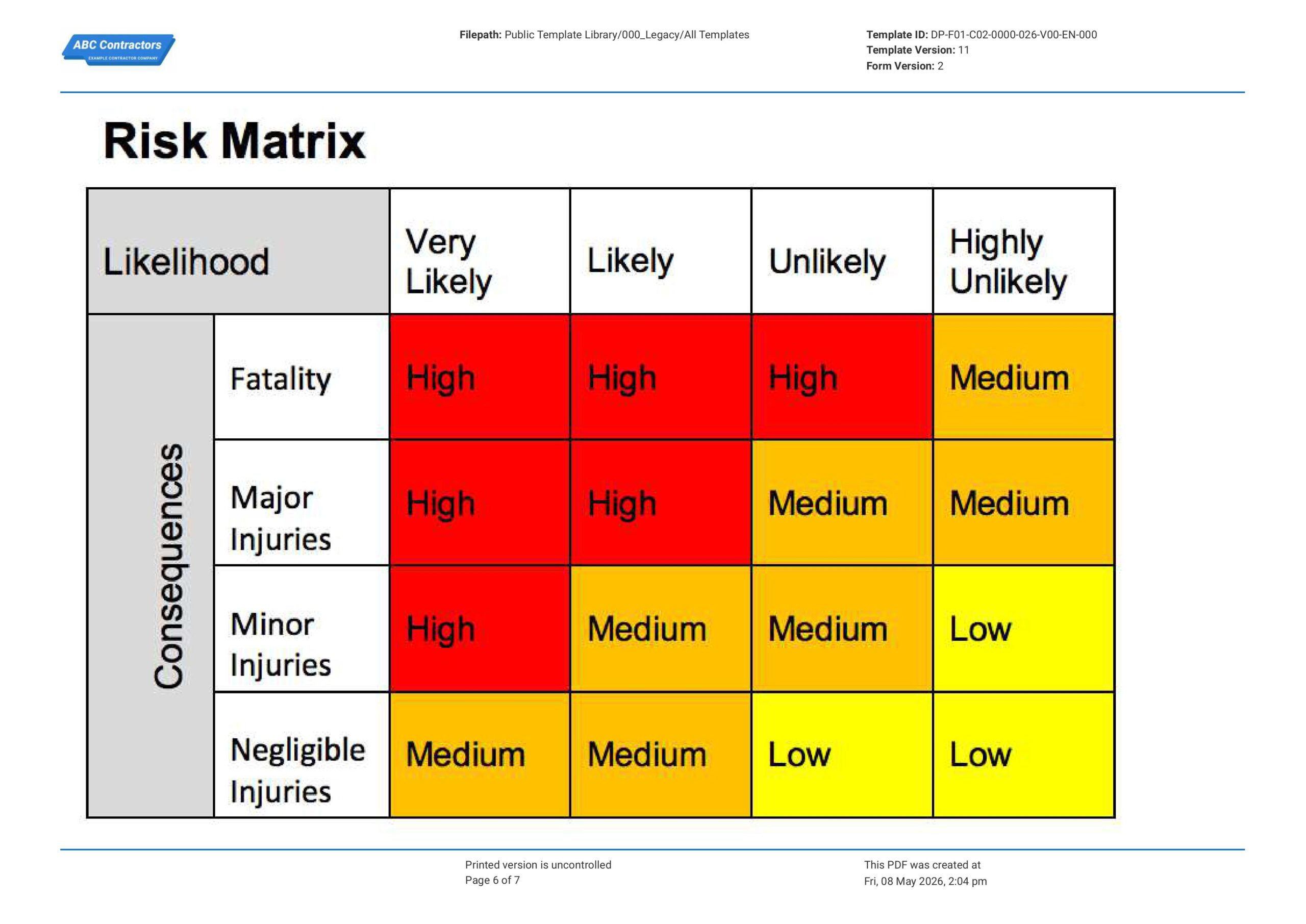
Performing a work activity risk assessment can get overwhelming without a guide in place to help. We highly recommend including a Risk Matrix Guide to assist users of your Lone Working Risk Assessment form.
- Photo or Table of the Risk Matrix
- Table for the Risk Score Guide
-
End your Lone Working Risk Assessment with Acknowledgements and Sign-offs
Finally, be sure to add sections where users of your Lone Working Risk Assessment can add comments and sign-offs. We also recommend using automatic e-signature fields to make this part of the process easier to do.
- Multi-line text field for Recommendations, Comments, and Remarks
- E-signature fields for the assessor
About the author

Ron Gadugdug
Content Engineer
 LinkedIn
Education
Cebu Institute of Technology - University - Civil Engineering
Bio
Ron is a Civil Engineer with 6 years of experience in the construction industry, primarily focused on quantity surveying, cost estimation, project management, quality control, contract administration, and property & engineering insurance. At Sitemate, he writes about practical applications of evolving technologies and digital solutions that support construction professionals in improving efficiency, compliance, and project delivery across the built world.
Past Projects
Quantity Surveying & Cost EngineeringPerformed quantity take-offs of several high-rise and horizontal structures using sheets and applications like Revit and Bluebeam Revu, and spearheaded trials with Building Information Modeling (BIM) software.
Project Management & ConsultancyCoordinated with project management teams during the construction of local projects such as a 4-tower hotel & resort, a 22 storey condominium project, and a school dormitory project.
Contract AdministrationAssisted during contract biddings and negotiations with general contractors and sub-contractors, and oversaw progress reporting, billings, and payment.
Property & Engineering InsuranceDedicated non-life claims handler, overseeing property and contractor all-risk insurance claims, risk management, and bonds.
Version History:
Related apps and templates
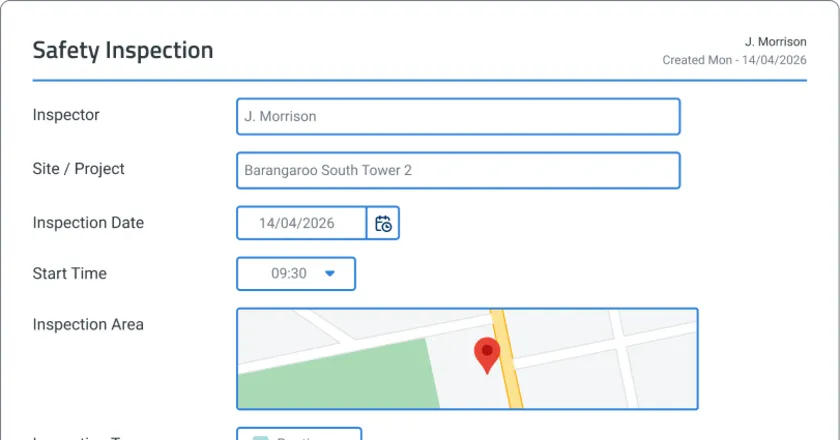
Safety Inspections App
Safety inspections app template that turns voice notes and photos into completed compliance reports on-site. GPS tagging, AI drafting, corrective
View app

Working at Heights Risk Assessment Template: Free to Use
This free Working at Heights Risk Assessment Template is readily downloadable to help identify, evaluate, and manage hazards when working in elevated places. The template is comprehensively designed and aligned with
View template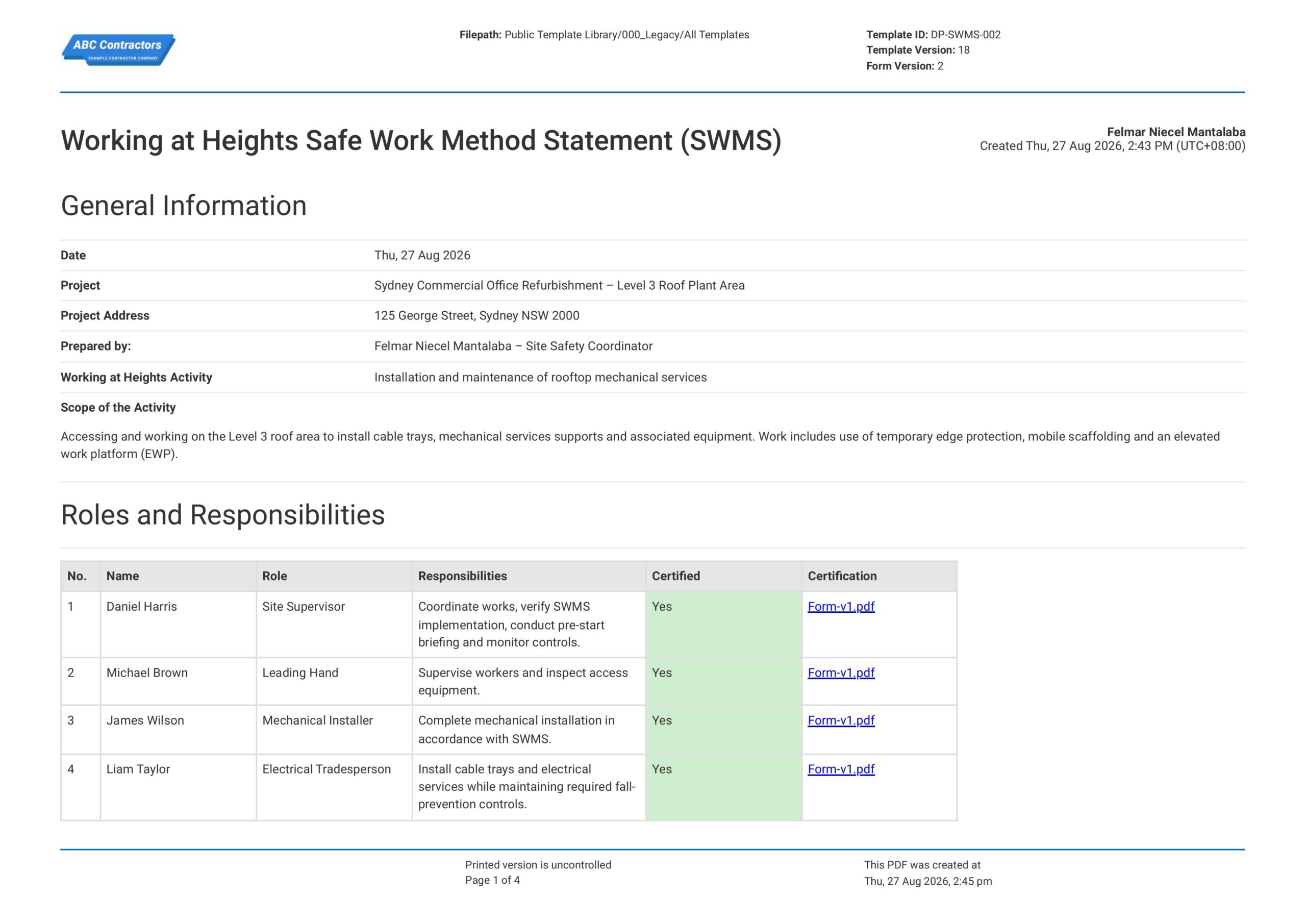
Safe Work Method Statement Working at Heights
This Safe Work Method Statement Working at Heights template is free and readily available to help the team create an effective safety management system that accurately assesses hazards and provides safe instruction in
View templateThis assessment was generated with Dashpivot software
- Access, edit and complete your Lone Working Risk Assessment from any device - mobile, tablet or computer.
- Print, download or send your Lone Working Risk Assessment as perfectly formatted PDF documents with your company logo.
- Store your Lone Working Risk Assessment securely online, where they can be searched and found in seconds
- Invite internal and external parties to see, edit and sign off on Lone Working Risk Assessment online.
