Risk Assessment for Lifting Operation Template

Start with a free 30-day trial. No credit card required.
Need a Risk Assessment for Lifting Operation that you can make your own? This template comes pre-built with user-friendly tables for task hazard analysis, risk assessment, and the personnel involved in a lifting activity, along with automated workflow notifications that alert key individuals when their sign-off is needed. You can edit any part of it to match your company's lifting procedures or operational needs, and the document will still hold up against the regulations you'd be audited on.
This Risk Assessment for Lifting Operation is an easy-to-use form that your workers can use to record lifting hazards efficiently and identify the control measures needed. It helps teams arrange appropriate controls and personnel early, cut out back-and-forth communication for approvals, and maintain a safe work environment for every lift.
 100% fully editable Risk Assessment for Lifting Operation
Export your Risk Assessment for Lifting Operation to PDF or CSV
Access your Risk Assessment for Lifting Operation on mobile, tablet or computer
Trusted by companies, projects and teams of all sizes















What is Risk Assessment for Lifting Operation?
A Risk Assessment for Lifting Operation is a document that outlines the risk evaluation procedure for lifting activities. This includes the list of potential hazards, their respective risk assessment scores, and the controls to mitigate them. This form's purpose is to primarily assist operators and safety officers in detecting possible dangers associated with using lifting equipment through a task hazard analysis. Operators, site officers, and site managers are able to effectively provide suitable controls and informed decisions for the hazards based on the risk scores obtained from the assessment to decrease the possibility of injury inflicted on the site workers or any property damage during lifting operations.
Preview this free Risk Assessment for Lifting Operation template
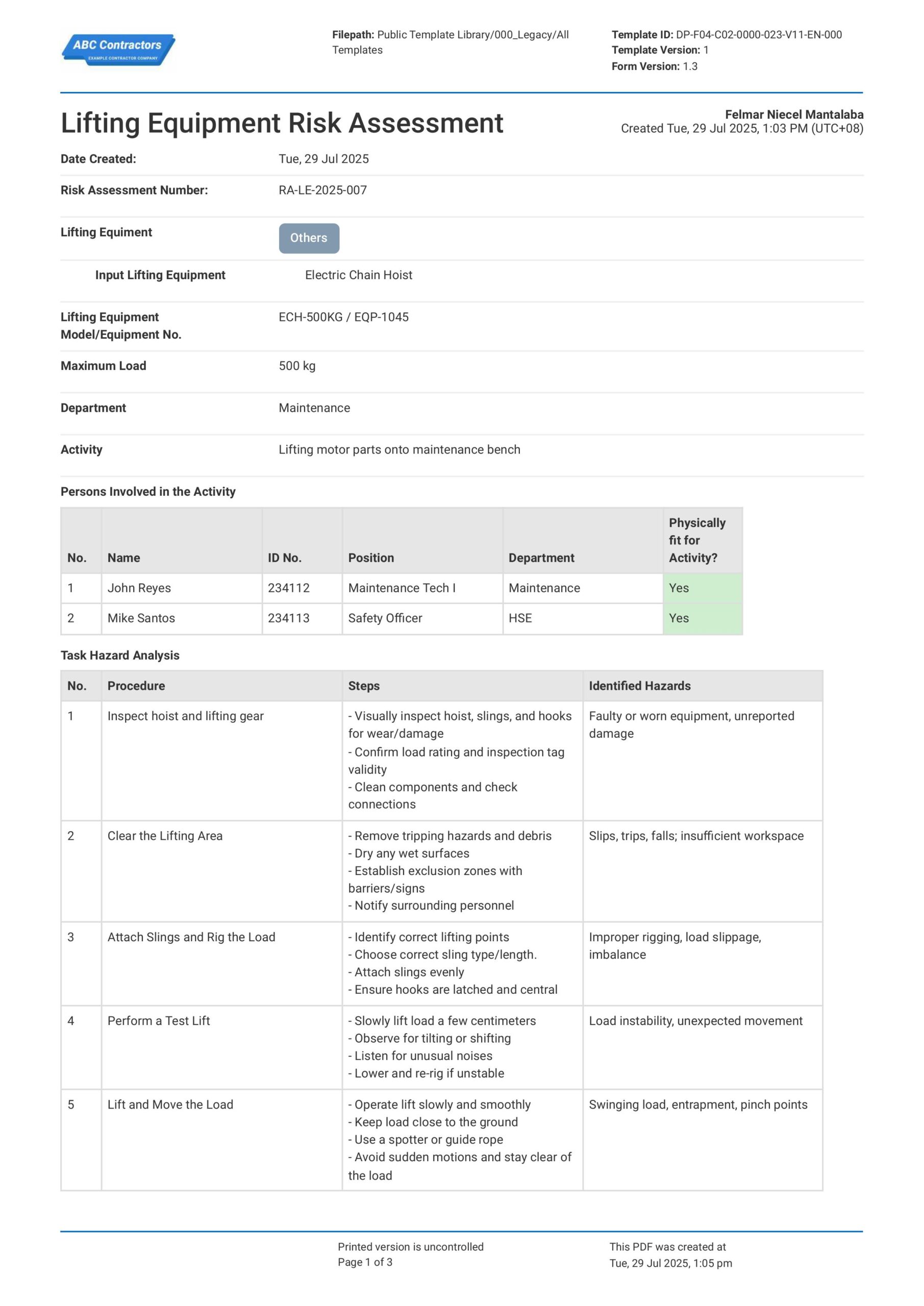
Curious how this Risk Assessment for Lifting Operation works? Check out the example below to see how the hazard analysis tables and automated approval notifications streamline the whole process. You can generate your own version, export it as a custom form with your company details, and fill in your lifting activity details to have a ready-to-use Risk Assessment for Lifting Operation in minutes.
Use this Risk Assessment for Lifting Operation template for free

Generate this template automatically with Storm
You don't have to build the Risk Assessment for Lifting Operation field by field. Let Storm, the AI Data Capture Agent inside Dashpivot, build the template for you in seconds.
Describe what you need
Tell Storm the form you want in plain language and it builds a structured digital template from scratch, with fields, tables, and signatures in place.
Upload what you already use
Drop in your existing PDF, Word, Excel, or even a photo of a paper form. Storm rebuilds it as a smart digital template with the structure intact.
 Storm
Storm
Generate a Risk Assessment for Lifting Operation form template that I can use for my business
Applicable Standards and Policies for Risk Assessment for Lifting Operation
Operating lifting equipment carries inherent risks. It contains numerous hazards that can seriously injure or potentially take a life. Given the dangers associated with lifting equipment, the Occupational Safety and Health Administration (OSHA) has established provisions for its use. They even provided specific requirements and regulations for both the general industry and the construction industry.
General Industry (29 CFR 1910)
The following are the provisions of the requirements and regulations for lifting equipment in the general industry:
- 1910.184: Slings—This section contains the requirements of ropes, metal mesh, and synthetic slings for their proper usage, inspection, and maintenance.
- 1910.179: Overhead Cranes – This section details the strict specifications of the design, inspection, and operation of cranes.
- 1910.179-180: Hoists – This lays out the guidelines for hoist equipment, the inspection process, and the load capacity limits.
- 1910.178: Powered Industrial Trucks (Forklifts) – This covers the regulations for operating and maintaining forklifts and the training requirements for forklift operators.
Construction Industry (29 CFR 1926)
The following are the provisions of the requirements and regulations for lifting equipment in the construction industry:
- 1926.251: Rigging Equipment – This provides the requirements for rigging equipment, the proper inspection procedure, the appropriate working loads, and their maintenance.
- 1926.1400-1442: Cranes and Derricks – This includes the requirements for setting up and operating the crane, the inspection process, and operator certification.
- 1926.552: Material Hoists and Personnel Hoists – This section details the design, installation, operation, and proper inspection for hoists.
- 1926.753(d): Safety around suspended loads – This lays out the requirements and procedure on how to protect operators and site workers from suspended load hazards.
Staff Members and Parties that use Risk Assessment for Lifting Operation
A risk assessment process is not a one-man job. It requires multiple heads to ensure that all hazards are identified and are provided with the appropriate control measures. The following are the staff members and related parties who are involved in conducting a Risk Assessment for Lifting Operation.
- Supervisors: These individuals are in charge of overseeing everyday duties and activities. One of their responsibilities as managers is to keep all employees safe and healthy. Lifting tasks are inherently dangerous; thus, managers must lead hazard investigations and implement suitable safety controls to keep workers safe.
- Safety Officer: A safety officer’s major responsibility is to completely implement safe work practices in the workplace. They establish the criteria for what is safe and what is not. They evaluate the control systems for tasks that entail high-risk activities, such as lifting operations. Safety officers would most likely need the risk assessment to conduct their evaluations and evaluate the present measures in place. These evaluations are critical since they determine how successful the controls are.
- Operators/Workforce: These are the employees who are directly exposed to dangers when performing lifting operations. These people may provide various crucial inputs during a risk assessment because they are the ones who are exposed to the hazards while operating the equipment. Furthermore, it is vital that they are aware of basic safety rules and practices in order to create a safe working environment.
Business Risks Reduced by Risk Assessment for Lifting Operation
Safety must always be the top priority, especially in industries that involve high-risk activities, such as lifting operations. Employing a Lifting Operations Risk Assessment would not only protect the employees and assets of the company but also protect against other risks that could damage the company in different ways. To put it simply, the Risk Assessment for Lifting Operation also acts as a shield to the following business risks:
- Financial losses due to high-costs related to accidents, property damage, and delays
- Legal liabilities due to non-compliance with safety regulations
- Fractured relationships due to poor reputation and trust
- High insurance costs and compensation claims
- Discontinuation or suspension of operations
- Poor employee work morale
Business Opportunities Created by Risk Assessment for Lifting Operation
Choosing to commit to providing a safe and healthy environment has its merits. It not only shields employees and company property from hazards but also provides benefits and advantages for the company. Establishing concrete safety processes, like the Lifting Operations Risk Assessment, provides companies business opportunities that help them gain more than what they have established. These are the business opportunities that can appear naturally when employing a Risk Assessment for Lifting Operation:
- Stable and solid client trust and relationship
- Greater competitive advantage on landing larger projects
- Achieving milestones on time or ahead of time
- Efficient operations
- Positive and a healthy workplace-both physical and mental
- Good reputational standing due to constant compliance to safety regulations
Correct Risk Assessment for Lifting Operation example
These are the correct and vital steps for conducting a Risk Assessment for Lifting Operation.
- Gather all involved personnel
- Orientation and introduction of risk assessment
- Identification of hazards through a task hazard analysis
- Hazard evaluation using the established risk matrix
- Provision of safety controls
- Form Review
- Implementation of safety controls
- Safety controls monitoring
Risk Assessment for Lifting Operation: safe lifting procedures
Lifting might sound like a simple activity; however, neglecting safety in an industrial setting can lead to numerous issues. To help prevent injury and property damage, here is a general safety procedure for lifting activities.
Inspect your lifting equipment prior to starting any activities
Lifting equipment must be inspected before conducting the activity. Inspections ensure that the equipment is functional, reliable, and safe during activity. Any found defects and problems should be addressed first, since they might compromise the safety and progress of the activity.
Assess the risk by using a risk assessment for lifting operation or equipment
After completing the inspection, the risk assessment can proceed. All the procedures of the lifting activity are reviewed for possible hazards and then provided with the appropriate control measures. In this procedure, collaboration among multiple minds is necessary to provide the best control measures and the safest procedures.
Plan and put in place the controls set from the lifting operation risk assessment
Now that the risk assessment has provided all the control measures, the team can begin planning the activity. Planning involves preparing the equipment and materials needed, which includes the control measures. The team also prepares the timeline of the activity and the procedure to follow, which already incorporates the control measures.
Clear and keep areas clean
Clear any obstructions, including equipment and personnel, from areas where lifting, lowering, and transferring loads occur. This is to avoid any striking injuries and damage to property or assets.
Assess the load and the crane
Before rigging the load to the crane, it is wise to first assess the load and the crane. Studying the structure of the load can supply an idea of how to balance it during lifting.
Safe Rigging
Rigging is a critical part of lifting. Improper rigging can cause imbalances, which may lead to serious problems such as property damage and severe injuries. It is best to employ trained and certified personnel to conduct the rigging process, for they have acquired the knowledge and skills of safe standard rigging procedures.
Control and monitor load movement
When loads are lifted, lowered, or transferred, personnel involved in the activity must consistently stay vigilant for any load shifts or imbalances. If any of these arise, it is best to immediately correct it for better control of the load.
Housekeeping
Cleaning up after the activity guarantees the cleanliness of working areas and the excellent condition of all equipment. Such practice also avoids any unnecessary problems for any activity that comes after the lifting activity.
Review procedures
Reviewing the activity is essential for identifying gaps. These encompass procedures, control measures, or any hazards that escaped detection during the risk assessment. This process will help further improve flow and safety in any lifting activity.
How to create a Lifting Operation Risk Assessment template?
This is a comprehensive guide for creating an effective, complete, and compliant Lifting Operation Risk Assessment template.
Prerequisites in creating a Risk Assessment for Lifting Operation
- Identify the activities and individuals engaged in the lifting operation.
- Implement frequency and timetables for the risk assessment.
- Develop risk assessment parameters and assessment procedures.
- Define the duties and assignments required to complete the evaluation.
- Establish legal requirements and documentation standards.
-
Risk Assessment for Lifting Operation Procedure Review
- Gather all staff involved in the lifting activity.
- Examine all existing processes, safety, and health measures.
- Conduct an orientation on doing and performing risk assessments.
- Identify all the necessary equipment, tools, and machines.
- Perform a work environment inspection.
-
Drafting the Risk Assessment for **Lifting Operation**
- Include a section for recording vital information about the activity.
- Add a section to record all the personnel involved in the activity.
- Provide a section for the task hazard analysis.
- Provide a risk scoring system or matrix.
- Add the risk assessment table.
- Add a checklist to verify completeness and correctness of the form.
-
Creating the risk scoring matrix
- Provide a scoring system for hazard likelihood. Ensure the scoring system is qualitative and scalable. Example: using the range 1-5 to score how likely the hazard will occur.
- Provide a scoring system for hazard impact severity. Make sure the scoring system is qualitative and scalable. Example: using the range 1-5 to score how severe the potential impact of the hazard will be.
- Create a legend for the risk score. The legend should show the equivalent risk score based on the product of the likelihood and severity of the hazard.
-
Review, implementation, and monitoring
- Ensure all the data in the form are complete and validated.
- Implement the safety control measures.
- Establish schedules for safety control monitoring.
- Establish schedules for form review.
Frequently asked questions
How to create your Risk Assessment for Lifting Operation in an App or Software System
Digital Lifting Operations Risk assessments assist in converting traditional paper-based evaluations into flexible, data-driven processes. Automatic scoring algorithms compute risk levels instantaneously, and the integration of lists into tables reduces the need for manual data entry. Integration with safety management systems guarantees that hazards generate immediate work orders for safety controls, and operator training tracking connects assessment results to competency development programs.
Automated reporting features allow managers to discover trending safety issues across numerous locations, while regulatory compliance dashboards provide real-time access to assessment completion rates and pending corrective actions.
30 mins
Medium difficulty
-
How to create a Risk Assessment for Lifting Operation in an app?
Using an app that uses digital forms instead of paper-based forms could improve the form by:
- Having a single access point for all created forms
- Less manual data entry.
- Easy reformatting to fit with new protocols or updated standards
- Quicker integration of photographs and data
- Producing a more defined workflow.
-
Creating the information section
A Risk Assessment for Lifting Operation form must include the following information fields:
- Date created
- Risk assessment number
- Forklift model/vehicle number
- maximum load the forklift can carry
- Department
-
Creating the persons involved in the activity section
This section provides information for all personnel involved in the activity. The table’s column headers should be as follows:
- Name
- ID number
- Position
- Department
- Confirmation for physical fitness. The confirmation column can be integrated with a yes-or-no list and assigned with colors for a more professional and aesthetic form.
-
Creating the task hazard analysis section
This section helps users identify the hazards by investigating the possible hazards for each procedure in an activity.
- Create a 4-column table where users can indefinitely add rows.
- The first column should display the numeric order of each row.
- The second column should allow users to provide the procedures of the activity involving a forklift.
- The third column should allow users to input the steps of each procedure.
- The fourth column is where all identified hazards in the procedure are placed.
-
Creating the Risk Assessment Section
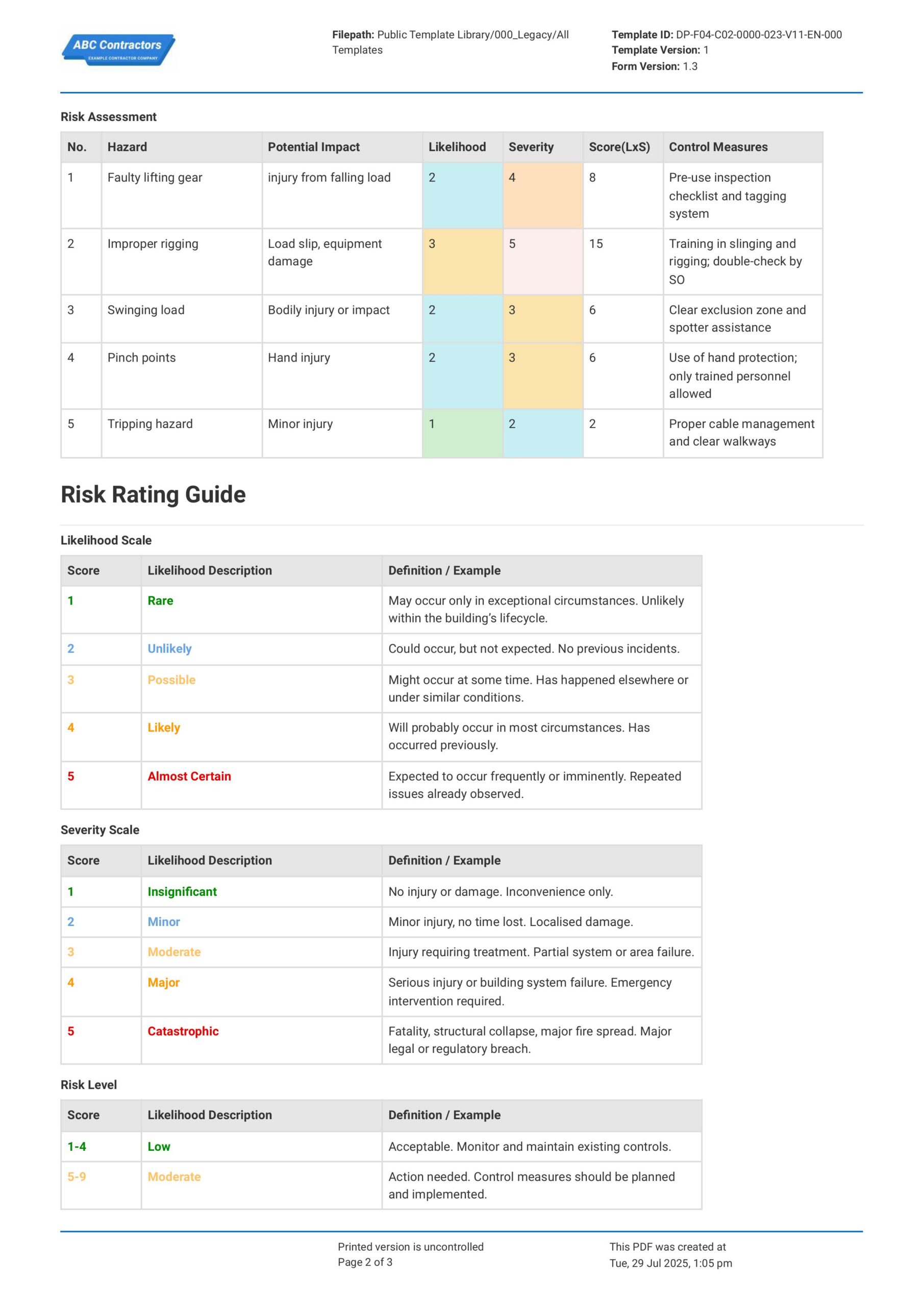
The most important aspect of the form is developing the risk assessment section, which is where potential hazards are examined and suitable control measures are implemented.
- Create a 7-column table that allows users to indefinitely add rows.
- The first column should show the numerical sequence of each row.
- The second column should allow users to enter the identified hazard.
- The third column should allow users to specify the potential impact of the risk.
- The fourth column should allow users to indicate the likelihood of the hazard. This fourth column could be integrated into a list containing the digits 1–5. Each option can be allocated a color to aid in the quick recognition of how probable the threat is to occur.
- The fifth column should let users specify the severity of the hazard. This column could potentially be displayed as a list containing the digits 1–5. Each selection can be allocated a color to aid in the rapid identification of the hazard’s criticality.
- The sixth column should show the hazard’s risk score. Automate to determine the risk score using the following formula: Risk Score = Likelihood x Severity.
- The final column should allow users to specify the appropriate control measure to manage the hazard.
-
Creating the Guide
This section of the Risk Assessment for Lifting Operation form serves as a guide, assisting users in scoring the hazard. The section should include the following elements:
- Likelihood scale
- Severity Scale
- Risk Score Level
Creating the Likelihood and Severity Legend
- Make a table with 5 rows and 3 columns.
- The first column should show the scale’s likelihood or severity level, which is ranked from 1 to 5 in each row.
- The second column should contain a description of each level in the scale.
- The third column should include a definition or example of each level on the scale.
Creating the Risk Score Level Legend
- Make a table with 4 rows and 3 columns.
- The first column should provide a range of equivalent scores. (1-4, 5-9, 10-15, 16-25)
- The second column must include the description of each range.
- The third column should include a definition or example for each range.
-
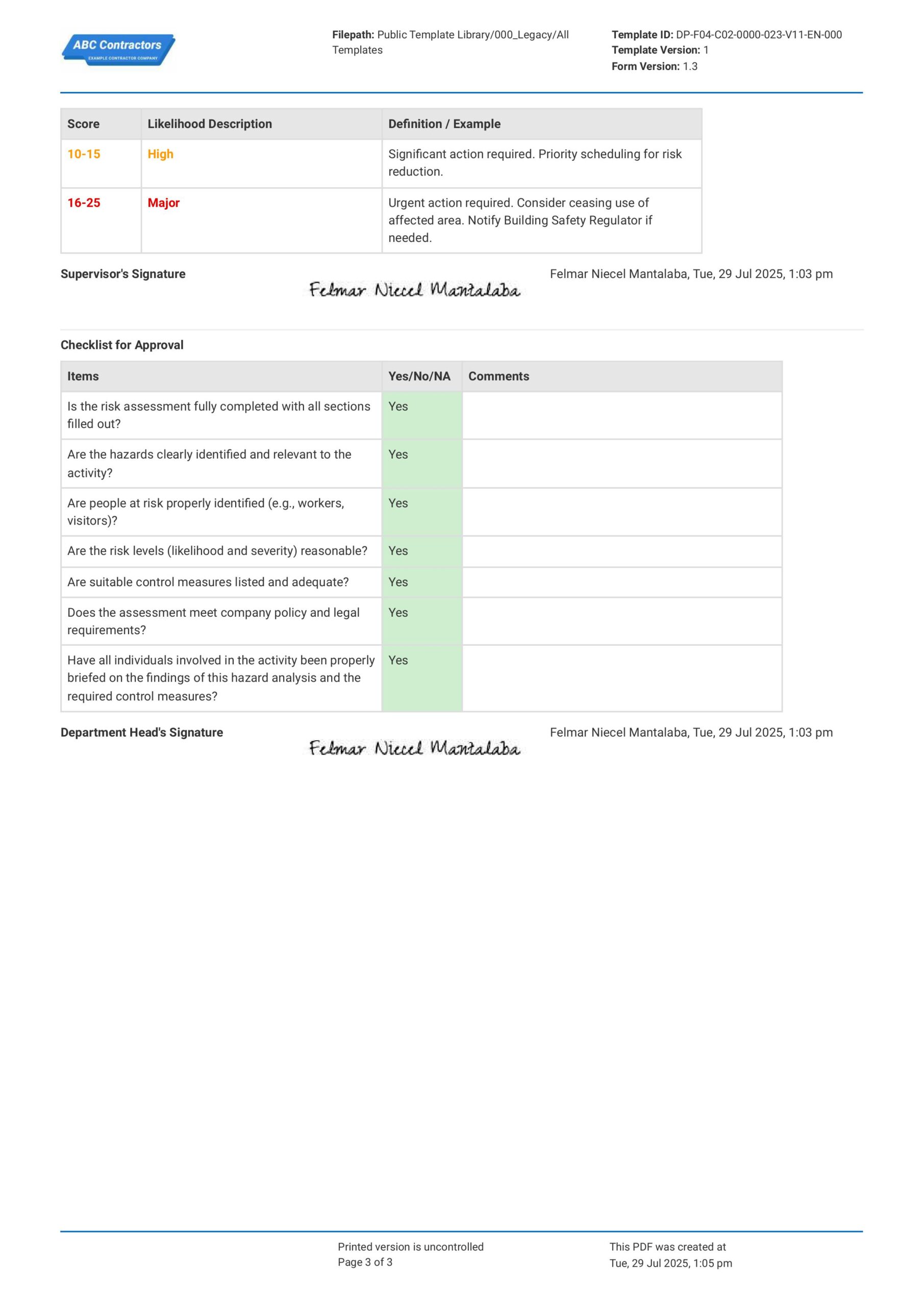
Creating the checklist for approval
This section verifies the accuracy and completeness of all processes in the risk assessment.
- Make a table with 3 columns.
- The first column should contain all the checklist items.
- The second column should be a yes-or-no list in which users can indicate whether or not they have completed the checklist items. This column can also be color-coded to make affirmations easier to identify.
- The third column should allow the form reviewer to provide comments.
-
Adding the signatories section
This part validates the form. The following signature fields are required on the Risk Assessment Forklift form:
- Supervisor’s Signature
- Manager’s Signature
About the author

Felmar Mantalaba
Content Engineer
 LinkedIn
Education
Cebu Institute of Technology - University - Mechanical Engineering with Mechatronics
Bio
Felmar is a mechanical engineer, whose four years of experience in the mining industry inspired him to write and share stories to progress the revolution of new technologies and create smarter, smoother ways of living.
Past Projects
Safety, Health, and Environment Management System (SHEMS) CoordinationSHEMS Coordinator at Atlas Consolidated Mining, ensuring organizational compliance with ISO 14001 and ISO 45001 standards, performing risk assessments, developing policies, and conducting audits and inspections to maintain a safe and environmentally responsible workplace.
Maintenance Management and OptimizationSenior Maintenance Manager (OIC) leading equipment maintenance and operational efficiency initiatives, reducing downtime by 10%, improving Mean Time Between Failure (MTBF) and Mean Time To Repair (MTTR) for major equipment, and managing maintenance schedules, manpower, and materials, while overseeing capital project optimization.
Inspection Engineering and Equipment ReliabilityInspection Engineer responsible for technical blueprint interpretation, vendor collaboration, preventive maintenance scheduling, and data collection for vibration and temperature readings, delivering actionable recommendations and comprehensive reports to improve equipment reliability and operational performance.
End-to-End Operational Oversight in Mining EngineeringContributed to multiple facets of operational management, including SHEMS compliance, maintenance optimization, inspections, and capital project evaluation, integrating safety, reliability, and efficiency improvements across all stages of copper production operations.
Version History:
Related apps and templates
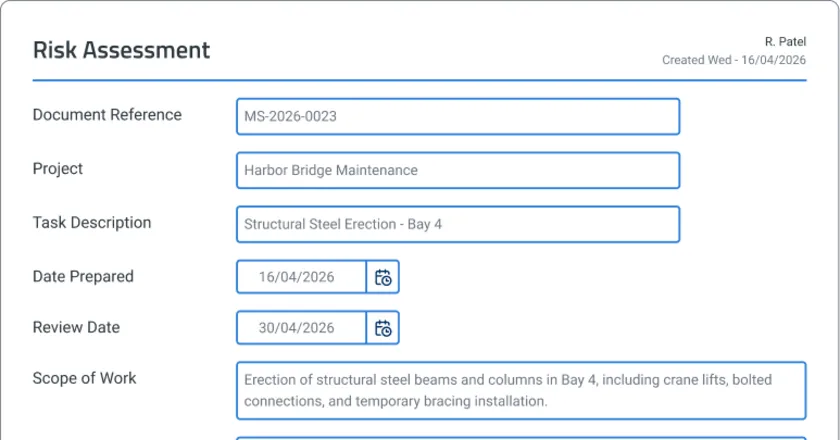
Risk Assessment App
This risk assessment app makes documenting, organising and analysing risk assessments quick and easy on site and in the office. Try the app for free
View app
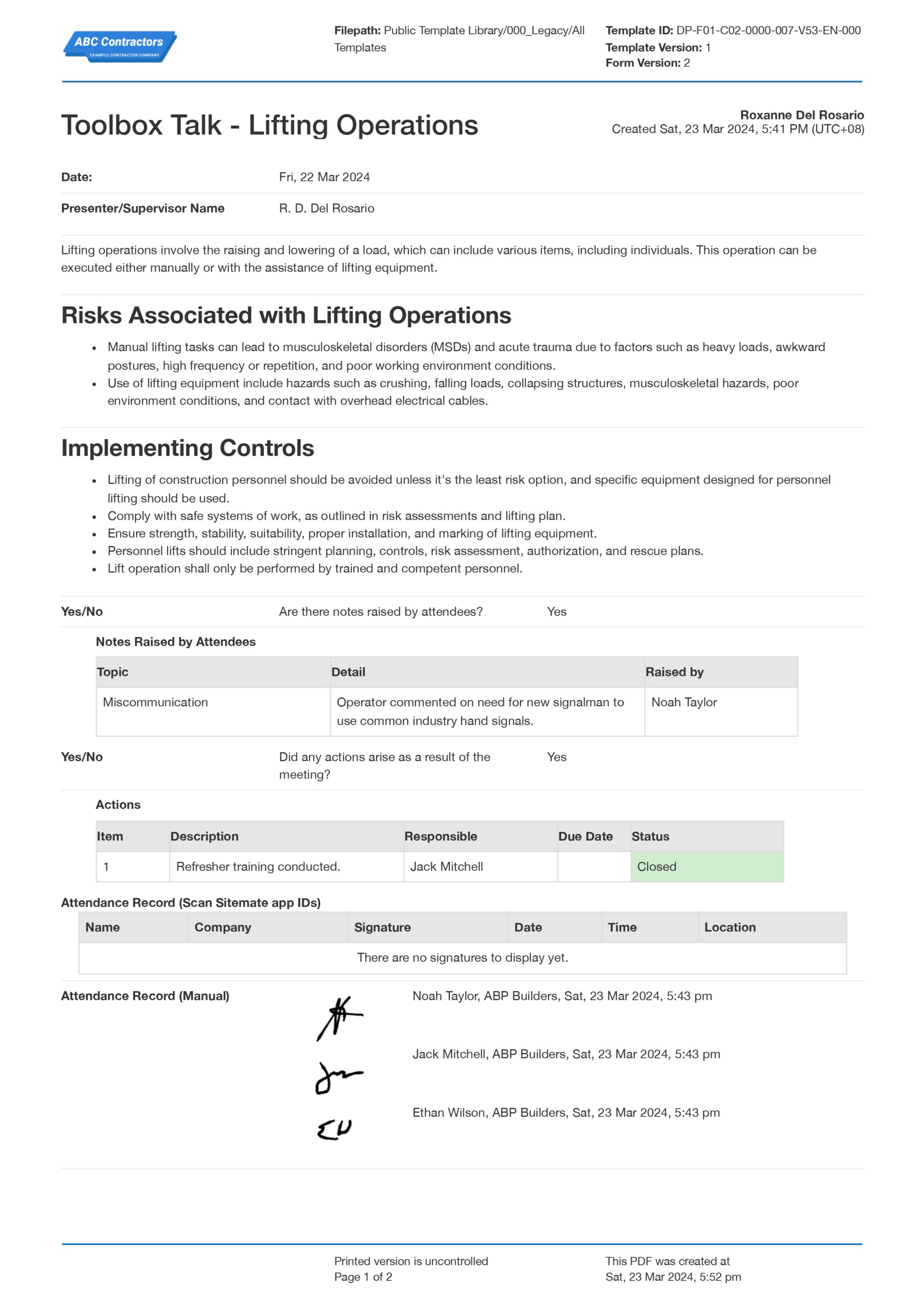
Toolbox Talks Lifting Operations
This Toolbox Talks Lifting Operations template is free and readily available to ensure your discussions are clear and impactful, making it easier to communicate important lifting safety information to the team. Want to
View template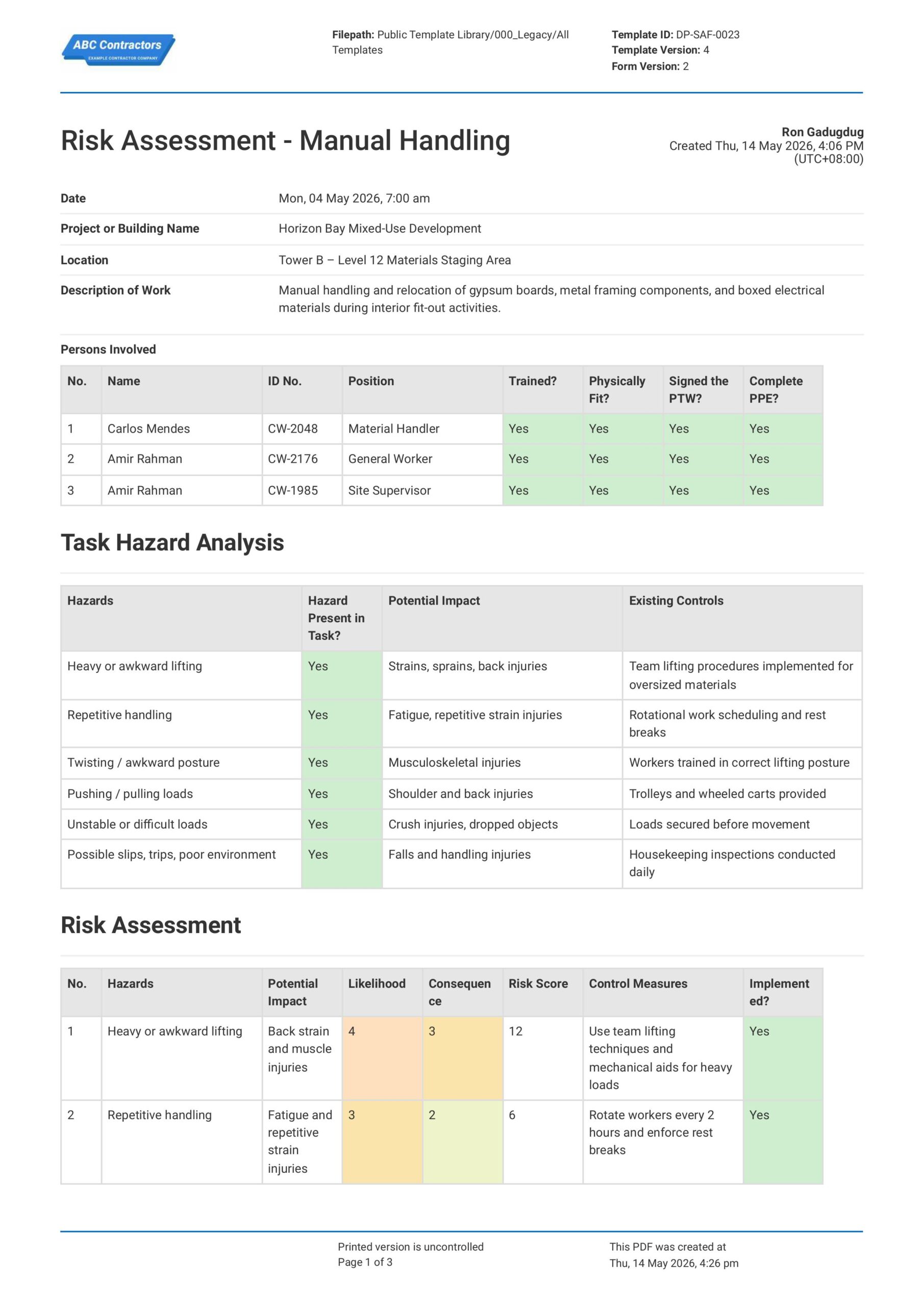
Free Manual Handling Risk Assessment
This Manual Handling Risk Assessment is free to use and ensures the safest possible manual handling jobs and outcomes. Ensure workplace safety by using this assessment to break down the task or activity into steps, and
View templateThis form was generated with Dashpivot software
- Access, edit and complete your Risk Assessment for Lifting Operation from any device - mobile, tablet or computer.
- Print, download or send your Risk Assessment for Lifting Operation as perfectly formatted PDF documents with your company logo.
- Store your Risk Assessment for Lifting Operation securely online, where they can be searched and found in seconds
- Invite internal and external parties to see, edit and sign off on Risk Assessment for Lifting Operation online.