Scaffolding RAMS Template

Start with a free 30-day trial. No credit card required.
This free and downloadable Scaffolding RAMS is perfectly designed to streamline all the RAMS processes and comprehensively includes all the needed safety regulatory requirements. The form accounts for the hazards and risks associated with working with scaffolding to ensure your work is safe and compliant.
Want a hassle-free method of updating your RAMS? This scaffolding RAMS template comes pre-built with all of the typical RAMS form fields and can also be customised with simple drag-and-drop to suit your own safety requirements.
 100% fully editable Scaffolding RAMS
Export your Scaffolding RAMS to PDF or CSV
Access Scaffolding Risk Assessment Method Statement on mobile, tablet or computer
Trusted by companies, projects and teams of all sizes















What is Scaffolding RAMS?
A Scaffolding RAMS document is a Risk Assessment and Method Statement rolled into one. It is the most crucial safety document on a UK construction site, particularly during scaffolding installation. The Risk Assessment section explains what could go wrong. The Method Statement side details how the project will be safely completed. Together, they demonstrate that the task has been thoroughly planned before anyone picks up any tools, which serves as the foundation for building site safety planning.
Check out this complete and free Scaffolding RAMS template
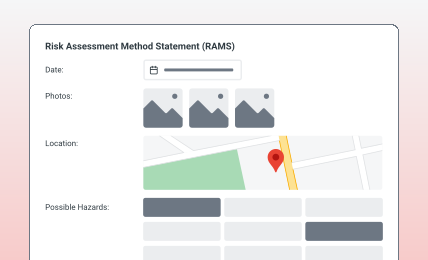
Preview this Scaffolding RAMS below and see how it's so much easier to create and navigate the form.
Explore this smart Scaffolding Risk Assessment Method Statement template and compare it to other rigid/static docs, like Word or Excel.
Use this Scaffolding RAMS template for free

Generate this template automatically with Storm
You don't have to build the Scaffolding Risk Assessment Method Statement process field by field. Let Storm, the AI Data Capture Agent inside Dashpivot, build the template for you in seconds.
Describe what you need
Tell Storm the form you want in plain language and it builds a structured digital template from scratch, with fields, tables, and signatures in place.
Upload what you already use
Drop in your existing PDF, Word, Excel, or even a photo of a paper form. Storm rebuilds it as a smart digital template with the structure intact.
 Storm
Storm
Generate a Scaffolding Risk Assessment Method Statement process form template that I can use for my business
Applicable Standards and Policies for Scaffolding RAMS
The construction sector is high-risk, with many potential hazards that require containment. The UK government aims to ensure that businesses have proper safety control systems to protect the safety and health of workers; hence, the following provisions must be met:
- The Health and Safety at Work Act of 1974: This Act requires firms to ensure the health and safety of all employees affected by the work or activity they carry out, to the maximum extent reasonably practical.
- The Management of Health and Safety at Work Regulations 1999: This legislation requires companies to conduct a thorough risk assessment, document important findings, and apply appropriate control measures for identified hazards.
- Construction (Design and Management) Regulations, 2015: This clause in the United Kingdom compels contractors to plan, supervise, and monitor their work in a safe manner.
- Work at Height Regulations 2005: This clause requires businesses to establish measures and method statements that prevent or arrest falls and protect workers from height-related risks.
Staff Members and Parties that use Scaffolding RAMS
Scaffolding RAMS are only functional and valuable when used by the suitable people. The following staff members and parties created and completed the Scaffolding Risk Assessment Method Statement:
- Field Workers: These are the people who actively do hands-on construction work. Their participation in the Scaffolding RAMS is crucial because they can provide real information about how jobs and activities are completed on-site.
- Site supervisors: They are largely responsible for ensuring that employees integrate and actively apply control measures in the workplace. Site supervisors can also provide feedback on whether the control measures are adequate to keep workers safe and healthy.
- Safety managers: They are largely in charge of ensuring health and safety compliance throughout all business activities. Their knowledge and experience with safety measures make them invaluable in the development and implementation of the Scaffolding RAMS.
Business Risks Reduced by Scaffolding RAMS
The Scaffolding RAMS primarily protects people and property from any working-at-height-related hazards. However, this form can also protect businesses against commercial risks that could imperil their financial position and reputation. Regular implementation of Scaffolding RAMS can help businesses avoid the following business risks:
- Increased risk of workplace injuries, leading to a greater Lost Time Injury Rate (LTI).
- Medical and non-compliance costs leading to financial instability.
- Disrupted operations leading to output losses and missed targets.
- Damaged reputation
- Poor interactions among employees, employers, and stakeholders.
- Loss of qualifications and accreditation.
Business Opportunities Created by Scaffolding RAMS
An effective Scaffolding RAMS improves planning and coordination and streamlines the prediction of construction activities or processes’ outcomes. It also suggests a proactive safety culture, which can boost reputation and provide a competitive advantage. It helps businesses by:
- Increasing the success rates in bidding and prequalification processes that require robust safety systems.
- Improving coordination between various trades and parties on-site.
- Enables accurate scheduling and resource allocation.
- Enables the use of digital safety tools and defined processes.
What should a Scaffolding RAMS contain?
The following sections must be present in a Scaffolding Risk Assessment Method Statement:
- Information on the contractor and the project.
- Hazard identification
- Assessment of hazards and provision of method statement and controls
- Attendance of all personnel concerned.
- Required signatories to authenticate the Scaffolding RAMS.
Scaffolding RAMS Template Customisation Options
Modern scaffolding RAMS templates can be tailored to specific project requirements, including specialized scaffolding types such as suspended access, temporary roofs, or complex geometric structures. Customisation options include project-specific hazard libraries, automated risk scoring based on site conditions, and integration with digital inspection schedules. Advanced templates also incorporate weather monitoring alerts, competency tracking for operatives, and automated compliance reporting to streamline regulatory submissions.
How to Create a Scaffolding RAMS template?
Creating an effective scaffolding RAMS template requires systematic assessment of site-specific hazards and development of corresponding safe working methods. This process ensures comprehensive safety planning before scaffolding operations commence.
Before creating a Scaffolding RAMS, gather the following:
- Construction drawings
- Scaffolding specifications and voltage ratings
- Design and structural calculations
- Previous construction incident reports and lessons learned
- Applicable construction codes and safety standards
- Scaffolding personnel certifications
- Emergency contact information and rescue procedures
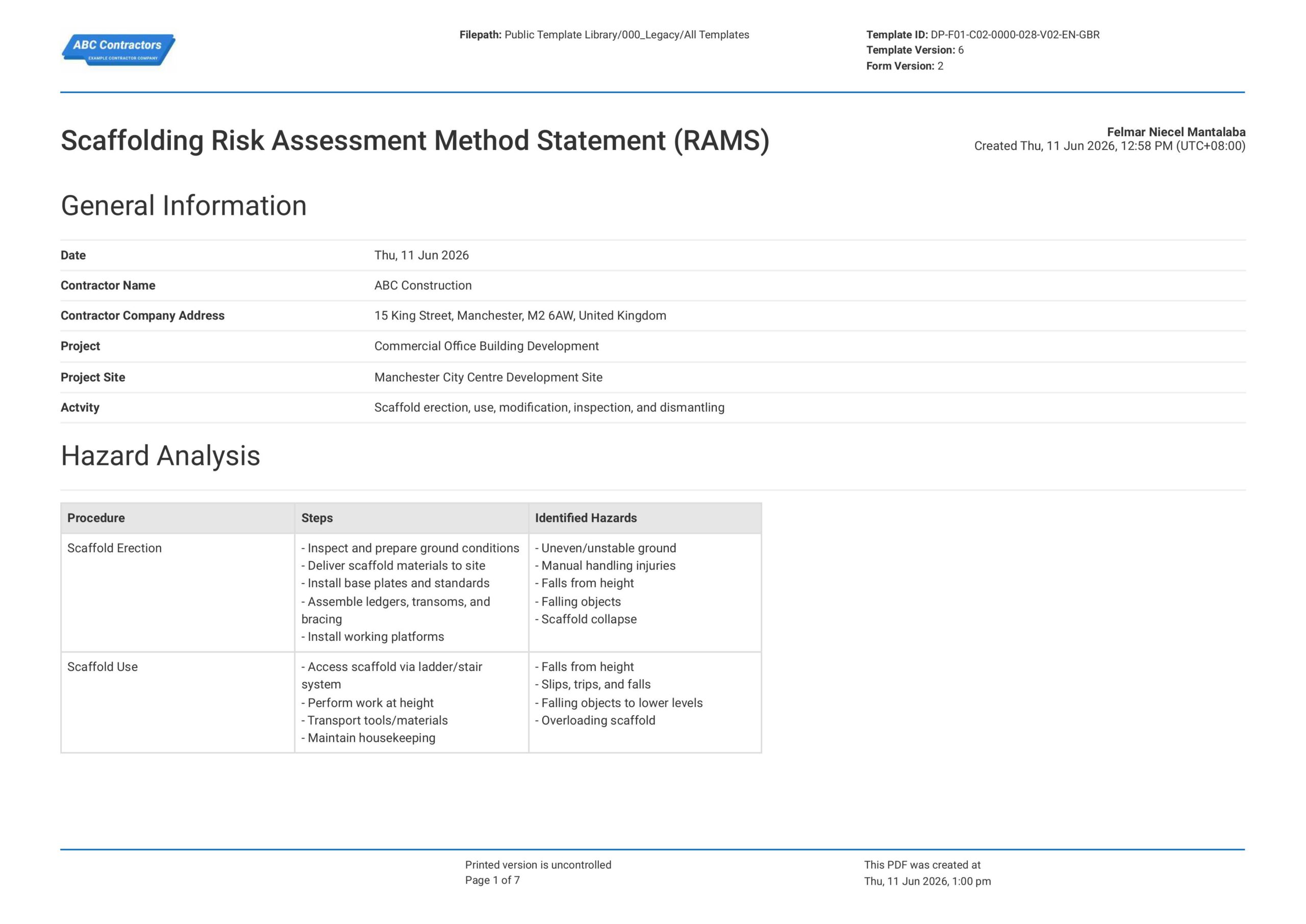
Add a general information section
These are the need fields in this section:
- Date
- Contractor
- Contractor company name
- Project
- Project Site
- Activity
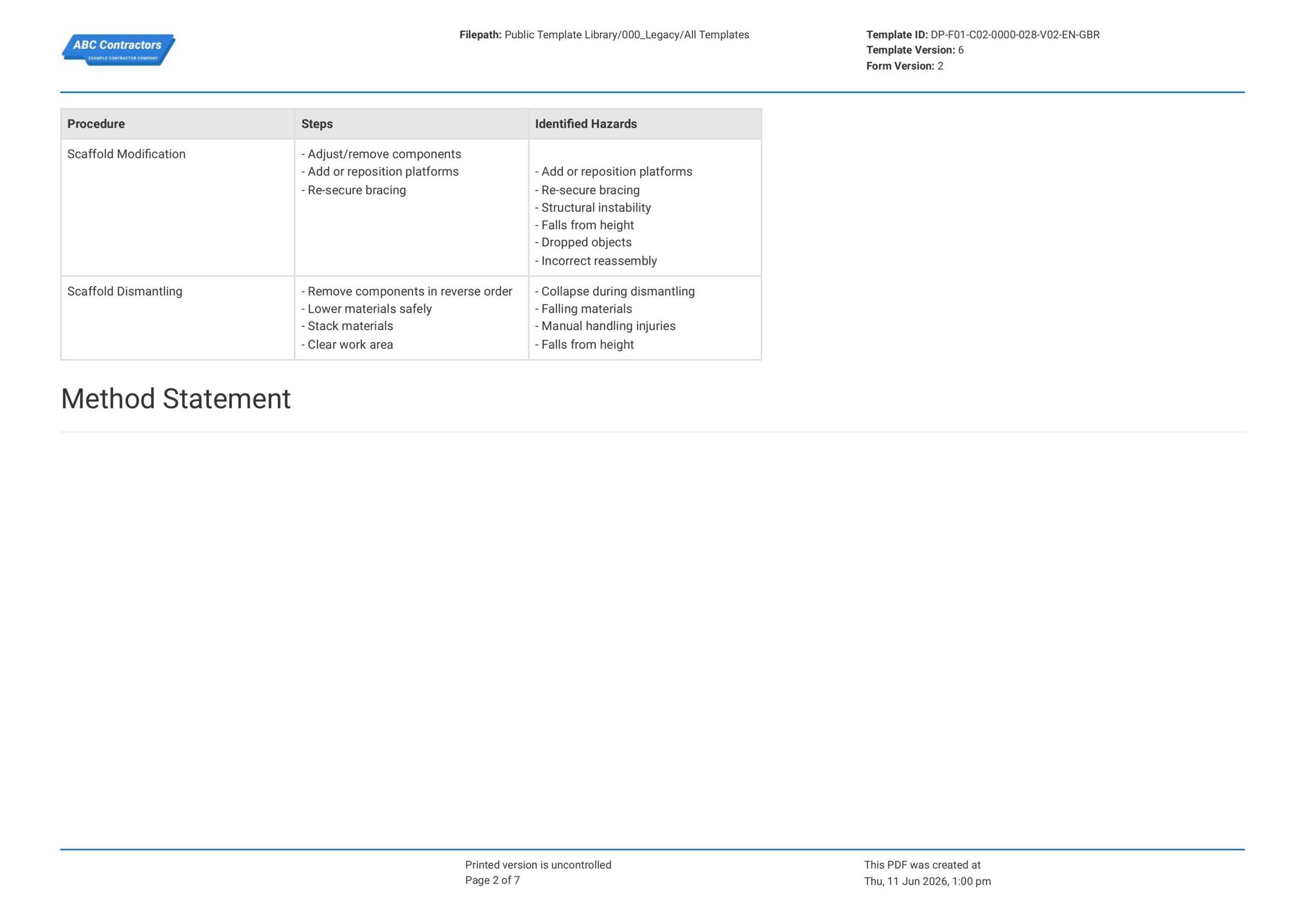
Include a hazard analysis
the following fields must be included in this section:
- Scaffolding procedures
- Steps to each procedure
- Identified hazards from each procedure.
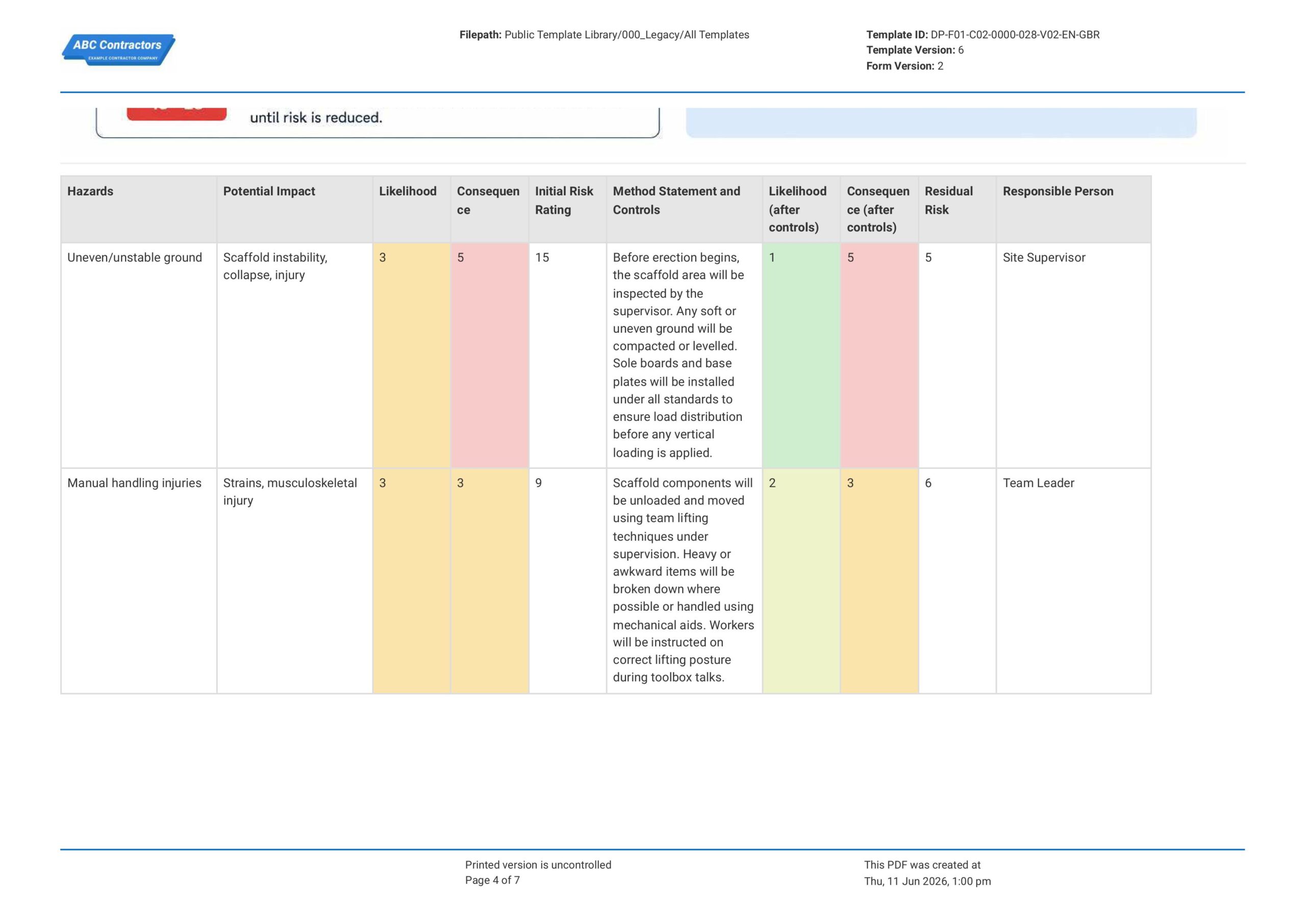
Include the method statement.
These are the main items required in this area.
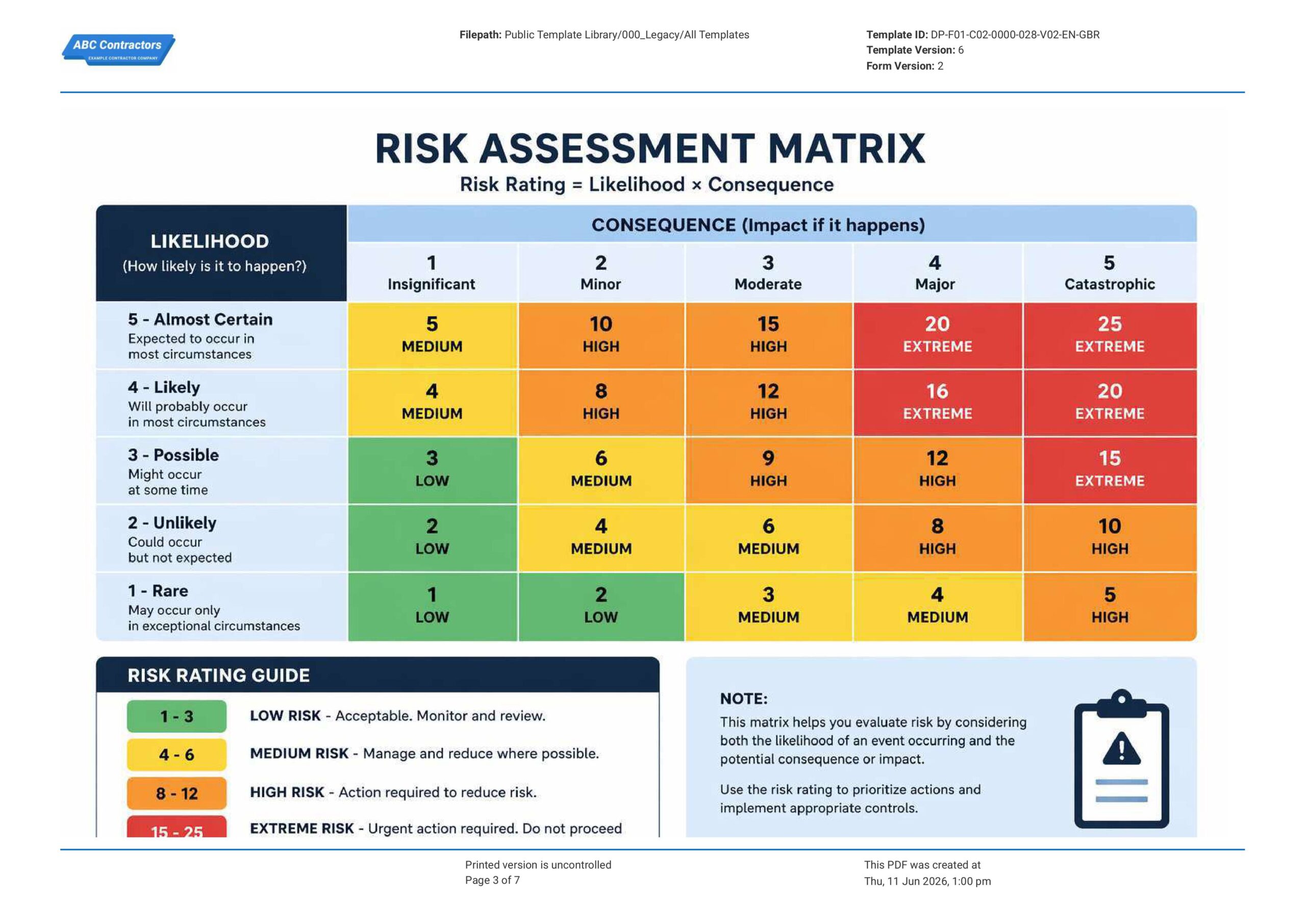
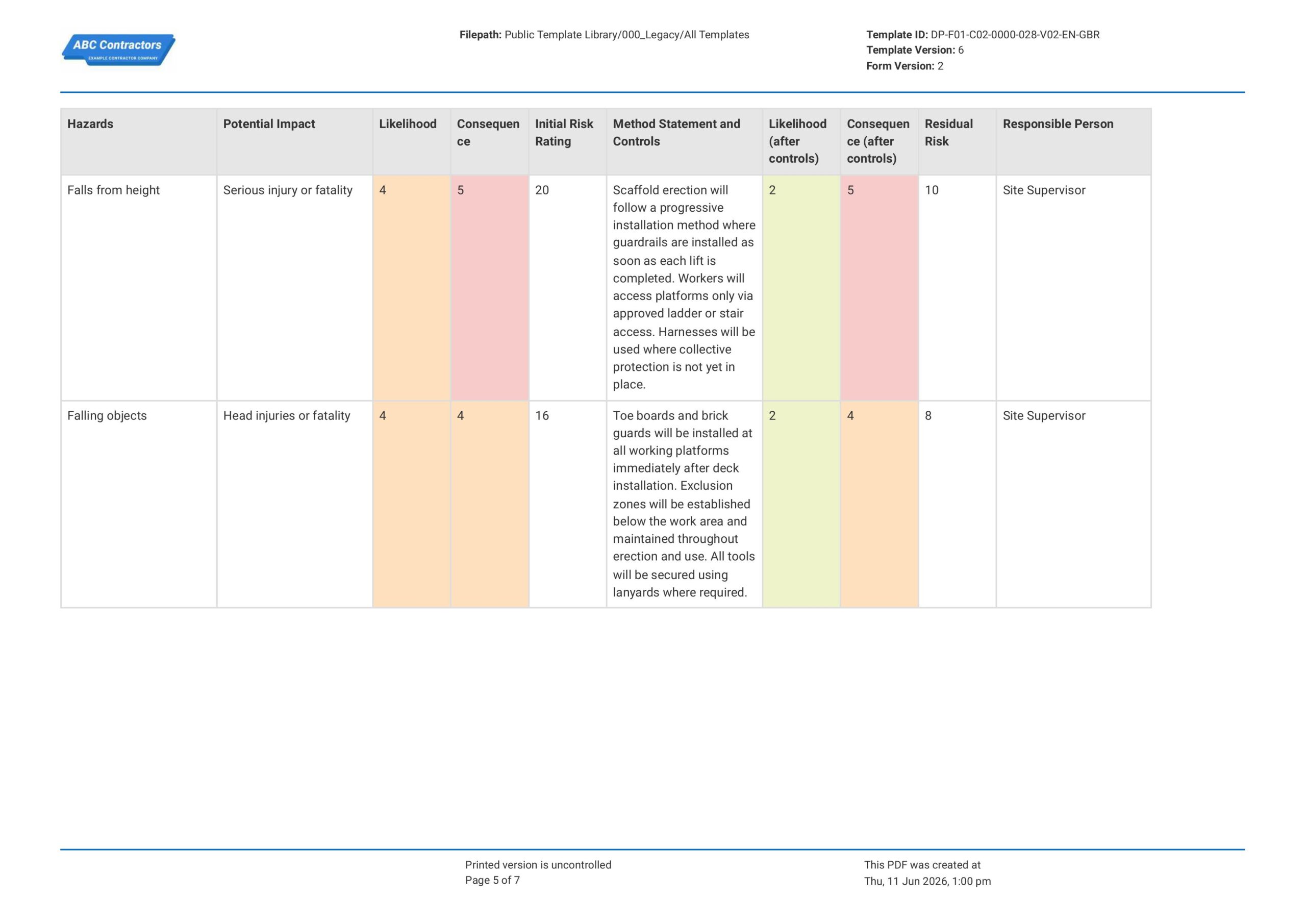
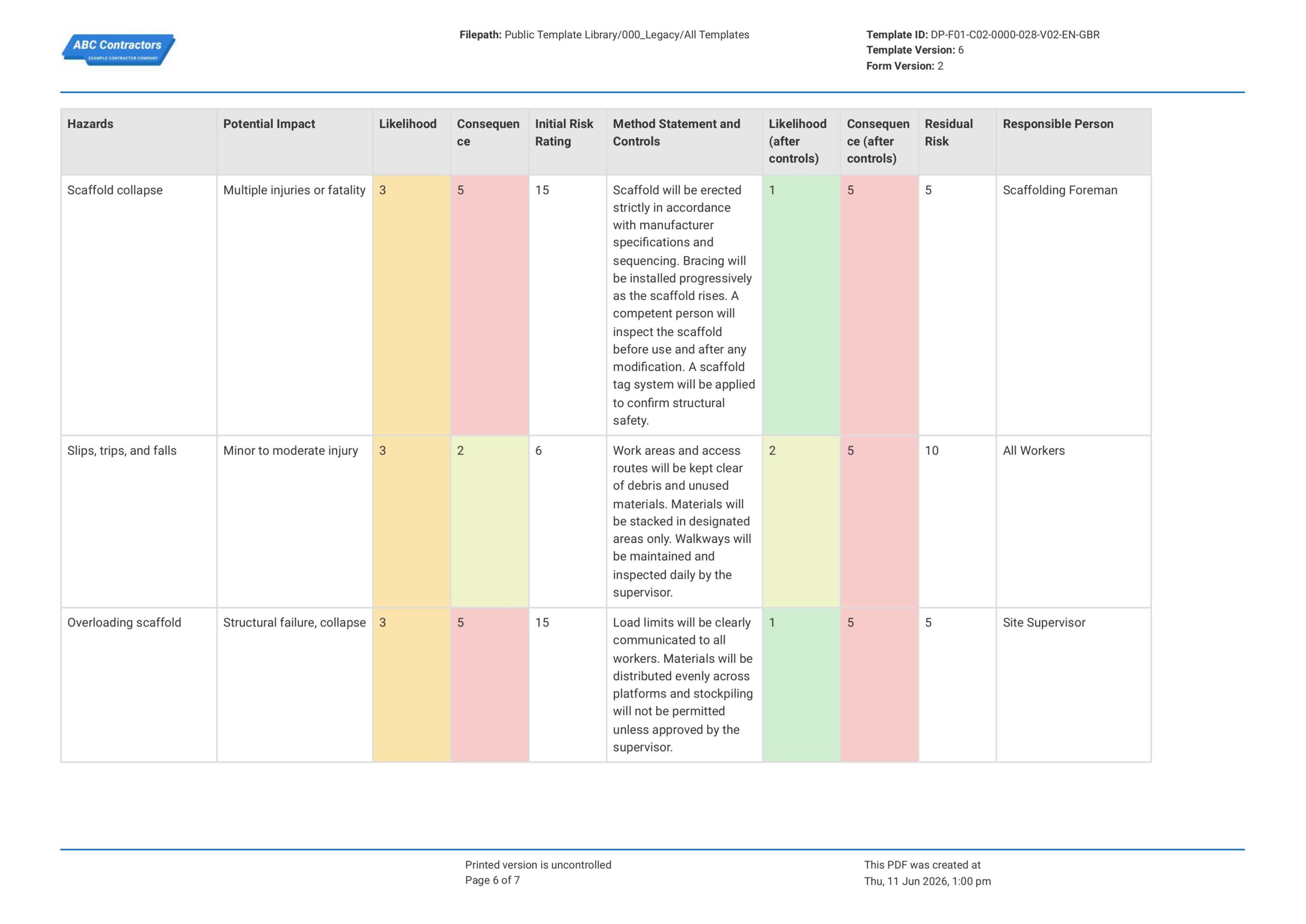
- A Risk Assessment Matrix
- A field for the detected hazards.
- A field for the probable impacts of hazards.
- A field for the possibility of hazards.
- A field for the consequences of the hazard.
- A field for the initial risk score.
- A field for the necessary control measures.
- A field for likelihood following the implementation of control measures.
- A field for the consequences of executing control measures.
- A field for the residual risk score.
- A field for responsible individuals.
Include declaration and signing
These are the key items needed in this section:
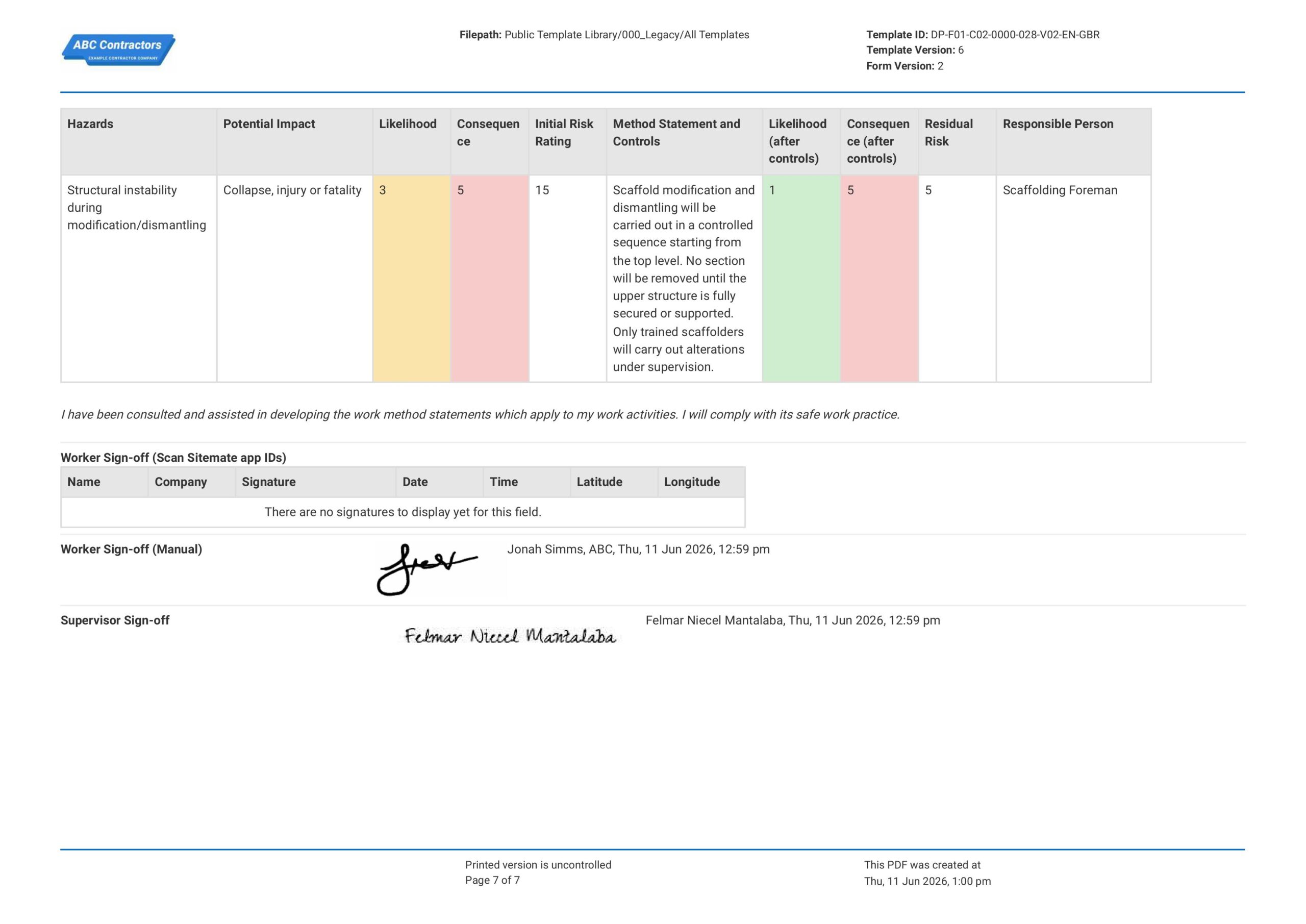
- Provide a declaration
- An attendance field for all involved employees
- Signatories to validate the Construction RAMS
Frequently asked questions
How to create Scaffolding Risk Assessment Method Statement process in an App or Software System
Digital scaffolding RAMS platforms transform traditional paper-based processes by providing real-time collaboration tools, automatic compliance checking, and mobile accessibility for field personnel. These systems eliminate common issues such as outdated documentation, incomplete assessments, and poor communication between office and site teams.
Advanced digital tools also enable predictive risk analysis by comparing current project conditions with historical incident data, automatically flagging high-risk scenarios and suggesting proven control measures. This data-driven approach significantly improves safety outcomes while reducing the administrative burden on safety professionals.
45 minutes
Medium difficulty
How to create a Scaffolding RAMS in an app
Using an app that employs digital forms instead of paper-based ones may help improve the process by:
- Assistance with artificial intelligence (AI).
- Having fewer manual data entries.
- All produced forms are stored in a single access cloud.
- Reformatting is straightforward and can be adapted to new protocols or updated standards.
- Formula integration is much more simple.
- Workflows and notifications may be automated and scheduled.
- Improved template design and look.
Creating the general information section
- Add a date field for date the RAMS was initiated
- Add a text field for Contractor name
- Add a text field for contractor company address
- Add a text field for project name
- Add a text field for project site
- Add a text field for activity
Creating the hazard analysis section
- Provide a default table element with three columns for this section. The default table element will allow users to indefinitely add more rows.
- Format the first column as a text field so users can input the procedures of the activity.
- Format the second column as a text field so users can input the steps needed to complete each procedure.
- Format the third column as a text field for the identified hazards for each procedure.
Creating the method statement (risk assessment) section
- Add a prefilled text field and upload an image of a risk assessment matrix.
- Provide a default table element with 10 columns for this section. The default table element will allow users to indefinitely add more rows.
- Format the first two columns as text fields to input the hazards and their potential impact.
- Format the third and fourth columns as selection fields, with selection items ranging from one to five. This will allow users to score the likelihood and consequence of the hazard. Each selection should be integrated with the following colors:
- 1-green
- 2-yellow-green
- 3-light orange
- 4-deep orange
- 5-red
- Format the fifth column as a formula field that automatically calculates the initial risk score. The initial risk score should be calculated by obtaining the product of the likelihood score and consequence score. Initial Risk Rating = Likelihood score x Consequence score.
- Format the sixth column as a text field to input the needed control measures.
- Format the seventh and eight columns as selection fields, with selection items ranging from one to five. This will allow users to score the likelihood and consequence of the hazard after the control measures are implemented. Each selection should be integrated with the following colors:
- 1-green
- 2-yellow-green
- 3-light orange
- 4-deep orange
- 5-red
- Format the ninth column as a formula field that automatically calculates the residual risk score. The residual risk score should be calculated by obtaining the product of the likelihood after the control measure and the consequence after the control measure score. Residual Risk Rating = Likelihood after the control measure score x Consequence after the control measure score.
- Format the last column as a text field for entering the responsible person.
Creating the attendance and signatories section
- Add a prefilled text field to create a declaration statement. You can use this declaration statement: “I have been consulted and assisted in developing the work method statements that apply to my work activities. I will comply with its safe work practices_.”_
- Provide an attendance field wherein involved members can just scan their QR codes to verify their attendance.
- Add signature fields for the required signatories.
About the author

Felmar Mantalaba
Engineering Content Writer

Education:
Cebu Institute of Technology - University - Mechanical Engineering with Mechatronics
Bio:
Felmar is a mechanical engineer, whose four years of experience in the mining industry inspired him to write and share stories to progress the revolution of new technologies and create smarter, smoother ways of living.
Project Details:
Safety, Health, and Environment Management System (SHEMS) Coordination
SHEMS Coordinator at Atlas Consolidated Mining, ensuring organizational compliance with ISO 14001 and ISO 45001 standards, performing risk assessments, developing policies, and conducting audits and inspections to maintain a safe and environmentally responsible workplace.
Maintenance Management and Optimization
Senior Maintenance Manager (OIC) leading equipment maintenance and operational efficiency initiatives, reducing downtime by 10%, improving Mean Time Between Failure (MTBF) and Mean Time To Repair (MTTR) for major equipment, and managing maintenance schedules, manpower, and materials, while overseeing capital project optimization.
Inspection Engineering and Equipment Reliability
Inspection Engineer responsible for technical blueprint interpretation, vendor collaboration, preventive maintenance scheduling, and data collection for vibration and temperature readings, delivering actionable recommendations and comprehensive reports to improve equipment reliability and operational performance.
End-to-End Operational Oversight in Mining Engineering
Contributed to multiple facets of operational management, including SHEMS compliance, maintenance optimization, inspections, and capital project evaluation, integrating safety, reliability, and efficiency improvements across all stages of copper production operations.
Version History:
Other popular templates you can use and edit for free


This form was generated with Dashpivot software
- Access, edit and complete your Scaffolding Risk Assessment Method Statement process from any device - mobile, tablet or computer.
- Print, download or send your Scaffolding Risk Assessment Method Statement process as perfectly formatted PDF documents with your company logo.
- Store your Scaffolding Risk Assessment Method Statement process securely online, where they can be searched and found in seconds
- Invite internal and external parties to see, edit and sign off on Scaffolding Risk Assessment Method Statement process online.
 English (United States)
  English (Australia)
  English (UK)
  English (New Zealand)
  English (South Africa)
  German