
Article Page – What is Approved Document M?
What is Approved Document M?
Accessibility is a growing pain in the built world. As buildings and construction methods evolve, we will also need to keep the actual users of our buildings in mind. In this article, we discuss inclusive design, accessibility requirements, and compliance to Approved Document M with free tools and resources.

Table of Contents
Article Summary
- Approved Document M (Access to and Use of Buildings) covers accessibility for any new building, and is divided into two volumes; Dwellings & Non-Dwellings.
- Wales created their own version of the Approved Document M to accommodate local needs.
- Support evidence packs such as reports and checklists, together with plans and other construction documents demonstrate compliance to Part M regulations.
Why are Approved Document M Regulations Important?
The Approved Document M Regulations are critically important to ensure any new buildings provide safe and easy access for its occupants. Officially, the Approved Document M (Part M) contains regulations on stairs, ramps, lifts, and even hallways and doorways. These features, when well-designed, help accommodate people of all kinds. Specifically, wheelchair users, those with physical impairments or those with limited mobility heavily rely on these features to safely and comfortably traverse spaces within a building.
After World War II, thousands of injured veterans returned home needing prosthetics, wheelchairs, and adapted environments.The U.S. Veterans Administration was one of the first organizations to issue design standards for accessibility and barrier-free design in housing and public buildings — particularly in the 1940s–1950s
Accessibility doesn't just benefit people with disabilities either. Well-designed ramps, lifts, and accessways provide safe and comfortable access to elderly people, children, parents with trolleys or prams, and people carrying heavy loads. For example, a ramp that’s too steep, or stairs without proper handrails increase the risks of slipping, falling or tripping, which will most likely lead to injury.
How to Demonstrate Compliance to Approved Document M
Being able to demonstrate compliance to regulations is a key part of the building regulations approval and acquiring a certificate of occupancy (also known as a Building Control Completion Certificate) in the UK. You will need to be able to prove that your building is compliant with building standards via documentary evidence. Typically, engineers prepare documents such as building design plans (floor plans, other as-built plans), design & access statements, site inspection reports, progress reports, manufacturer’s certificates, compliance reports, and other photographic evidence.
One sure fire way to show you’re building according to Approved Document M regulations is to create a compliance report focused on accessibility. A compliance report would allow you to list down all instances of compliance, based on the regulations set out in the UK Part M document itself. We’ve prepared a sample you can browse in the preview below to give you a better idea on what a good compliance report is formatted.
Free Part M Compliance Report Template
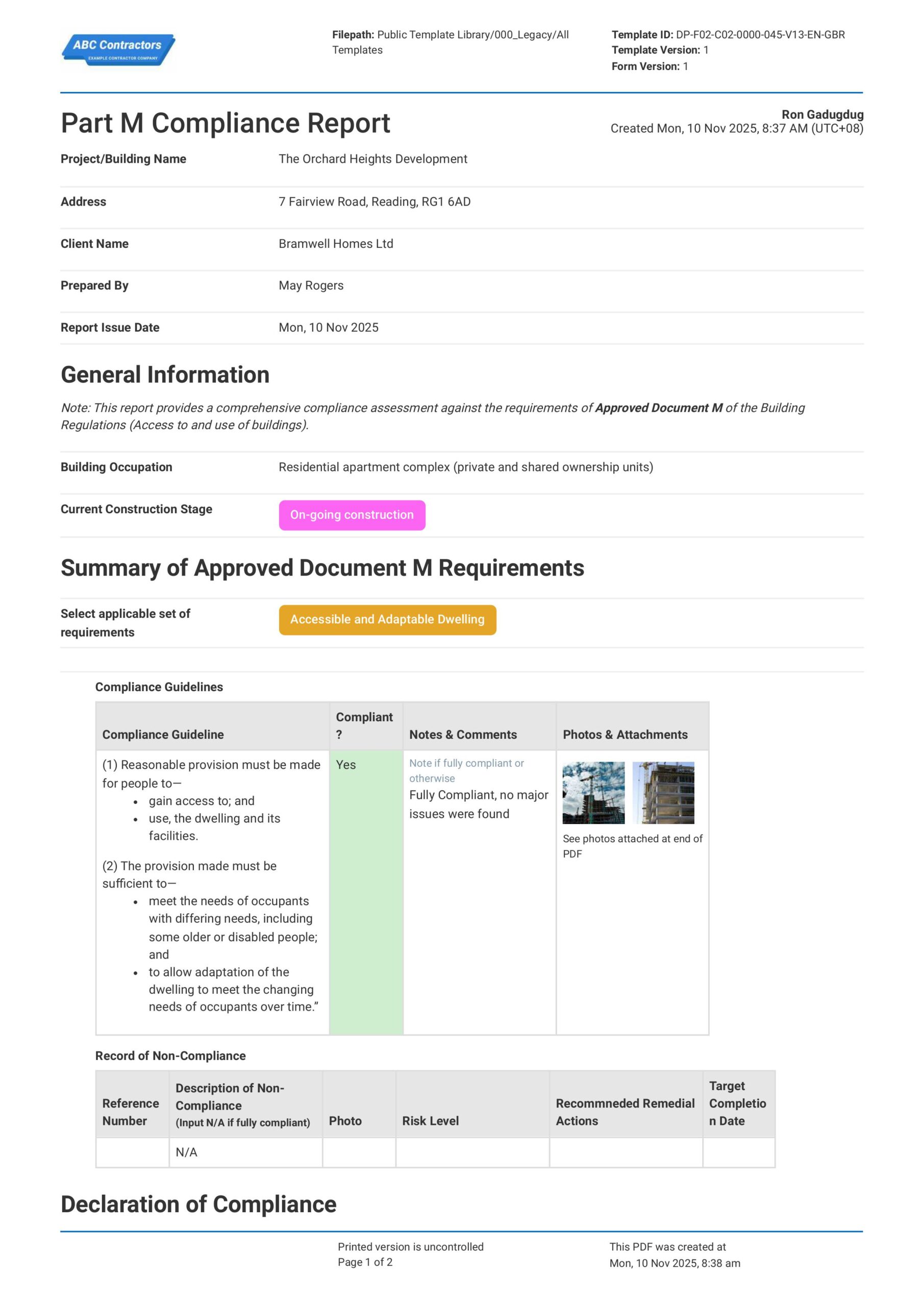
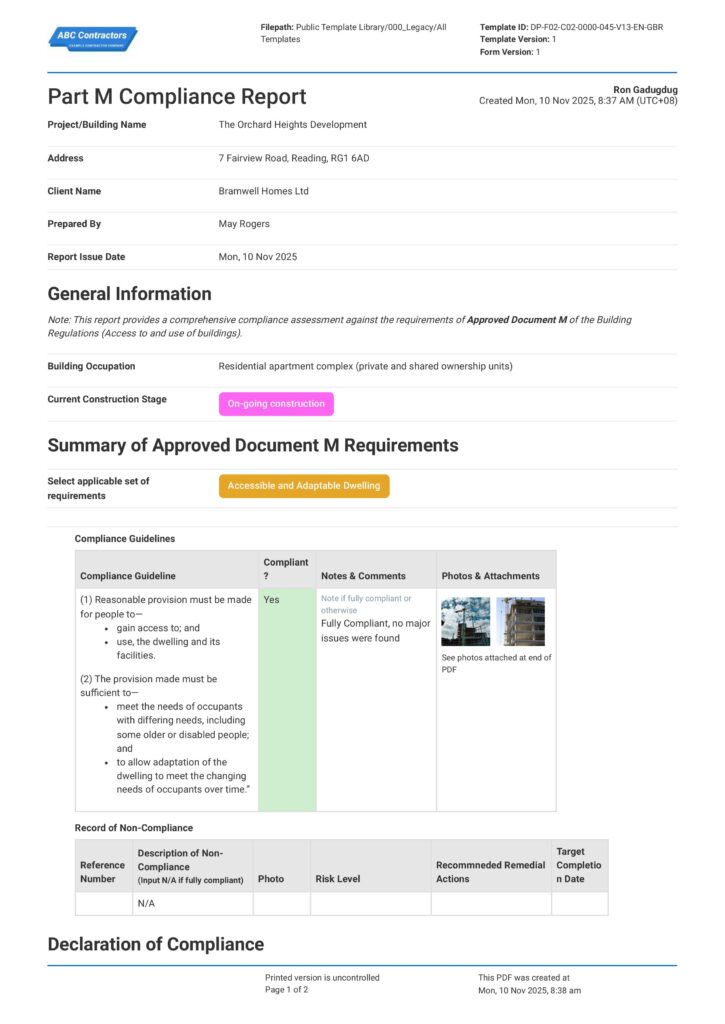
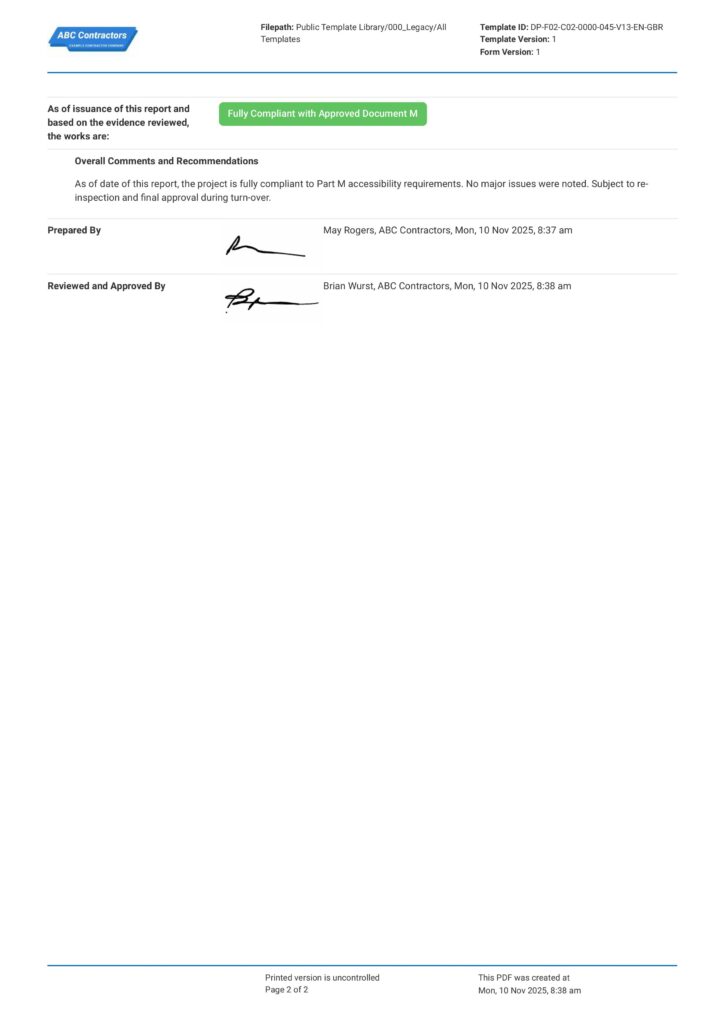
Use this Part M Compliance Report for free
What is the Approved Document M All About?
In this section, we’ll discuss some of the regulations that make up what is Approved Document M, which is formally titled “Access to and Use of Buildings”. The Building Regulations Approved Document Part M contains standards on building accessibility, of which, compliance is required for any new building in the UK. As a result, engineers use tools like Approved Document M Compliance Reports in order to stay on top of all the requirements.
Below we discuss Part M requirements for some common accessibility features:
Ramp Regulations UK Part M
Ramp Regulations UK Part M requirements include requirements on ramp gradient and geometry that primarily promote the inclusive design of these features. Typically, you may find that the general gradient requirement is a maximum gradient of 1:12 (and preferably 1:20), depending on the ramp length. Additionally, Part M requires that ramps must have well-designed handrails and must be installed along the length of the ramp. You can use this Handrail Compliance Checklist to help guide you regarding this.
You may have noticed that some ramp regulations UK Part M requirements overlap with those in Part K. However, these overlaps are well-integrated, as Part K primarily covers the safety aspect of the construction of ramps. You can check out the exact ramp requirements in this Stair & Ramp Compliance Checklist based on Part K.
Additionally, it is important to note that ramps are required to provide safe, convenient access where level entry isn’t possible. However, sometimes, ramps can be unreasonable to install, especially in cases where the vertical distance between levels is too great. In cases like these, you will want to consider other options like platform lifts or passenger lifts instead. Here are samples of a Platform Lift Inspection Checklist and a Passenger Lift Compliance Checklist you can use to guide you.
Approved Document M Door Widths
The Approved Document M regulations cover standards on accessibility of doors and entryways of a building. Primarily, these regulations benefit those with wheelchairs or limited mobility, like those using crutches, as it ensures their safety and comfortability when accessing spaces. For example, a doorway that's too thin could cause collisions and make it hard for occupants using a wheelchair to move through.
Regulations on minimum door widths are a portion of part M regulations on internal circulation. In this context, internal circulation refers to the main access ways that connect spaces within a building. Approved Document M door threshold, Approved Document M door handle height, Approved Document M effective clear widths for stair stairs and ramps, Approved Document M level threshold, and Approved Document M corridor widths are examples of other features included in the internal circulation regulations. Here's a sample form of an Internal Circulation Checklist you can use to ensure compliance with all these regulations.
Approved Document M Fire Doors
If you are familiar with the UK building regulations, you may be aware that Part B is the primary source of fire safety regulations for building design. However, part B focuses on practical guidelines for fire safety, which include building design, fire escapes, evacuation routes, etc. On the other hand, Part M ensures that these safety features are inclusive and accessible to all types of occupants such as wheelchair users, those with limited mobility, elderly, children, and even the parents with trolleys or prams.
Approved Document M Building Regulations: Dwellings and Non-Dwellings
Building Regulations Approved Document M for Dwellings
The building regulations UK Part M is divided into two volumes; Volume 1 contains regulations that are solely focused on dwellings, or residential spaces, such as houses, flats, apartment complexes, and condominiums. Specifically, these regulations ensure that these buildings are accessible and adaptable to all kinds of inhabitants such as the elderly, people with disabilities or limited mobility, wheelchair users, and even children.
These regulations are further subdivided into 3 main categories, depending on the level of safety and accessibility needed in your building:
- Category 1 – Visitable dwellings
- Category 2 – Accessible and adaptable dwellings
- Category 3 – Wheelchair user dwellings
Approved Document M of the Building Regulations for Non-Dwellings
Volume 2 of the Approved Document M focuses on buildings used other than dwellings. Buildings like schools, universities, hospitals, offices, malls, banks, theatre halls, and government buildings all fall into this category. Similar to Volume 1, these regulations ensure that occupants of all types have easy and safe access to a building, with the added complexity of it being a public or commercial space.
Approved Document M Wales Edition
In 2011, full legislative power over building regulations, energy, and sustainability in buildings was devolved to Wales under the Wales Act of 2011. Then, a couple of years later, Wales officially published their own version of each of the Approved Documents from the original UK building regulations. This allowed Welsh building regulators to accommodate specific local needs and promote Welsh policy goals on equality, health, and safety.
Despite being separate documents, the Approved Document M (England) and the Approved Document M (Wales) both cover regulations on accessibility, internal circulation, entrances, sanitary facilities, etc., with the aim of ensuring buildings feature safe and easy access to all people regardless of age or disability. However, there are some distinctions between the two documents. For example, the Welsh version of the Approved Document M doesn’t divide its regulations into two volumes. Instead, the regulations for dwellings and buildings used other than dwellings are combined into one document.
What does Access To and Use of Buildings Approved Document M Mean?
The Approved Document M (access to and use of buildings) refers to a set of regulations that promote an inclusive and accessible building design. In this context, "access" refers to the entire experience of getting into, traversing, and using facilities found within a building.
The Approved Document M (Part M) contains several regulations on accessibility features such as entrances and accessible routes, way-finding or information gathering, vertical access ways, internal circulation, and emergency route access. You can check out this Accessible Route Checklist to give you an idea of the type of regulations contained in Part M.
Approved Document M Guidance
The primary source of accessibility regulations can be found on the official Approved Document M PDF files, which can be found on the official UK government website. You will find the latest versions of volumes one and two, together with previous versions and other details regarding approved document M consultations and information on the latest changes and amendments.
What is the Approved Document M Latest Version?
The latest edition for volume one of the approved document M regulations is the 2015 edition with amendments made in 2016. This took effect on March 1, 2016 and was uploaded to the UK building regulations official website. In addition to this, a correction document, which lists the changes made in 2016, was also uploaded and published to the official website.
Next, the latest edition for volume two of the approved document M is a 2015 edition, with amendments made during 2020 and 2024. The 2015 edition came into effect on October 1, 2015 for use in England. The 2020 amendment introduced a mandatory requirement for certain large, publicly accessible buildings to include a “changing places” accessible toilet. The 2024 amendment updated some references and made changes to the original Part M regulations so it would better integrate with a newly issued Approved Document T for toilet accommodation.
Approved Document M Buildings Other than Dwellings Regulations VS Dwellings Regulations
Approved Document M Dwellings
Volume 1 of the Approved Document M applies to dwellings such as houses, flats, and apartments. The regulations are subdivided into three categories depending on the level of accessibility required for these homes. One example of a regulation in volume one is how it sets internal circulation dimensions such as minimum room and corridor widths based on the expected use of the area or space.
Approved Document M Commercial Buildings
Volume 2 of the Approved Document M applies to buildings used other than dwellings such as schools, hospitals, malls, etc. Naturally, as these spaces are subject to higher levels of foot traffic, Volume 2 regulations expand upon regulations to dwellings, and are more focused on access to buildings, circulation, the use of facilities, and sanitary accommodation. Using the same example on internal circulation, volume two set wider requirements to accommodate for higher foot, including larger turning spaces, wider corridor, and stricter requirements on sanitary facilities vertical access features.
Approved Doc M Accessible WC
The latest amendments to Volume 2 of the Approved Document M regulations were regarding accessible sanitary facilities and toilets. In this section, we discuss the importance of safe and accessible toilets and some specific requirements that you should know.
Importance of Part M Accessible WC (Water Closets) Requirements
Under the equality act of 2010, any new buildings are required to provide safe and accessible features to ensure the safety and comfort of its inhabitants. However, aside from legal requirements, compliance to Part M accessible toilet regulations create accessible sanitary facilities that allow disabled people to use toilet facilities safely and independently. The required layouts include standards on handrails, turning circles, transfer space, and fixtures, and are all intended to reduce the risks of falls strains or, worse, entrapment for users. To guide you on specific Approved Document M accessible toilet regulations, here’s an Accessible Toilet (WC) Checklist that you can review.
Part M Disabled Toilet Layout
The disabled toilet regulations UK Part M regulations on toilet rooms to be used by the disabled can be found on both volume 1 and volume 2 of the approved document M PDF file. Within, you can find specific requirements and diagrams to help you stay compliant with Part M disabled toilet layouts or Part M disabled WC layouts.
For example, Approved Document M disabled regulations include regulations on the number of WCs per floor, wall and ceiling structure, handrails, and other inclusive design features. Again, it is important to note that these requirements and standards may differ depending on the building and occupancy you are working on.
Approved Document M Bathroom
Bathrooms are another important feature in many homes across the world. To ensure the safety of inhabitants, especially those with wheelchairs or with limited mobility, building regulators also included regulations for bathrooms. For example, in the wheelchair–user dwellings category of volume 1, the WC layout is coordinated with the bathroom and internal circulation spaces, including a 1500 mm turning circle radius, to allow for full wheelchair turning.
Approved Document M Pack
An Approved Document M Pack for features like WCs, toilets, bathrooms and all other kinds of accessible features is a compiled set of all essential requirements, plans, diagrams, and standards for the construction of these sanitary facilities. Typically, this includes an overview of the requirements, essential diagrams, compliance checklists, and reports.
Streamlining Quality Inspection Tasks with Digital Tools
Technology and digital tools has been shifting the way people work for years now. But at the construction site, many engineers still use legacy forms on Word or PDF to create and store field documents. Or even worse, they still use pen and paper.
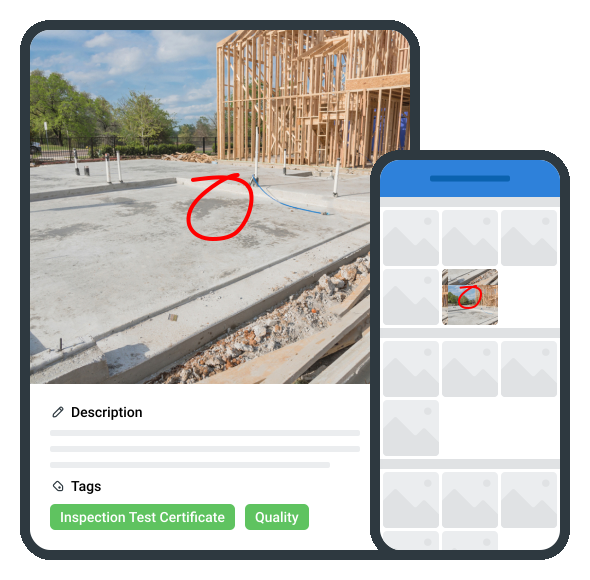
With this Inspection and Test Record App, you can evolve and take your workflow to the next level. Easily create forms, take and attach photos to documents on the spot, and send out reports for approval online. No more waiting around and dealing with that mountain of paper work, take your work digital now.
Frequently Asked Questions
Is the submission of an Approved Document M Compliance Report required?
No, the submission of an Approved Document M Compliance Report is not explicitly required. However, you are required to demonstrate compliance to Part M regulations. Engineers use a compliance report as a strong supporting evidence packet to comply with this.
How is technology improving report making and compliance inspections for Part M?
Many of today's engineers all over the world are taking advantage of digital tools like checklist, form, and report templates in order to cut down on paper-work, time they spend on actual engineering, deisgn, and supervision work.
Does Sitemate offer templates for Part M compliance?
Yes - Sitemate offers all kinds of checklist and report templates to help you and your team comply with Part M regulations. Looking for templates to help with another part of the UK Building Regulations? We've got that too.
Related resources

Part M Accessible Route Checklist
Conveniently check if accessibility routes comply with Part M requirements by reviewing gradients, surfaces, and access features.

Part M Internal Circulation Checklist
Ensure buildings meet Part M internal circulation requirements for corridors, doorways, and movement spaces.
Site-Specific Risk AssessmentPart M Accessible Toilet (WC) Checklist
Verify compliance with accessible toilet standards by reviewing WC layout with this Part M focused checklist.
Sitemate builds best in class tools for built world companies.


 English (United States)
  English (Australia)
  English (UK)
  English (New Zealand)
  English (South Africa)
  German