Free Field Reporting template
Geotechnical Engineering Report for Borehole Yield Test Template
No credit card required.
Need a complete Geotechnical Engineering Report for Borehole Yield Test you can still make your own? This template comes pre-written with the key sections geotechnical engineers and field teams need to document borehole location and construction details, record yield test data including pumping rates and water level drawdown, capture soil and aquifer descriptions, and present findings and recommendations in a format that holds up against project specifications and hydrogeological investigation standards. You can edit any part of it to match your company's reporting conventions, site conditions, drilling methodology, or client requirements, and the document will still reflect the structured, professional output expected in a geotechnical report.
This Geotechnical Engineering Report for Borehole Yield Test is an easy-to-use form that your field teams and geotechnical engineers can use to record borehole construction details, log yield test procedures and pumping parameters, document water level measurements at timed intervals, capture aquifer performance data, and compile findings into a structured report ready for client delivery or project records. It lets them work through a ready-to-use reporting framework covering site description, borehole specifications, test methodology, field observations, data tables, and engineering conclusions — all in a single, exportable document.
- 100% fully editable Geotechnical Engineering Report for Borehole Yield Test
- Export your Geotechnical Engineering Report for Borehole Yield Test to PDF or CSV
- Access your Geotechnical Engineering Report for Borehole Yield Test on mobile, tablet or computer
- Thousands of templates including other Field Reporting templates
 Click to preview
Trusted by thousands of companies, projects & teams worldwide















See how this Geotechnical Engineering Report for Borehole Yield Test compares to traditional Word, Excel, and PDF-based processes
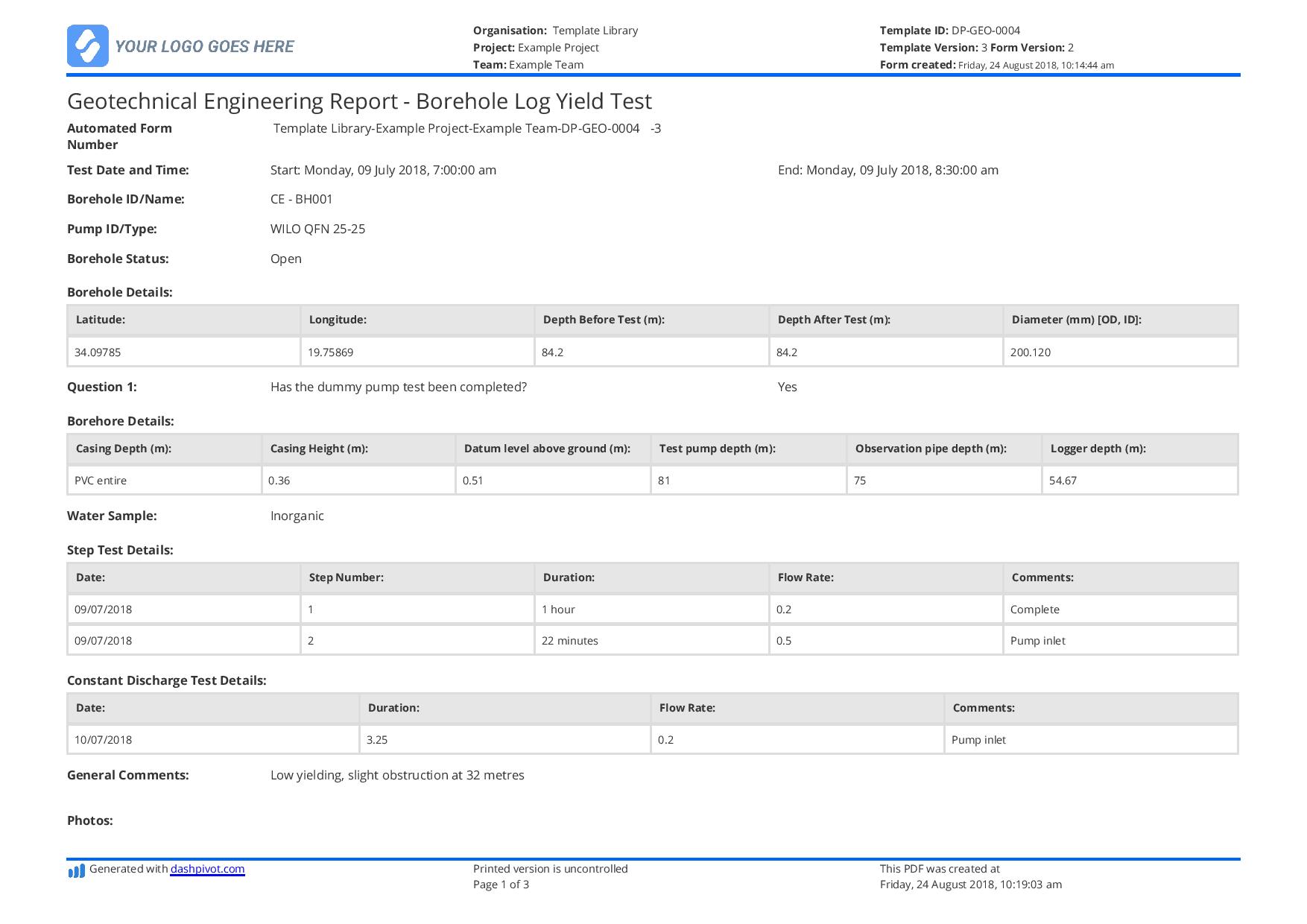
Curious how this Geotechnical Engineering Report for Borehole Yield Test works? Check out the example below to see exactly what the completed document looks like, from borehole construction details and pumping test data tables through to engineering conclusions and recommendations. You can generate your own version just as quickly, export it as a custom form with your company branding and project details, and have a finished, professional Geotechnical Engineering Report for Borehole Yield Test ready for client delivery or project records in a matter of minutes.

This Geotechnical Engineering Report for Borehole Yield Test Sample Was Generated With Dashpivot
This Geotechnical Engineering Report for Borehole Yield Test template was generated using Dashpivot's field reporting platform, which allows geotechnical engineering teams to create structured investigation reports with data tables, photo attachments, e-signatures, and automatic PDF export built in. The template is designed to capture both field data and engineering interpretation in a single, auditable document that can be completed on site or in the office.
- Access, edit and complete your Geotechnical Engineering Report for Borehole Yield Test from any device - mobile, tablet or computer.
- Print, download or send your Geotechnical Engineering Report for Borehole Yield Test as perfectly formatted PDF documents with your company logo.
- Store your Geotechnical Engineering Report for Borehole Yield Test securely online, where they can be searched and found in seconds
- Invite internal and external parties to see, edit and sign off on Geotechnical Engineering Report for Borehole Yield Test online.
Need a version for your own site?
Storm, the AI agent in Dashpivot, can build one from a short description or the form you already use.


 GLOBAL


Template guide
Learn More About the Geotechnical Engineering Report for Borehole Yield Test
What is a Geotechnical Engineering Report for Borehole Yield Test?
What Is a Geotechnical Engineering Report for a Borehole Yield Test?
A Geotechnical Engineering Report for a Borehole Yield Test is a formal technical document produced by geotechnical engineers or hydrogeologists following the completion of a borehole yield test on a site. This type of geotechnical report documents the full scope of the investigation, including borehole construction details, the pumping test methodology used, water level drawdown and recovery measurements taken at timed intervals, calculated yield values, and an engineering interpretation of the aquifer's performance and sustainable supply capacity. The report is used to inform decisions around groundwater extraction, construction dewatering, water supply feasibility, and infrastructure planning.
Borehole yield testing is a critical component of preliminary geotechnical investigation and soil geotechnical reporting on projects where groundwater conditions are a key design consideration. The test involves pumping water from a borehole at a controlled rate while monitoring the drop in water level over time, then recording the recovery once pumping ceases. The resulting data is used to calculate the specific capacity of the borehole, estimate aquifer transmissivity, and determine whether the groundwater source can sustain the required extraction rate. Without a properly structured geotechnical report capturing these findings, the raw field data has limited value for engineering design, regulatory compliance, or client sign-off.
Geotechnical engineering reports for borehole yield tests are commonly required on construction, mining, agricultural, municipal water supply, and infrastructure projects across the US and internationally. They may be required as part of a preliminary geotechnical investigation, as a standalone hydrogeological assessment, or as supporting documentation for permitting and environmental review. A well-structured soil geotechnical report covering borehole yield test findings gives project teams, clients, and regulators the confidence that groundwater conditions have been properly assessed and that the recommended design parameters are based on reliable field evidence.
Applicable Standards and Policies for Geotechnical Engineering Report for Borehole Yield Test
Geotechnical Engineering Reports for Borehole Yield Tests must align with applicable geotechnical investigation standards, groundwater testing guidelines, and jurisdictional regulatory requirements. While exact requirements vary by project type, location, and client specification, the following standards and frameworks are commonly referenced:
- ASTM D4050 – Standard Test Method for (Field Procedure for) Withdrawal and Injection Well Tests for Determining Hydraulic Properties of Aquifer Systems: The primary ASTM standard governing pumping test procedures in the US, informing how yield test data is collected and reported in a geotechnical report.
- ASTM D4105 – Standard Test Method for (Analytical Procedure for) Determining Transmissivity and Storage Coefficient of Nonleaky Confined Aquifers by the Modified Theis Nonequilibrium Method: Provides the analytical framework for interpreting borehole yield test data captured in the geotechnical engineering report.
- ASTM D4106 – Standard Test Method for (Analytical Procedure for) Determining Transmissivity and Storage Coefficient of Nonleaky Confined Aquifers by the Theis Recovery Method: Covers recovery analysis procedures referenced in yield test reporting.
- ASTM D5784 / D5785 – Standard Guides for Selection of Drilling Methods for Environmental Site Characterization: Informs borehole construction documentation included in a soil geotechnical report.
- US EPA Groundwater and Drinking Water Standards: May apply where borehole yield testing supports water supply or contamination investigation work subject to federal oversight.
- State-level well construction and groundwater permitting regulations: Many US states require geotechnical reports and yield test documentation to accompany well construction permits, with specific formatting and data requirements that vary by jurisdiction.
- ASCE 7 and relevant geotechnical design standards: Where yield test findings inform foundation or dewatering design, the geotechnical engineering report must align with applicable structural and geotechnical design standards.
- Client or project-specific geotechnical investigation specifications: Engineering firms, government agencies, and project owners frequently issue their own geotechnical report format requirements that must be followed alongside published standards.
Staff Members and Parties That Use the Geotechnical Engineering Report for Borehole Yield Test
A Geotechnical Engineering Report for a Borehole Yield Test is prepared and used by a range of technical and project personnel across the geotechnical investigation lifecycle. Here are the key staff members and parties typically involved:
- Geotechnical Engineers: The primary authors of the geotechnical report, responsible for designing the yield test program, supervising field activities, interpreting pumping test data, and producing the final engineering conclusions and recommendations.
- Hydrogeologists: Often involved where the borehole yield test is focused on groundwater supply assessment, aquifer characterisation, or water resource evaluation, contributing specialist interpretation to the geotechnical engineering report.
- Field Technicians and Drillers: Responsible for executing the borehole construction, operating pumping equipment, and recording field measurements including water level drawdown and pumping rate data that feed directly into the geotechnical report.
- Project Managers: Use the geotechnical report to track investigation progress, manage deliverable timelines, and communicate findings to clients and stakeholders.
- Clients and Asset Owners: Receive the completed geotechnical engineering report as the primary evidence base for groundwater-related design decisions, permitting applications, and project feasibility assessments.
- Regulatory and Permitting Authorities: May require submission of the geotechnical report as part of well construction permits, environmental impact assessments, or groundwater extraction licence applications.
Business Risks Reduced by the Geotechnical Engineering Report for Borehole Yield Test
Inadequate Documentation of Groundwater Conditions
- Without a structured geotechnical report, borehole yield test data may be incomplete, inconsistently recorded, or impossible to audit after the field investigation is complete.
- Missing pumping rates, drawdown measurements, or recovery data can invalidate the investigation and require costly remobilisation to site.
Non-Compliance with Regulatory and Client Requirements
- Geotechnical reports that fail to meet ASTM standards, state well regulations, or project-specific geotechnical investigation specifications risk rejection by regulators or clients.
- Non-compliant reporting can delay permitting, block project approvals, and expose the engineering firm to professional liability.
Poor Engineering Decisions Based on Unreliable Data
- Unstructured or informal yield test records increase the risk of misinterpreted aquifer data, leading to incorrect sustainable yield estimates and poorly designed dewatering or water supply systems.
- Errors in the geotechnical engineering report can result in infrastructure failures, construction complications, or water supply shortfalls with significant cost implications.
Reputational Risk for Engineering Firms
- Geotechnical reports that are poorly formatted, missing key sections, or inconsistent with industry standards reflect poorly on the engineering firm and can damage client relationships and future tender opportunities.
- A professional, complete geotechnical engineering report sample delivered consistently builds credibility and repeat business.
Business Opportunities Created by the Geotechnical Engineering Report for Borehole Yield Test
Faster Report Turnaround and Field Efficiency
- A pre-structured Geotechnical Engineering Report for Borehole Yield Test reduces the time engineers and field teams spend formatting and assembling reports from scratch after each investigation.
- Standardised data capture in the field means information flows directly into the report, reducing transcription time and the risk of data loss.
Improved Quality and Consistency Across Projects
- Using a consistent geotechnical report template across investigations ensures that all key sections, data fields, and engineering conclusions are covered every time, regardless of which engineer or technician is completing the report.
- Consistent, high-quality geotechnical engineering report samples strengthen the firm's professional reputation and support quality management system (QMS) compliance.
Stronger Tender and Prequalification Competitiveness
- Engineering firms that can demonstrate a structured, professional approach to geotechnical reporting, backed by a clear geotechnical engineering report sample PDF, are better positioned in competitive tender processes.
- Clients increasingly expect digital, auditable field reporting as evidence of a firm's technical capability and project management maturity.
Easier Compliance with Permitting and Regulatory Submissions
- A well-designed geotechnical report template makes it straightforward to produce documentation that meets state well permitting requirements, environmental review submissions, and groundwater licensing applications.
- Reduced back-and-forth with regulatory authorities on report format or missing data saves time and project cost.
What Should a Geotechnical Engineering Report for a Borehole Yield Test Include?
A complete Geotechnical Engineering Report for a Borehole Yield Test should be structured to capture all field data, test parameters, and engineering interpretations required for informed groundwater decision-making. While the exact format may vary by project and jurisdiction, the following core sections and elements are typically required:
Project and Site Information
- Project name, client name, and site address or coordinates
- Date of investigation and report preparation date
- Name and qualifications of the supervising geotechnical engineer or hydrogeologist
- Site access details and general site description
Borehole Construction Details
- Borehole ID, location coordinates, and ground surface elevation
- Drilling method, drill rig type, and drilling contractor details
- Borehole diameter, depth, and casing specifications
- Screen and filter pack details, grout seal design, and development method
- Borehole completion diagram or schematic
Yield Test Methodology
- Type of yield test conducted (step drawdown, constant rate, or airlift test)
- Pumping equipment specifications including pump type, capacity, and installation depth
- Test duration, pumping rate(s), and measurement intervals
- Water level measurement method and instrumentation used
Field Data and Measurements
- Time-drawdown data table with water level readings at specified intervals
- Time-recovery data table following pumping cessation
- Pumping rate measurements and any variations recorded during the test
- Field observations including turbidity, colour, odour, and water quality indicators
Data Analysis and Engineering Interpretation
- Specific capacity calculation
- Transmissivity and hydraulic conductivity estimates where applicable
- Sustainable yield recommendation with supporting rationale
- Comparison with local aquifer performance data or regional hydrogeological context
Conclusions and Recommendations
- Summary of key findings from the geotechnical investigation
- Engineering recommendations for pump selection, well design, or dewatering system
- Limitations of the investigation and recommendations for further testing if required
- Engineer's signature, registration details, and report date
How to Create a Geotechnical Engineering Report for a Borehole Yield Test
Building a complete and professional Geotechnical Engineering Report for a Borehole Yield Test requires a clear structure that covers both field data capture and engineering interpretation. The following steps walk you through how to create one from scratch.
Before creating your Geotechnical Engineering Report for a Borehole Yield Test, gather the following information and materials:
- Project brief, client specifications, and any geotechnical investigation scope of works documents
- Borehole location coordinates, site plans, and ground surface elevation data
- Drilling contractor records including borehole construction logs, casing specifications, and completion diagrams
- Pumping equipment specifications including pump model, capacity, and installation depth
- Field datasheets with time-drawdown and time-recovery measurements recorded during the yield test
- Any applicable ASTM standards, state well regulations, or client-specified geotechnical report format requirements
- Regional hydrogeological data or previous geotechnical reports from nearby investigations for comparison
Step 1: Add Project and Site Information
Begin your Geotechnical Engineering Report for Borehole Yield Test with a general information section that establishes the context for the investigation. Include the following fields:
- Project name and project number
- Client name and contact details
- Site address or GPS coordinates
- Date of field investigation
- Report preparation date
- Name, qualifications, and registration number of the supervising geotechnical engineer or hydrogeologist
- Name of drilling contractor
- Brief site description including topography, land use, and access conditions
Step 2: Document Borehole Construction Details
Record the full borehole construction specification so the report provides a complete technical record of the installed well. Include the following:
- Borehole ID and unique reference number
- Borehole location coordinates and datum
- Ground surface elevation (AHD or relevant datum)
- Drilling method (e.g., rotary air blast, mud rotary, cable tool)
- Total borehole depth and diameter
- Casing material, diameter, and installation depth
- Screen type, slot size, and screened interval
- Filter pack specification and placement depth
- Grout seal design and grouted interval
- Borehole development method and duration
- Borehole completion schematic or diagram
Step 3: Record Yield Test Methodology
Document the yield test design and equipment so the investigation can be reproduced or audited. Include the following:
- Type of yield test conducted (step drawdown test, constant rate test, airlift test, or other)
- Pump type, model, and rated capacity
- Pump installation depth below ground surface
- Discharge measurement method (e.g., flow meter, bucket and stopwatch, orifice plate)
- Water level measurement method (e.g., electric dip meter, pressure transducer, data logger)
- Reference datum for water level measurements
- Test duration and pumping rate(s) applied at each step
- Measurement intervals used during pumping and recovery phases
Step 4: Enter Field Data Tables
Present the raw field data from the yield test in structured tables. This is the core evidentiary section of the geotechnical report. Include the following:
- Time-drawdown data table: elapsed time, clock time, measured water level depth, drawdown from rest level
- Pumping rate log: recorded discharge rate at each measurement interval
- Time-recovery data table: elapsed time since pump off, measured water level depth, residual drawdown
- Field observations log: water colour, turbidity, odour, weather conditions, and any anomalies noted during the test
- Photographs of borehole setup, pumping equipment, and field conditions
Step 5: Present Data Analysis and Engineering Interpretation
This section converts the raw field data into engineering findings. Complete the following:
- Calculate the specific capacity of the borehole (yield divided by drawdown) for each pumping step
- Plot time-drawdown and time-recovery curves
- Estimate aquifer transmissivity using the Theis or Cooper-Jacob method where appropriate
- Assess borehole efficiency and identify any evidence of well loss or aquifer dewatering
- Compare findings with regional hydrogeological data or nearby borehole records
- Identify the sustainable yield for the recommended pump setting depth
Step 6: Write Conclusions, Recommendations, and Engineer Sign-Off
Complete the Geotechnical Engineering Report for Borehole Yield Test with a conclusions and recommendations section and the required professional certification. Include the following:
- Summary of key findings from the borehole yield test investigation
- Recommended sustainable yield and pump installation depth
- Recommendations for pump selection, well head protection, and operational monitoring
- Any limitations of the investigation, including short test duration or single-borehole testing constraints
- Recommendations for additional investigation if data is inconclusive
- References to applicable standards and guidelines (e.g., ASTM D4050)
- Engineer's name, professional registration number, signature, and date of report
- Space for client or project manager acknowledgement if required
Why Digital Field Reporting Improves Geotechnical Reports for Borehole Yield Tests
Traditional approaches to preparing a Geotechnical Engineering Report for a Borehole Yield Test typically involve field technicians recording drawdown data on paper datasheets, which are then manually transcribed into a Word or Excel document back in the office. This two-step process introduces transcription errors, creates version control problems, and adds hours of non-billable formatting time to every investigation. When a project requires multiple boreholes or repeated test cycles, these inefficiencies compound quickly and can delay final report delivery to the client.
Digital field reporting tools allow geotechnical teams to capture borehole yield test data directly on a mobile device during the test, with time-stamped water level readings, pumping rate entries, and field observations recorded in structured data fields that feed automatically into the geotechnical report template. This eliminates the transcription step entirely and ensures the raw field data is preserved in an auditable, searchable format. Engineers can then review and annotate the data from any location, run analysis, and produce a polished geotechnical engineering report PDF for client delivery without rebuilding the document structure from scratch. For firms managing multiple concurrent geotechnical investigation projects, this capability is the difference between reports that ship on time and investigations that sit in a backlog waiting for someone to find time at a desk.
How to Create Your Geotechnical Engineering Report for Borehole Yield Test in an App or Software System
A structured geotechnical investigation process for borehole yield testing moves through clear phases: pre-investigation planning, field data collection during the pumping and recovery test, data analysis back at the office, and final report production and delivery. When this process relies on paper datasheets and manual report assembly, information gets lost between phases, transcription errors accumulate, and engineers spend hours reformatting raw data into a presentable geotechnical report rather than focusing on the interpretation that adds real value to the project.
Digital tools that connect field data capture directly to the geotechnical report template compress the time between investigation and report delivery significantly. Field technicians enter time-drawdown readings into a structured mobile form during the test, with automatic timestamping and data validation reducing errors at the source. Engineers can access the field data remotely, add their analysis and conclusions, and produce a final geotechnical engineering report PDF that is consistent, complete, and ready for client delivery without a full rebuild in Word. For firms running multiple concurrent geotechnical investigation projects, this kind of connected field-to-report workflow is what makes it possible to scale output without scaling headcount.
Step 1: Build the Project Information Section in Your Reporting App
Start your digital Geotechnical Engineering Report for Borehole Yield Test by creating a general information section at the top of the form. Use simple input fields that are quick to complete on a mobile device in the field:
- Text field or automatic form counter for Report Reference Number
- Date selector field for Date of Investigation
- Date selector field for Report Date
- Text fields for Project Name, Project Number, and Client Name
- Text field or map pin field for Site Address or GPS Coordinates
- Text field for Supervising Engineer Name and Qualifications
- Text field for Drilling Contractor Name
- Multi-line text field for Site Description
Step 2: Create Sections for Borehole Construction and Test Methodology
Build structured sections for the technical specification data that frames the yield test investigation. Use a combination of text fields, dropdown selectors, and number fields:
- Dropdown selector for Drilling Method (options: Rotary Air Blast, Mud Rotary, Cable Tool, Sonic, Other)
- Number fields for Borehole Depth, Borehole Diameter, and Casing Installation Depth
- Text fields for Casing Material, Screen Type, Screen Slot Size, and Screened Interval
- Text fields for Filter Pack Specification and Grout Seal Details
- Dropdown selector for Yield Test Type (options: Step Drawdown, Constant Rate, Airlift, Recovery Only, Other)
- Number fields for Pump Installation Depth, Pumping Rate, and Test Duration
- Dropdown selector for Water Level Measurement Method
- Photo upload field for Borehole Completion Diagram
Step 3: Add Data Tables for Field Measurements
Create the core data capture tables for time-drawdown and time-recovery readings. Use repeatable table elements so field technicians can add as many rows as needed during the test:
- Time-Drawdown Table: columns for Elapsed Time (min), Clock Time, Water Level Depth (m), and Drawdown (m)
- Pumping Rate Log Table: columns for Elapsed Time (min) and Measured Discharge Rate (L/s or m³/hr)
- Time-Recovery Table: columns for Elapsed Time Since Pump Off (min), Water Level Depth (m), and Residual Drawdown (m)
- Multi-line text field for Field Observations (colour, turbidity, odour, weather, anomalies)
- Photo upload fields for site photographs and equipment setup images
Step 4: Add Analysis Summary, Conclusions, and Engineer Sign-Off
Complete the digital geotechnical report form with analysis outputs, engineering recommendations, and professional certification fields:
- Number fields for Specific Capacity at each pumping step (auto-calculate where possible: yield ÷ drawdown)
- Text or number fields for Estimated Transmissivity and Hydraulic Conductivity
- Multi-line text field for Engineering Interpretation and Aquifer Assessment
- Multi-line text field for Sustainable Yield Recommendation with supporting rationale
- Multi-line text field for Conclusions and Recommendations
- Multi-line text field for Investigation Limitations
- Text field for References to applicable standards (pre-fill with ASTM D4050 and relevant state regulations)
- E-signature field for Supervising Geotechnical Engineer with automatic date and time stamp
- Text field for Engineer's Professional Registration Number
- Optional e-signature field for Client or Project Manager Acknowledgement
Frequently Asked Questions
What is a geotechnical engineering report?
A geotechnical engineering report is a formal technical document produced by a geotechnical engineer or hydrogeologist that presents the findings of a subsurface investigation, including soil and rock conditions, groundwater characteristics, and engineering recommendations for design and construction. For a borehole yield test, the geotechnical report specifically documents pumping test methodology, time-drawdown data, aquifer performance analysis, and sustainable yield recommendations. It serves as the primary evidence base for groundwater-related design decisions, regulatory submissions, and project feasibility assessments.
What does a geotechnical engineering report sample include?
A geotechnical engineering report sample for a borehole yield test typically includes sections covering project and site information, borehole construction details, yield test methodology, field data tables with time-drawdown and recovery measurements, specific capacity and transmissivity calculations, and engineering conclusions with sustainable yield recommendations. Most geotechnical report samples also include a borehole completion diagram, field photographs, references to applicable standards such as ASTM D4050, and the supervising engineer's professional certification and signature. Reviewing a geotechnical engineering report sample or geotechnical engineering report PDF before preparing your own is a practical way to confirm your document covers all required sections.
What is the difference between a soils report and a geotechnical report?
A soils report and a geotechnical report are terms that are often used interchangeably, but a soil geotechnical report typically focuses specifically on soil classification, bearing capacity, and foundation design parameters derived from laboratory testing and in-situ tests like SPT or CPT. A geotechnical report is a broader term that can cover any subsurface investigation, including groundwater assessment, rock characterisation, slope stability analysis, and borehole yield testing. A Geotechnical Engineering Report for a Borehole Yield Test is a specialised form of geotechnical report focused on aquifer performance and groundwater supply rather than soil engineering properties.
Where can I download a geotechnical report PDF for a borehole yield test?
You can access a ready-to-use Geotechnical Engineering Report for Borehole Yield Test template directly through Sitemate's Dashpivot platform, where you can preview the completed document, customise it to your project and company requirements, and export it as a geotechnical engineering report PDF in minutes. The template comes pre-structured with all the key sections required for a professional Geotechnical Engineering Report for Borehole Yield Test, including field data tables, analysis sections, and engineer sign-off fields, so you are not starting from a blank page. This is a faster and more reliable alternative to downloading a static geotechnical report sample PDF that cannot be easily edited or connected to your field data capture process.
About the Author

Felmar Mantalaba
Content Engineer
 LinkedIn
Education
Cebu Institute of Technology - University - Mechanical Engineering with Mechatronics
Bio
Felmar is a mechanical engineer, whose four years of experience in the mining industry inspired him to write and share stories to progress the revolution of new technologies and create smarter, smoother ways of living.
Past Projects
Safety, Health, and Environment Management System (SHEMS) CoordinationSHEMS Coordinator at Atlas Consolidated Mining, ensuring organizational compliance with ISO 14001 and ISO 45001 standards, performing risk assessments, developing policies, and conducting audits and inspections to maintain a safe and environmentally responsible workplace.
Maintenance Management and OptimizationSenior Maintenance Manager (OIC) leading equipment maintenance and operational efficiency initiatives, reducing downtime by 10%, improving Mean Time Between Failure (MTBF) and Mean Time To Repair (MTTR) for major equipment, and managing maintenance schedules, manpower, and materials, while overseeing capital project optimization.
Inspection Engineering and Equipment ReliabilityInspection Engineer responsible for technical blueprint interpretation, vendor collaboration, preventive maintenance scheduling, and data collection for vibration and temperature readings, delivering actionable recommendations and comprehensive reports to improve equipment reliability and operational performance.
End-to-End Operational Oversight in Mining EngineeringContributed to multiple facets of operational management, including SHEMS compliance, maintenance optimization, inspections, and capital project evaluation, integrating safety, reliability, and efficiency improvements across all stages of copper production operations.
Version history
Last edited on , template version 25-11-v1