Electric Car Charging Fire Risk Assessment Template

Start with a free 30-day trial. No credit card required.
Need a ready-to-use Electric Car Charging Fire Risk Assessment that still fits how your team inspects? This template comes pre-built with comprehensive tables and checklists that guide the fire assessment checks required by Part S regulations for installed EV charging points. You can edit any part of it to match your company's inspection process and the charging points you manage, and the assessment will still hold up against the Part S requirements you'd be assessed on.
This Electric Car Charging Fire Risk Assessment is an easy-to-use form that your workers can use to identify fire risks at EV charging points, record their findings in easy-to-fill fields, and make immediate decisions on any hazards found without compromising safety or regulatory processes.
 100% fully editable Electric Car Charging Fire Risk Assessment
Export your Electric Car Charging Fire Risk Assessment to PDF or CSV
Access your Electric Car Charging Fire Risk Assessment on mobile, tablet or computer
Trusted by companies, projects and teams of all sizes















What is Electric Car Charging Fire Risk Assessment?
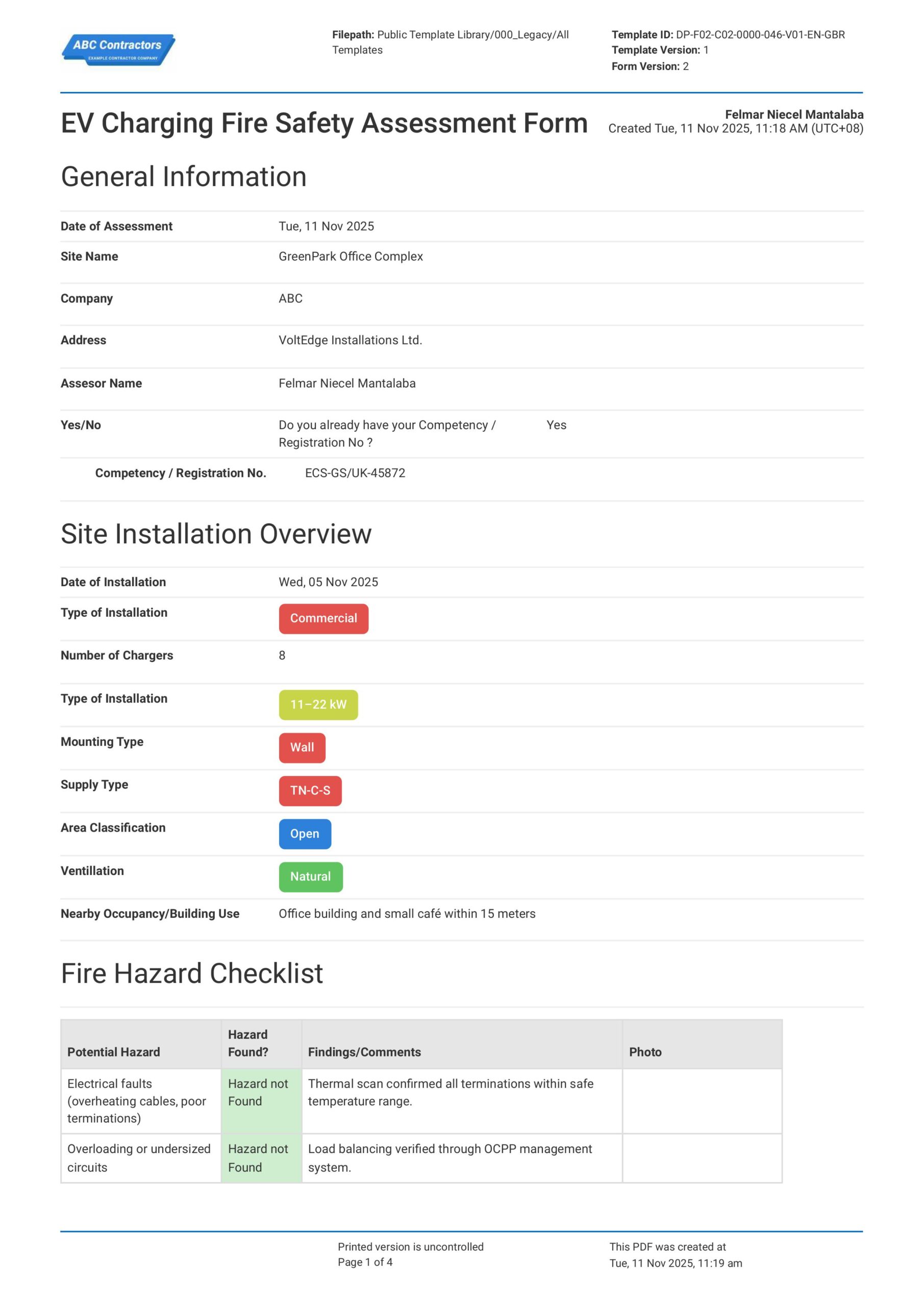
An EV Charging Fire Safety Assessment is a form used for a safety protocol that inspects all fire safety-related components, measures, and instructions. This inspection ensures that all these relevant items are functioning properly to control the risk of a fire.
The fire safety assessment form needs to be comprehensively and thoroughly constructed to have a successful and effective assessment.
Compare this EV Charging Fire Safety Assessment Form to paper-based forms created from Word, Excel, or PDF
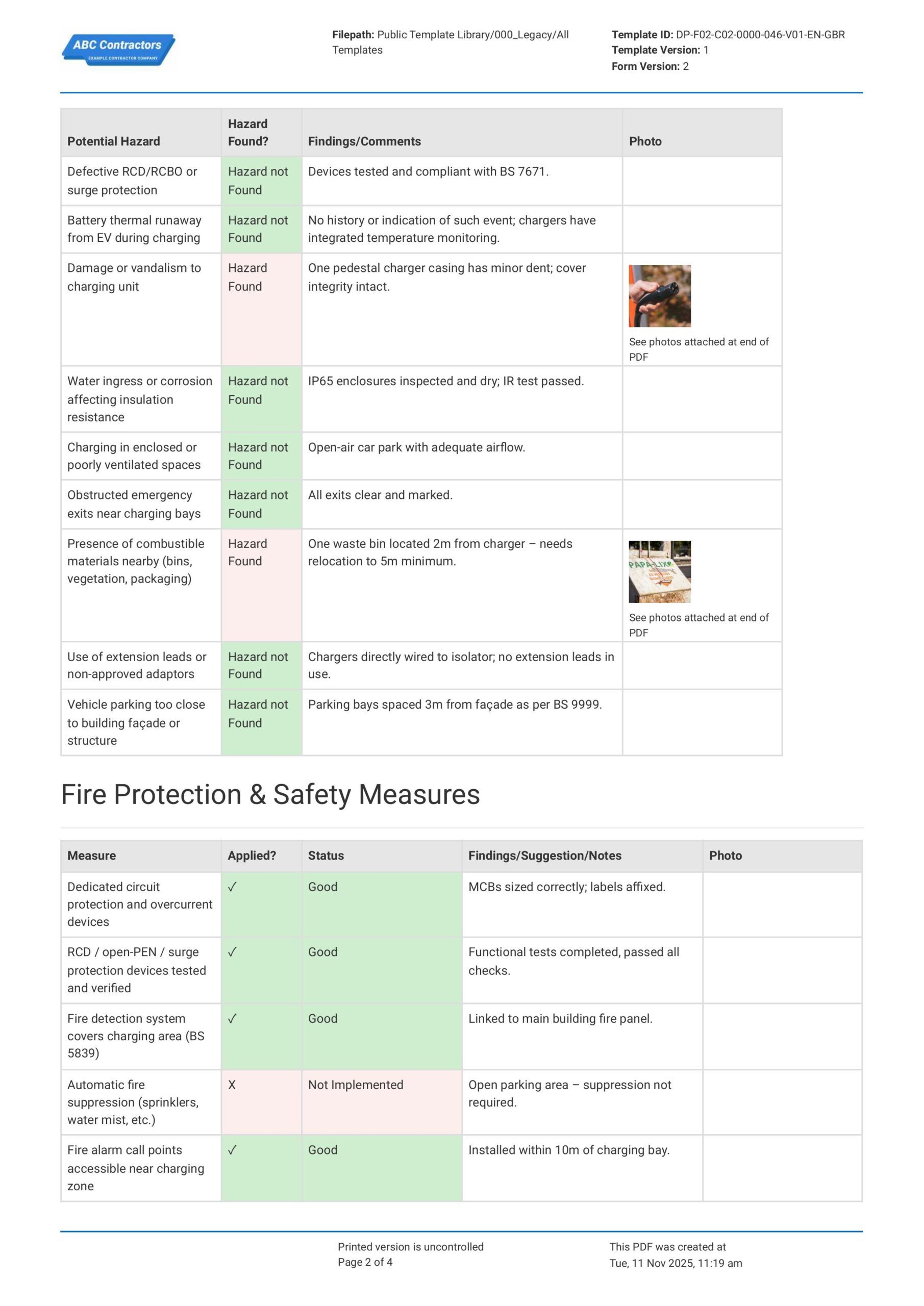
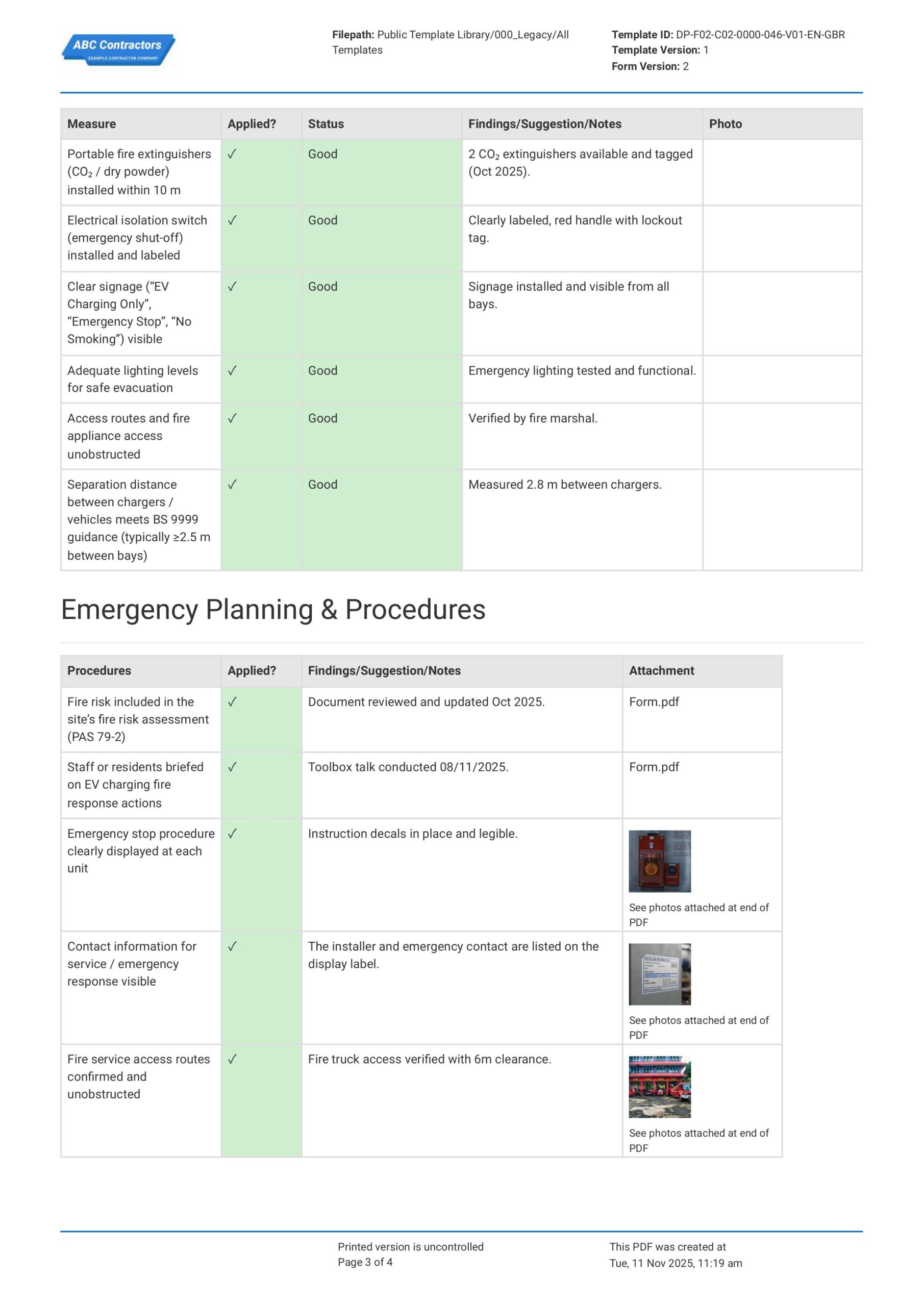
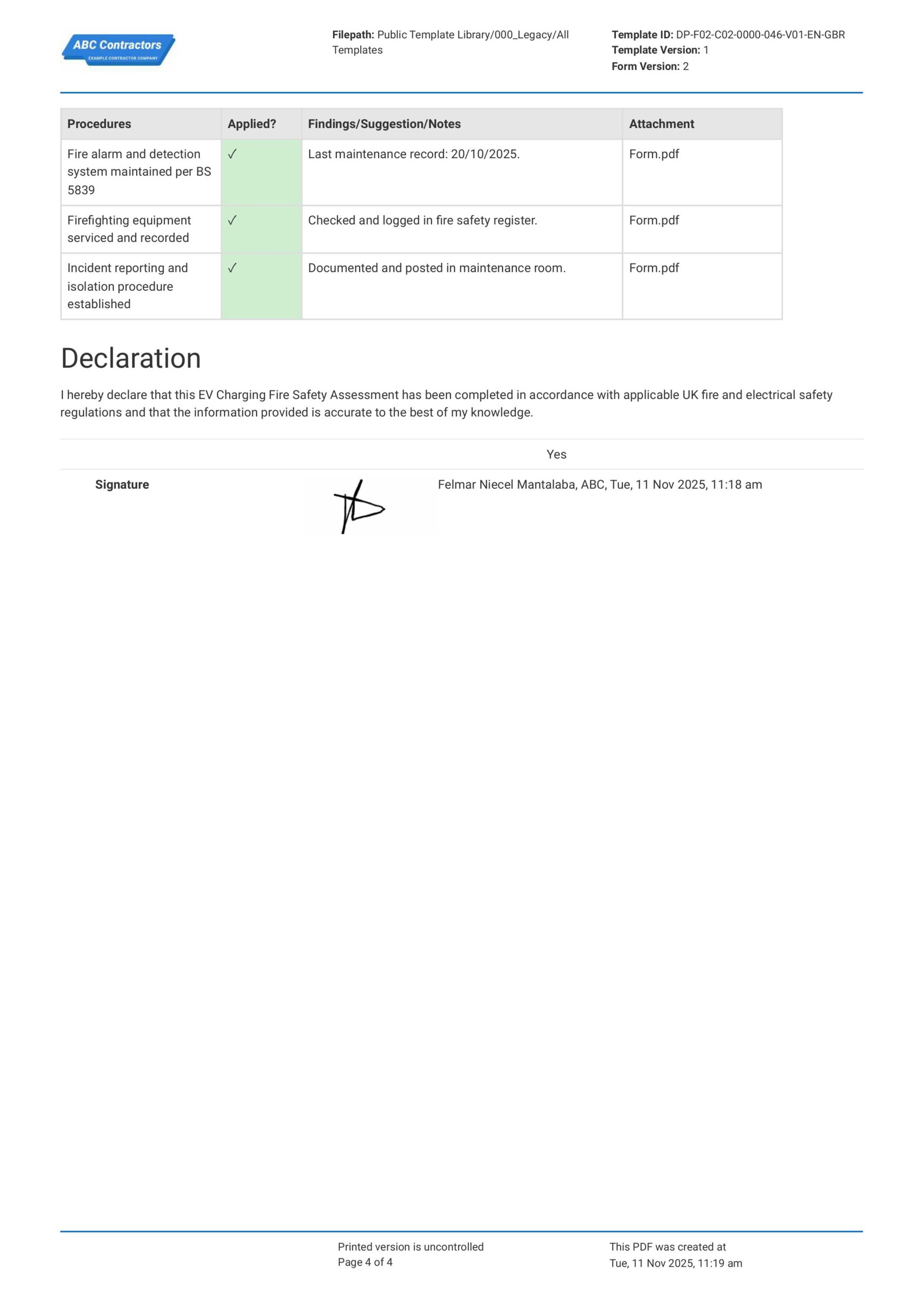
Curious how this Electric Car Charging Fire Risk Assessment works? Check out the example below to see how the tables and checklists walk through each fire safety check for installed EV charging points. You can generate your own version, export it as a custom form with your company details, and fill in your information to have a ready-to-use Electric Car Charging Fire Risk Assessment in minutes.
Use this Electric Car Charging Fire Risk Assessment template for free

Generate this template automatically with Storm
You don't have to build the Electric Car Charging Fire Risk Assessment field by field. Let Storm, the AI Data Capture Agent inside Dashpivot, build the template for you in seconds.
Describe what you need
Tell Storm the form you want in plain language and it builds a structured digital template from scratch, with fields, tables, and signatures in place.
Upload what you already use
Drop in your existing PDF, Word, Excel, or even a photo of a paper form. Storm rebuilds it as a smart digital template with the structure intact.
 Storm
Storm
Generate a Electric Car Charging Fire Risk Assessment form template that I can use for my business
Applicable Standards and Policies for Electric Car Charging Fire Risk Assessment
In the UK, Electric Vehicle (EV) Charging Fire Risk Assessments are guided by general fire safety laws and emerging guidance specific to EV infrastructure and lithium-ion battery risks. These frameworks require duty holders to assess fire hazards, implement appropriate controls, and ensure that new technologies like EV charging are safely integrated into buildings and sites.
- Regulatory Reform (Fire Safety) Order 2005 – requires non-domestic premises and common areas to have fire risk assessments.
- Building Regulations (Approved Document B) – provides fire safety design guidance relevant to EV charger placement.
- IET Code of Practice for Electric Vehicle Charging Equipment Installation (BS 7671 aligned) – covers safety and fire requirements for EV charging.
- NFCC (National Fire Chiefs Council) – contains guidance on EV fires and charging infrastructure risk management.
Staff Members and Parties that use Electric Car Charging Fire Risk Assessment
An Electric Car Charging Fire Risk Assessment is used by those responsible for installing, managing, and operating EV charging infrastructure within buildings or sites. Here are some of the most common parties that use Electric Car Charging Fire Risk Assessment forms:
- Property owners and landlords responsible for the safety of the property.
- Installers or designers of the charging systems.
- Fire risk assessors and safety consultants who evaulate hazards and controls.
- Property or building managers overseeing a property’s operation and maintenance.
- Fire and rescue authorities who assess compliance and respond to incidents.
Business Risks Reduced by Electric Car Charging Fire Risk Assessment
Using an Electric Car Charging Fire Risk Assessment reduces the risk of fire incidents associated with electrical faults, battery failures, and poorly planned charger installations. For example, here are ways it can help businesses respond to evolving safety expectations and avoid operational, financial, and reputational impacts:
- Reduces risk of fire caused by electrical faults, overheating, or battery failure.
- Avoids non-compliance with fire safety laws and associated enforcement actions.
- Prevents business disruption due to unsafe installations or emergency incidents.
- Reduces liability exposure that arises from property damage.
Business Opportunities Created by Electric Car Charging Fire Risk Assessment
Implementing proper Electric Car Charging Fire Risk Assessments supports safe use of electric vehicle infrastructure which enables organizations to meet sustainability goals while maintaining safety standards. Here are examples of how it creates confidence among users and improves business.
- Enables safe expansion of EV-related infrastructure to meet growing demand.
- Enhances property value and attractiveness to tenants.
- Improves trust with insurers, regulators, and stakeholders.
Common Fire Risk Hazards in EV Chargers
Electric vehicles are now starting to dominate in the UK. This has been one of the UK’s measures to achieve net zero by 2050. The rising popularity of EVs has also boosted the need for EV charging stations. However, like their gasoline and diesel station counterparts, EV charging points also present fire hazards. To effectively control these hazards, one of the best measures is to acquaint yourself with them. Having sufficient knowledge of such hazards can help choose the best possible measure to eliminate them. Here are some common fire hazards found in EV charging points.
- Overheating components – Excess heat from heavy use or poor cooling can cause ignition.
- Faulty installation – Loose or improper wiring can lead to short circuits.
- Damaged cables/connectors – Wear or moisture can cause arcing or sparks.
- Battery failures – EV battery issues can trigger fires during charging.
- Missing protections – Lack of breakers or sensors increases fire risk.
Why are Electric Car Charging Fire Risk Assessments Important?
Electric car charging fire risk assessments are important because they identify potential hazards before they lead to serious incidents. EV chargers involve high electrical loads, and without proper evaluation, issues like overheating, faulty wiring, or equipment failure can go unnoticed. Early detection helps reduce the likelihood of fires and protects both people and property.
They also ensure compliance with safety standards and regulations, which is critical for businesses and property owners. Regular assessments support proper installation, maintenance, and use of charging systems, improving overall reliability. This not only minimizes downtime and liability but also builds confidence in EV infrastructure safety.
Prerequisites for Creating an Electric Car Charging Fire Risk Assessment
Electric Car Charging Fire Risk Assessments must be done accurately and to the standards set by local fire regulations in order to ensure the safety of car owners and their property. In this section, we discuss a few important steps in order for you to create your own Electric Car Charging Fire Risk Assessment.
Before you start creating your own Electric Car Charging Fire Risk Assessment, you will need the following items ready.
- Site details and layout plans
- Electrical system information
- Charger specifications
- Existing fire safety measures
- Usage profile and risk factors
- Relevant regulations and standards
-
Note Down the Important General Information
Capturing key general information at the beginning of your fire risk assessment sets the foundation for clarity and traceability. This ensures all stakeholders understand the scope and context, so include:
- Date of Assessment
- Location of Charging Station
- Project or Facility Name
- Type of Charging Infrastructure (AC/DC, fast/slow chargers)
- Assessor’s Name and Role
- Relevant Standards or Regulations Referenced
-
Identify Actual Site Conditions
Accurately identifying actual site conditions helps contextualize fire risks specific to the charging environment. This allows for a more precise and relevant assessment, so document:
- Layout of charging area
- Ventilation conditions (indoor, outdoor, enclosed space)
- Proximity to buildings or flammable materials
- Electrical infrastructure and load capacity
- Environmental factors (temperature, flooding risk, etc.)
-
Determine the Possible Fire Risks and Hazards
Determining potential fire risks and hazards ensures that all credible ignition sources and contributing factors are addressed. Here are some examples of the most common fire hazards you can expect:
- Electrical faults or overloading
- Damaged charging equipment or faulty cables
- Improper use or unauthorized modifications to the charging station
- Accumulation of combustible materials nearby
-
Highlight the Existing Fire Safety Control Measures
Highlighting existing fire safety control measures provides visibility into current protections already in place. This helps evaluate effectiveness and identify gaps, so include:
- Any existing Fire Detection Systems
- Fire suppression equipment (extinguishers, sprinklers, etc.)
- Maintenance and Inspection Practices
- Clear signage and safety instructions
-
List Down the Emergency Control Procedures
Listing emergency control procedures ensures preparedness in the event of a fire incident. Clear actions and responsibilities improve response time and safety, so outline:
- Emergency Shutdown Procedures for charging units
- Fire response actions
- Contact information of local Emergency Services
- Communication protocols during incidents
-
Ensure the Assessment is Reviewed, Approved, and Signed
Ensuring the assessment is reviewed, approved, and signed formalizes accountability and confirms that all controls are acknowledged. This step supports compliance and continuous improvement, so include:
- Reviewer and Approver names and roles
- Signatures of responsible personnel
- Date of Approval
- Confirmation of Understanding by the relevant staff
Frequently asked questions
How to create your Electric Car Charging Fire Risk Assessment in an App or Software System
A well-designed Electric Car Charging Fire Risk Assessment allows safety inspectors to note down important site information, identify risks and hazards, and highlight safety control measures and emergency plans.
30 minutes
Easy difficulty
-
Start your Electric Car Charging Fire Risk Assessment with General Information
Make sure to begin your Electric Car Charging Fire Risk Assessment with important, high-level information. This allows readers and users to easily understand and provide context for the assessment. Here are some fields you can use for this section:
- Date fields or selectors for Date of Assessment
- Text fields for Site Information (Name, Location, etc.)
- Text fields for Company Name
- Text fields for Assessor Information
-
Add a Section for a Site Installation Overview
This section will provide a deeper look into site conditions and the existing set-up at the EV charging station. Be sure to include the following fields in your Electric Car Charging Fire Risk Assessment:
- Date fields or selectors for Date of Installation
- Drop-down field for Type of Installation (Residential, commercial, etc.)
- Text fields or drop-down fields for station mounting type, number of chargers, & supply type
- Drop-down field for Ventillation Type
- Text field to describe Occupancy of Nearby or Adjacent Buildings
-
Create a Table for a Fire Hazard Checklist
Creating a Fire Hazard Checklist within your Electric Car Charging Fire Risk Assessment can help guide users and assessors when they use your assessment form at the site. We highly recommend using a table to house this checklist, with the following columns in order:
- First column for descriptions of the Potential Hazard
- Second column to identify if Potential Hazard was found at site
- Third column for comments or remarks
- Fourth column for attachments and photos
-
Highlight Fire Protection & Safety Measures
Next, it is important to note down the required fire protection systems and safety control measures at the site so assessors can determine the overall safety of the site. Again, we recommend using a table for this section, with the following headers in order:
- First column for descriptions of the Safety Measure
- Second column for a ticker to indicate whether the safety measure was applied
- Third column for a status tracker of the safety measure during assessment
- Fourth column for findings, notes, and recommendations
- Fifth column for attachments or photos
-
List Down Emergency Planning & Procedures
Any Fire Risk Assessment from needs a section where assessors can review the existing emergency plans and safety procedures. In order to neatly compile these documents and information, you should use a table with the following columns:
- First column for descriptions of the safety procedure
- Second column for a checkbox to indicate whether the procedure is implemented
- Third column for findings, notes, or recommendations
- Fourth column for attachments where the relevant documents can be uploaded
-
Complete your Electric Car Charging Fire Risk Assessment with Sign-Offs
Finally, you should add a section where assessors can certify and sign-off on the assessment. Be sure to take advantage of e-signature fields in your form whenever possible to improve ease of use. Be sure to include the following:
- Signature fields for assessor sign-off
- Signature fields for Site Supervisor or Project Manager
About the author

Ron Gadugdug
Content Engineer
 LinkedIn
Education
Cebu Institute of Technology - University - Civil Engineering
Bio
Ron is a Civil Engineer with 6 years of experience in the construction industry, primarily focused on quantity surveying, cost estimation, project management, quality control, contract administration, and property & engineering insurance. At Sitemate, he writes about practical applications of evolving technologies and digital solutions that support construction professionals in improving efficiency, compliance, and project delivery across the built world.
Past Projects
Quantity Surveying & Cost EngineeringPerformed quantity take-offs of several high-rise and horizontal structures using sheets and applications like Revit and Bluebeam Revu, and spearheaded trials with Building Information Modeling (BIM) software.
Project Management & ConsultancyCoordinated with project management teams during the construction of local projects such as a 4-tower hotel & resort, a 22 storey condominium project, and a school dormitory project.
Contract AdministrationAssisted during contract biddings and negotiations with general contractors and sub-contractors, and oversaw progress reporting, billings, and payment.
Property & Engineering InsuranceDedicated non-life claims handler, overseeing property and contractor all-risk insurance claims, risk management, and bonds.
Version History:
Related apps and templates
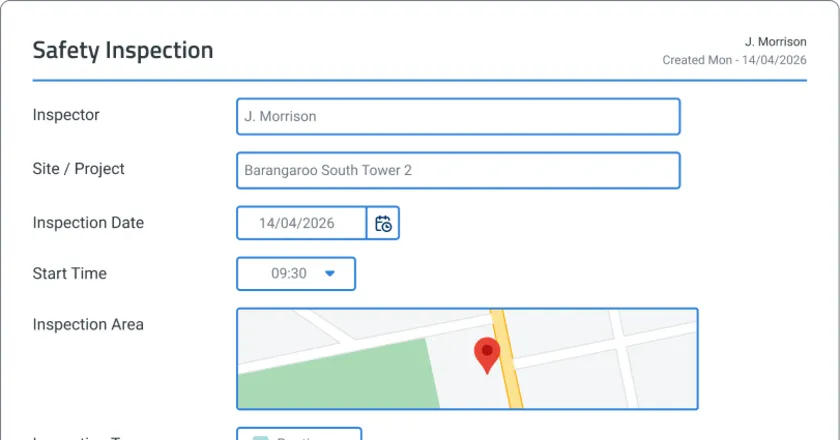
Safety Inspections App
Safety inspections app template that turns voice notes and photos into completed compliance reports on-site. GPS tagging, AI drafting, corrective
View app
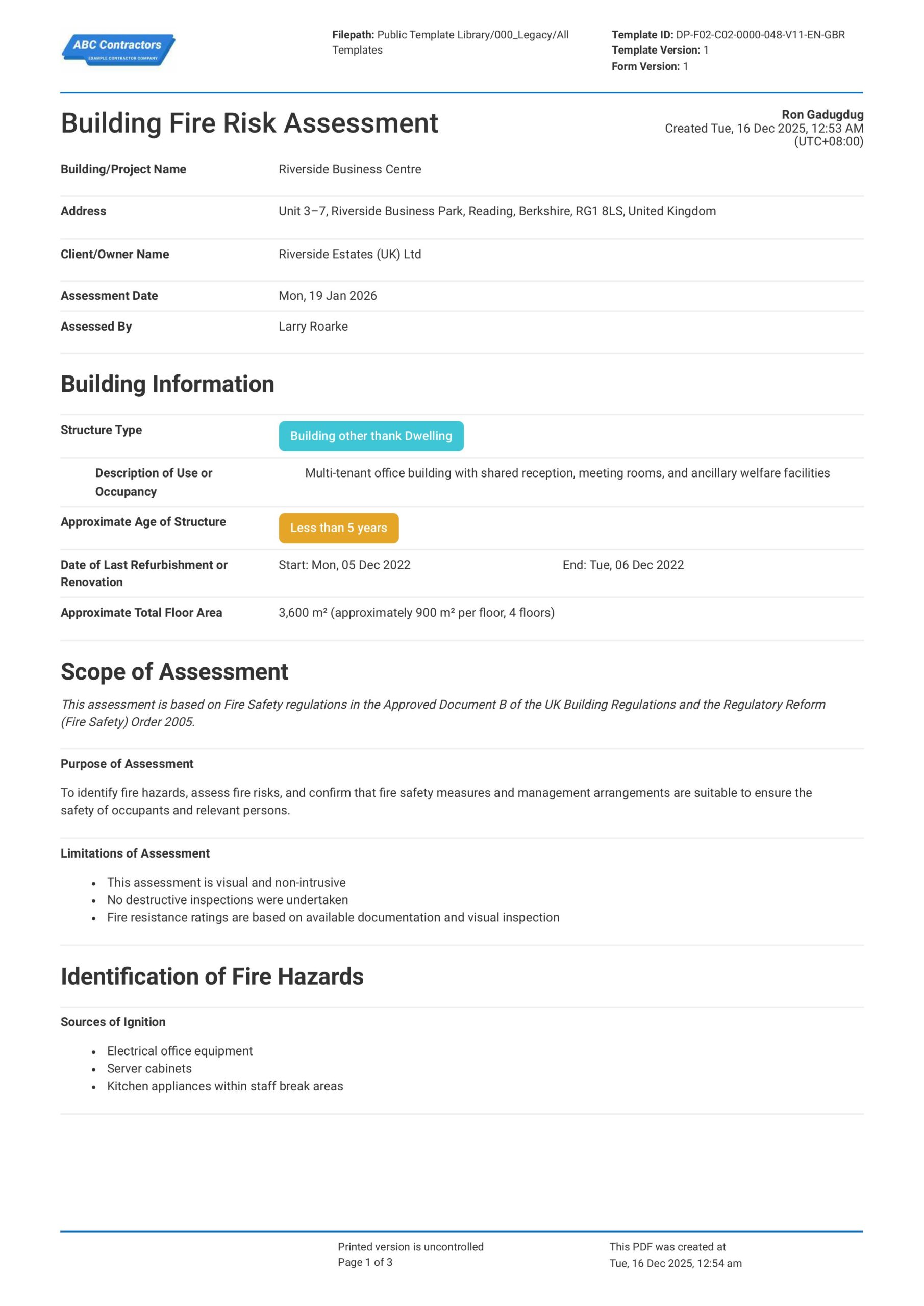
Building Fire Risk Assessment
This Building Fire Risk Assessment template enables safety professionals to conduct comprehensive fire risk evaluations for buildings and projects. The template covers essential elements including general building
View template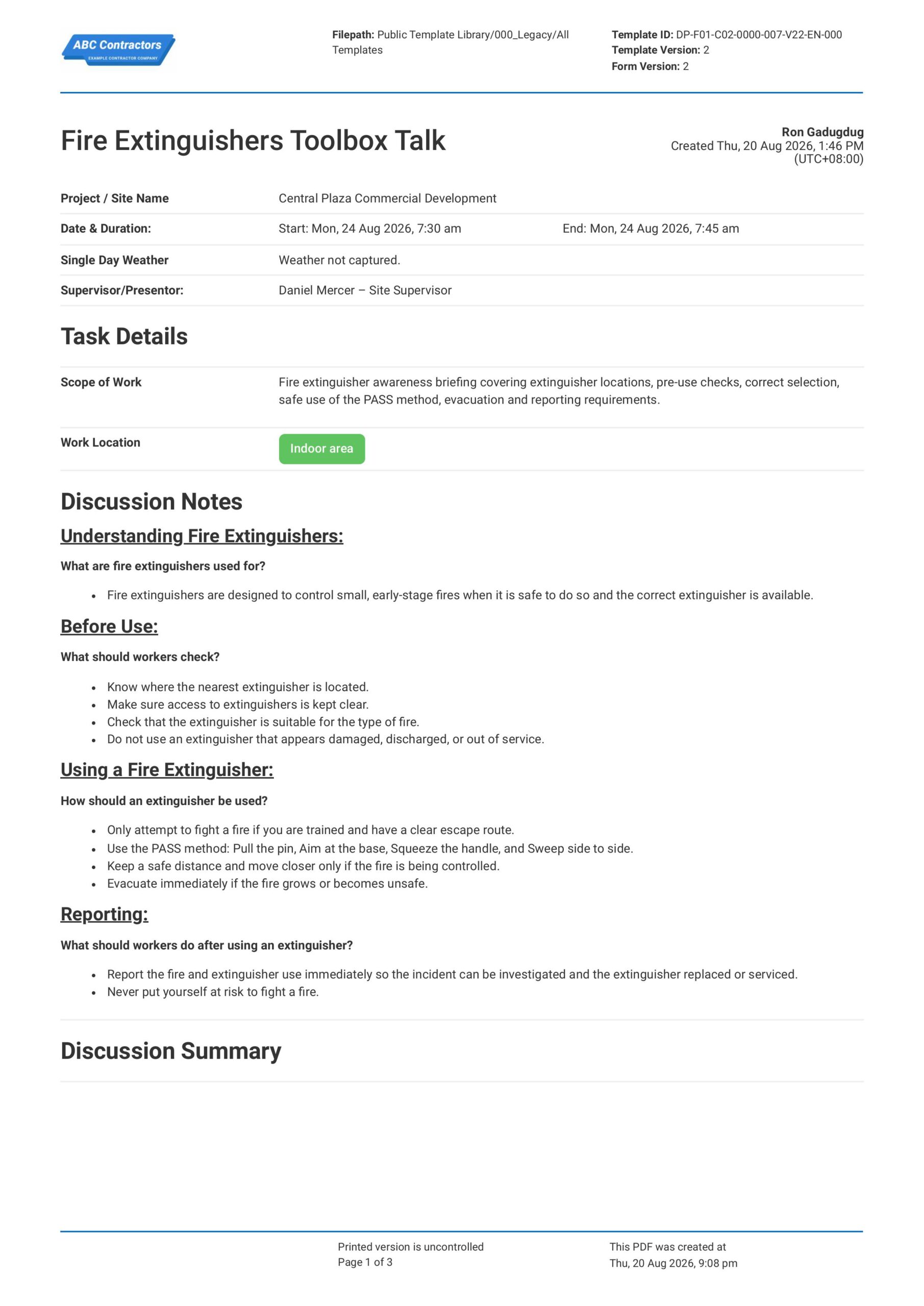
Fire Extinguishers Toolbox Talk
This Fire Extinguishers Toolbox Talk is an easy-to-use form that your workers can use to discuss fire extinguisher locations, basic use, inspection checks, and when to evacuate instead of trying to fight a fire. Record
View templateThis assessment was generated with Dashpivot software
- Access, edit and complete your Electric Car Charging Fire Risk Assessment from any device - mobile, tablet or computer.
- Print, download or send your Electric Car Charging Fire Risk Assessment as perfectly formatted PDF documents with your company logo.
- Store your Electric Car Charging Fire Risk Assessment securely online, where they can be searched and found in seconds
- Invite internal and external parties to see, edit and sign off on Electric Car Charging Fire Risk Assessment online.
