Structural Load Path Verification Checklist
Start with a free 30-day trial. No credit card required.
 100% fully editable Structural Load Path Verification Checklist
Export your Load Path Verification Checklist to PDF or CSV
Access checklists on mobile, tablet or computer
Thousands of templates including other quality templates

~10,000 employees

~10 employees

~200 employees

~25,000 employees

~1,000 employees

~1,500 employees

~30 employees
What is a Structural Load Path Verification Checklist?
A Structural Load Path Verification Checklist is a form used by structural engineers to verify if the route that loads take through a structure, from the point of application to the foundation, is according to the approved design and sufficiently supports its function. The purpose of this form is to ensure the building’s stability and robustness, preventing potential fractures and structural collapse.
Compare this Structural Load Path Verification Checklist to paper-based forms created from Word, Excel, or PDF
Use this Structural Load Path Verification Checklist template for free.
What is a structural load path?
All loads imposed on a structure must flow straight to the earth. Every Civil or Structural Engineer's objective is to build structures using this idea, which is known as the structural load path. They must ensure that each load's path is clear and that all components along that path can support the load. Most load pathways are straightforward. In a multi-story building, the load travels through the slab or floor to the principal beams, then out to the columns, and finally down to the foundation.
The primary purpose of this structural load path is to prevent a total structural collapse of the building in the event that any of its elements fail. In England and Wales, Part A of the Building Regulations 2010 states that a building “shall be constructed so that in the event of an accident the building will not suffer collapse to an extent disproportionate to the cause.” Therefore, it is critical for engineers designing the building to conduct a thorough assessment to ensure that the designed structural load path was followed.
Structural load test: Types of loads
Approved Document A of the UK Building Regulations requires that structures be designed and built to withstand all load types that they are expected to encounter over their lifetime. The load types listed below must be considered throughout the building's design process.
Dead Load
Dead loads, also known as static loads, usually refer to the weight of the structure, which remains static and generally constant over time. Dead loads can also include the weight of any structural element or permanent non-structural barriers that are fixed. Dead loads can be computed by weighing the materials given and measuring their volume as illustrated on drawings. This means that, in theory, dead loads can be calculated with reasonable precision. Common examples of dead loads are beams, columns, slabs, cladding, finishes, facades, and built-in elements like fixed shelves, cabinets, and permanent fixtures.
Live Loads
Live loads, also known as imposed loads, are typically transitory, changing, and non-static. Moving and dynamic loads include cars driving over bridges, as well as humans, furniture, and other equipment. The intensity of these loads varies. It could change based on the time of day, season, or even the activities brought inside the structure, such as concerts and festivities. Live loads can be concentrated or spread, and they may cause impact, vibration, or acceleration.
Environmental Loads
Environmental structural loads are caused by topography or weather. There are numerous environmental loads that act on a structure, some of which have a lower impact on structural loads but nevertheless have an impact on the building's performance and comfort levels; these may be referred to as environmental factors. The following environmental loads are generally considered in the United Kingdom.
- Wind Loads
- Snow Loads
- Earthquake Loads
- Thermal Loads
- Settlement Loads
Frequently Asked Questions
Why use this Structural Load Path Verification Checklist template?
Sitemate’s Structural Load Path Verification Checklist is the best structural load path inspection template because it is already proven by thousands of UK construction and structural engineering companies. It comes pre-built to align with UK structural load path verification best practice, and is quick and easy to use for any type of worker.
Is this template compliant with UK Building Regulations standards?
Yes — this template is fully aligned with UK Building Regulations, including Approved Document A for structural safety and load-bearing requirements. It is actively used by certified UK construction and structural engineering contractors to ensure compliance, streamline inspections, and maintain high standards of quality and regulatory assurance.
Can I edit this Structural Load Path Verification Checklist for my project or company?
Yes — the template is fully editable with intuitive drag-and-drop functionality. You can create thousands of document variations using different field types, including tables, formulas, sketches, photos, and more, to capture any type of data. It also allows you to add your company logo, headers, and other essential structural elements. All of this flexibility is powered by Dashpivot’s template builder.
On what platforms is the checklist accessible?
This template works seamlessly across all devices — computer, mobile, and tablet. You can complete and update Structural Load Path Verification Checklist forms directly from the field or your office. Once submitted, records can be generated or exported as PDF or CSV, giving you the versatility of Word, Excel, and PDF combined with the efficiency of modern software.

Other popular templates you can use and edit for free

Masonry Inspection Checklist
Efficiently inspect the quality of masonry materials, construction techniques, and compliance with regulations, particularly Approved Document A.

Masonry Quality Control Plan
Integrate all masonry-related approvals, drawings, calculations, rules, procedures, memos, and papers required by Approved Document A into one document.

Part A Structural Design Checklist
Streamline the process of inspecting important structural design elements needed for a building to meet standards.

This Structural Load Path Verification Checklist was generated with Dashpivot
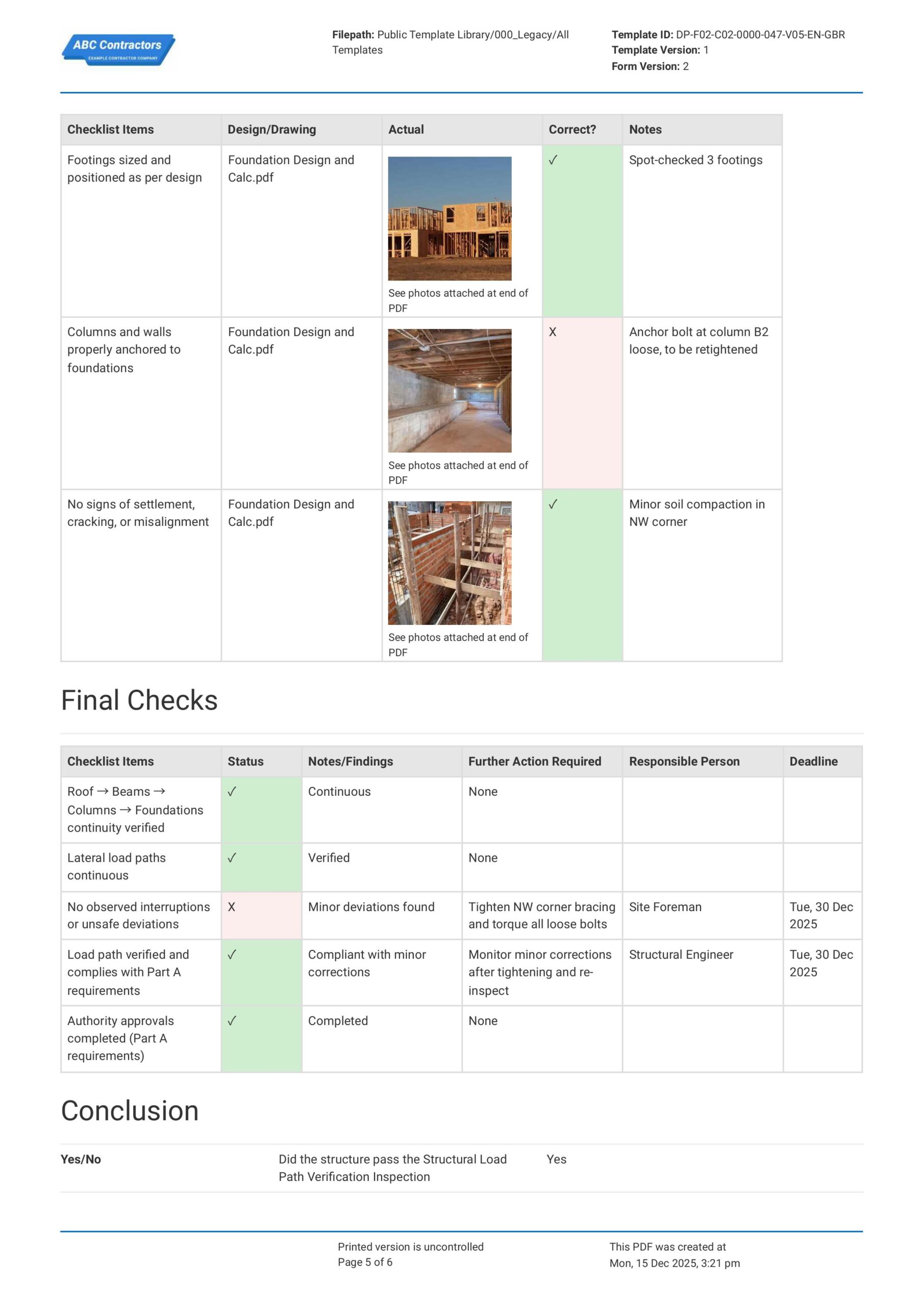
Effectively verify if the load path is according to design. This Structural Load Path Verification Checklist enables users to upload the design as an attachment for inspection and then take pictures of the actual structural elements to compare them with the design.
- Complete, edit, and review the Structural Load Path Verification Checklist form from any device.
- Export and send inspection records as perfectly formatted PDF documents with your company logo.
- Securely store and manage your mobile tower inspection checklist for easy searching and finding.
- Invite internal and external parties to see, edit, and review the Structural Load Path Verification Checklist.

Sitemate builds best-in-class software tools for built world companies.

 English (United States)
  English (Australia)
  English (UK)
  English (New Zealand)
  English (South Africa)
  German