

INSIDE SITEMATE
For The Managers and Leaders Building Sitemate
Preface
Over time, your job changes.
You go from the one building the product.
To the one building the team, that builds the product.
To the one building the company, that builds the team, that builds the product.
To the one building the culture, that builds the company, that builds the team, that builds the product.
- Cameron Adams, Co-Founder & CTO @ Canva
This blog is a few loosely organized, sometimes unrelated, thoughts and reflections on building Sitemate to date.
It is not about our values and culture, that’s already covered here; On Sitemate's Values, Culture and DNA
It is about the mechanics, the structure of building, the specifics - packaged up in a way that is designed to help Sitemate’s Managers and Leaders day to day, month to month, quarter to quarter
Mental Models For Company Building
Throughout the journey to date, which as at the time of writing this blog post - has Sitemate at nearly 3,000 customers and ~160 employees - I’ve noticed that a number of similar challenges and situations have come up time and time again.
This has organically given rise to repeat use frameworks and mental models - tools that can help simplify complex situations.
The below is a collection of the frameworks and mental models that I have developed to help me simplify the complexity, and cut through the noise quickly and cleanly, in any given situation.
“The Bar” – Details, Standards And Urgency
When Sarah Flynn came through as an applicant for Sitemate, it was originally for an Account Executive role.
We hopped on a call, and I guided her towards Customer Success - I don’t quite know why, it just felt like the best entry point for her at the time.
Luckily, she agreed - and she joined Sitemate right at the tail end of covid - starting as a Customer Success Manager.
From that point onward, Sarah’s ascent at Sitemate has been continuous - growing into senior customer success roles, becoming our first ever director of customer success and leading what at the time was a team looking after all of our customers globally, coming full circle by moving into the enterprise sales team, and becoming Sitemate’s first ever Blue Heart - someone with equivalent decision making authority to the CEO on any hiring decision.
However, even for Sarah, a star of Sitemate, our first ever Blue Heart, someone who has risen through the ranks - it hasn’t been all sunshine and roses.
As she was preparing to take on the customer success team, Sarah and I were working together very closely.
It was great, we had a blast, but I could tell - I was also driving her crazy at times.
I had to re-wire some very entrenched habits, habits that had been built up over many years - relating to attention to detail, clarity in thinking, communication, work management and task planning.
I could almost sense at times, she was confused why I wasn’t talking strategy and big picture, why was I honing in on the smallest, most minute details.
Right before we made the change for Sarah to take on the team, we went into a meeting room in our old office in Fishburners, stood in front of a blank whiteboard, and I tried to explain it to her.
I drew a line, straight across the whiteboard, and said something along the lines of;
This is your bar.
When you take the team, the entire team will all be held at the level this bar, your bar, is set to.
It won’t be my bar anymore, it will be yours.
What I’m trying to do, is raise your bar closer to mine, as close as possible, so that I know when you take the team, things will be well run.
I think that was the point it clicked, the reason became clear.
Now, every time this topic comes up, we laugh about it, Sarah laughs at what sorts of habits she had to have re-wired.
I often share this snippet from Jason Lemkin;

Being driven crazy, is when someone is raising your bar.
Imagine you have a group of people - surrounding them at all times is an invisible bar - “the bar”.
The bar is not fixed or rigid, it is fluid, it floats up and down in a reactive way based on the actions of the specific people it surrounds.
However, the leader of the group has the strongest influence on the movement of the bar, their actions outweigh the actions of others by 10X-100X.
Some people can see the bar clearly, others not as well - but, even for those who can’t see it, everyone can feel it.
One of my most frequently referred to mental models is "the bar".
The bar is defined as the overall set of standards, and level of urgency, that surrounds a group of people at any given time.
The bar means that a team of people will only ever rise as high as their direct manager/leader holds the bar.
If the bar is low, it will compress the team’s potential - low performers won’t mind this, high performers will get frustrated, and likely leave, eventually.
If the bar is high, it will lift the team’s potential - low performers may feel uncomfortable, and they will either gossip and complain, or they will leave, high performers will be excited and energetic due to this.
So, the higher one's bar is as a manager/leader, the higher their team will rise.
There are some very rare exceptions to this, where a specific individual will hold a higher standard than their manager, but it's super rare - maybe 1% of the total people I've seen and worked with at Sitemate, or less.
To clarify, that’s 1% of the people or less that have joined, and we have an acceptance rate of ~0.5%-1%, meaning against the average person - the probability is one in somewhere between ten and twenty thousand people.
Player/Coaches – Genuine Authority And Conviction
There is often a debate as to whether you should be on the tools, or whether you should be working ‘strategically’ as a manager and leader.
Time management is important, yes, but becoming disconnected, especially in today’s day and age, with things moving so, so fast, is a large and material risk for managers and leaders, in my opinion.
Ultimately, there is a spectrum here;
- On one hand you can operate purely strategically and managerial, as a leader.
- On the other hand, you can operate ‘in the trenches’ with the team, and you do need to be mindful of not letting yourself be dragged into the weeds too far, and for too long.
In the context of GTM - I like staying hands on with opps and accounts for periods of time, as it helps me build confidence and conviction in our Strategy, as well as our Playbooks, Frameworks and Operating Principles - as I can personally visualize how they apply to changes such as new products, new pricing, new positioning.
For me, this time investment short circuits endless amounts of research, interpretation, internal meetings, feedback surveys and the like.
I believe when a Manager deeply understands something, it enables them to be truly helpful to their team, it enables them to have and speak with genuine authority.
You can either spend effort and time trying to fabricate authority and conviction, or you can just get it, like get it for real, it’s a choice that is up to any manager or leader.
From what I’ve seen, only one really works in the medium to long term, and when the team feels uncertainty, when the team needs leadership, they always gravitate towards the people who hold genuine authority and conviction.
In summary, my recommendation is to not see the player vs coach roles as competing - I would see it as the portion of time one spends playing, should be sharpening one's understanding, building one's conviction (or raising with leadership if one feels like something needs tweaking), so that one can be a better manager, so that one can lead with genuine authority and conviction.
Diversity – A Lever, Not A Check Box
Diversity has been under attack lately, and I’m not sure why.
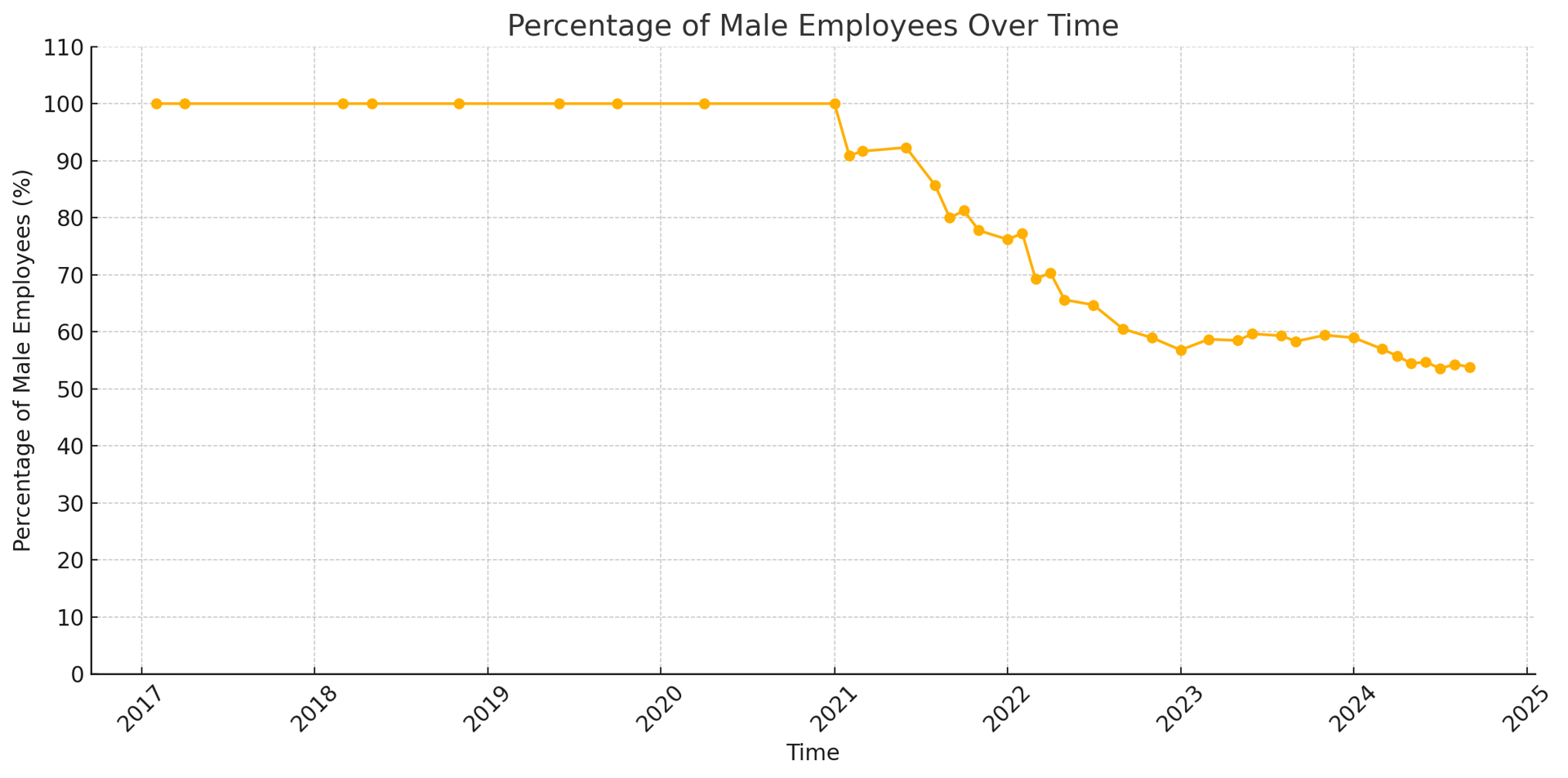
Referring to the below chart, Sitemate has gone from 100% Male off the back of covid, to now approaching 50/50.
During this period, I believe Sitemate has gotten better over time, significantly better.
I believe we are better than we have ever been or were, and I believe that’s due to diverse viewpoints, different perspectives, different energy.
We are building to ensure that there is no mould at Sitemate, there is no typical team member.
The only thing that should be consistent is the values that we share.
In summary - I don’t care whether you’re white, black, asian, hispanic, gay, straight, bi-sexual, single, married, divorced, whatever you are - if you’re on board with Sitemate’s mission to Multiply The Engineering Power Of The Built World, and on our team, then that’s all I need to know.
Elevators – A Way To Assess Career Opportunities
Imagine you are standing in the lobby of a building, and you’ve got 4 elevator doors in front of you - each representing an opportunity, a company that you could join and help build.
From what I’ve seen - the majority of people have either an unclear, or a non-existent, mental model for how to decide on specific companies to join.
Many people place a disproportionate amount of weight on their immediate title and remuneration within the next 6-12 months, and almost no weight on what the journey of the elevator will look like over the next 12, 24, 36 months.
The diagram below is a rough sketch of this mental model - 5 elevator shafts, with levels for startup, scale up and late stage companies, arrows represent direction and velocity.
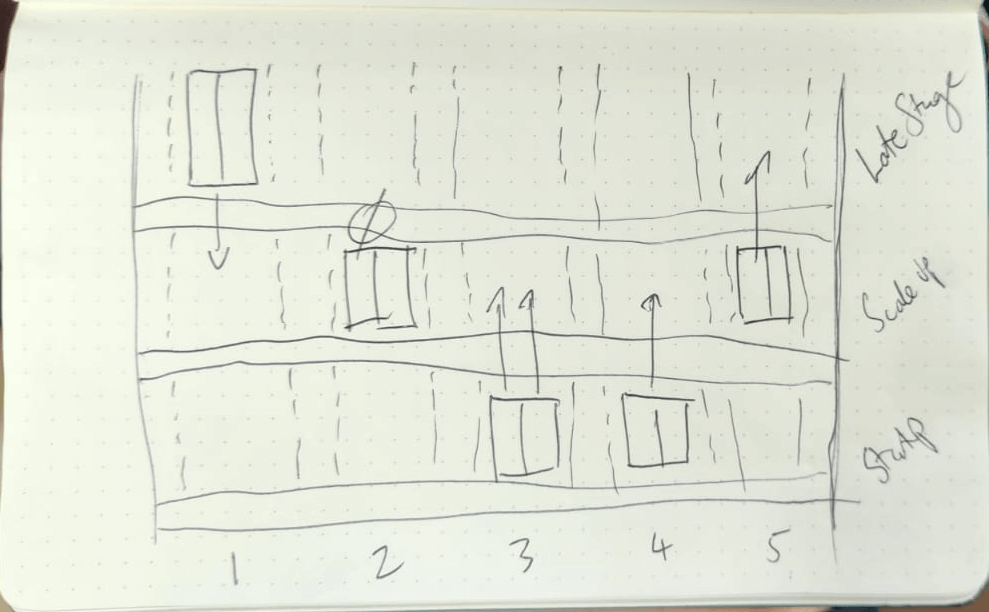
In other words, it might not matter if you get a pay raise, if the elevator you join is going down - you are going down with it.
Vice versa, it likely won’t matter if your starting title feels “junior” compared to your expectations, if the elevator you step into is headed up 50 floors, at rapid place, then your entry point won’t matter, you are just going to fly up with it.
The challenge with elevators, just like companies, is that before you step inside, it’s impossible to know for sure, which direction the elevator is going.
However, this is where it’s easier when reviewing companies in the real world - there is a vast amount of information available online, if you know what to look for.
Here are three simple but powerful filters that can help you evaluate whether an “elevator” is likely to be heading up or down:
Market Tailwinds
- Is the company operating in a growing market, or one that is shrinking/flat?
- Look for secular trends: regulation shifts, technology adoption, demographic movements.
- Even average companies can succeed in a booming market, while great companies get crushed in stagnant ones.
Business Model Strength
- How does the company actually make money, and does the model scale?
- Recurring vs one-off revenue, gross margins, customer concentration, pricing power.
- A “leaky bucket” business (high churn, low margins) can look glamorous from the outside, but the elevator cable is already fraying.
Execution DNA (Leadership + Culture)
- Who is building this? Do the leaders have a track record of shipping, raising, selling, surviving downturns?
- How do people describe the culture? Glassdoor is noisy, but patterns emerge.
- Are they attracting and retaining the kinds of people you’d want to work with and learn from?
Other filters exist (valuation vs traction, competitive moat, unit economics), but these three are the non-negotiables. If the market is growing, the business model is sound, and the leadership team knows how to execute – the elevator is probably going up.
I also like to look at LinkedIn, click on jobs, open a job, and see their headcount trend over time - this is often a really clear indication of how stable the company’s growth is - see here an excerpt from a company in a similar space to Sitemate;
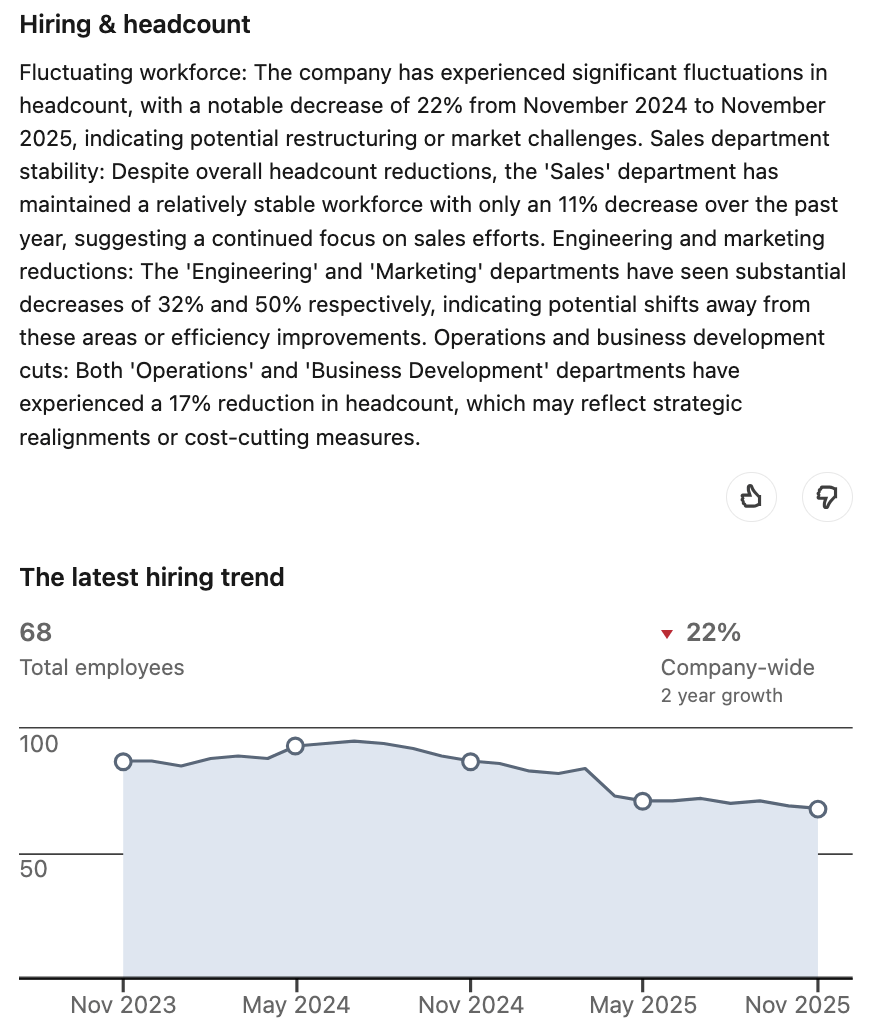
One caveat, is that AI has made this insight less meaningful, as there are now cases where some roles are being removed from the hiring roadmap, and in some cases removed entirely, whilst growth is still steady - so it needs to be sanity checked.
Of course there is another option - build your elevator!
This option warrants an entirely separate blog post, or a book, and there is already a myriad of startup content out there.
The best resource I can recommend is the 20 video YouTube series - “How to start a startup”, by YC.
The general advice is - if you just want to start a startup for the sake of it, don’t do it, don’t do it unless it’s your life’s work, don’t do it unless it pulls itself out of you.
Slingshot Moves – A Way To Consider Backward, Or Sideways, Steps
Not every career move is a straight upward trajectory. Sometimes, the most powerful way to accelerate forward is to step back first.
However, in the world of LinkedIn status updates, titles, and constantly comparing ourselves to others, this can often feel daunting, shameful, or just plain wrong.
This section is an attempt to remove that external noise, and help you either make personally, or guide someone else to make, a decision that could re-define one’s trajectory.
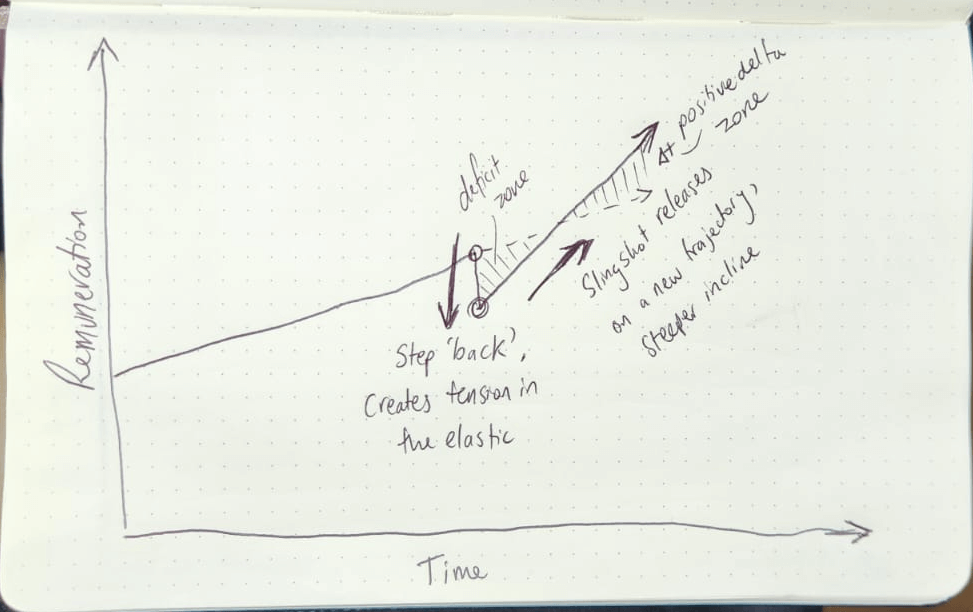
A Slingshot Move is when you deliberately take a backward or sideways step in your career; in title, responsibility, or even remuneration - in order to reset your trajectory onto a steeper incline. Think of it like pulling back an elastic band; the backward motion creates tension, and when released, the forward motion is far more powerful.

How Slingshot Moves Work
- The Step Back: You accept a role that may feel like a downgrade on paper - smaller team, lower compensation, narrower scope, “lower” title. This is the deficit zone in the diagram below.
- Tension Builds In The Elastic: The trade-off is that you are loading up exposure, learning, network, or alignment with a higher-potential path.
- The Release: After a period of proving yourself, the slingshot fires, and you find yourself not just back where you were, but on a steeper trajectory.
The diagram below plots Remuneration (a roughly aligned but not perfect proxy measure for ‘progress’) vs Time, to illustrate the slingshot move.
Advantages If Executed Successfully
- Trajectory Reset: Moves you onto a higher slope of growth compared to your previous slope.
- Skill Acceleration: Gives you access to knowledge, networks, or markets you couldn’t otherwise tap into.
- Long-Term Compounding: Over a 5-10 year horizon, a slingshot often outpaces those who stayed on the linear path.
Risks and Tolerable Period
Of course, slingshot moves come with risk. If the release doesn’t happen, you may find yourself stuck in the deficit zone.
Realistically, 6-12 months is a tolerable period to sit in the deficit zone. In exceptional cases, 18 months.
Beyond that, the elastic starts to fray - what was meant to be a slingshot risks becoming a trap.
The key is clarity: you should know what you’re betting on (a leader, a market, a product, a company trajectory), and have a realistic view of how long you’re willing to wait for the release.
Here’s a real example of a career progression chart, of someone from within Sitemate, that illustrates the point;
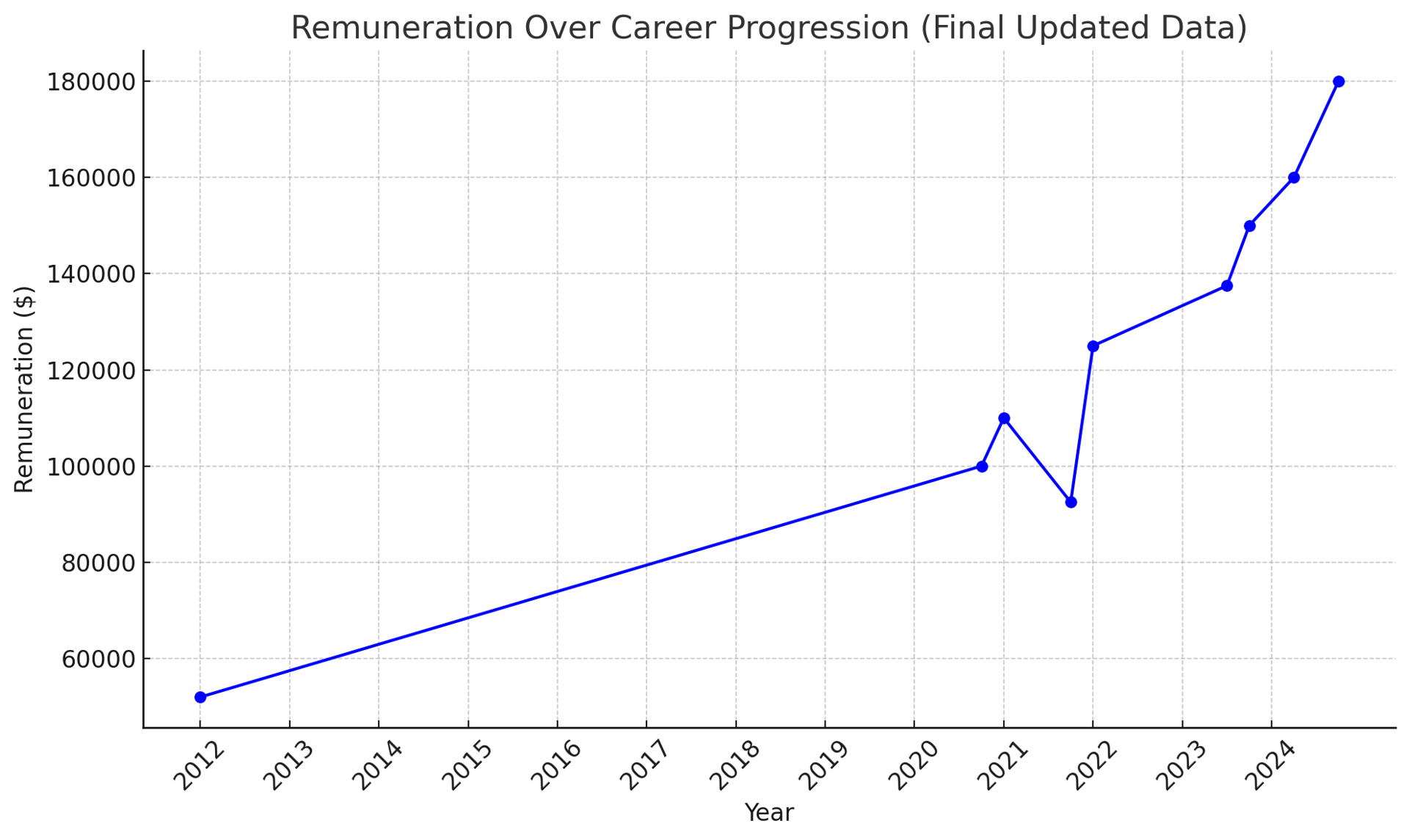
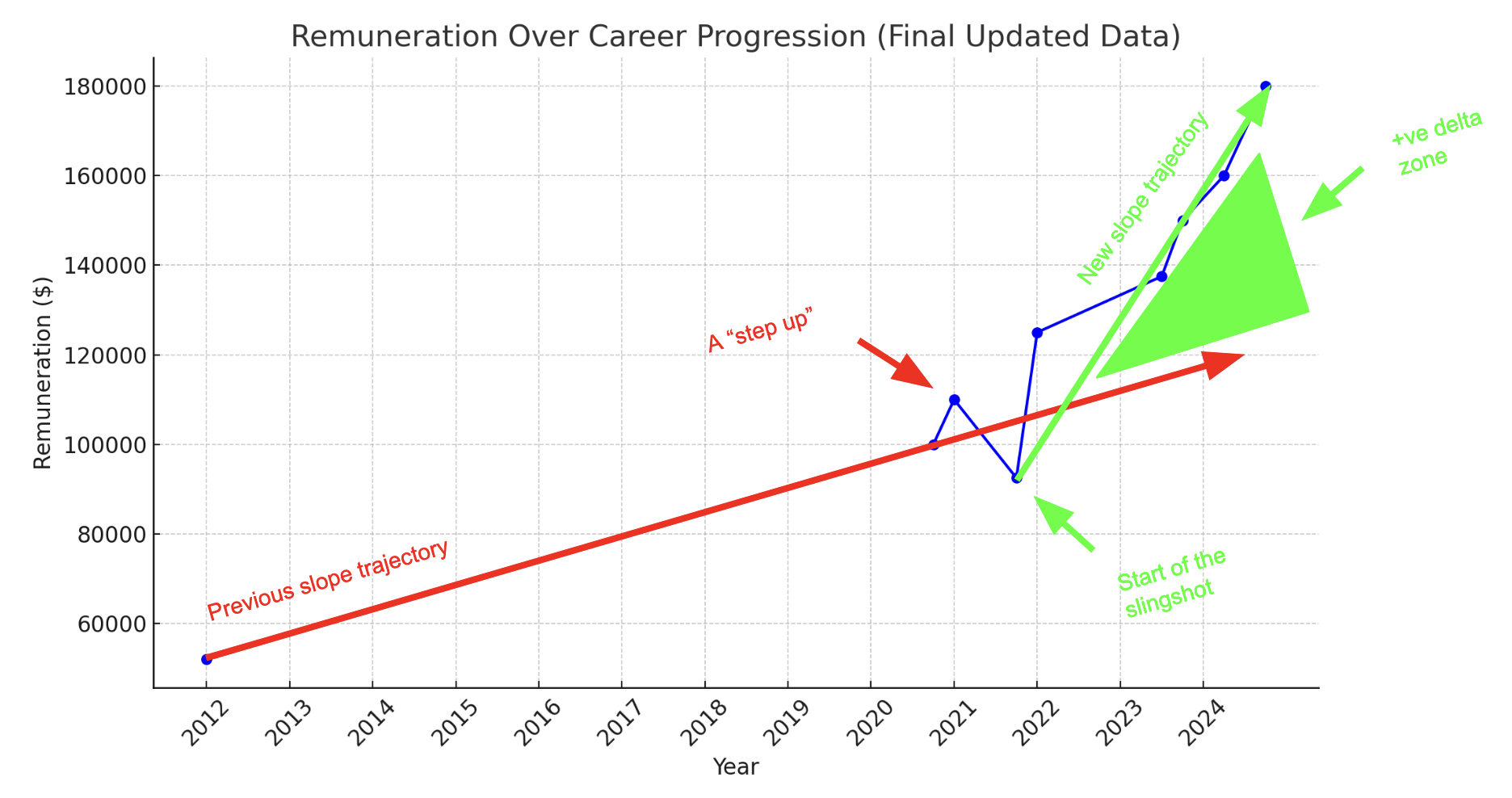
The timespan from 2012 to the end of 2021 was the person’s prior career trajectory - then, they took a pay bump for a new role, but departed the role shortly after due to material cultural issues.
They then joined Sitemate at the end of 2021, taking a “step back” - this was the start of the slingshot.
Here’s the same chart, but annotated with the slingshot move indicators;
Slingshot moves are not for the faint of heart; they require humility, patience, and conviction.
But when done right, they can work spectacularly - turning a temporary step back into the very thing that makes the next 10 steps forward possible.
Self-Guided Missiles – Gauging Impact And Recognition
In the scale up stage, managers and leaders become the bottleneck - there are a million things going on, and the reality is - if you rely on them to tell you you’re doing a good job, you’re probably going to end up disappointed.
The best people figure out a way to know if they’re doing a good job, before being told if they are, or if they are not.
This is done by looking at a small number of relevant metrics, and monitoring one’s own work.
Pre-plan your work and success criteria, get early feedback from management and leadership to ensure your success criteria are logical and vision/strategy aligned.
Then, once live, monitor it - seek out usage metrics, seek out user feedback, close the loop yourself.
The result - you become a self guided missile of impact, and it makes the two below sections much, much more likely to swing in your favour
The general advice is - don’t wait for your manager or leadership as the sole indicator as to whether you’re doing a good job or not, and definitely don’t wait until a performance review, or when you want to bring up remuneration, else you risk going in drastically under-prepared.
Below is a diagram to help, on the y axis you have three tiers of “Impact”, and on the x axis you have three degrees of how much “Guidance” one needs day to day;
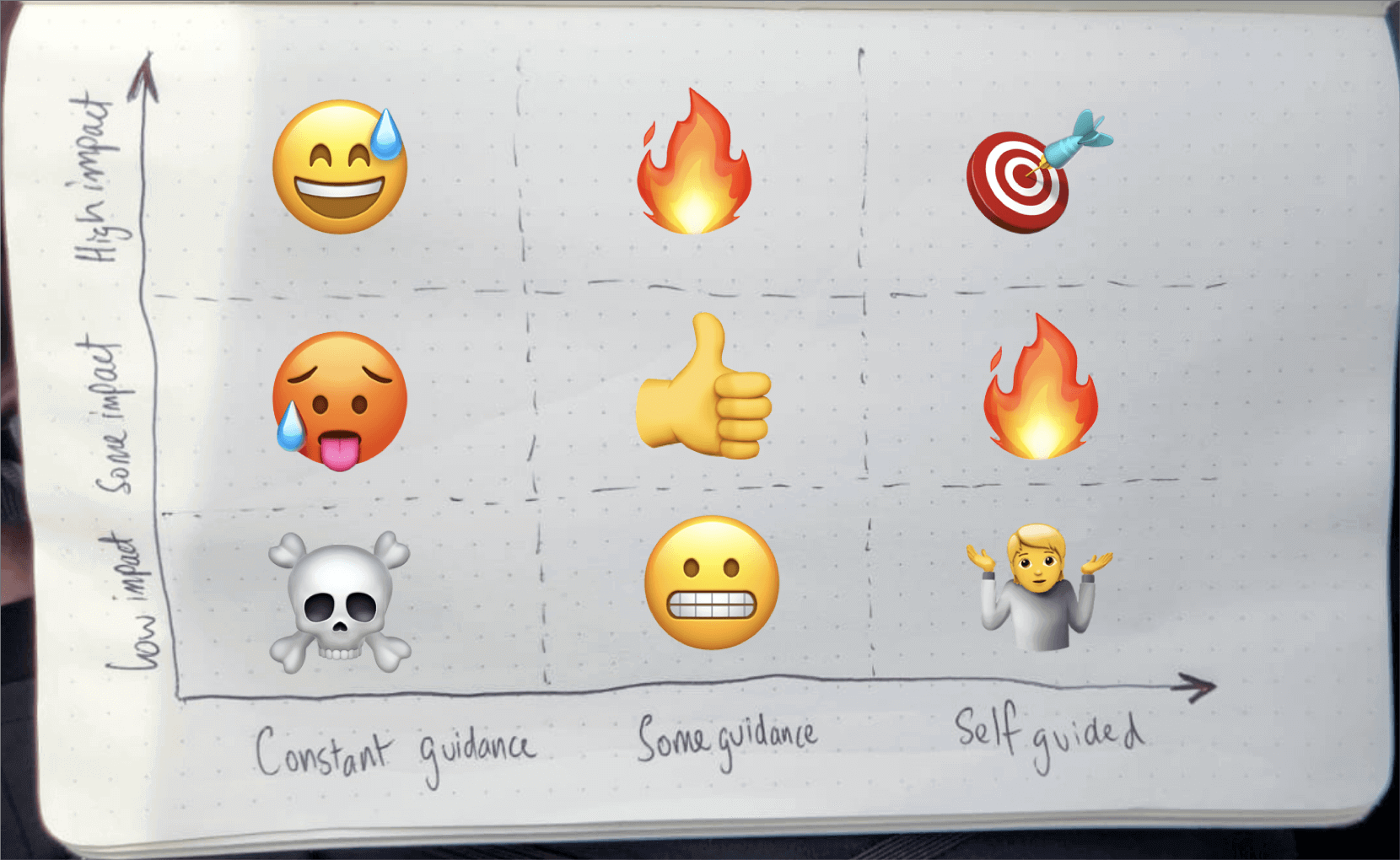
Consider the two scenarios:
Person A:
- Is generally doing a good job, but has no grasp on the impact of their work - hence, when it comes time to discuss remuneration and promotions, management and leadership are stuck.
- They have someone who works hard, does a good job, but is frustrated, and has no direct ties to impact and usage. This puts the manager in a position where they need to go and figure out if they’ve been having impact or not.
Person B:
- Is generally doing a good job, has a constantly tight grip on the impact of their work, and aligns it to company strategy / product vision, recognition and impact is controlled by one’s self.
- It is validated by seeing how what you’ve built is used and received, makes creating roadmaps towards promotion and progression smooth and seamless.
As an aside note, on burnout - it’s directly related to this topic, if you can’t see the impact of what you’re doing, everything becomes pointless, which accelerates the spiral into burnout.
Personal Vs Company Growth Curves – Gauging Pace Of Development
Companies have different rates of growth - this is normal.
The challenge with startups and scaleups, if they’re going well, is that it warps the typically acceptable development timelines, as the slope of the curve creates inherent pressure to develop and improve.
Collectively, the group of people are ‘the company’, but each individual is just that - an individual, and these two things have growth curves that are linked, but ultimately exist independent of one another.
Below is a diagram that represents the types of scenarios that can arise - on the y axis Growth is plotted, on the x axis Time;
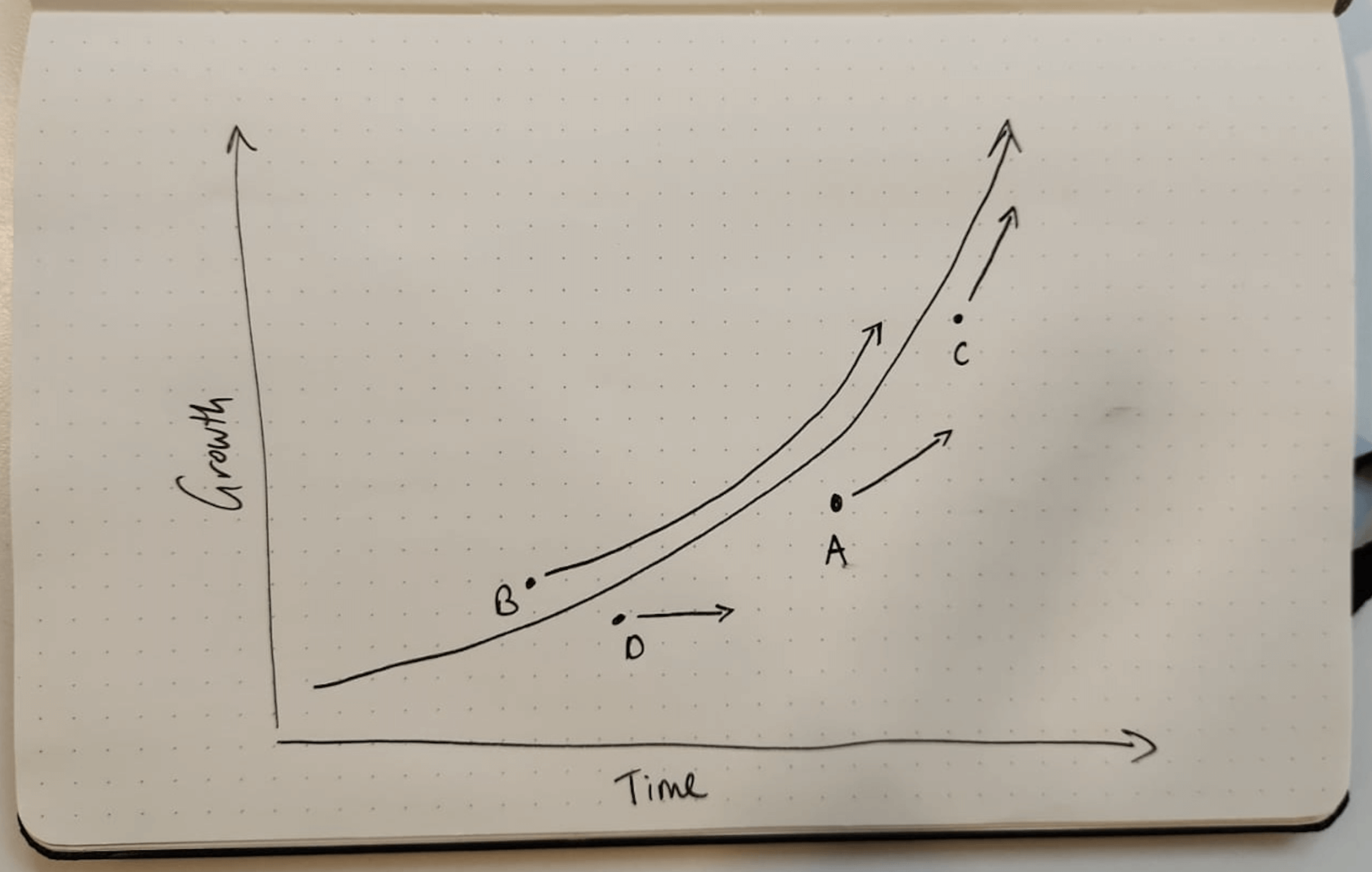
The primary line on the chart is the growth of the company, surrounding it are A, B, C, D - representing four people on the team, from the time that they joined the company.
As you can see, each person has their own growth curve;
- Person A - is trending in the right direction, but their rate of growth is not at the same slope as the company. In this scenario, they would likely continue to contribute well and grow, however, they may need to join new teams, and receive support from a new manager.
- Person B - has been through a long journey, and is growing at the same rate as the company - a perfect fit.
- Person C - has joined recently, and it seems like they’re used to this environment, perhaps they have startup and scaleup experience of this similar stage and pace, as they are slotting right in.
- Person D - joined a while back, and did ok, but did not grow, did not progress, did not evolve. It is likely they would have departed voluntarily, or involuntarily, by now.
Leadership Operating Principles
In addition to the above mental models, which are inherently abstract, broad and conceptual - requiring thought around how to apply in a given situation, we have also invested in documenting a set of Operating Principles (OPs) for Leadership specifically.
These OPs are designed to be more concrete and tactical, compared to the above mental models.
No Immunity, No Sacred Cows
The ironic part about these journeys, is that when we create something that is bigger than ourselves, more important than ourselves, the biggest challenge becomes - keeping up with the growth of the thing that you created.
Sam and I have had many frank discussions over the years, about how there’s no immunity, no sacred cows - even for us as founders, we need to earn our right on the team now, we need to be constantly improving, growing, evolving, ideally at a rate just ahead of the company, or at least on par.
All of this aligns with what’s documented in On Operating Like a Pro Sports Team, Not a Family and it’s an important piece of context for all managers and leaders at Sitemate to keep in mind.


 English (United States)
  English (Australia)
  English (UK)
  English (New Zealand)
  English (South Africa)
  German