Structural Risk Assessment Template

Start with a free 30-day trial. No credit card required.
Want a Structural Risk Assessment that is ready to go but still yours to shape? This template comes pre-built with drop-down menus for the type and age of the structure, plus option fields for the overall risk level and conclusion, so engineers and safety inspectors can work through it quickly on a mobile or tablet. You can edit any part of it to match your company's evaluation process, and the document will still hold up against the regulations you would be audited on.
This Structural Risk Assessment is an easy-to-use form that your workers can use to assess specific risk areas on a structure, select evaluation results without writing long descriptions, and record a clear conclusion. Once completed, the form can be exported to PDF for reporting and collaboration with the wider team.
 100% fully editable Structural Risk Assessment
Export your Structural Risk Assessment to PDF or CSV
Access your Structural Risk Assessment on mobile, tablet or computer
Trusted by companies, projects and teams of all sizes















What is Structural Risk Assessment?
A Structural Risk Assessment identifies the potential for harm or damage to a structure and the risk it is exposed to, considering the associated risks such as its age, wear and tear, exposure to natural disasters, material degradation, and other conditions. It is used by professionals such as engineers, architects, and safety inspectors who are competent experts in assessing structural risk. The form is categorized according to risk area, and it is assessed according to risk level (low, medium, or high). Most companies that evaluate structural risks would require action, especially for identified high-risk areas.
Check out this Structural Risk Assessment
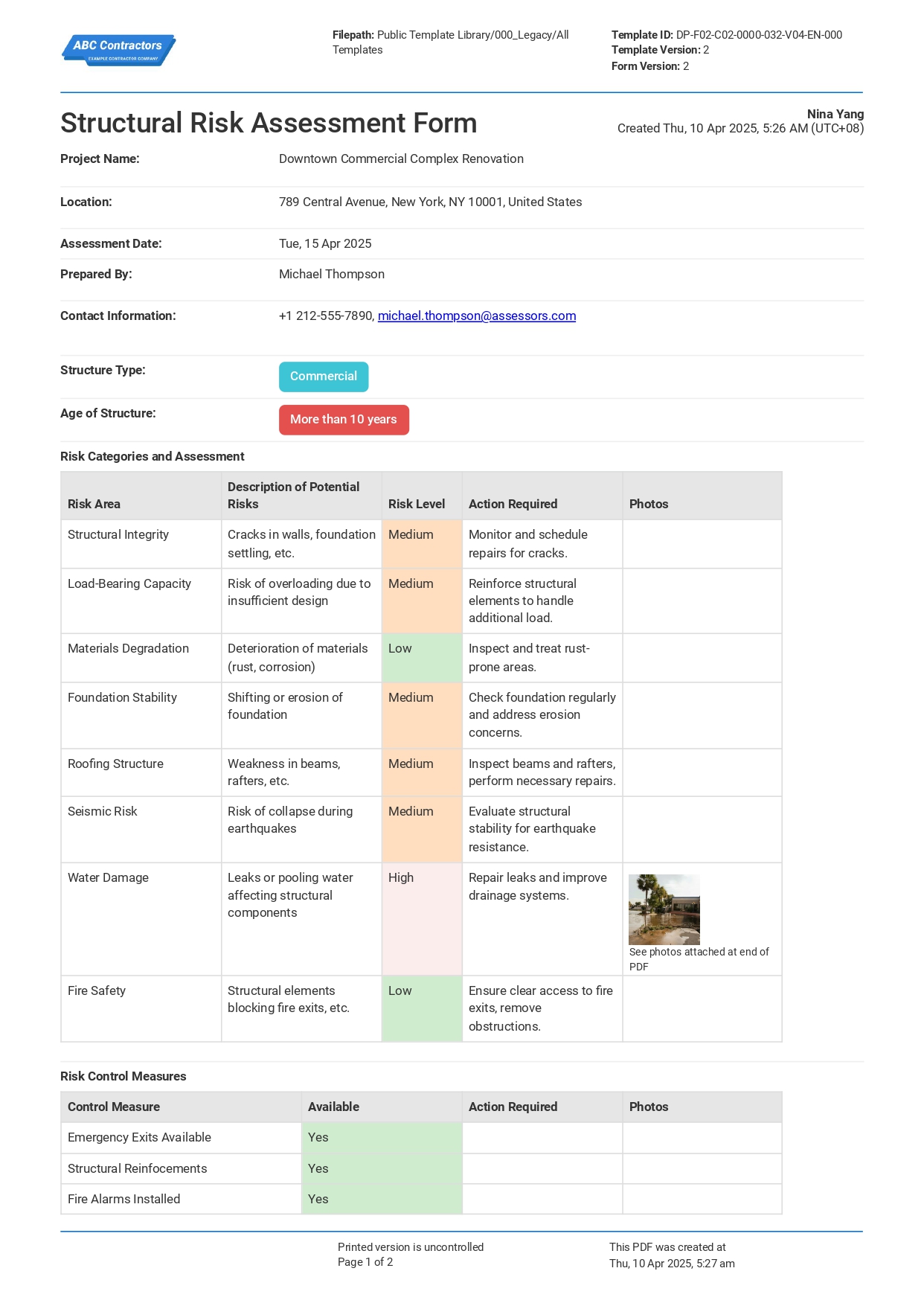
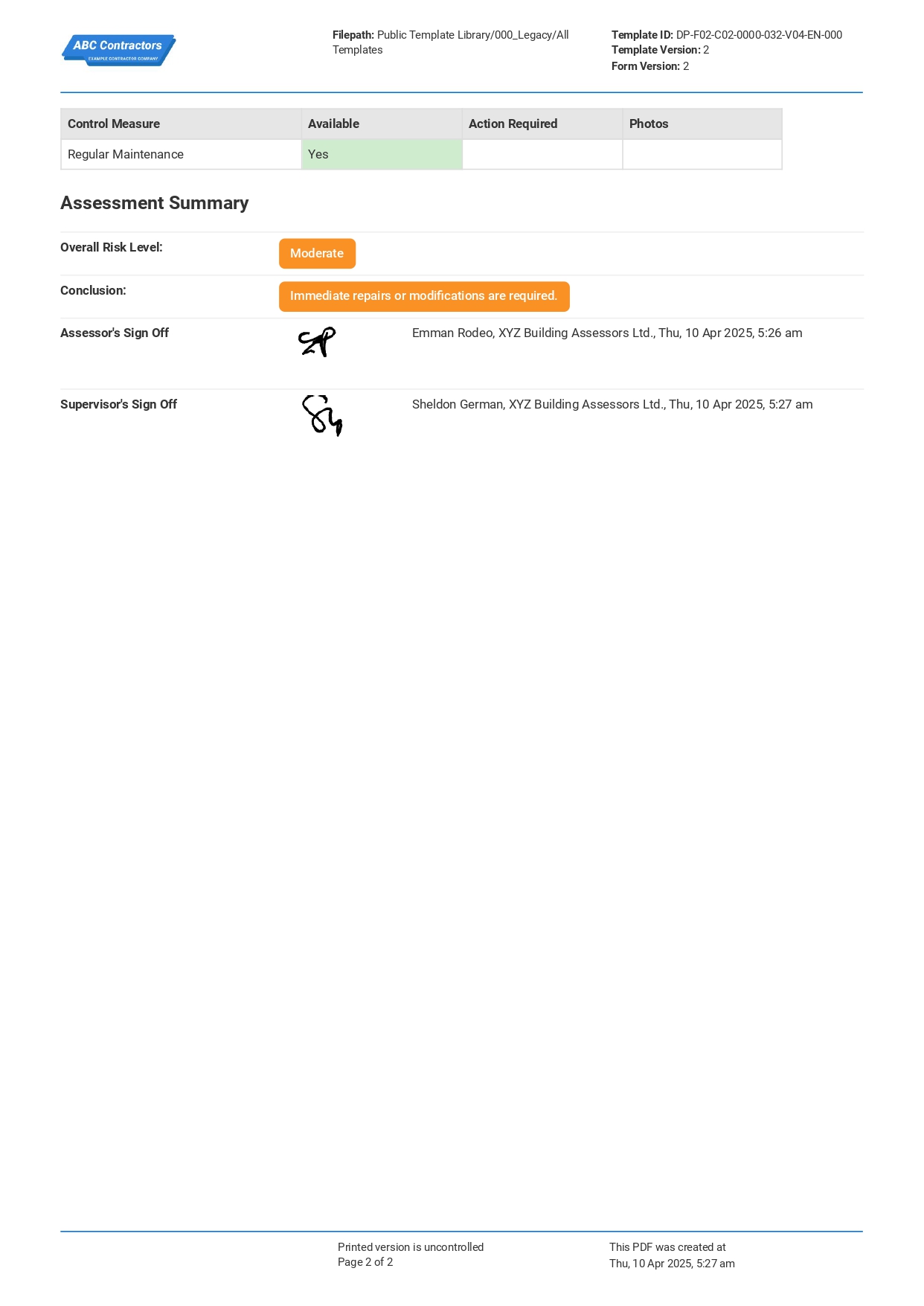
Curious how this Structural Risk Assessment works? Check out the example below to see what a completed assessment looks like, from the structure details through to the overall risk level and conclusion. You can generate your own version, export it as a custom form with your company details, and fill in your information to have a ready-to-use Structural Risk Assessment in minutes.
Use this Structural Risk Assessment template for free

Generate this template automatically with Storm
You don't have to build the Structural Risk Assessment field by field. Let Storm, the AI Data Capture Agent inside Dashpivot, build the template for you in seconds.
Describe what you need
Tell Storm the form you want in plain language and it builds a structured digital template from scratch, with fields, tables, and signatures in place.
Upload what you already use
Drop in your existing PDF, Word, Excel, or even a photo of a paper form. Storm rebuilds it as a smart digital template with the structure intact.
 Storm
Storm
Generate a Structural Risk Assessment form template that I can use for my business
Applicable Standards and Policies for Structural Risk Assessment
Structural Risk Assessments are performed to verify that safety measures are applied to properly manage hazards. This procedure is also mandated by regulatory bodies around the globe. Companies that regularly complete Structural Risk Assessments will effectively protect their personnel and meet regulatory requirements. When performing risk assessments, businesses automatically comply with the following standards:
USA
- OSH Act of 1970 (General Duty Clause): The mandate requires employers to provide a safe and healthy environment for the employees.
- 29 CFR 1926—Construction Standards: This provision has standards with regard to proper load-bearing requirements, scaffolding safety, and general construction safety procedures.
Canada
- Canada Labour Code Part II: This regulation outlines employers’ primary duty to protect employees from hazards encountered when doing structural or construction activities.
- National Building Code of Canada (NBC): This provision has standards for the safe design and construction of structures and buildings.
Australia
- Work Health and Safety (WHS) Act: A standard that defines health and safety tasks, including risk management throughout the structural construction process.
- National Construction Code (NCC): This provides the standard requirements for structural safety, performance, and reliability of buildings and infrastructures.
New Zealand
- Health and Safety at Work Act 2015: This standard specifies the tasks and obligations for maintaining a safe workplace.
- Building Act 2004: Has provisions for ensuring building works comply with standards for structural performance and safety.
UK
- Health and Safety at Work, etc. Act 1974: This standard specifies obligations and responsibilities for ensuring a safe workplace.
- Construction Regulations 2015 (CDM): This provision requires employers to conduct proper planning, design, and management of structural projects to ensure safety in the workplace.
Ireland
- Safety, Health, and Welfare at Work Act 2005: This is a mandate requiring employers to fully manage workplace hazards and dangers.
- Building Regulations 1997-2020: This standard in Ireland has provisions on the safety requirements for structures and buildings.
Staff Members and Parties that use Structural Risk Assessment
The Structural Risk Assessment would be significantly more efficient if those involved in the activity participated in the process. Buildings and structures would be thoroughly inspected for hazards and equipped with safety controls, leaving no opportunity for safety or health risks. Ideally, the following individuals are essential for the risk assessment process:
- Field Workers: These are the people who build and repair. It is their obligation to meet daily targets and implement safety measures. Integrating appropriate safety control measures is critical to ensuring that all activities are safe, especially from structural conditions that can endanger the lives of these personnel. Involving these personnel in the risk assessment session would help expedite the process of determining which building activities require safety controls.
- Field managers and supervisors: They lead in the field. They supervise and manage the crews who undertake building activities. As leaders, their major responsibility is to guarantee that all operations, from start to finish, are safe. To achieve 100% safety, they must lead the risk assessment session and collect all involved individuals to help identify, evaluate, and control dangers.
- Safety Officers: The safety officer’s major role is to properly execute safe work rules in the workplace. They set the standards for what is safe and what is not. They assess the control mechanisms for tasks that involve high-risk building activities. Safety officials would most likely require the risk assessment to conduct their evaluations and determine the current measures in place. These evaluations are crucial since they determine how effective the controls are.
Business Risks Reduced by Structural Risk Assessment
The Structural Risk Assessments protects personnel from risk and damage. However, this form also safeguards the corporation against commercial hazards that may threaten its financial standing and reputation. To prevent the company from collapsing due to such risks, management must uphold safety measures, which is why Structural Risk Assessments is essential. Frequent Structural Risk Assessments can help avoid the following business risks:
- Increased risk of workplace injuries, resulting in a higher Lost Time Injury Rate (LTI)
- Financial instability caused by medical and non-compliance costs
- Disrupted operations resulting in output losses and missed targets
- Damaged reputation
- Deteriorated relationships between employees, employers, and stakeholders
- Loss of certifications and accreditations
Business Opportunities Created by Structural Risk Assessment
Regularly conducting a Structural Risk Assessment is beneficial to the firm. It protects personnel and assets and improves the company’s general reputation. Companies that do regular risk assessments perform better because they have fewer accidents and equipment downtime than those who do not take a proactive approach to hazard mitigation. Furthermore, it opens up the following business options for the company:
- Competitive advantage in bidding
- Better cost savings
- Long equipment and machinery life
- Better insurance terms
- Improved gains and output
Structural Risk Assessment Best Practices
Structural Risk Assessments are an essential and reliable evaluation to maintain structural safety and integrity that involves defining judgment criteria, developing control measures, and reducing potential hazards. The following are considered best practices in conducting structural risk assessment:
- Require actions to be created immediately as soon as a high-risk, high-severity structural issue is found
- Perform a thorough site investigation and inspection by identifying and predetermining risk areas that are high-risk
- Implement regular follow-ups for recorded actions to ensure they are addressed accordingly.
- Maintain detailed records and documentation that are easy to access and managed
- Improve efficiency in documentation by using an app to streamline structural risk assessment
How to assess structural risk according to risk level?
Risk level is the degree of potential hazard the structure is exposed to, and usually, it is determined according to the impact and likelihood of its occurrence. Assessing structural risk can be qualitative, as defined by the standards set by the inspecting body, or quantitative, which is based on numerical data from the assessment.
Usually, a structural risk assessment form has a qualitative assessment of risk level, and the competent inspector would rate the risk area as low, medium, or high risk. The level of risk is determined by inspection findings; for example, cracks in walls would indicate a medium risk level, and water leakage would indicate a high risk of damage.
While it depends on the inspecting company, the level of risk can be described as below:
Low Risk: The findings are minimal and can easily be mitigated through regular maintenance, as they are due to minor wear and tear or nearly invisible cracks in the walls or roofs.
Medium Risk: The issues found have the potential for failure, and the signs are visible, i.e., cracks, minor water leaks, and early signs of degradation or weakness in beams.
High Risk: The risks are significant and can be a serious threat to structural safety, such as severe water damage affecting structural components, which calls for immediate repair and improvement.
How to make a Structural Risk Assessment
This is a comprehensive guide that provides thorough instructions for creating an effective, complete, and compliant Structural Risk Assessment form.
Prerequisites in creating a Structural Risk Assessment
- Identify all the activities and personnel involved in the structural operation
- Establish risk assessment frequency and review schedules
- Establish risk assessment criteria and scoring mechanisms.
- Define the duties and assignments for assessment completion.
- Establish legal obligations and documentation standards.
-
Structural Risk Assessment Procedure Review
- Gather all involved personnel.
- Review all the established procedures and safety and health protocols.
- Conduct an orientation about conducting and performing risk assessments.
- Identify all needed equipment, tools, and machinery
- Conduct a work environment inspection
-
Drafting the Structural Risk Assessment
- Include a field that records all identified hazards from the structural activities
- Add a field to determine the potential impact of the listed hazards
- Make sure there is an established risk scoring system
- Add a field for the needed corrective actions for the hazards
-
Structural safety control measures inspection
- Make a checklist to verify if all corrective actions are implemented.
- Be certain to add a field for evidence of implementation.
- Add a field for providing further corrective actions for control measures that were not implemented.
-
Making a summary for Structural Risk Assessment
- Provide an evaluation field on the overall risk assessment
- Make sure there is a field for the final conclusion
- Add signature fields
Frequently asked questions
How to create your Structural Risk Assessment in an App or Software System
Digital Structural Risk Assessment solutions are replacing traditional paper-based risk assessments with dynamic, collaborative processes that increase accuracy and follow-through. Dashpivot’s platform offers real-time data capture and integrated corrective action tracking, ensuring that detected hazards are addressed promptly. The system’s mobile features enable inspections to be conducted immediately at equipment sites, with immediate photo recording, while cloud-based storage ensures that vital safety information is available to all relevant workers, regardless of physical location. This digital solution also helps companies spot patterns across many buildings, making it easier to find ongoing safety problems and improve their overall safety programs.
30
Medium difficulty
-
How to make a Structural Risk Assessment in an app?
Using an app that employs digital forms instead of paper-based ones may help improve the process by:
- Having less manual data entries
- All produced forms can be stored in a single and accessible cloud.
- Photos can be directly uploaded to forms
- Reformatting is straightforward—easily adapting to new protocols or updated standards.
- Workflows and notifications may be automated and scheduled.
- Improved template design and appearance.
-
Drafting the information section
The following fields should be present in the information section:
- Project Name
- Location
- Assessment Date
- Prepared by field
- Contact information
- Structure type
- Age of structure
- The type and age of the structure fields can be turned into a selection list, where each item on the list is provided with different colors to improve the overall aesthetic of the form.
-
Drafting the risk assessment section
This section identifies hazards, evaluates them, and provides the appropriate control measures. Here are the steps for making this section highly effective:
- Add a 5-column table where users can add rows indefinitely.
- The first column is a field where users can input hazards.
- The second column is a field where users can input the description of the potential risks of each hazard.
- The third column is a field where users can evaluate the hazard. This field should offer a selection of different risk levels (low, medium, and high).
- Provide colors on each selection item in the third column.
- The fourth column is a field where users can input the needed corrective action to control or mitigate the hazards.
- The fifth column must be a photo field, where users can directly upload pictures of the identified hazards. This will provide visuals of the current situation in the field and assist in providing the needed control measures.
-
Drafting the safety controls verification section
This section verifies if control measures are implemented in the field. These are the instructions for making this section:
- Make a fixed table with 4 columns.
- The first column is a list of safety measures that are based on the established health and safety protocols.
- The second column is a field to verify whether the control measures are implemented or not.
- The third column should allow users to place the required additional corrective actions for control measures that are not implemented.
- The last column should provide evidence of the non-existent control measure. This field would appropriately be a photo field to provide a complete visual of the absence of the control measure.
-
Drafting the summary section
This section should provide an overall summary of the structure’s safety situation. Here are the steps to create this section:
- Provide a selection list for the overall risk level.
- Provide a selection list for the conclusion.
- The selection items can be integrated with colors to improve the overall aesthetic of the form.
- Provide signature fields for the assessor and supervisor.
About the author

Felmar Mantalaba
Content Engineer
 LinkedIn
Education
Cebu Institute of Technology - University - Mechanical Engineering with Mechatronics
Bio
Felmar is a mechanical engineer, whose four years of experience in the mining industry inspired him to write and share stories to progress the revolution of new technologies and create smarter, smoother ways of living.
Past Projects
Safety, Health, and Environment Management System (SHEMS) CoordinationSHEMS Coordinator at Atlas Consolidated Mining, ensuring organizational compliance with ISO 14001 and ISO 45001 standards, performing risk assessments, developing policies, and conducting audits and inspections to maintain a safe and environmentally responsible workplace.
Maintenance Management and OptimizationSenior Maintenance Manager (OIC) leading equipment maintenance and operational efficiency initiatives, reducing downtime by 10%, improving Mean Time Between Failure (MTBF) and Mean Time To Repair (MTTR) for major equipment, and managing maintenance schedules, manpower, and materials, while overseeing capital project optimization.
Inspection Engineering and Equipment ReliabilityInspection Engineer responsible for technical blueprint interpretation, vendor collaboration, preventive maintenance scheduling, and data collection for vibration and temperature readings, delivering actionable recommendations and comprehensive reports to improve equipment reliability and operational performance.
End-to-End Operational Oversight in Mining EngineeringContributed to multiple facets of operational management, including SHEMS compliance, maintenance optimization, inspections, and capital project evaluation, integrating safety, reliability, and efficiency improvements across all stages of copper production operations.
Version History:
Related apps and templates
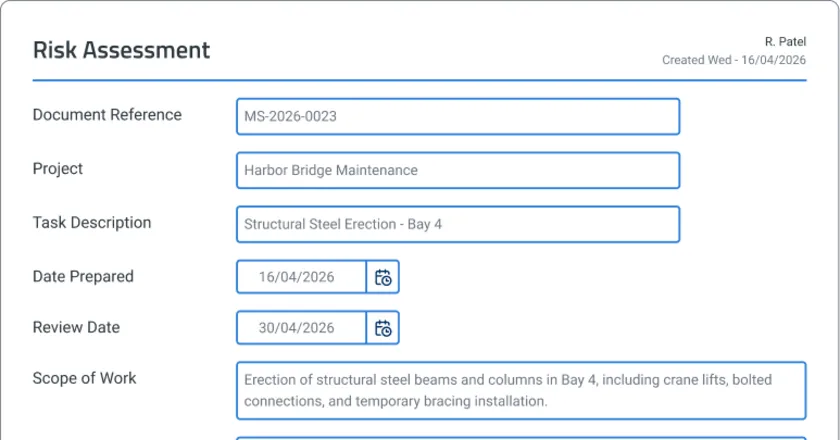
Risk Assessment App
This risk assessment app makes documenting, organising and analysing risk assessments quick and easy on site and in the office. Try the app for free
View app
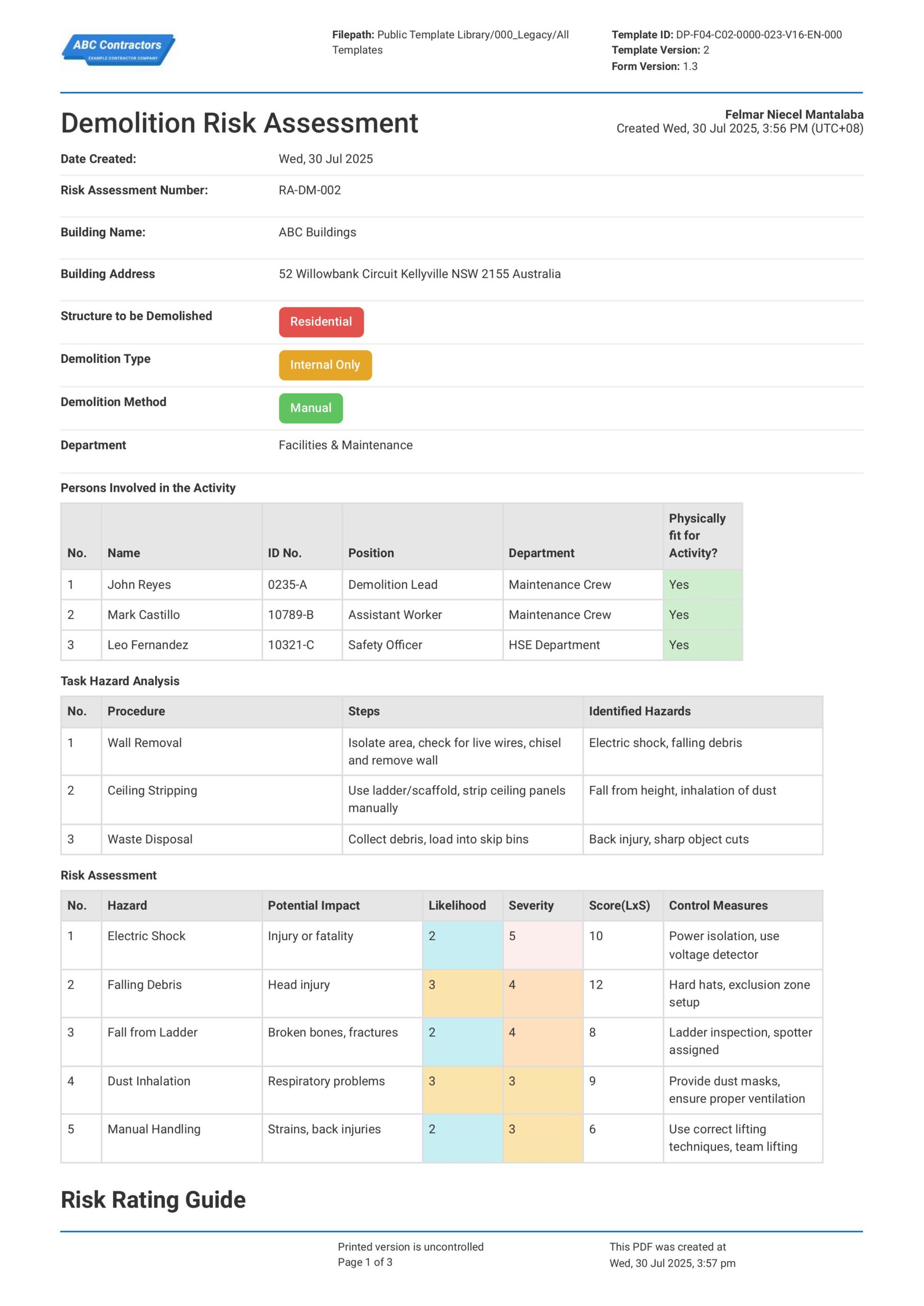
Risk Assessment for Demolition
This downloadable Demolition Risk Assessment is readily available to help you effectively manage safety risks on your demolition projects. It has all the standard features of a demolition risk assessment, ensuring your
View template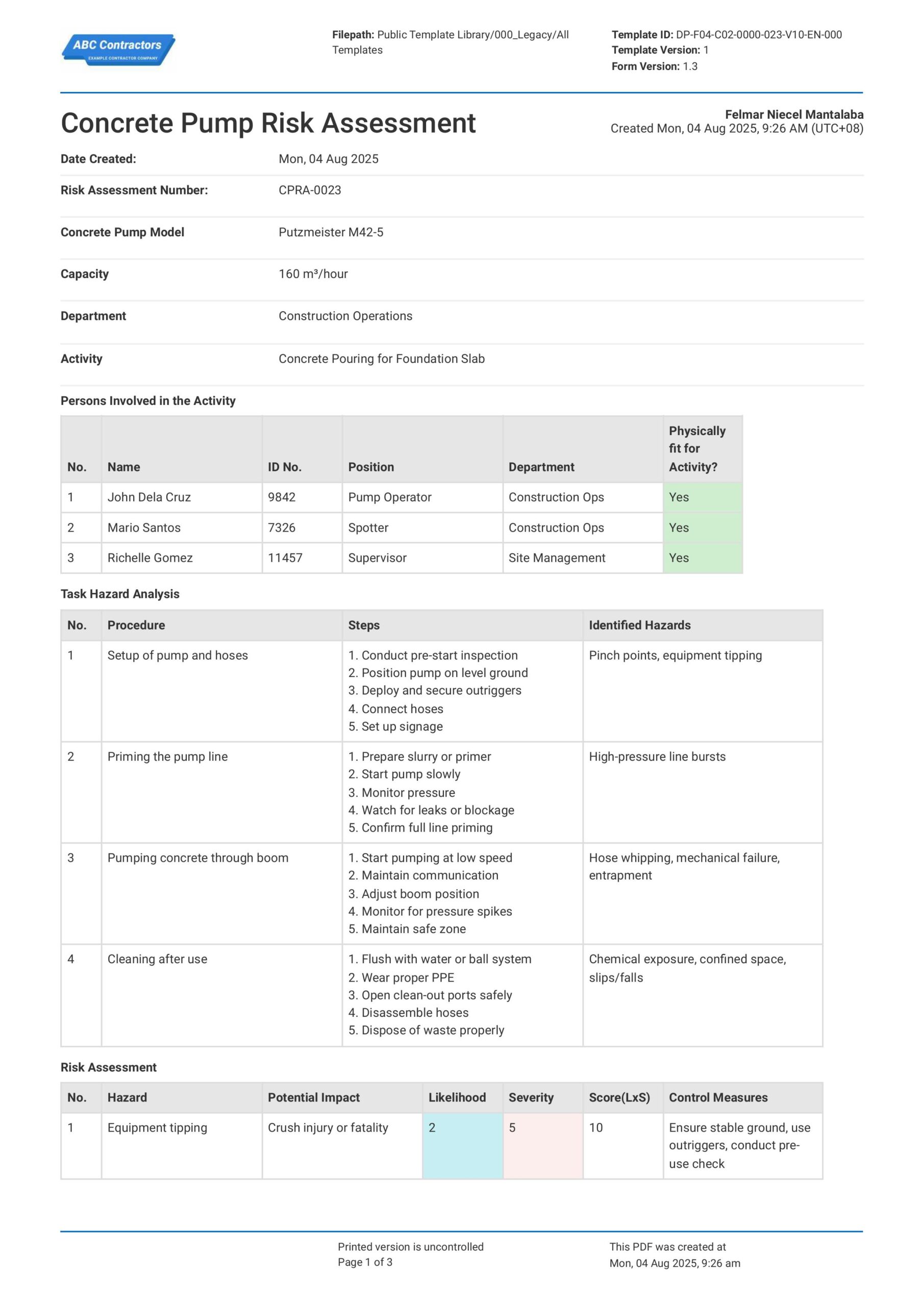
Concrete Pumping Risk Assessment
This Concrete Pumping Risk Assessment Template is free and readily available to help manage safety risks when using concrete pumps. The form features all the necessary standards and regulatory requirements in concrete
View templateThis form was generated with Dashpivot software
- Access, edit and complete your Structural Risk Assessment from any device - mobile, tablet or computer.
- Print, download or send your Structural Risk Assessment as perfectly formatted PDF documents with your company logo.
- Store your Structural Risk Assessment securely online, where they can be searched and found in seconds
- Invite internal and external parties to see, edit and sign off on Structural Risk Assessment online.