Working at Heights Risk Assessment Template

Start with a free 30-day trial. No credit card required.
Looking for a ready-to-use Working at Heights Risk Assessment that still fits how your team works? This template comes pre-written with the fields teams need to identify, evaluate, and manage hazards when working in elevated places, and it is designed in line with global standards so that every hazard is properly controlled. You can edit any part of it with a simple drag-and-drop tool to match your company's processes and the latest rules, and the document will still hold up against the regulations you would be audited on.
This Working at Heights Risk Assessment is an easy-to-use form that your workers can use to identify height-related hazards before work starts, assess the level of risk each one presents, and record the control measures needed to keep everyone safe. Because it is easy to update, the form stays current with the latest required safety practices.
 100% fully editable Working at Heights Risk Assessment
Export your Working at Heights Risk Assessment to PDF or CSV
Access your Working at Heights Risk Assessment on mobile, tablet or computer


Trusted by companies, projects and teams of all sizes















What is Working at Heights Risk Assessment?
A Working at Heights Risk Assessment Template is a safety tool that helps identify, evaluate, and provide appropriate safety measures for hazards in activities where personnel work in elevated areas. The risk assessment for working at heights is not just a moral obligation but also a legal requirement for employers. The Working at Heights Risk Assessment will also serve as evidence that employers are proactively providing employees with a safe and healthy workplace, especially when doing critical activities, such as working at heights.
Check this free and downloadable Working at Heights Risk Assessment Template
Curious how this Working at Heights Risk Assessment works? Check out the example below to see exactly what the completed document looks like, from hazard identification through to control measures. You can generate your own version, export it as a custom form with your company details, and fill in your details to have a ready-to-use Working at Heights Risk Assessment in minutes.
Use this Working at Heights Risk Assessment template for free

Generate this template automatically with Storm
You don't have to build the Working at Heights Risk Assessment field by field. Let Storm, the AI Data Capture Agent inside Dashpivot, build the template for you in seconds.
Describe what you need
Tell Storm the form you want in plain language and it builds a structured digital template from scratch, with fields, tables, and signatures in place.
Upload what you already use
Drop in your existing PDF, Word, Excel, or even a photo of a paper form. Storm rebuilds it as a smart digital template with the structure intact.
 Storm
Storm
Generate a Working at Heights Risk Assessment form template that I can use for my business
Applicable Standards and Policies for Working at Heights Risk Assessment
As mentioned, the Working at Heights Risk Assessment Template is not just a moral obligation but a legal one as well. These are the specific standards in each region that mandate the need for a Working at Heights Risk Assessment:
USA
- OSH Act of 1970 (General Duty Clause): The mandate requires employers to provide a safe and healthy environment for the employees.
- 29 CFR 1926 Subpart M—Fall Protection: This standard has provisions for the required fall protection system that needs to be established at certain heights.
- 29 CFR 1910 Subpart D—Walking-Working Surfaces: This standard covers workplace conditions that have effects on safety.
Canada
- Canada Labour Code Part II: This legislation establishes a primary duty of employers to keep employees safe and protected.
- CSA Z259—Fall Protection Code: This provision sets out standards for fall protection equipment systems and training.
Australia
- Work Health and Safety (WHS) Act: A standard that provides the definition of duties to health and safety, which includes risk management.
- Model Code of Practice for Working at Heights: This standard has regulations in the process of identifying and controlling risks when working on elevated areas.
New Zealand
- Health and Safety at Work Act 2015: This provision has requirements regarding eliminating workplace hazards.
- Best Practice Guidelines for Working at Heights: A standard that provides guidance on the appropriate working at heights equipment and procedures.
UK
- Health and Safety at Work, etc. Act 1974: This standard establishes duties and responsibilities for maintaining a safe workplace.
- Work at Height Regulations 2005: This provision addresses the risks associated with working at heights. It requires employers to plan, manage, and control these risks to ensure a safe working environment.
- Lifting Operations and Lifting Equipment Regulations (LOLER) 1998: This mandate provides standards for all lifting equipment and its operation.
Ireland
- Safety, Health, and Welfare at Work Act 2005: This is a mandate that requires employers to effectively manage workplace hazards and risks.
Staff Members and Parties that use Working at Heights Risk Assessment
The Working at Heights Risk Assessment Template is not a one-person activity. It requires multiple inputs from different personnel to ensure that they identify all hazards and provide the best controls. The following personnel are required to be involved in the risk assessment process:
- Field Supervisors: These professionals are responsible for overseeing day-to-day tasks and activities. One of their responsibilities as managers is to keep all employees safe and healthy. Working at heights is a critical activity; thus, supervisors must conduct hazard assessments and apply proper safety controls to ensure worker safety.
- Safety Officers: Their major responsibility is to completely implement safe work practices in the workplace. They establish the criteria for what is safe and what is not. They evaluate the control procedures for critical tasks, such as working at heights. To conduct their evaluations, safety officers will most likely need the risk assessment to determine the present measures in place. These evaluations are critical since they determine how successful the controls are.
- Involved Personnel: These are the employees who are most aware of the hazards. These are the people who can provide various crucial inputs during a risk assessment, as they are the ones exposed to the hazards. Furthermore, they must be familiar with proper safety standards and precautions to ensure safety when working at heights.
Business Risks Reduced by Working at Heights Risk Assessment
Completing a Working at Heights Risk Assessment is vital for the health and safety of the personnel. Employing modern methods, such as integrating AI tools like Sitemate’s AI assistant Storm, will significantly enhance and streamline the risk assessment process. Using this modern approach, workers can meticulously identify hazards, effectively score the risk, and provide accurate and appropriate control measures, which reduces the following business risks:
- Increased cost due to workplace incidents caused by unidentified hazards or inadequate control measures.
- Non-compliance with safety regulations due to incomplete or inaccurate documentation.
- Project delays caused by accidents from unidentified hazards or inadequate control measures.
- Inconsistent risk assessments resulting in misaligned countermeasures.
- Loss of productivity due to manual work on creating and completing risk assessment documents.
- Poor audit findings, which negatively impact company reputation and standing.
Traditional methods of completing risk assessments present a challenge in providing the needed control measures in a timely manner, especially for high-risk activities such as working at heights. Employing Storm streamlines this process and helps companies avoid any unnecessary risks, costs, or delays.
Business Opportunities Created by Working at Heights Risk Assessment
Establishments that commit to complying with safety regulatory standards and best safety practices often enjoy the benefits of their efforts. Conducting a risk assessment while using Storm for working at heights shields the company from business risks and provides benefits that could ensure continuous success. Additionally, such commitment ensures a continuous beneficial relationship for both employees and stakeholders, which creates the following business opportunities:
- Better eligibility for contracts due to establishing a strong safety management system.
- Increased trust between stakeholders in managing risk and hazards in the workplace.
- Faster decision-making due to a streamlined risk assessment process.
- Solid consistency in controlling hazards across different projects.
- Improved resource planning and allocation due to better visibility of workplace risks.
- Improved trust and communication between workers and management.
Applying modern tools, like Storm, allows companies to work more efficiently and effectively, especially when it comes to safety. Risk assessment documents are structured better and completed more efficiently to allow more time in completing projects and attaining targets, which gives companies more wins and fewer losses.
What should a Working at Heights Risk Assessment Template contain?
The effectiveness of a risk assessment for working at heights depends heavily on the design of the template. To ensure completeness, a Working at Heights Risk Assessment Template needs the following important sections:
- Information section
- Heights and environmental considerations section
- Risk Assessment section
- Emergency management section
- Signatories section
Why use a tool when doing a Working at Heights Risk Assessment?
A tool facilitates the updating of working-at-heights risk assessments to align with new regulations or project-specific requirements. This flexibility guarantees consistent adherence to safety standards and keeps procedures up-to-date and efficient.
A satisfactory Working at Heights Risk Assessment Template should integrate insights from recently reported hazards or incidents to keep team members educated on risks they may encounter in the workplace. This encourages team members to contribute to workplace safety by reporting any incidents that they experience.
An effective working-at-heights risk assessment contains the following sections:
- Project Information: Basic details about the project and location.
- Heights Considerations: Checklist for safety measures, such as guardrails and safety nets.
- Hazard Identification: Identifying potential hazards like slippery surfaces and weather conditions.
- Risk Evaluation and Control Measures: Assessing risks and implementing mitigation steps, like using harnesses and securing ladders.
- Emergency Management Plan: Procedures and contacts for handling emergencies.
Steps in creating a Working at Heights Risk Assessment Template
Creating an effective Working at Heights Risk Assessment Template should help users easily identify, assess, and provide control measures for potential hazards. To achieve this, here are the proper procedures in making an effective Working at Heights Risk Assessment Template:
What you need to do before creating the Working at Heights Risk Assessment Template
- Prepare the relevant design plans and drawings.
- Be certain to verify weather conditions before starting the activity.
- Prepare all approved pieces of equipment and materials needed for the activity, especially those needed to prevent falls.
- Ensure that all workers are certified and prepared for the activity.
- Ensure emergency procedures are in place.
-
Adding the information section
Add the following details in this section:
- Date
- Project name
- Project location
- Activity
- Activity description
-
Adding the persons involved section
Here are the important items needed in this section:
- Name of employee
- Employee ID number
- Position
- Verification of training
- Verification of physical fitness
- Verification that the employee signed the PTW
- Verification that the employee has the complete PPE needed for the activity
-
Adding the heights and environmental considerations section
This section needs the following key items:
- List of considerations
- Verification of the considerations
- Action needed if consideration cannot be done
- Comments and suggestions
-
Adding the risk assessment section
These are the elements and fields needed in this section:
- Identified hazards
- Potential impact of the hazard
- Likelihood and consequence score of the hazard
- Risk rating of the hazard
- Needed safety control measures for the hazard
- Verification if the safety control measure was already implemented
-
Adding the emergency management plan section
Provide the following fields in this section:
- Emergency rescue plan
- Emergency contacts
- PPE needed for rescue
-
Adding the signatories section
Make sure to provide signature fields for the following:
- Risk-assessing officer
- Reviewer
- Approver
Frequently asked questions
How to create your Working at Heights Risk Assessment in an App or Software System
Digital working-at-heights risk assessment tools transform traditional paper-based processes by enabling real-time data capture, automatic risk calculations, and immediate sharing with relevant stakeholders. The digital approach ensures assessments are completed consistently, photographs of hazards are captured at the point of assessment, and all team members have access to current safety information. Automated workflows help users follow each step of the assessment, and built-in checks stop incomplete or poor risk evaluations, greatly enhancing overall safety outcomes.
45 minutes
Medium difficulty
-
How to make the Working at Heights Risk Assessment Template in an app?
Creating templates in an app can significantly streamline both the process of making and filling out the Working at Heights Risk Assessment Template. It improves the process by:
- Creating a more professional and styled template
- Reducing manual data entry
- Providing a single access point for all created forms
- Allowing easy reformatting to conform with new protocols or updated standards
- Allowing easy integration of formulas
-
Creating the information section
This section provides the information on the details and scope of the project and activity. This section includes the following information fields:
- Date and time of risk assessment
- Project name
- Location
- Activity
- Description of work
-
Adding the Persons Involved section
This field provides information on who is involved in the project and checks if they are ready for the working at heights activity.
- Make an eight-column table where users can freely add rows.
- For the first column, integrate a formula that automatically numbers the rows.
- The second column should allow users to provide the name of the personnel involved.
- The third column should allow users to provide the ID number of the personnel involved.
- The fourth column should allow users to provide the position of the personnel involved.
- The fifth column should allow users to have options to verify if the personnel are trained.
- The sixth column should allow users to have options to verify if the personnel are physically fit for the activity.
- The seventh column should allow users to have options to verify if the employee has signed the permit to work (PTW).
- The last column should allow users to have options to verify if the personnel have the complete personal protective equipment (PPE) for the activity.
- The list of options in columns 5–8 can be integrated with colors to make the form more appealing.
-
Making the heights and environmental considerations section
This section provides a checklist of the preparatory considerations needed before working at heights activities.
- Make a table with four columns.
- Add rows for each necessary height and environmental consideration needed before the activity.
- The second column should confirm whether the consideration was completed, omitted, or not applicable to the activity.
- The third column should be a selection list of action items and considerations that were omitted.
- The fourth column should allow users to place comments and suggestions.
- Columns with selection lists can be integrated with colors to make the section more professional and appealing.
-
Making the risk assessment section
This is the template’s most important part, where hazards are identified, assessed, and controlled.
- Provide a risk assessment matrix to guide users on how to score hazards.
- Make an eight-column table where users can freely add rows.
- For the first column, integrate a formula that automatically numbers the rows.
- The second column should allow users to input the identified hazards.
- The third column should allow users to input the potential impact for each hazard identified.
- The fourth column should allow users to score the likelihood of the hazard.
- The fifth column should allow users to score the consequence of the hazard.
- The sixth column should automatically calculate the risk score of each hazard. A formula can be integrated into this section: Risk Score = Likelihood * Consequence.
- The seventh column should allow users to input the appropriate control measures for managing the hazard.
- The last column should allow users to verify if the control measures are already implemented.
- A selection list integrated with colors can be provided in the fourth, fifth, and last columns to make the section more appealing.
-
Providing the emergency management plan section
This section provides information on how actual emergencies are handled in case a working-at-heights accident happens.
- Create a field where users can input a thorough emergency rescue plan. This field should be able to handle multiple lines of text.
- Create a table for the emergency contact information. It should contain the following: emergency contact, company or agency, number, and location.
- Create a table for personal protective equipment (PPE) used in rescue operations. It should contain the following: PPE, PPE location, PPE availability, date last inspected, and department in charge.
- The column with the PPE availability can be a selection list integrated with colors to make the section more appealing.
-
Adding the signatories section
This is the section that provides evidence that the assessment was completed, reviewed, and approved. It should contain the following signatures:
- Person completing the risk assessment
- Person reviewing the risk assessment
- Person approving the risk assessment
About the author

Felmar Mantalaba
Content Engineer
 LinkedIn
Education
Cebu Institute of Technology - University - Mechanical Engineering with Mechatronics
Bio
Felmar is a mechanical engineer, whose four years of experience in the mining industry inspired him to write and share stories to progress the revolution of new technologies and create smarter, smoother ways of living.
Past Projects
Safety, Health, and Environment Management System (SHEMS) CoordinationSHEMS Coordinator at Atlas Consolidated Mining, ensuring organizational compliance with ISO 14001 and ISO 45001 standards, performing risk assessments, developing policies, and conducting audits and inspections to maintain a safe and environmentally responsible workplace.
Maintenance Management and OptimizationSenior Maintenance Manager (OIC) leading equipment maintenance and operational efficiency initiatives, reducing downtime by 10%, improving Mean Time Between Failure (MTBF) and Mean Time To Repair (MTTR) for major equipment, and managing maintenance schedules, manpower, and materials, while overseeing capital project optimization.
Inspection Engineering and Equipment ReliabilityInspection Engineer responsible for technical blueprint interpretation, vendor collaboration, preventive maintenance scheduling, and data collection for vibration and temperature readings, delivering actionable recommendations and comprehensive reports to improve equipment reliability and operational performance.
End-to-End Operational Oversight in Mining EngineeringContributed to multiple facets of operational management, including SHEMS compliance, maintenance optimization, inspections, and capital project evaluation, integrating safety, reliability, and efficiency improvements across all stages of copper production operations.
Version History:
Related apps and templates
Risk Assessment App
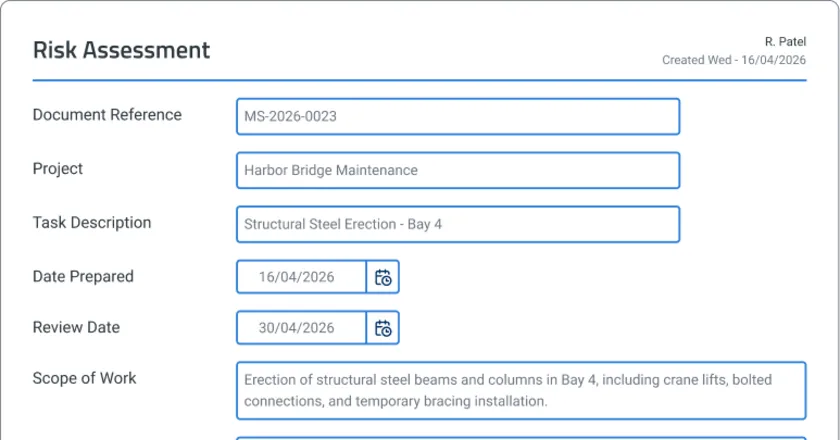
This risk assessment app makes documenting, organising and analysing risk assessments quick and easy on site and in the office. Try the app for free
View app
Safe Work Method Statement Working at Heights
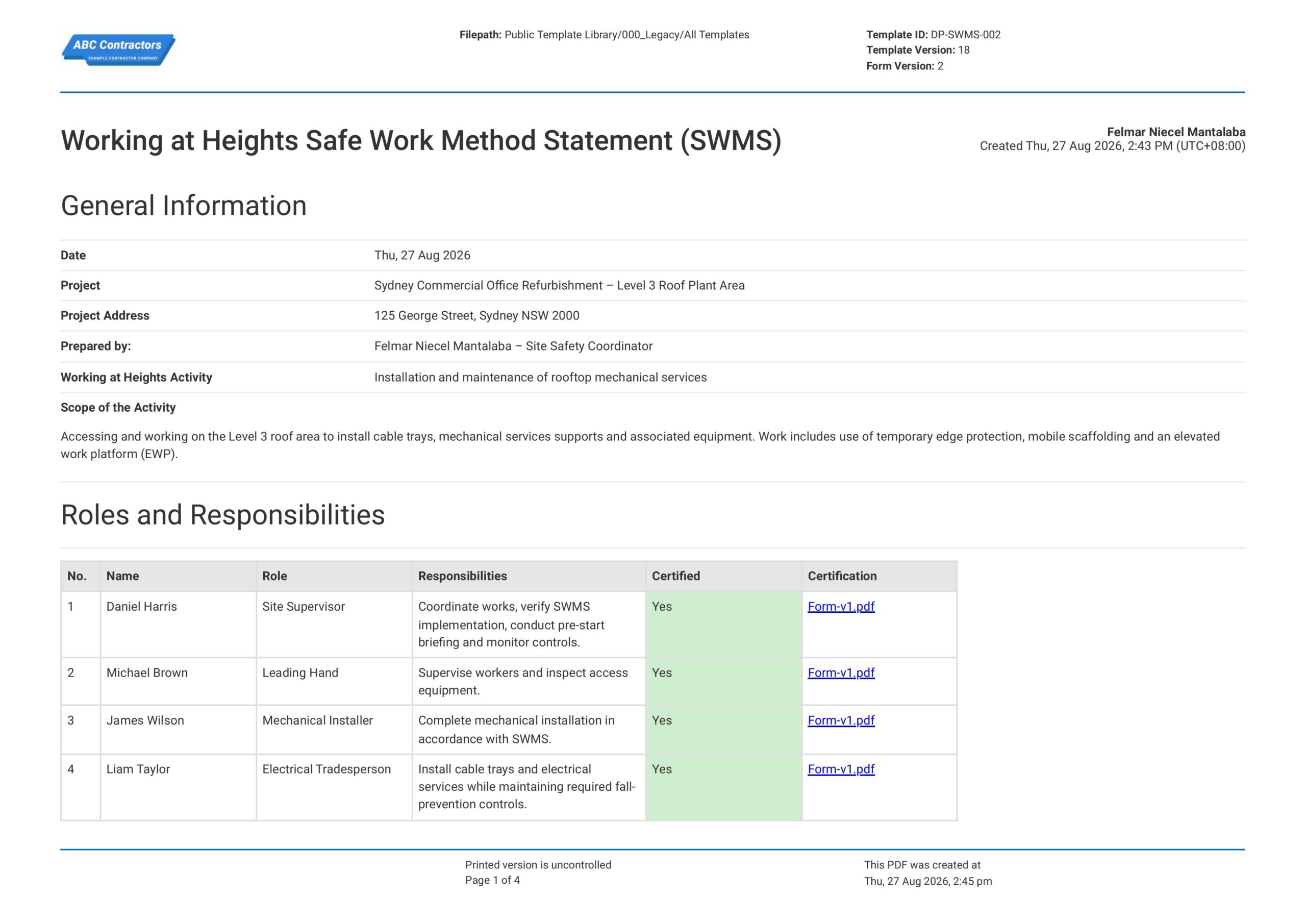
This Safe Work Method Statement Working at Heights template is free and readily available to help the team create an effective safety management system that accurately assesses hazards and provides safe instruction in
View template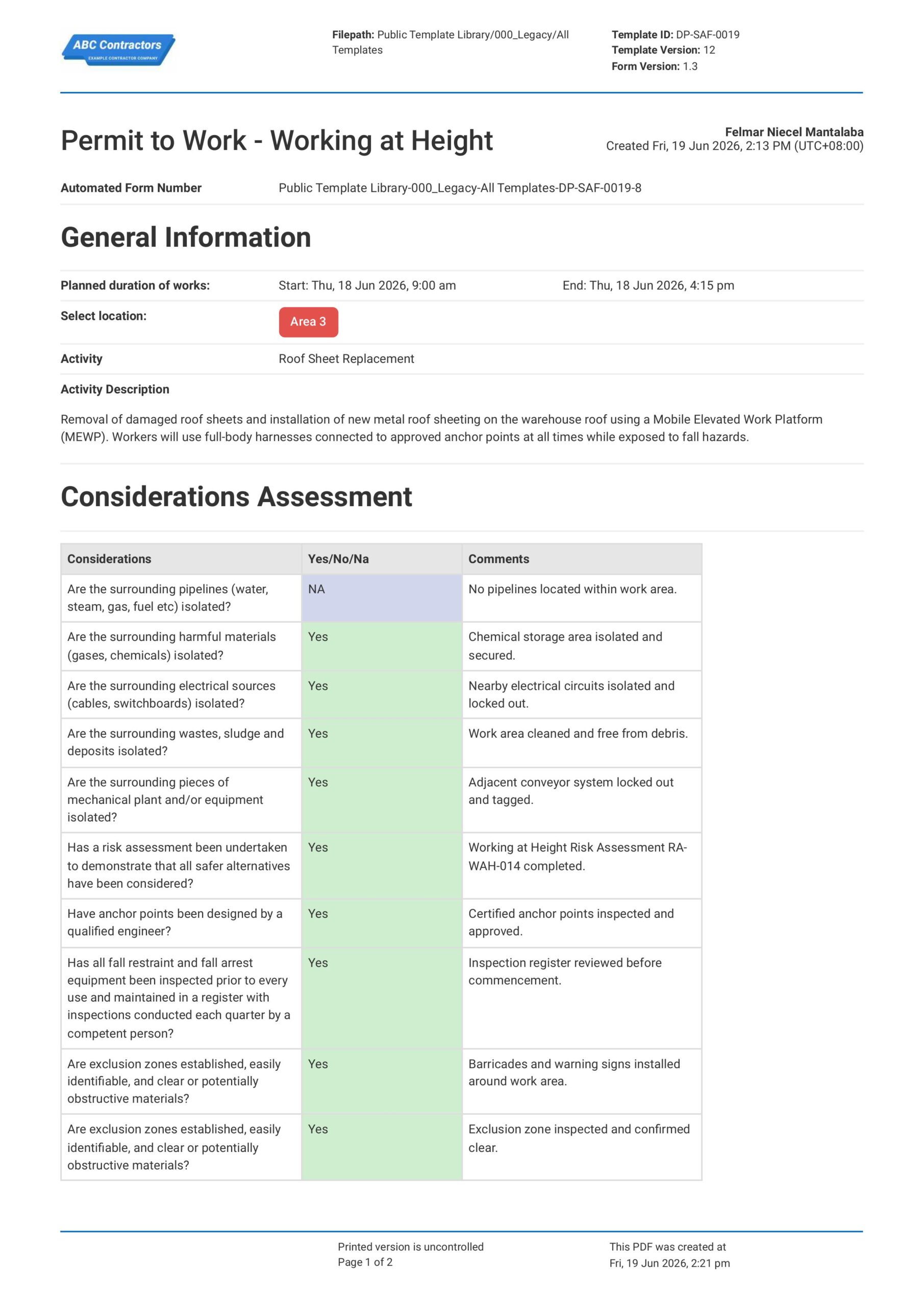
Working at Heights Permit
This free Working at Heights Permit is readily available to help streamline the permit-to-work process for activities conducted at dangerous heights. The template comes with easy-to-fill fields that reduce manual data
View templateThis form was generated with Dashpivot software
- Access, edit and complete your Working at Heights Risk Assessment from any device - mobile, tablet or computer.
- Print, download or send your Working at Heights Risk Assessment as perfectly formatted PDF documents with your company logo.
- Store your Working at Heights Risk Assessment securely online, where they can be searched and found in seconds
- Invite internal and external parties to see, edit and sign off on Working at Heights Risk Assessment online.
