Material Safety Data Sheet Template

Start with a free 30-day trial. No credit card required.
Working with hazardous substances and need a Material Safety Data Sheet you can make your own? This template comes pre-built with sections for material details, hazards, handling and storage requirements, PPE requirements, first aid measures, and emergency procedures. You can edit any part of it to match your company's processes or the substances on your site, and the document will still hold up against the regulations you'd be audited on.
This Material Safety Data Sheet, or MSDS, is an easy-to-use form that your workers can use to record important information about hazardous substances used at the workplace or project site. It keeps chemical safety information ready and accessible, even during emergencies, so your team can manage risks, handle materials safely, and share the document by exporting it to PDF or CSV.
 100% fully editable Material Safety Data Sheet
Export your Material Safety Data Sheet to PDF or CSV
Access your Material Safety Data Sheet on mobile, tablet or computer
Trusted by companies, projects and teams of all sizes















What is Material Safety Data Sheet?
A Material Safety Data Sheet is a form that engineers and site personnel use to document vital safety information about hazardous chemicals and materials used in the workplace. For example, information about chemical composition, physical properties, health hazards, fire and explosion risks, reactivity data, spill or leak procedures, and protective equipment requirements are all listed in a standard MSDS form.
GHS mandates that material safety data sheet examples follow a 16-section format that covers everything from product identification to disposal considerations. These documents are legally required to be readily accessible to all employees who work with or may be exposed to hazardous chemicals. This is especially important for emergency situations in the construction or industrial industries, where first responders depend on an expected format when looking through a safety data sheet.
Compare this Material Safety Data Sheet to traditional Word/Excel documents
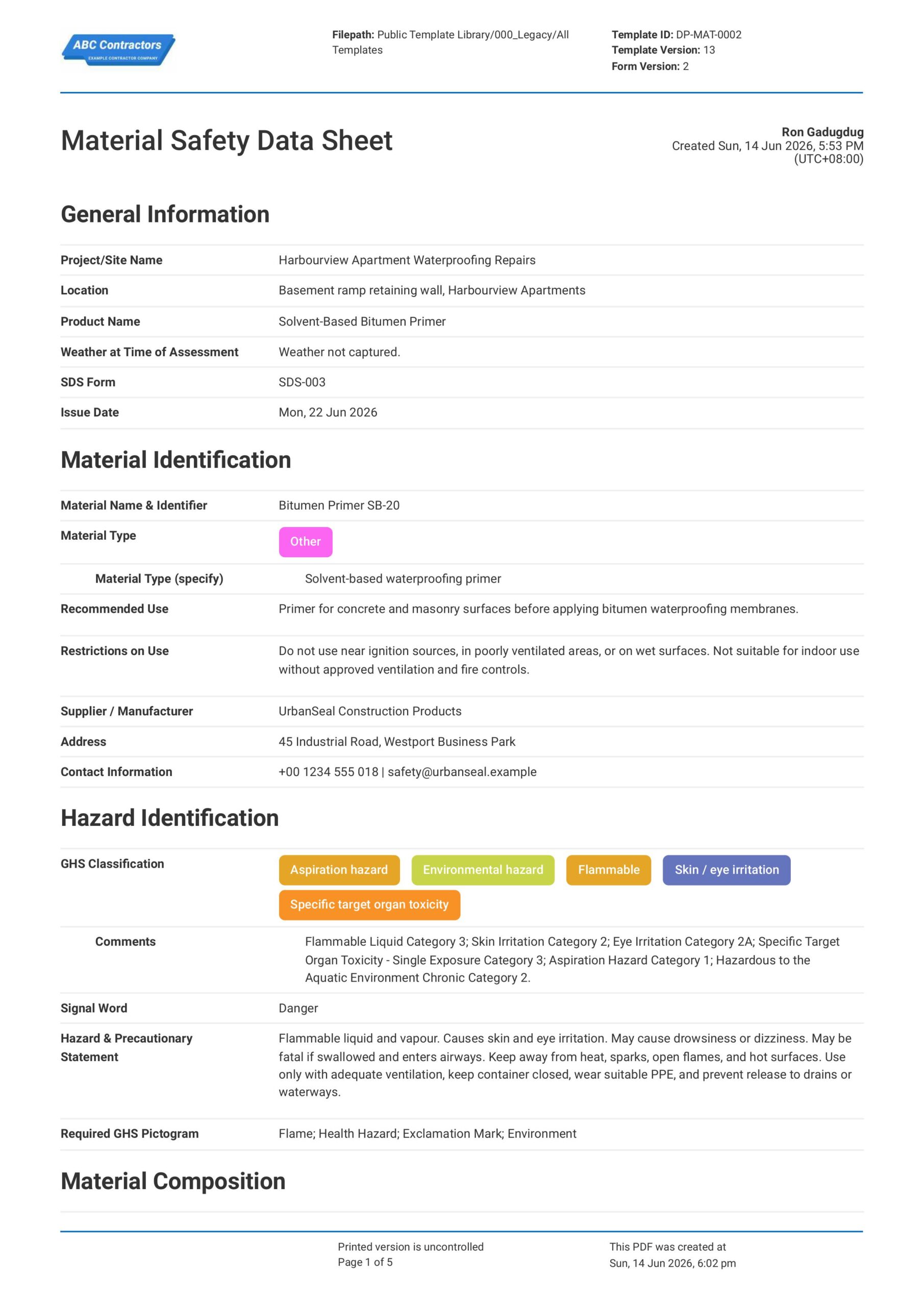
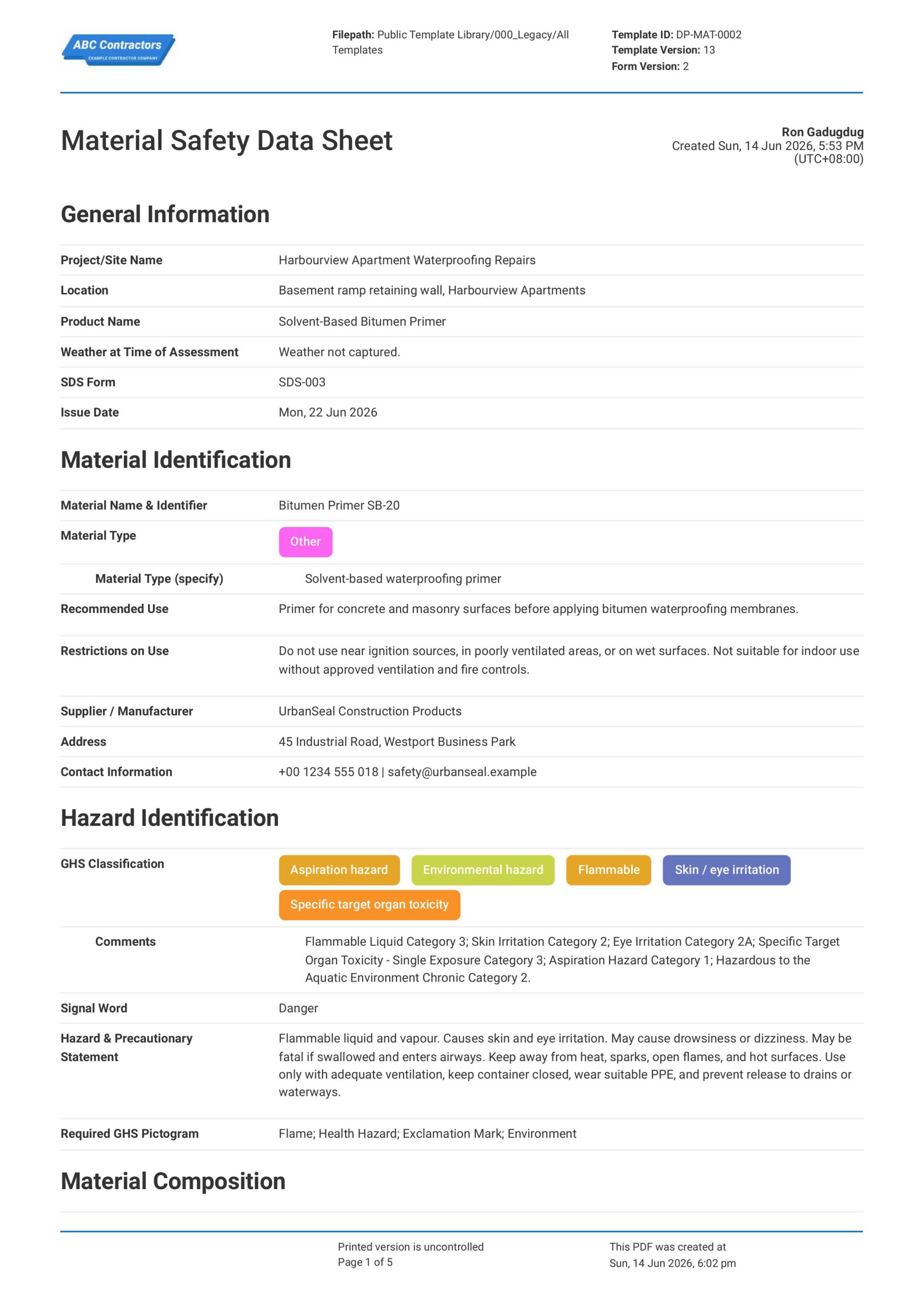
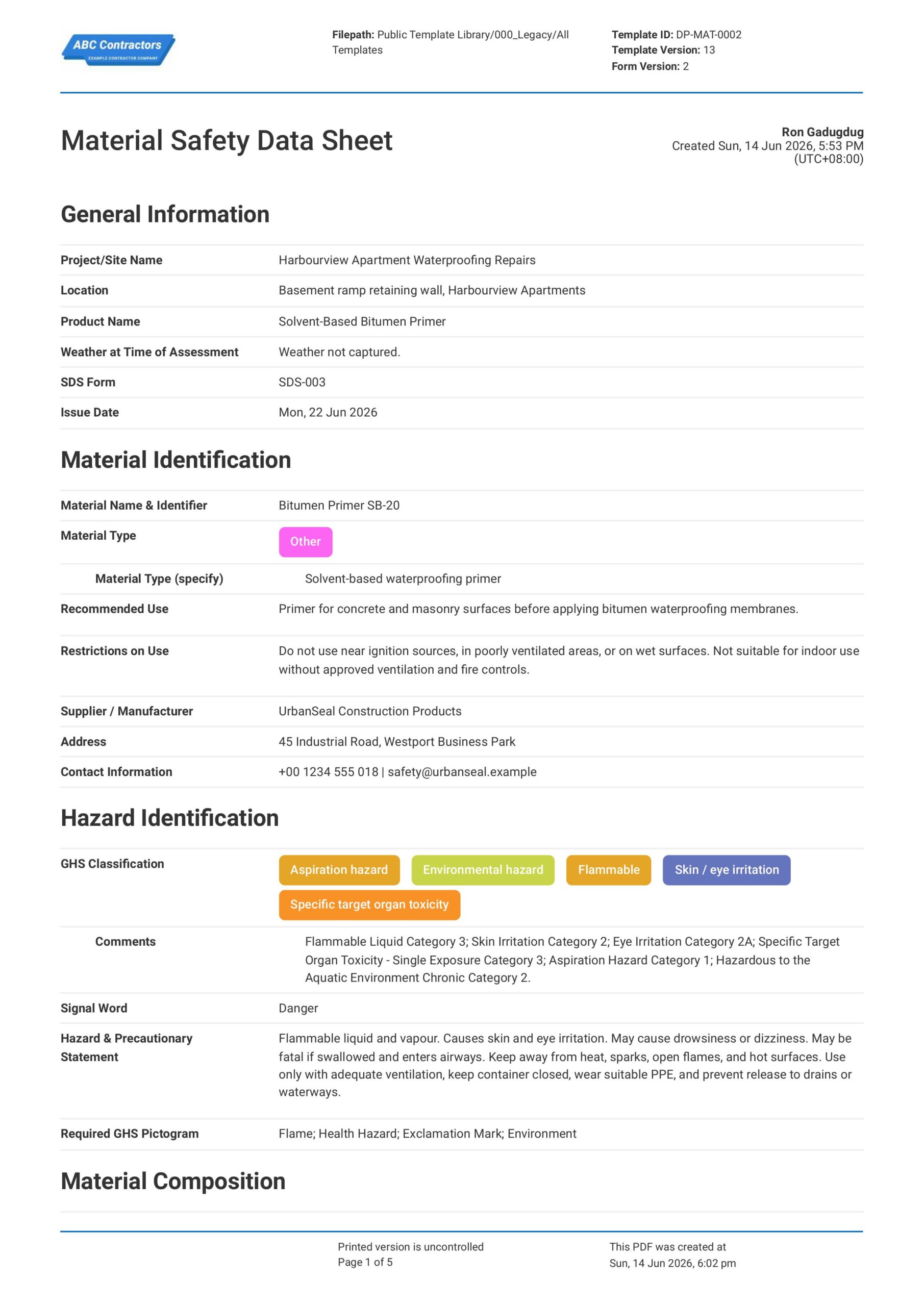
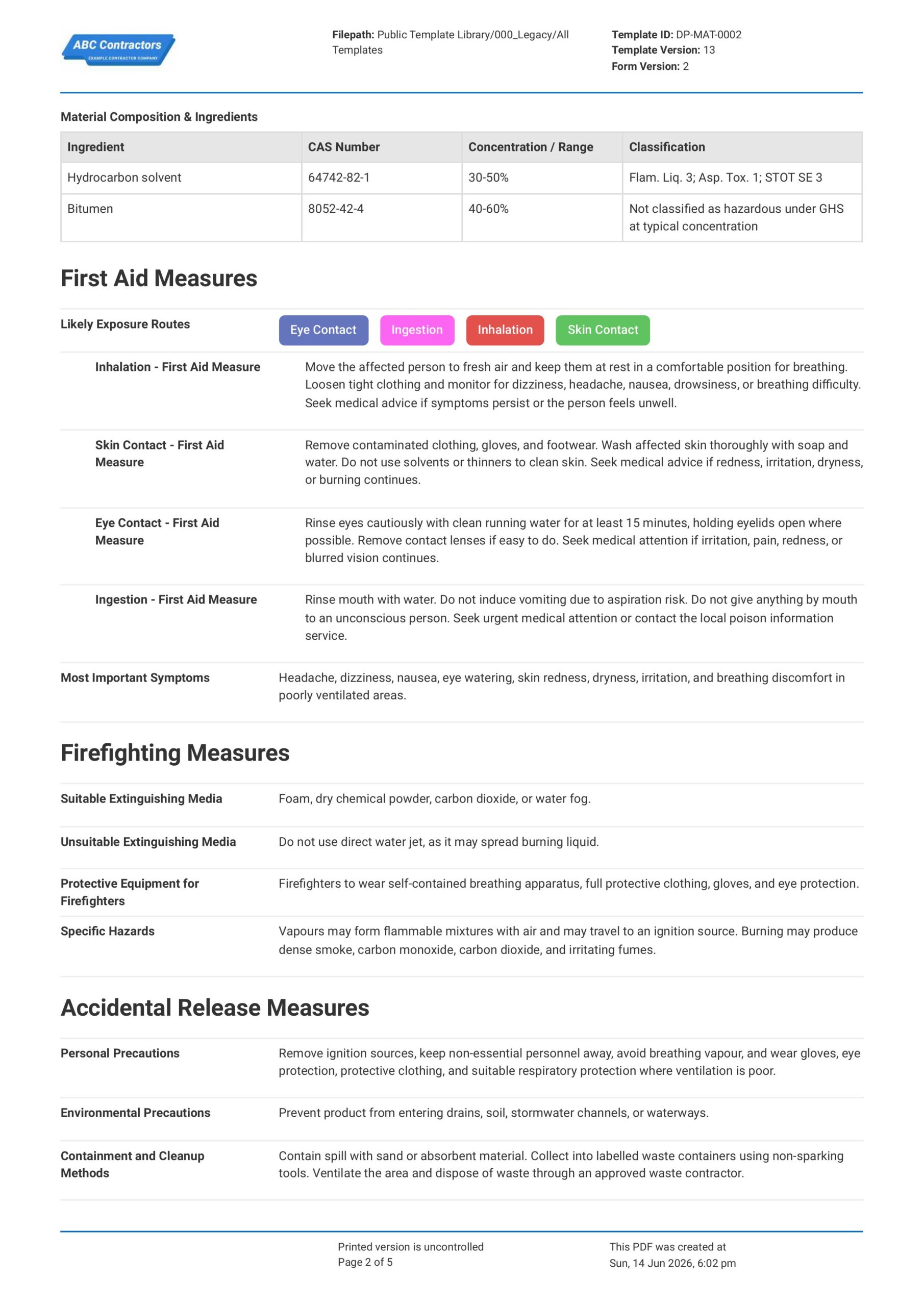
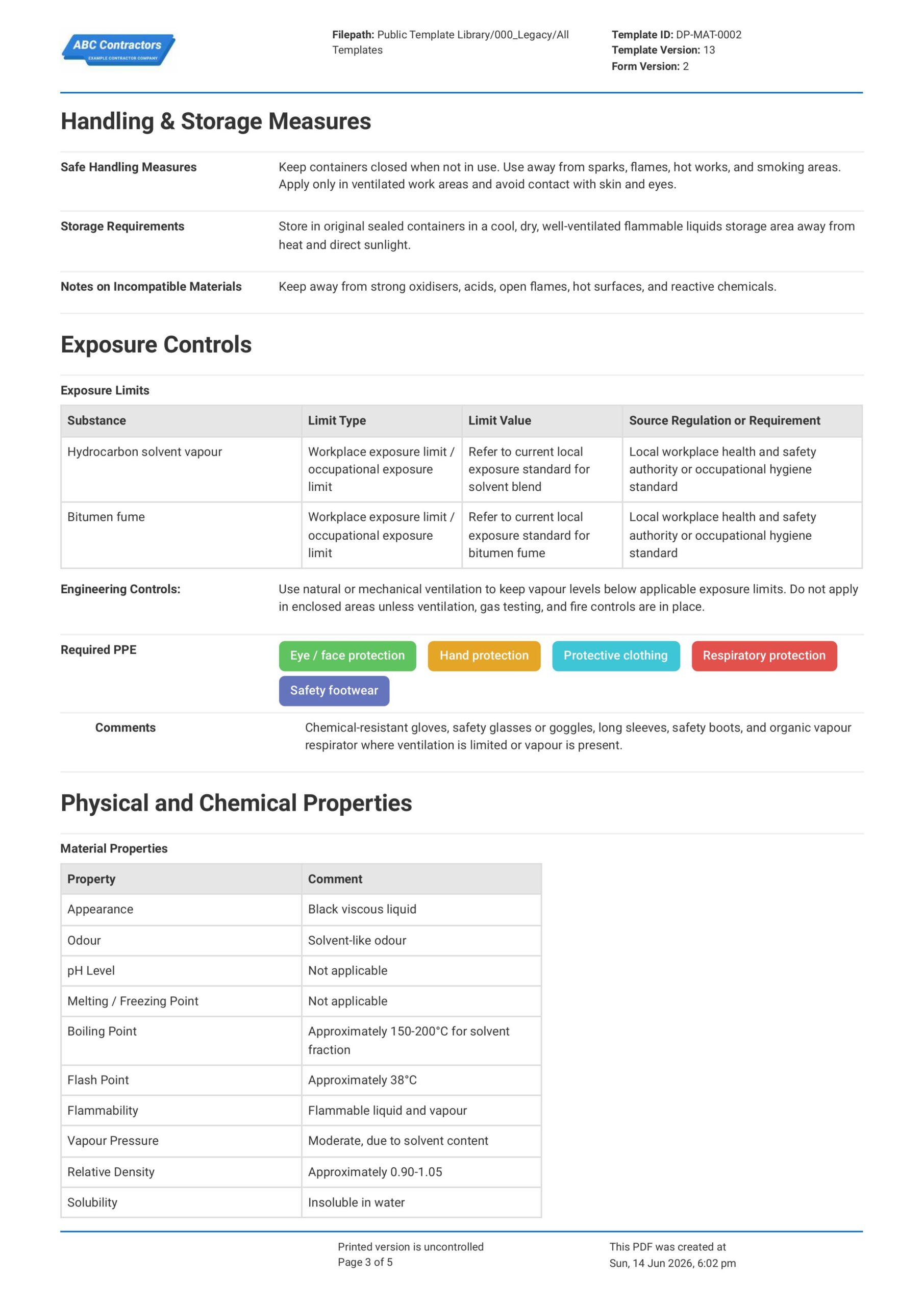
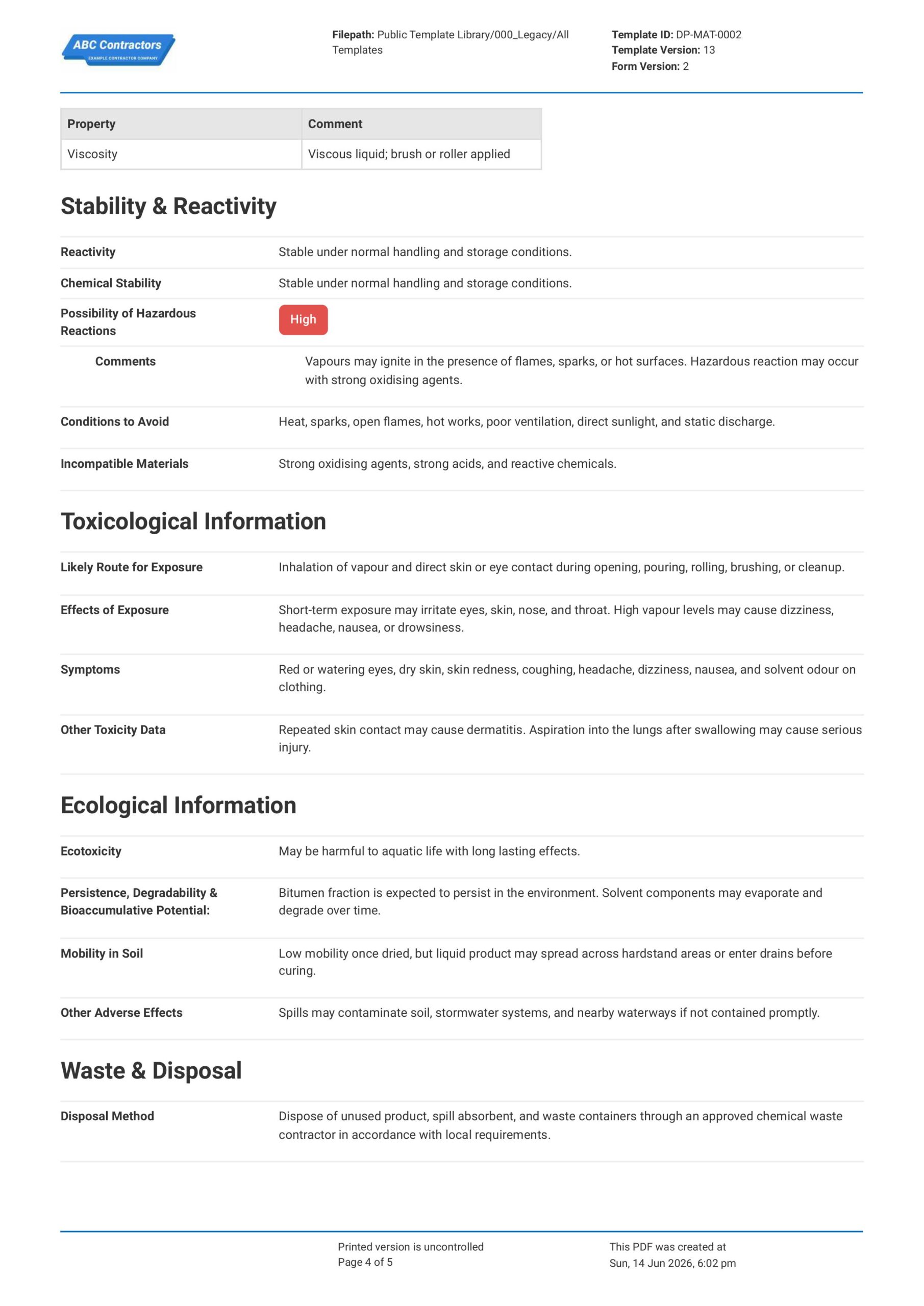
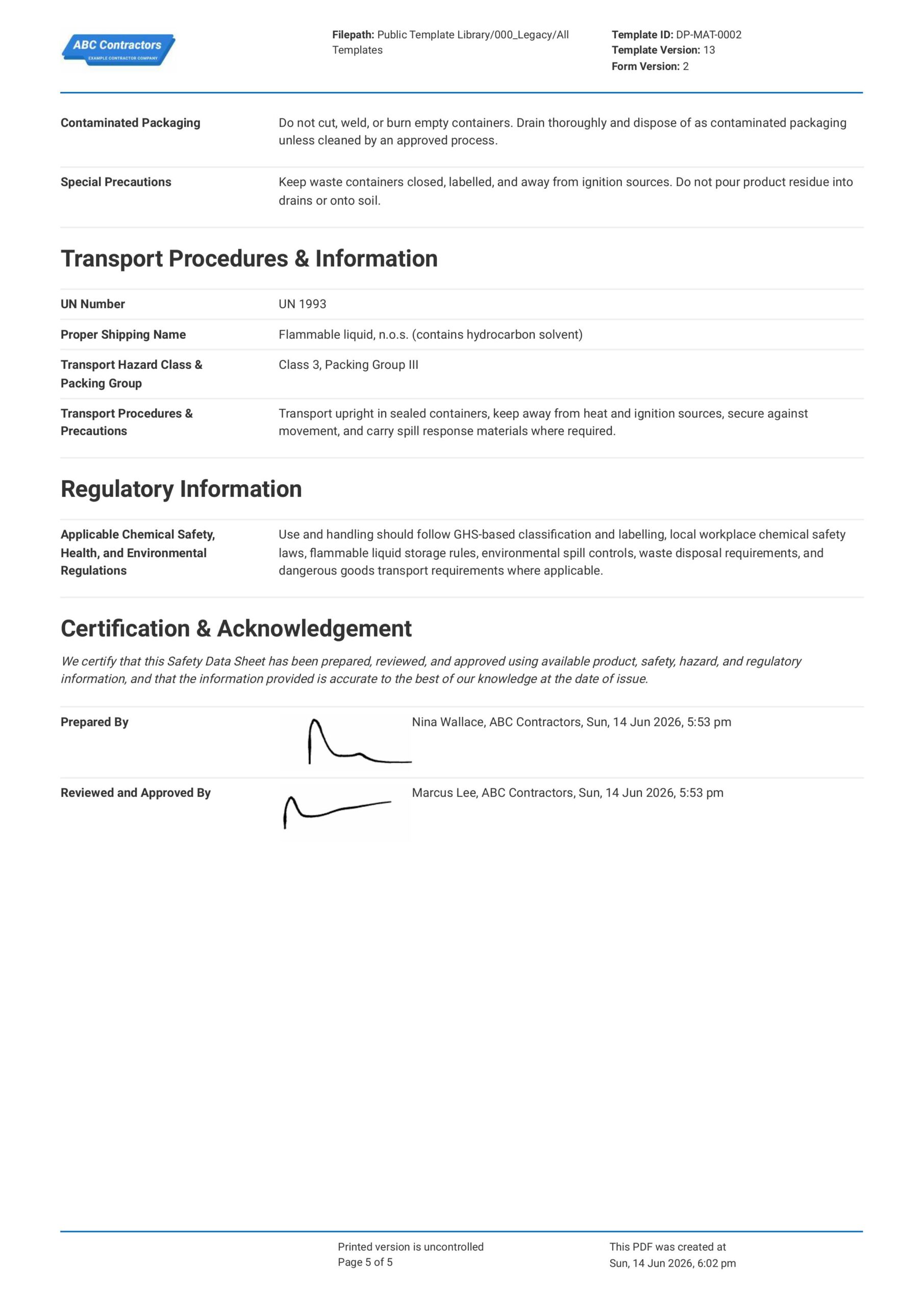
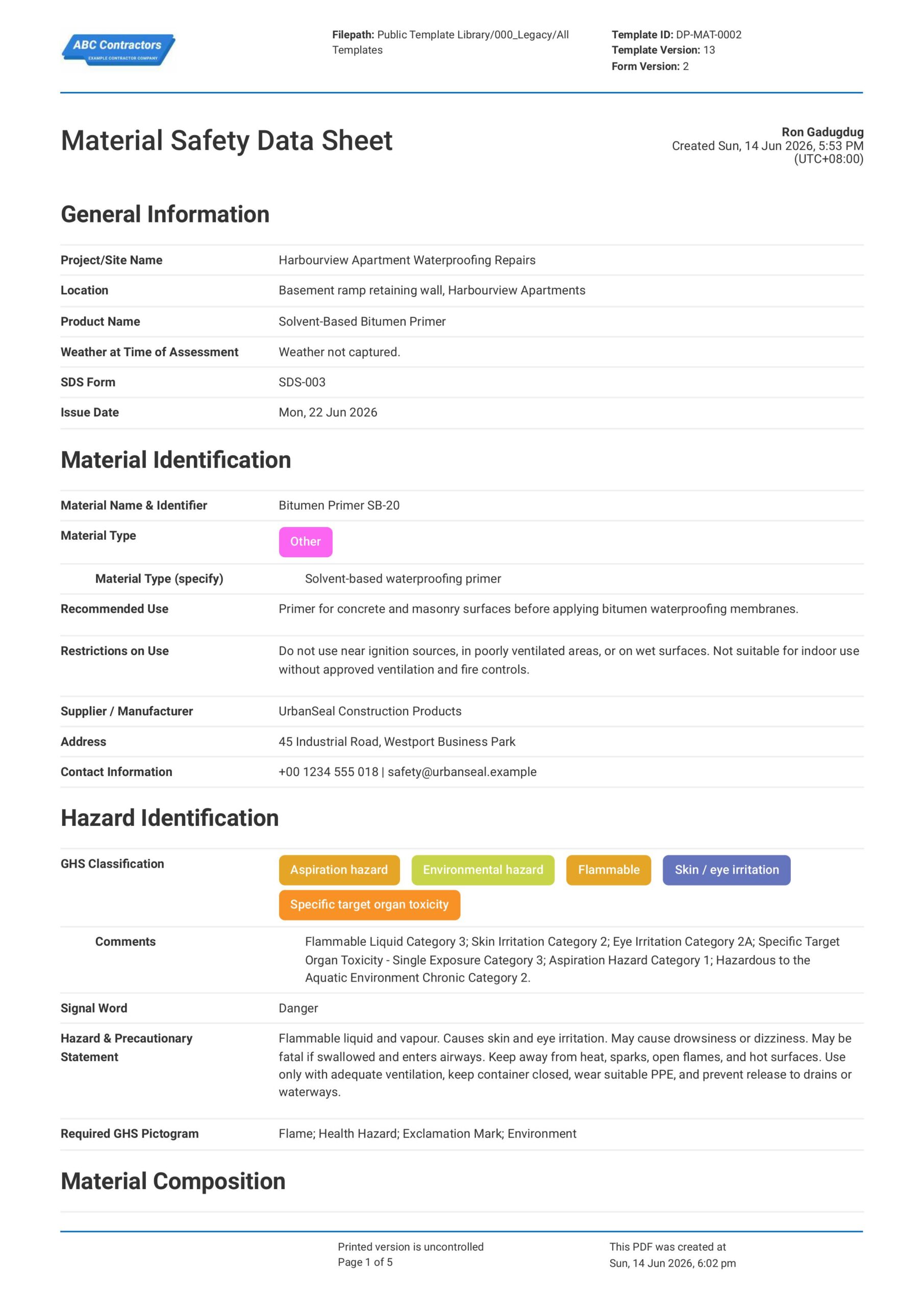
Curious how this Material Safety Data Sheet works? Check out the example below to see how hazards, handling requirements, and emergency procedures are laid out in one place. You can generate your own version, export it as a custom form with your company details, and fill in your substance information to have a ready-to-use Material Safety Data Sheet in minutes.
Use this Material Safety Data Sheet template for free

Generate this template automatically with Storm
You don't have to build the Material Safety Data Sheet field by field. Let Storm, the AI Data Capture Agent inside Dashpivot, build the template for you in seconds.
Describe what you need
Tell Storm the form you want in plain language and it builds a structured digital template from scratch, with fields, tables, and signatures in place.
Upload what you already use
Drop in your existing PDF, Word, Excel, or even a photo of a paper form. Storm rebuilds it as a smart digital template with the structure intact.
 Storm
Storm
Generate a Material Safety Data Sheet form template that I can use for my business
Applicable Standards and Policies for Material Safety Data Sheet
There are internationally accepted standards and regulations that guide the structure and use of Material Safety Data Sheets, now more commonly referred to as Safety Data Sheets (SDS). While exact requirements vary by region, most jurisdictions require SDS documents to include chemical hazards, safe handling procedures, emergency measures, and exposure controls. Here are some examples of the most common regulations that engineers reference:
- GHS supports the standard 16-section SDS format.
- OSHA Hazard Communication Standards require SDSs for hazardous chemicals.
- EU REACH requires SDSs for applicable substances and mixtures.
- WHMIS requires SDSs for hazardous workplace products in Canada.
- Local WHS laws commonly require chemical hazards to be communicated to workers.
Staff Members and Parties that use Material Safety Data Sheet
A Material Safety Data Sheet is commonly used by businesses that manufacture, store, transport, handle, or use chemicals and hazardous substances. Here are some examples of specific parties that also make use of MSDS:
- Chemical manufacturers and suppliers
- Health and safety teams
- Site supervisors and project managers
- Workers handling or storing chemicals
- Emergency responders who may need chemical hazard and first aid information during an incident
Business Risks Reduced by Material Safety Data Sheet
Using a Material Safety Data Sheet helps reduce the risk of chemical-related incidents by clearly documenting hazards, exposure controls, first aid measures, storage requirements, and emergency response procedures. This is especially important for businesses to:
- Reduce risk of chemical burns, inhalation exposure, poisoning, or environmental release
- Avoid non-compliance with workplace health and safety or chemical management regulations
- Prevent unsafe storage, handling, transport, or disposal of hazardous substances
- Lower exposure to legal claims, regulatory penalties, and incident-related costs
Business Opportunities Created by Material Safety Data Sheet
A well-managed Material Safety Data Sheet process helps businesses improve chemical safety, training, and operational control across projects and facilities. In turn, accurate and accessible SDS documentation can help businesses:
- Improve worker confidence when handling hazardous substances
- Support faster onboarding and chemical safety training
- Strengthen audit readiness and contractor prequalification
- Build trust with clients, regulators, insurers, and project stakeholders
What Should be Included in a Material Safety Data Sheet?
A Material Safety Data Sheet should primarily include clear information about the hazardous substance or chemical product involved in the work task. While SDS formats and naming conventions can vary across regions, most modern Safety Data Sheets follow a format that helps workers, supervisors, and emergency responders understand how to use the material safely, namely:
- Product and supplier identification
- Hazard identification and warning information
- Composition and ingredient details
- First aid, firefighting, and accidental release measures
- Safe handling, storage, exposure controls, and disposal requirements
What Makes a Material Safety Data Sheet Important?
Material Safety Data Sheets are important because hazardous substances are commonly used across construction, manufacturing, maintenance, cleaning, and other built-world activities. Without clear information on chemical hazards, workers may be exposed to serious health, fire, explosion, environmental, or contamination risks.
This is especially critical when handling risks can cause serious damage or loss to both property and lives. Additionally, a Material Safety Data Sheet can also support emergency response by giving first aiders, spill responders, and fire crews the information they need to act quickly when chemical exposure, spills, or fires occur at the work site.
How to Create a Material Safety Data Sheet
Creating a comprehensive Material Safety Data Sheet requires careful data collection and knowledge of the relevant regulatory requirements. In this section, we discuss important steps that will guide you in creating your own Material Safety Data Sheet.
Before creating a Material Safety Data Sheet, ensure the following items are ready.
- Product identity, intended use, supplier details, and emergency contact information are required.
- Current hazard classifications must align with applicable GHS-based requirements.
- Chemical composition, hazardous ingredients, and concentration ranges must be available.
- Safe handling, storage, transport, disposal, and emergency response information must be included.
- Applicable workplace, environmental, and transport requirements must be considered.
- SDS review and update requirements must be established for hazard, formulation, or regulatory changes.
-
Start with Product and Supplier Information
Recording product and supplier information at the beginning of the Material Safety Data Sheet helps identify the chemical, its intended use, and the party responsible for providing safety information. This section should give users enough context to confirm that they are using the correct safety data for the correct material.
- Product name and chemical identifier
- Recommended usage and restrictions on use
- Supplier, manufacturer, or importer details
- Emergency contact information
- SDS form number or revision number
-
Identify the Hazards and Composition of the Material
First, you need to identify the hazards and composition of the material so workers, site teams, and emergency responders understand what the material is made of and the risks it may create. It is important to capture the following data:
- Hazard classification under the applicable GHS system
- Appropriate signal word, hazard statements, and precautionary statements
- Relevant hazard pictograms
- Chemical name, CAS number, or other chemical identifiers
- Hazardous ingredients and concentration ranges
-
Outline Emergency Response Measures
Next, you will need to record emergency response procedures to ensure that workers know what to do if the material causes exposure, fire, or accidental release. These sections should be practical and simple to enable quick action during site or workplace emergencies. Here are some examples of the most critical information:
- First aid measures for inhalation, skin contact, eye contact, and ingestion
- Symptoms and effects requiring medical attention
- Suitable and unsuitable extinguishing media
- Specific fire hazards and protective equipment for firefighters
- Spill containment, cleanup, and disposal precautions
-
Define Safe Handling, Storage, and Exposure Controls
Safe handling, storage, and exposure control information helps prevent incidents during normal use, transport around site, and longer-term storage. Here are examples of practical workplace controls and requirements that should be covered:
- Safe handling procedures and best practices
- Storage instructions (e.g., ventilation and temperature requirements)
- Incompatible materials or substances that may cause unwanted chemical reactions
- Occupational exposure limits to workers and handlers and exposure controls
- Any required Personal Protective Equipment (respiratory, hand, eye, and skin protection)
-
Provide Technical, Stability, and Disposal Information
Next, you will need to document technical material properties to help users understand how the product behaves under normal and abnormal conditions. These details are critical for proper storage planning, compatibility checks, disposal, and emergency response, so be sure to include:
- Appearance, smell, pH, boiling point, and flash point
- Flammability, vapor pressure, density, and solubility
- Stability and reactivity information
- Hazardous decomposition products
- Waste disposal methods and environmental precautions
-
Complete Review, Approval, and Revision Control
Finalizing the Material Safety Data Sheet with review and revision control confirms that the information has been checked and is ready for workplace use. This also helps users identify whether they are relying on the most current version of the document.
- Prepared by and reviewed by details
- Date of preparation or last revision
- Summary of changes from the previous version
- Approval or authorization signature
- References to applicable standards, regulations, or source data
Frequently asked questions
How to create your Material Safety Data Sheet in an App or Software System
A well-designed Material Safety Data Sheet process ensures that your team stays on top of handling, usage, and disposal of potentially dangerous materials, while keeping documentation structured and easily reviewable and shareable.
40 minutes
Medium difficulty
-
Start your Safety Data Sheet with General Information
It is important to begin your Safety Data Sheet with the key project, site, product, and issue details so the document can be traced to the correct material and work location. This section should use simple text and date fields for fields such as:
- Text fields for Project/Site Name, Location, Product Name, SDS Form, and Weather at Time of Assessment
- Date selector field for Issue Date
- Text field for Recommended Use
- Text field for Restrictions on Use
-
Create a Section for Material Identification
Next, create a section where users can list down the material, supplier, and manufacturer details for additional context on the material in question. Be sure to add the following fields:
- Text field for Material Name & Identifier
- Dropdown field for Material Type
- Optional text field for Material Type to Specify other material types
- Text fields for Supplier / Manufacturer, Address, and Contact Information
-
Create a Section for Hazard Identification
After the material is identified, add a section that captures the product’s GHS hazard information. For simplicity, we recommend using the following fields:
- Multiple-choice selector field for GHS Classification
- Multi-line text field for any Comments
- Text field for Signal Word
- Text field for Required GHS Pictogram
- Multi-line text field for Hazard & Precautionary Statement
-
Create a Table for Material Composition
Next, we will need to provide a section where users can list ingredients and hazard details for each component of the material. We highly recommend using a table for this section, with the following formatting for the columns:
- First column for Ingredient
- Second column for CAS Number
- Third column for Concentration / Range
- Fourth column for Classification
-
Create a Section for First Aid Measures
Users will next need to input first-aid procedures to guide workers on what to do if someone is exposed to the hazardous material. Be sure to add text fields where users can input specific measures for different kinds of exposure routes, such as:
- Multiple-choice selector field for Likely Exposure Routes
- Multi-line text field for Inhalation – First Aid Measure
- Multi-line text field for Skin Contact – First Aid Measure
- Multi-line text field for Eye Contact – First Aid Measure
- Multi-line text field for Ingestion – First Aid Measure
- Multi-line text field for Most Important Symptoms
-
Create Sections for Firefighting and Accidental Release Measures
After the first aid section, add fields for fire response and spill response. These sections should be formatted in sequence for ease of use. We recommend the following fields for these sections:
- Multi-line text fields for Suitable Extinguishing Media and Unsuitable Extinguishing Media
- Multi-line text fields for Protective Equipment for Firefighters and Specific Hazards
- Multi-line text field for Personal Precautions
- Multi-line text field for Environmental Precautions
- Multi-line text field for Containment and Cleanup Methods
-
Create Sections for Handling, Storage, and Exposure Controls
Provide sections that explain how the material should be stored, handled, and controlled during use. Here are examples of fields that should help users document ventilation needs, storage conditions, incompatible materials, exposure limits, and PPE.
- Multi-line text fields for Safe Handling Measures, Storage Requirements, and Notes on Incompatible Materials
- Table for Exposure Limits with columns for Substance, Limit Type, Limit Value, and Source Regulation or Requirement
- Multi-line text field for Engineering Controls
- Multiple-choice selector field for Required PPE
- Multi-line text field for PPE Comments
-
Create a Table for Physical and Chemical Properties
Next, create a properties table so users can record the key physical and chemical details of the product. We recommend using a two-column table for this section with the following format:
- First column for Property
- Second column for Comment
- Rows for Appearance, smell, pH Level, Melting / Freezing Point, Boiling Point, Flash Point, Flammability, Vapour Pressure, Relative Density, Solubility, and Viscosity
-
Create a Section for Stability and Reactivity
Next, create a section that records the product’s stability, reaction risks, and conditions to avoid. This section is especially important for materials affected by heat, ignition sources, oxidising agents, or reactive chemicals, so be sure to add the following fields:
- Multi-line text field for Reactivity
- Multi-line text field for Chemical Stability
- Dropdown field for Possibility of Hazardous Reactions
- Multi-line text field for Conditions to Avoid
- Multi-line text field for Incompatible Materials
-
Create Sections for Toxicological, Ecological, Waste, Transport, and Regulatory Information
Next, create the supporting SDS sections that describe health effects, environmental impact, disposal, transport, and applicable requirements. Here are some examples of the most important fields that you will need to add:
- Multi-line text fields for Likely Route for Exposure, Effects of Exposure, Symptoms, and Other Toxicity Data
- Multi-line text fields for Ecotoxicity, Persistence, Degradability & Bioaccumulative Potential, Mobility in Soil, and Other Adverse Effects
- Multi-line text fields for Disposal Method, Contaminated Packaging, and Special Precautions
- Multi-line text field for Transport Procedures & Precautions, with text fields for UN Number, Proper Shipping Name, and Transport Hazard Class & Packing Group
- Multi-line text field for Applicable Chemical Safety, Health, and Environmental Regulations
-
End your Material Safety Data Sheet with Certification and Acknowledgement
Finally, complete the Material Safety Data Sheet with a certification statement and sign-off fields for the personnel preparing and approving the document. If your app or software allows, use automatic e-signature fields and include fields like:
- Pre-filled text field for Certification & Acknowledgement Statement
- E-signature field for Prepared By
- E-signature field for Reviewed and Approved By
- Company field for each sign-off
- Automatic date and time stamp fields for each sign-off
About the author

Ron Gadugdug
Content Engineer
 LinkedIn
Education
Cebu Institute of Technology - University - Civil Engineering
Bio
Ron is a Civil Engineer with 6 years of experience in the construction industry, primarily focused on quantity surveying, cost estimation, project management, quality control, contract administration, and property & engineering insurance. At Sitemate, he writes about practical applications of evolving technologies and digital solutions that support construction professionals in improving efficiency, compliance, and project delivery across the built world.
Past Projects
Quantity Surveying & Cost EngineeringPerformed quantity take-offs of several high-rise and horizontal structures using sheets and applications like Revit and Bluebeam Revu, and spearheaded trials with Building Information Modeling (BIM) software.
Project Management & ConsultancyCoordinated with project management teams during the construction of local projects such as a 4-tower hotel & resort, a 22 storey condominium project, and a school dormitory project.
Contract AdministrationAssisted during contract biddings and negotiations with general contractors and sub-contractors, and oversaw progress reporting, billings, and payment.
Property & Engineering InsuranceDedicated non-life claims handler, overseeing property and contractor all-risk insurance claims, risk management, and bonds.
Version History:
Related apps and templates
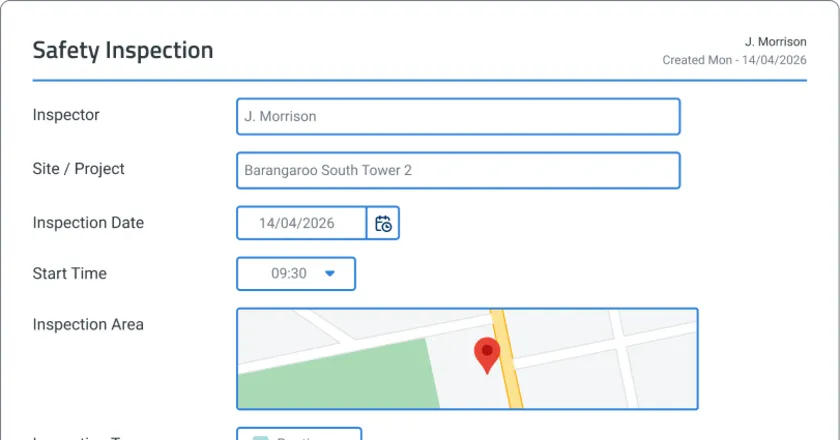
Safety Inspections App
Safety inspections app template that turns voice notes and photos into completed compliance reports on-site. GPS tagging, AI drafting, corrective
View app

Labor Equipment Material Form
This Labor Equipment Material (LEM) form is free and readily available to record the daily labor, equipment, and materials cost in a project. It features easy-to-fill tables that users can effortlessly use to provide
View templateLabor Equipment Material Template
This Material and Labor Invoice is free and readily available to record the daily LEM cost in a project. It features easy-to-fill tables that users can effortlessly use to provide the required data for the day-to-day
View templateThis safety data sheet was generated with Dashpivot software
- Access, edit and complete your Material Safety Data Sheet from any device - mobile, tablet or computer.
- Print, download or send your Material Safety Data Sheet as perfectly formatted PDF documents with your company logo.
- Store your Material Safety Data Sheet securely online, where they can be searched and found in seconds
- Invite internal and external parties to see, edit and sign off on Material Safety Data Sheet online.
