Risk Assessment for Excavation Template

Start with a free 30-day trial. No credit card required.
This free and downloadable Risk Assessment for Excavation template is fully ready to help streamline the risk assessment process, since it provides a more structured and targeted checklist, considers environmental factors, and integrates proper risk scoring for hazards to provide appropriate controls.
Want a faster approval process? Immediately inform users, reviewers, and approvers using the notification feature for risk assessment for excavation activities. Immediate notification and a structured signing of the form enable faster approval and implementation of controls to eliminate hazards.
 100% fully editable Risk Assessment for Excavation
Export your Risk Assessment for Excavation to PDF or CSV
Access Excavation Safety Assessment on mobile, tablet or computer


Trusted by companies, projects and teams of all sizes















What is Risk Assessment for Excavation?
A Risk Assessment for Excavation is a template used for a risk assessment process specifically designed for excavation activities. It evaluates each procedure and the environment of the excavation activity for any possible hazards that could potentially harm both workers and pedestrians alike. The identified hazards are scored based on the risk scoring matrix, and they are then provided with the appropriate safety control measures to effectively eliminate or mitigate their effects. The risk assessment form will serve as both written documentation and evidence for compliance with regulations.
Preview this Risk Assessment for Excavation and download for free
In today's modern world, traditional paper-based methods have become outdated. Aside from the fact that using them would require a substantial amount of time to create and complete, they also fail to capture critical data that are required for the risk assessment, which would compromise the needed measures to protect employees from hazards.
Using modern methods, like digital forms, is the perfect solution for the paper-based forms. They reduce manual data entry and streamline the creation process of the forms by using advanced tools like drag-and-drop builders. Digital forms can also easily capture accurate data like the precise location, real-time photos, and vital attachments. To better understand how digital processes work for risk assessments, visit the Risk Assessment for Excavation example below.
Use this Risk Assessment for Excavation template for free

Generate this template automatically with Storm
You don't have to build the Excavation Risk Assessment field by field. Let Storm, the AI Data Capture Agent inside Dashpivot, build the template for you in seconds.
Describe what you need
Tell Storm the form you want in plain language and it builds a structured digital template from scratch, with fields, tables, and signatures in place.
Upload what you already use
Drop in your existing PDF, Word, Excel, or even a photo of a paper form. Storm rebuilds it as a smart digital template with the structure intact.
 Storm
Storm
Generate a Excavation Risk Assessment form template that I can use for my business
Applicable Standards and Policies for Risk Assessment for Excavation
A Risk Assessment for Excavation is a form that is not only needed internally in a company but also a needed requirement for safety regulatory bodies as well.
USA
- OSH Act of 1970 (General Duty Clause): The mandate requires employers to provide a safe and healthy environment for the employees.
- 29 CFR 1926 Subpart P—Excavations: These provisions have standards with regard to excavation and trenching activities, which include safety measures, soil classification, and safe emergency exits.
Canada
- Canada Labour Code Part II: This legislation establishes a primary duty of employers to keep employees safe and protected.
Australia
- Work Health and Safety (WHS) Act: A standard that provides the definition of duties to health and safety, which includes risk management.
- Model Code of Practice for Excavation Work: This is a regulation that provides a guide that helps identify and control hazards found in excavation activities.
New Zealand
- Health and Safety Work Act 2015: This provision has requirements regarding eliminating workplace hazards.
- Best Practice Guidelines for Excavation: This standard provides guidance on best excavation safety processes and practices.
UK
- Health and Safety at Work, etc. Act 1974: This standard establishes duties and responsibilities for maintaining a safe workplace.
- HSE Guidance HSG150: This provision addresses the risks associated with excavation activities. It requires employers to plan, manage, and control these risks to ensure a safe working environment.
Ireland
- Safety, Health, and Welfare at Work Act 2005: This is a mandate that requires employers to effectively manage workplace hazards and risks.
- Safety, Health, and Welfare at Work Act 2013 (Construction): This standard provides regulations on the proper safety measures in construction, including excavation activities.
Staff Members and Parties that use Risk Assessment for Excavation
Completing risks assessments typically requires several people to complete the process. This requirement is crucial for identifying all hazards, particularly the critical ones, and implementing controls to accurately target them. These are the staff members who are required to join the risk assessment process:
- Operators: These are the employees who personally drive the equipment. Their input to the risk assessment is quite crucial since they are the people who are at the frontline with the hazards. Their exposure to the hazards allows them to easily identify them, therefore ensuring the safety controls manage them.
- Supervisors and Managers: Overseeing work and processes are the main focus of their jobs. Their role also includes planning and managing safety in the workplace, which is why it is their responsibility to initiate the risk assessment process. These personnel should always initiate a risk assessment meeting for high-risk activities, such as excavation.
- Safety Officers: Their primary responsibility is to implement the best safety practices in the workplace. Part of their role involves evaluating the safety control measures, which is why it is a necessity that safety officers are included in the risk assessment process. Their involvement ensures that the best and accurate safety control measures are provided to control and manage the hazards.
Business Risks Reduced by Risk Assessment for Excavation
The Excavation Risk Assessment is not just an ordinary document that businesses keep on file. It serves a more critical purpose than just being a record and a compliance document. The Risk Assessment for Excavation also protects businesses and establishments from any business risks that could potentially impact important assets, their overall financial structure, and reputation. Regularly conducting the risk assessment process helps avoid the following business risks:
- High incurred costs for equipment damage
- High incurred costs for accidents and fatalities
- High incurred costs for reworks
- High incurred costs for fees accumulated from non-compliance with regulatory bodies
- Projects delays
- Harmed company reputation for lack of safety responsibility
- Harmed relationships between employer and employee
Business Opportunities Created by Risk Assessment for Excavation
Rigorously implementing the risk assessment process for excavation not only protects employees and other assets but also provides businesses and establishments benefits. Meeting their moral and legal obligations to keep everyone safe in the workplace would surely return as a bonus to employers in the form of business opportunities, which would help maintain a healthy reputation and financial standing. Here are the business opportunities created by frequently conducting risk assessments for excavation:
- Better advantage to win projects
- Low operational costs
- Insurance premiums are reduced
- Improved productivity due to consistent and better safety processes
- Stronger relationships with clients and stakeholders
- Stronger relationships with employees
- Good brand standing and trust
Ground stability considerations for excavation risk assessments
Before conducting the risk assessment process for excavation and ensuring a smoother workflow, it is essential to first assess these considerations in order to easily identify hazards:
- The excavation area should be identified and marked
- Underground services should be located and identified
- Soil type must be assessed
- Trench walls should be rigid and supported
- There should be no signs of ground or soil movement
- Spoil piles and equipment must be kept away from excavation edges
- Water accumulation must be prevented
Risk Assessment for Excavation Purpose
Excavation activities involve powerful and useful machines used for digging, demolition, and construction. But these machines have inherent dangers that could harm or kill those who work with or near them. To eliminate or mitigate these hazards, a risk assessment is needed. Below are the reasons why a risk assessment achieves them.
An Excavation Risk Assessment form aids in preventing injuries and fatalities
A risk assessment for excavation meticulously assesses hazards in every procedure in an activity. This means that for each step in an activity, all potential risks are identified and appropriate measures are implemented to ensure that no danger arises, thereby maintaining safety at all times.
Avoid property and asset damage through proper safety management
A risk assessment considers the safety of workers and the public. It also protects all equipment and other company assets related to the excavation activity. The assessment will also take note of the risks that could potentially damage or destroy company assets and provide them with appropriate control measures.
Ensure the correct people are assigned
Untrained personnel can create many hazards. Without proper training and certification, personnel might lack the skill and knowledge to take part in the excavation activity. A risk assessment can consider this situation and guarantee the appointment of only trained and certified personnel. The aim is to consistently uphold safety in all excavation operations.
How to Create a Risk Assessment for Excavation?
This is a step-by-step guide to creating a Risk Assessment for Excavation. It includes all critical and necessary steps to create a complete, comprehensive, and compliant Excavation Risk Assessment.
Prerequisites before making a Risk Assessment for Excavation
- Plan and maps of the excavation site
- Soil assessment records and report findings
- Weather condition assessment
- Equipment functionality records
- Emergency procedures
-
Include an environmental and site considerations survey
This section contains the following assessments to ensure everything is ready before activity execution:
- Evaluation of the site if it’s prepared for the excavation activity
- Evaluation of all involved equipment to see if it’s prepared for the activity
- Evaluation of all personnel to see if they are qualified and ready for the excavation activity
- Evaluation of isolated pedestrians and traffic routes affected by the activity
-
Making the risk assessment
The risk assessment section should present the following fields to ensure compliance and completeness:
- Identified hazards
- Potential Impact
- Likelihood score
- Severity Score
- Risk Rating
- Control Measures
-
Include an emergency plan
This will be the section that provides a guide on what to do in an emergency scenario. It should include the following:
- Emergency procedures
- Emergency Contacts
- PPE for rescue
-
Monitoring and review
To maintain the effectiveness of controls, the following must be conducted:
- Establish frequent inspections.
- Update the assessment when site conditions, process, and standards change.
- Record any near misses
- Frequent review of safety controls
Frequently asked questions
How to create Excavation Risk Assessment in an App or Software System
Digital Excavation Risk Assessment tools transform traditional paper-based processes by enabling real-time data collection, automated compliance checking, and instant communication of critical safety information. These platforms integrate GPS mapping, weather monitoring, and utility databases to provide comprehensive situational awareness throughout the excavation lifecycle. The digital approach also facilitates better coordination between multiple stakeholders, including utility companies, regulatory agencies, and emergency responders, while maintaining complete audit trails for compliance documentation.
45 minutes
Medium difficulty
-
How to make a Risk Assessment for Excavation in an app
Creating templates in an app may significantly speed up the process of creating and filling out the Excavation Risk Assessment. The following can be performed with an app:
- Creates a more professional and structured template.
- Reduces handwritten data entry.
- Creates a single source of access for all generated forms.
- Providing easy reformatting to comply with new protocols or updated standards.
- Allows simple formula integration
-
Creating the information section
This section contains information about the details and scope of the project and activities. This section contains the following information fields:
- Date and time of risk assessment
- Project name
- Location
- Activity
- Description of work
-
Setting up the Persons Involved section
This field offers information on who is involved in the project and whether they are ready for the excavation activity.
Create an eight-column table that allows users to add rows repeatedly.- In the first column, include a formula that automatically numbers the rows.
- The second column should allow users to enter the names of the personnel involved.
- The third column should allow users to enter the ID numbers of the personnel involved.
- The fourth should enable users to specify the position of the individuals involved.
- The fifth column should provide users with choices for verifying if staff have been trained.
- The sixth column should include selections for users to determine whether personnel are physically fit for the task.
- The seventh column should include selections for users to confirm whether the employee has signed the permit to work (PTW).
- The final column should provide users with options for verifying whether personnel have all of the necessary personal protective equipment (PPE) for the activity.
- The list of options in columns 5-8 can be enhanced with different hues to improve the form’s appearance.
-
Drafting the considerations section
This section includes a checklist of the preparations required prior to the excavation activity
- Generate a table with four columns.
- Add rows for each necessary consideration required prior to the activity.
- The second column should indicate whether the consideration was completed, omitted, or inapplicable to this activity.
- The third column should provide a list of action items for considerations that were not implemented.
- The fourth column should allow people to leave comments and recommendations.
- Columns containing selection lists can be enhanced with hues to make the area more professional and appealing.
-
Making the risk assessment section
This is the template’s most important part, where hazards are identified, assessed, and controlled.
- Provide a risk assessment matrix to help users understand how to evaluate hazards.
- Create an eight-column table that allows users to add rows repeatedly.
- In the first column, include a formula that automatically numbers the rows.
- The second column should allow users to enter the identified hazards.
- The third column should allow users to input the potential impact of each hazard found.
- The fourth column should let users rate the likelihood of the hazard.
- The fifth column should allow users to rate the outcome of the hazard.
- The sixth column should automatically generate the risk score for each hazard. This section can include a formula: Risk Score = Likelihood x Consequence.
- The seventh column should allow users to enter the necessary control measures for addressing the hazard.
- The last column should allow users to see if the control measures have already been deployed.
- To make the section more engaging, include a color-coded selection list in the fourth, fifth, and last columns.
-
Creating the emergency management plan section
This section describes how to manage actual crises in the event of a working-at-heights accident.
- Create a field in which users can provide a detailed emergency rescue plan. This field should support multiple lines of text.
- Create a table with emergency contact information. It should include the following information: emergency contact, company or agency, phone number, and location.
- Make a table of personal protective equipment (PPE) used during rescue operations. It should consist of the following: PPE information includes the location, availability, date of last inspection, and department in charge.
- The column with PPE availability can be a selection list with colors to make the area more visually appealing.
-
Adding the signatories section
This is the section that provides evidence that the assessment was completed, reviewed, and approved. It should contain the following signatures:
- Person completing the risk assessment
- Person reviewing the risk assessment
- Person approving the risk assessment
About the author

Felmar Mantalaba
Content Engineer
 LinkedIn
Education
Cebu Institute of Technology - University - Mechanical Engineering with Mechatronics
Bio
Felmar is a mechanical engineer, whose four years of experience in the mining industry inspired him to write and share stories to progress the revolution of new technologies and create smarter, smoother ways of living.
Past Projects
Safety, Health, and Environment Management System (SHEMS) CoordinationSHEMS Coordinator at Atlas Consolidated Mining, ensuring organizational compliance with ISO 14001 and ISO 45001 standards, performing risk assessments, developing policies, and conducting audits and inspections to maintain a safe and environmentally responsible workplace.
Maintenance Management and OptimizationSenior Maintenance Manager (OIC) leading equipment maintenance and operational efficiency initiatives, reducing downtime by 10%, improving Mean Time Between Failure (MTBF) and Mean Time To Repair (MTTR) for major equipment, and managing maintenance schedules, manpower, and materials, while overseeing capital project optimization.
Inspection Engineering and Equipment ReliabilityInspection Engineer responsible for technical blueprint interpretation, vendor collaboration, preventive maintenance scheduling, and data collection for vibration and temperature readings, delivering actionable recommendations and comprehensive reports to improve equipment reliability and operational performance.
End-to-End Operational Oversight in Mining EngineeringContributed to multiple facets of operational management, including SHEMS compliance, maintenance optimization, inspections, and capital project evaluation, integrating safety, reliability, and efficiency improvements across all stages of copper production operations.
Version History:
Related apps and templates
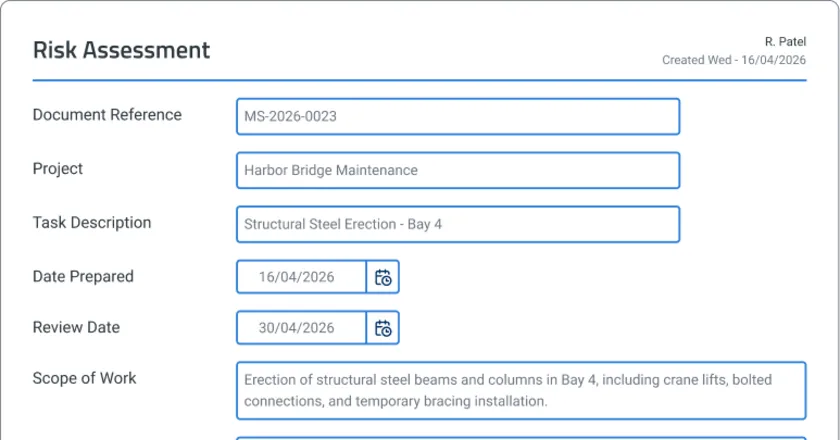
Risk Assessment Software
Risk assessment software template that captures voice notes and photos on-site, with AI drafting compliance reports instantly. Try Sitemate
View app
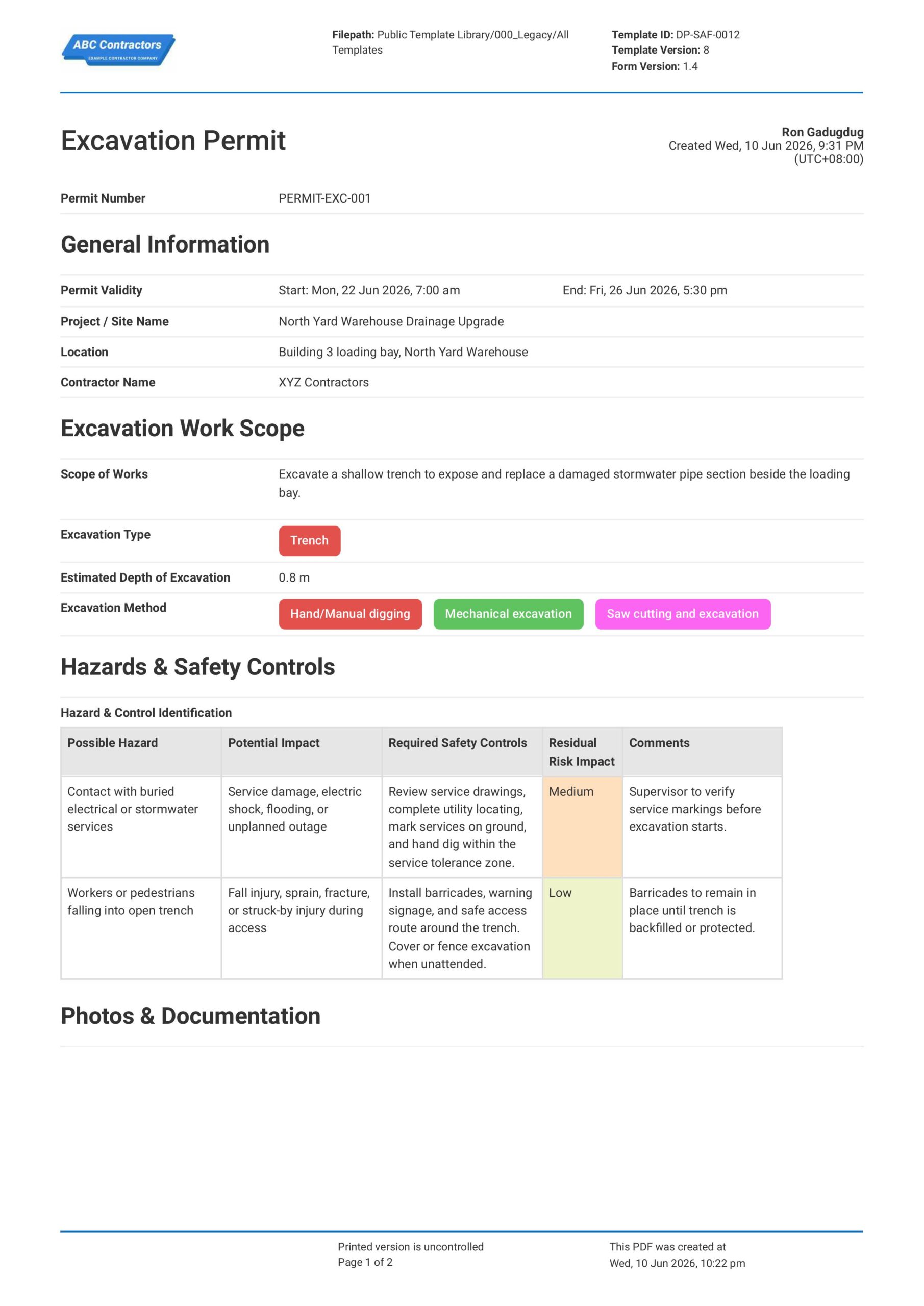
Excavation Permit
This Excavation Permit is an easy-to-use form that your workers can use to request, review, and approve excavation work before digging begins. Record important excavation details such as the work location, excavation
View template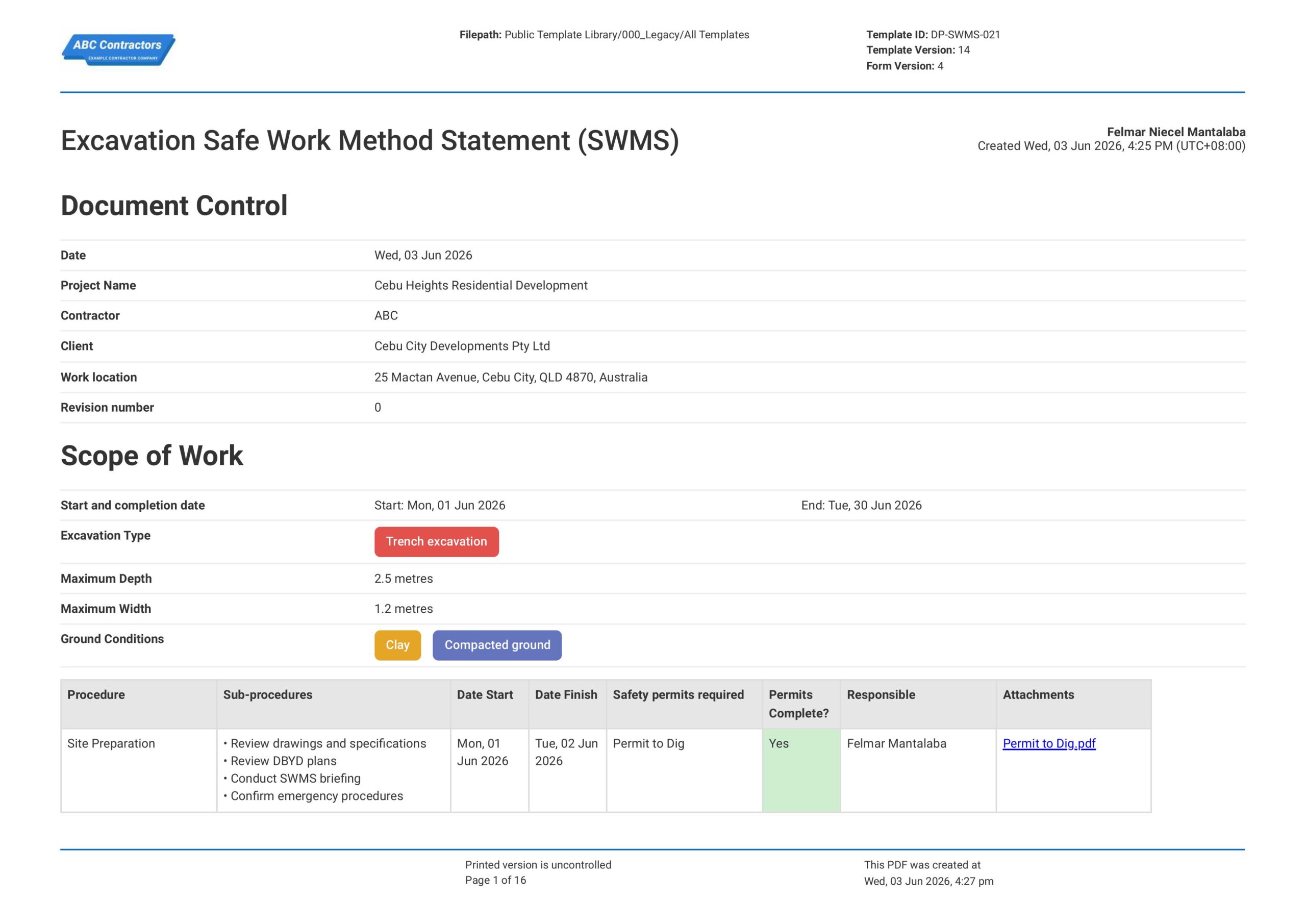
Excavation Safe Work Method Statement
This free Excavation Safe Work Method Statement is comprehensively designed to ensure excavation activities are safely conducted and are compliant with safety regulations. The template also features easy-to-fill fields,
View templateThis form was generated with Dashpivot software
- Access, edit and complete your Excavation Risk Assessment from any device - mobile, tablet or computer.
- Print, download or send your Excavation Risk Assessment as perfectly formatted PDF documents with your company logo.
- Store your Excavation Risk Assessment securely online, where they can be searched and found in seconds
- Invite internal and external parties to see, edit and sign off on Excavation Risk Assessment online.
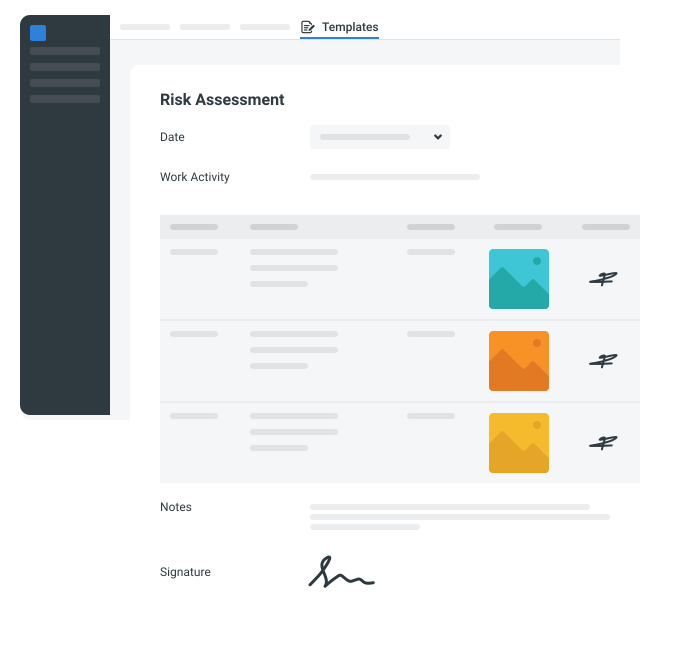
 English (United States)
  English (Australia)
  English (UK)
  English (New Zealand)
  English (South Africa)
  German