Safe Work Method Statement Roofing Template

Start with a free 30-day trial. No credit card required.
Need a Safe Work Method Statement Roofing your crew can pick up and use straight away? This template comes pre-written with the job steps, hazards, and risk controls most commonly required for roofing work, including tasks performed at height on residential and commercial buildings. You can edit any part of it to reflect your company's specific methods, equipment, and site conditions, and the document will still hold up against the legal obligations and audit standards that apply to high-risk construction work.
This Safe Work Method Statement Roofing is an easy-to-use form that your workers can use to identify and document the hazards involved in roofing activities, confirm the controls in place to manage those risks, and demonstrate that everyone on site has been briefed and understands their responsibilities before work begins.
 100% fully editable Safe Work Method Statement Roofing
Export your Safe Work Method Statement Roofing to PDF or CSV
Access your Safe Work Method Statement Roofing on mobile, tablet or computer
Trusted by companies, projects and teams of all sizes














What is Safe Work Method Statement Roofing?
A Safe Work Method Statement Roofing template is a legal document that ensures all people involved in roofing activities, especially those working in buildings with very high elevation, have a thorough understanding of the hazards and risks involved in the task, as well as controls to manage the risks associated with those hazards.
Compare this Safe Work Method Statement Roofing template to paper-based forms created from Word, Excel or PDF
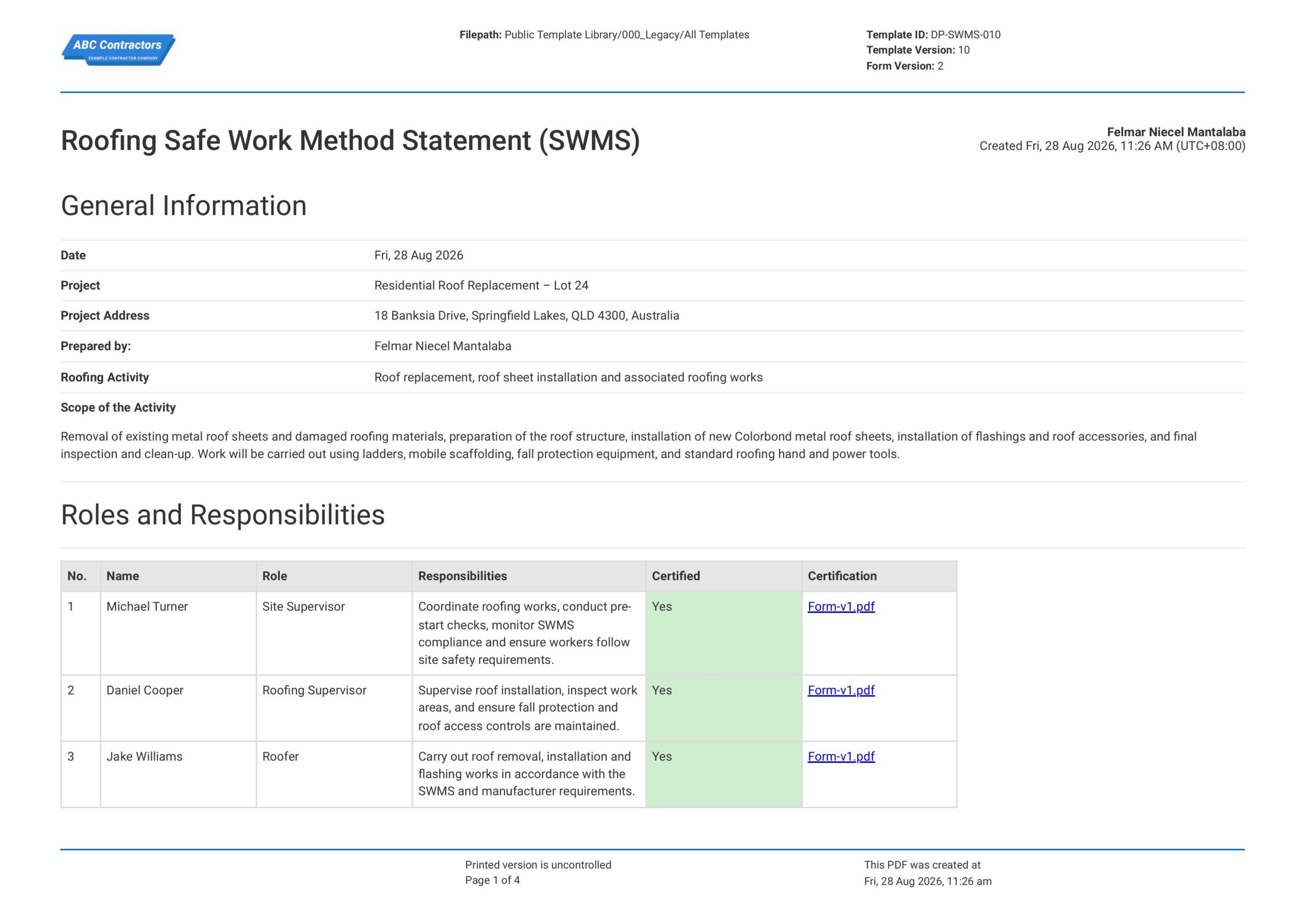
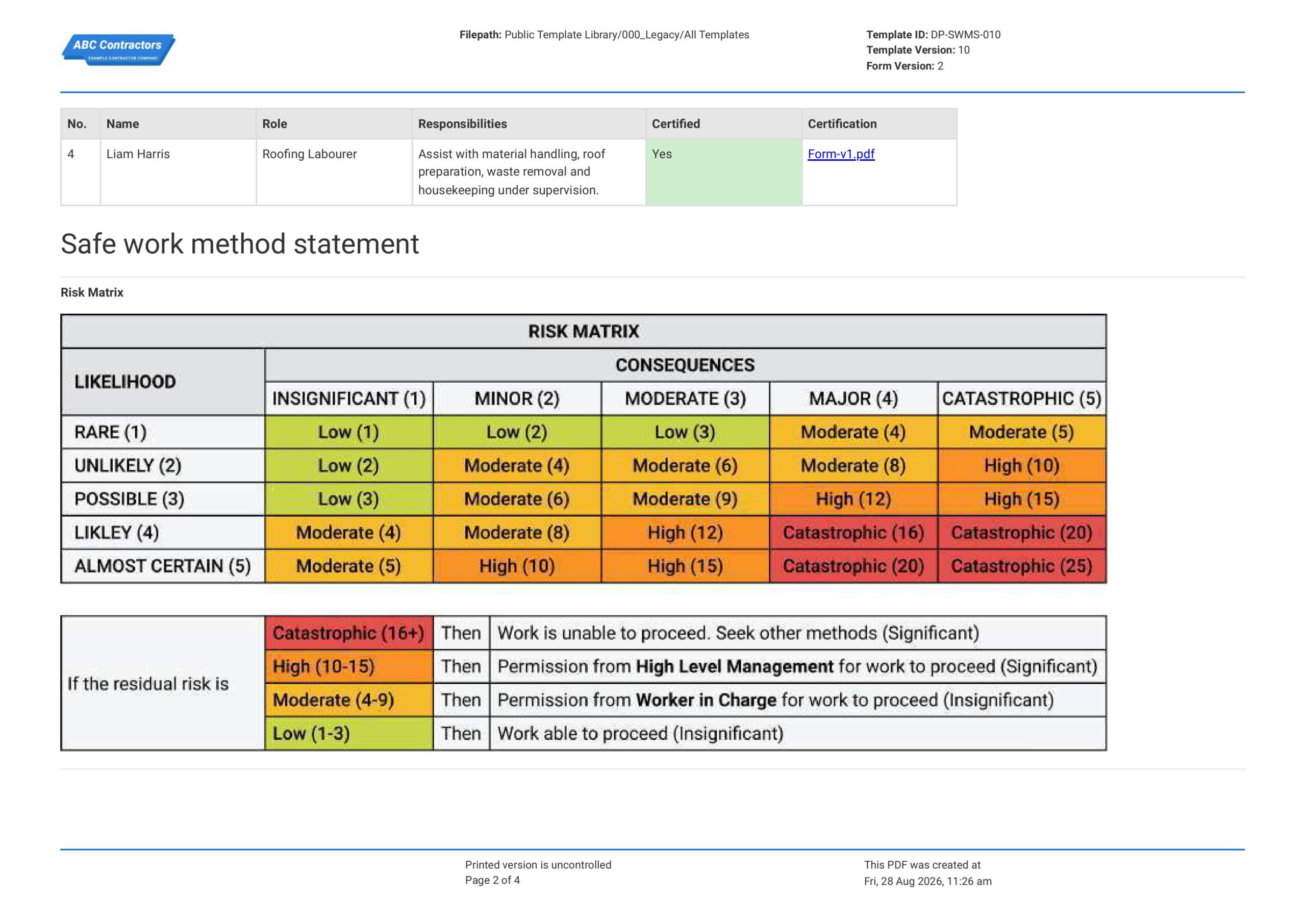
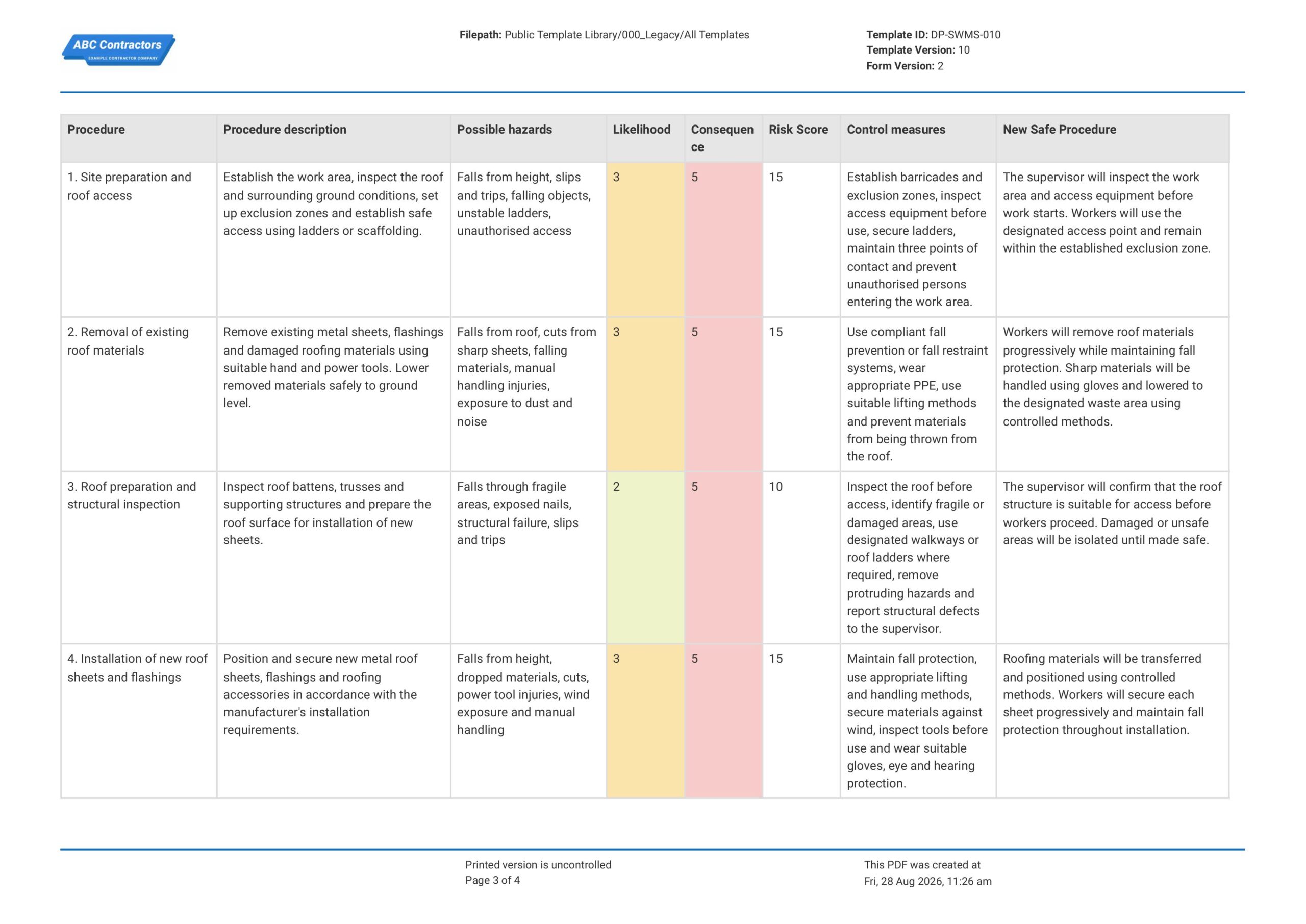
Curious how this Safe Work Method Statement Roofing works? Check out the example below to see exactly what the completed form looks like and how quickly one can be generated. You can export it as your own custom document, fill in your job-specific details, and have a compliant, ready-to-use Safe Work Method Statement Roofing in minutes.
Use this Safe Work Method Statement Roofing template for free

Generate this template automatically with Storm
You don't have to build the Safe Work Method Statement Roofing field by field. Let Storm, the AI Data Capture Agent inside Dashpivot, build the template for you in seconds.
Describe what you need
Tell Storm the form you want in plain language and it builds a structured digital template from scratch, with fields, tables, and signatures in place.
Upload what you already use
Drop in your existing PDF, Word, Excel, or even a photo of a paper form. Storm rebuilds it as a smart digital template with the structure intact.
 Storm
Storm
Generate a Safe Work Method Statement Roofing form template that I can use for my business
Applicable Standards and Policies for Safe Work Method Statement Roofing
Roofing activities are generally considered working-at-heights activities, which are known to be high-risk activities in Australia. Fortunately, the WHS regulations in Australia have provided safety guidelines on how to prevent working-at-heights incidents, such as falling from heights, from occurring when performing roofing activities. The following standards contain the guidelines:
- WHS Regulation 2011, Regulation 299—This provision in Australia requires establishments to create a Safe Work Method Statement for high-risk construction work.
- WHS Regulation 2011, Regulation 291—This regulation is a provision in Australia that defines and classifies high-risk construction work.
- Health and Safety at Work Act (HSWA) 2015, section 30—This legislation is a provision in New Zealand that describes the requirements to control risks that affect health and safety.
- Health and Safety at Work Act (HSWA) 2015, section 36—This legislation is a provision in New Zealand that requires persons conducting a business or undertaking to ensure the health and safety of workers affected by the hazards found at work.
Staff Members and Parties that use Safe Work Method Statement Roofing
The effectiveness of creating and completing a Safe Work Method Statement relies heavily on the involvement of the following staff members:
- Project Manager: The project manager oversees operational requirements on a high level. He is responsible for ensuring sufficient resources, planning, and compliance requirements (quality, health, and safety) are effectively in place.
- Site Manager: Their role includes planning and managing safety in the workplace, which is why it is their responsibility to implement the SWMS. They review and approve the SWMS, especially for activities that involve working at heights.
- Workforce: The workforce directly faces the hazards. Part of their duty is to guarantee that they perform the provided method statement; therefore, their participation in creating and completing the Safe Work Method Statement Roofing is essential. Their exposure and firsthand knowledge of the hazards also enable them to provide diverse perspectives on the observable hazards they encounter while performing their work.
- Safety Officers: These are the individuals who assess the effectiveness and efficiency of controls offered in all activities, particularly those in which employees work at dangerous heights. It is their responsibility to guarantee that safety management measures are adequate and sufficient to protect all workers engaging in high-risk activities.
Business Risks Reduced by Safe Work Method Statement Roofing
Keeping everyone safe also means keeping the business safe. Employers must commit to the duty to protect the firm against various hazards, in addition to the employees, who are the company’s lifeblood. Committing to the practice of implementing Safe Work Method Statement Roofing for any activity reduces the following business risks:
- Increased expense owing to unanticipated downtime
- Increased expense due to accidents and injuries
- Increased expense owing to non-compliance with regulations
- Increased rate of lost time incidents (LTI)
- Delayed timetables and deadlines
- Negative impact on company reputation
Business Opportunities Created by Safe Work Method Statement Roofing
The Safe Work Method Statement Roofing document can provide all the necessary safety measures to adequately safeguard employees from potential hazards while performing their daily activities. However, compliance with this document provides more than just protection. Businesses can greatly benefit from this simple yet effective tool. Compliance with this document creates the following commercial opportunities:
- More cost savings over time
- Longer machine and equipment life
- Lower insurance premiums
- Stronger relationships among employers, employees, and stakeholders
- Better output quality
- Enhances the company’s reputation
What does the Safe Work Method Statement Roofing form eliminate?
The Safe Work Method Statement Roofing form ensures the following problems are addressed:
- Unidentified hazards
- Uncontrolled risks
- Unclear work procedures
- Miscommunication
- Unsafe work methods
- No clear responsibilities
- Improper PPE
- Panic during emergencies
Safe Work Method Statement Roofing: Working Safely on Roofs
A Safe Work Method Statement Roofing document helps workers understand the hazards involved in roofing activities and the safety measures they need to follow. It covers common risks such as working at heights, falling objects, handling roofing materials, using tools and equipment, and working in bad weather. By following the Safe Work Method Statement, workers can complete roofing activities in a safer and more structured way while reducing the risk of accidents and injuries.
How to create a Safe Work Method Statement Roofing template
Creating an effective Safe Work Method Statement Roofing template requires systematic planning and thorough understanding of work processes and associated risks. Follow these structured steps to develop a comprehensive Safe Work Method Statement Roofing template that meets regulatory requirements and protects worker safety.
Prerequisites before making a Safe Work Method Statement Roofing template
- Detailed work scope and activity descriptions
- Site plans, drawings, and environmental assessments
- Relevant safety regulations and compliance requirements
- Equipment specifications and manuals
- Previous incident reports and lessons learned
- Worker input and consultation feedback
- Emergency contact information and procedures
- Training records and competency requirements
-
Add a section for project details
This section provides an overview of what the SWMS is for. It should have the following fields:
- Project name
- Project location
- Activity date
- Roofing activity
- Roofing activity scope
-
Add a roles and responsibilities section
This section provides the details of each role and responsibility. The following fields should be present:
- Name of Employee
- Role
- Responsibilities
- Certifications
-
Create a hazard and control section
This section records the identified hazards and the needed control measures. It should have the following fields:
- Task/procedure
- Identified hazard
- Severity of hazard
- Control measures
- Corrected procedure
-
Add a PPE requirement and emergency procedure section
This section provides a list of the PPE needed for the activity and the emergency protocols.
- Provide a field for all the needed PPE for the activity
- Add another field for the emergency procedures and contacts
-
Add a sign-off section
The following signatures should be present to validate the SWMS:
- Person who prepared the SWMS
- Person who approves the SWMS
Frequently asked questions
How to create your Safe Work Method Statement Roofing in an App or Software System
A well-designed digital Safe Work Method Statement Roofing template ensures automated compliance tracking and mobile accessibility that traditional paper-based systems cannot match. These platforms enable immediate updates to safety procedures, instant communication of changes to all relevant personnel, and comprehensive audit trails that demonstrate regulatory compliance.
20 minutes
Easy difficulty
-
How to create a Safe Work Method Statement Roofing template in an app?
Using an app that employs digital forms instead of paper-based ones may help improve the process by:
- Assistance with artificial intelligence (AI).
- Having fewer manual data entries.
- All produced forms are stored in a single access cloud.
- Reformatting is straightforward and can be adapted to new protocols or updated standards.
- Formula integration is much simpler.
- Workflows and notifications may be automated and scheduled.
- Improved template design and look.
-
Formatting the project details section
- Add a text field to allow users to input a project name.
- Add another text field to allow users to input the project location.
- Provide a date field for the activity date.
- Provide a text field to allow users to input roofing activity.
- Provide a multiple-text field to allow users to input roofing activity scope.
-
Formatting the roles and responsibilities section
- Add a 5-column table where users can freely add rows.
- Use the following headers for each column: name, role, responsibilities, certified, and certification.
- Format columns one, two, and three as text fields so users can input the names, roles, and responsibilities.
- Format column 4 as a selection field to provide the users with options if the employee requires a certification for the role. Each selection item can be provided with colors to make the form more appealing.
- Format column 5 as an attachment field to allow users to upload the relevant certification.
-
Formatting the safe work method statement section
- Provide an 8-column table where users can freely add rows.
- Provide these as headers for each column: procedure, procedure description, possible hazards, likelihood, severity, risk score, control measures, and corrected procedure.
- Format the first, second, and third columns as a text field to allow users to input the procedure, procedure description, and possible hazards, respectively.
- Format the fourth and fifth columns as selection fields to provide the users with options for the likelihood and severity score of each identified hazard. Each selection item can be integrated with colors to make the form more professional. Selection items are 1, 2, 3, 4, and 5.
- Format the sixth column as a formula field to automatically calculate the risk score of the hazard. The resulting value should follow this formula: Risk score = Likelihood score x Severity score.
- Format the seventh and eighth columns as text fields to allow users to input the appropriate control measure and the corrected procedures, respectively.
- Add a multiple-text field after the table to allow users to input all the required PPE for the activity.
-
Formatting the signatory section
- Provide a signature field for the person who prepares the SWMS.
- Another signature field should be provided for the person who will approve the SWMS.
About the author

Felmar Mantalaba
Content Engineer
 LinkedIn
Education
Cebu Institute of Technology - University - Mechanical Engineering with Mechatronics
Bio
Felmar is a mechanical engineer, whose four years of experience in the mining industry inspired him to write and share stories to progress the revolution of new technologies and create smarter, smoother ways of living.
Past Projects
Safety, Health, and Environment Management System (SHEMS) CoordinationSHEMS Coordinator at Atlas Consolidated Mining, ensuring organizational compliance with ISO 14001 and ISO 45001 standards, performing risk assessments, developing policies, and conducting audits and inspections to maintain a safe and environmentally responsible workplace.
Maintenance Management and OptimizationSenior Maintenance Manager (OIC) leading equipment maintenance and operational efficiency initiatives, reducing downtime by 10%, improving Mean Time Between Failure (MTBF) and Mean Time To Repair (MTTR) for major equipment, and managing maintenance schedules, manpower, and materials, while overseeing capital project optimization.
Inspection Engineering and Equipment ReliabilityInspection Engineer responsible for technical blueprint interpretation, vendor collaboration, preventive maintenance scheduling, and data collection for vibration and temperature readings, delivering actionable recommendations and comprehensive reports to improve equipment reliability and operational performance.
End-to-End Operational Oversight in Mining EngineeringContributed to multiple facets of operational management, including SHEMS compliance, maintenance optimization, inspections, and capital project evaluation, integrating safety, reliability, and efficiency improvements across all stages of copper production operations.
Version History:
Related apps and templates
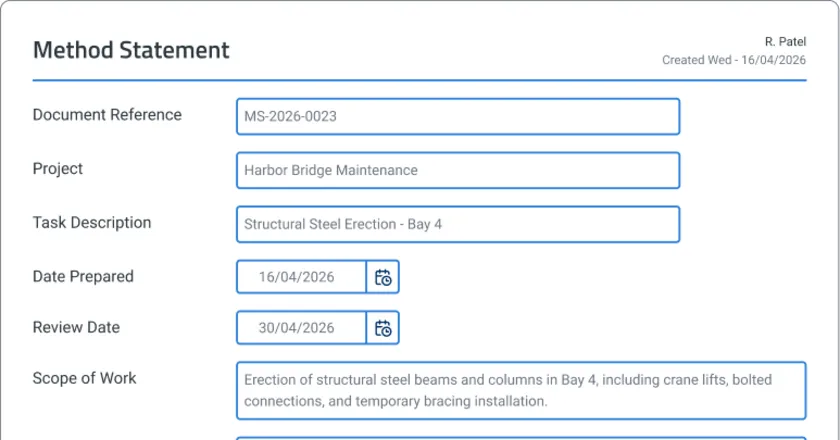
Safe Work Method Statement App
Sitemate’s safe work method statement app template helps supervisors draft, review, sign off, and store SWMS fast. Try free — no credit card
View app
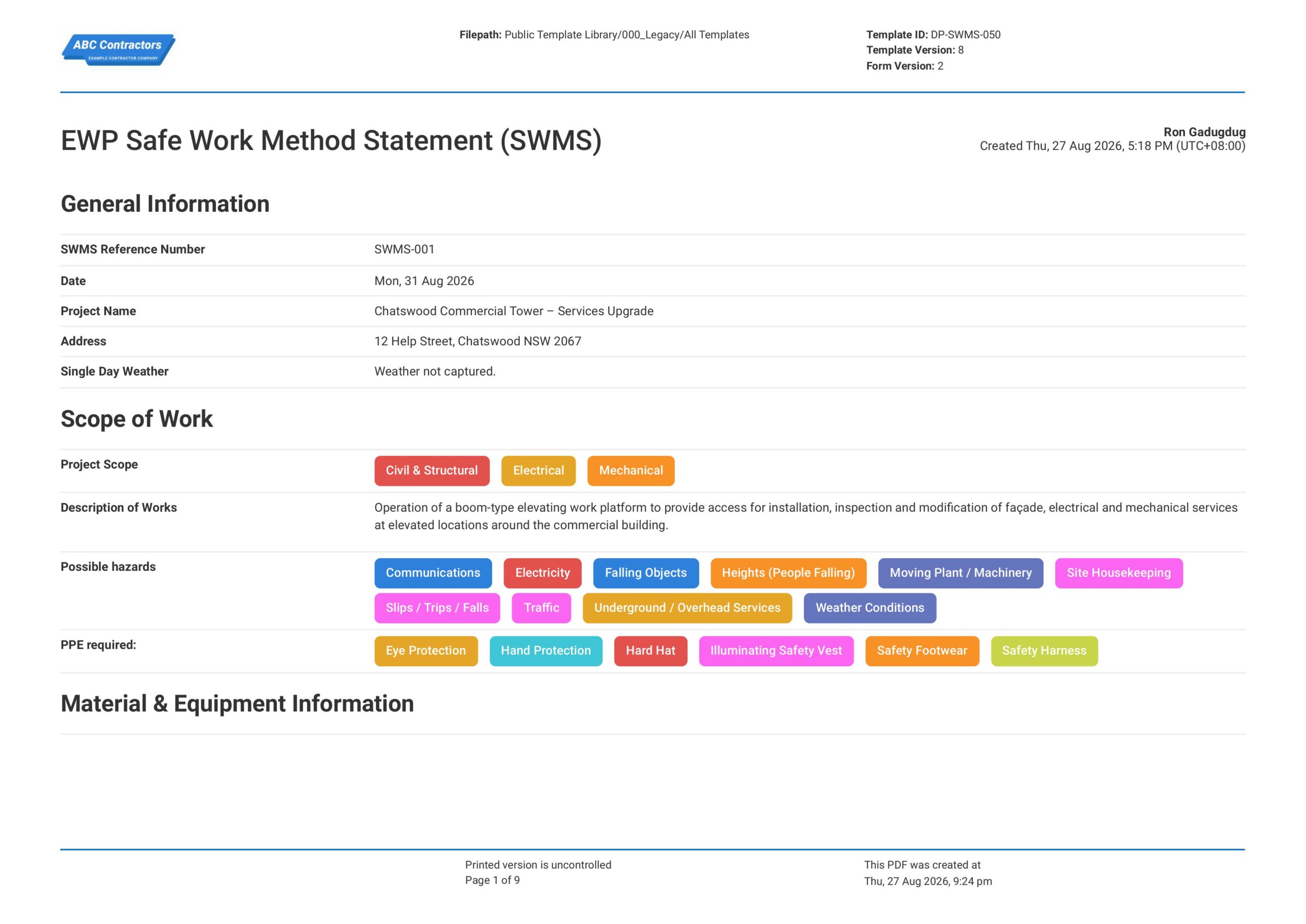
Elevated Work Platform (EWP) Safe Work Method Statement
This Elevated Work Platform Safe Work Method Statement, or EWP SWMS, is an easy-to-use form that your workers can use to plan and manage elevated work platform risks before working at height. Easily select the scope of
View template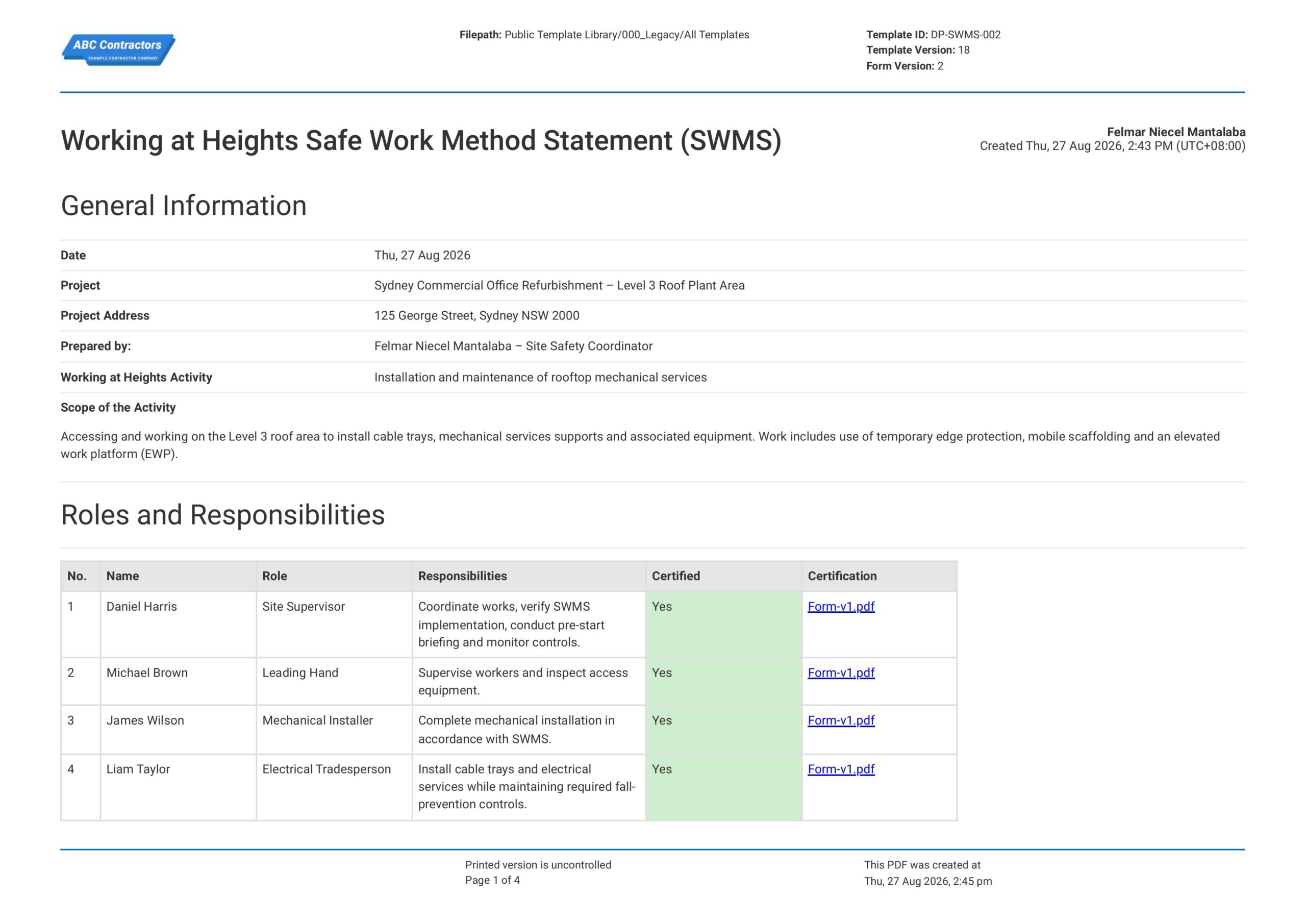
Safe Work Method Statement Working at Heights
This Safe Work Method Statement Working at Heights template is free and readily available to help the team create an effective safety management system that accurately assesses hazards and provides safe instruction in
View templateThis form was generated with Dashpivot software
- Access, edit and complete your Safe Work Method Statement Roofing from any device - mobile, tablet or computer.
- Print, download or send your Safe Work Method Statement Roofing as perfectly formatted PDF documents with your company logo.
- Store your Safe Work Method Statement Roofing securely online, where they can be searched and found in seconds
- Invite internal and external parties to see, edit and sign off on Safe Work Method Statement Roofing online.