
Article Page – Approved Document A Building Regulations
Approved Document A Building Regulations
Approved Document A serves as the primary foundation of safety in the UK when constructing buildings. This article will break down the contents of this regulation and provide a Structural Design Checklist that aligns with its mandates.

Table of Contents
Article Summary
- Approved Document A of the UK Building Regulations specifies how a structure should be built to provide stability and integrity, as well as safety for its occupants and nearby communities.
- The Part A Structural Design Checklist is an invaluable resource for both the final assessment of construction project plans and specifications and the creation of designs. It should include all of the fields specified in Approved Document A to verify that the building satisfies quality and safety standards.
- UK Building Regulations Approved Document A is a particularly detailed regulation. It promotes safety and quality in all aspects of building construction. That being said, it specifies extremely stringent standards for both the construction process and the materials utilized in it.
What is the importance of Approved Document A?
Approved Document A of the UK Building Regulations provides mandates on how a structure should be constructed to ensure its stability and integrity, which also provides assurance of safety for its inhabitants and neighboring communities. The information included covers structural loading, safe standards for building foundations, disproportionate collapse, and the potential for ground movement, such as subsidence, all of which help prevent structural collapse.
British standards for structural design based upon the Eurocodes were correspondingly implemented by the British Standard Institution (BSI) on April 1, 2010 and it is these standards with their UK National Annexes that are now referenced in this Approved Document as practical guidance in meeting Part A requirements.
The British Standard Institution (BSI) last issued Approved Document A in 2013. It requires that buildings are designed, built, or remodeled in such a way that they are structurally safe and sturdy, without jeopardizing the stability of other buildings. It requires buildings to withstand dead loads, imposed loads, wind loads, and ground movements like subsoil swelling, shrinking, freezing, and land subsidence.
How should a Part A Structural Design Checklist be formatted?
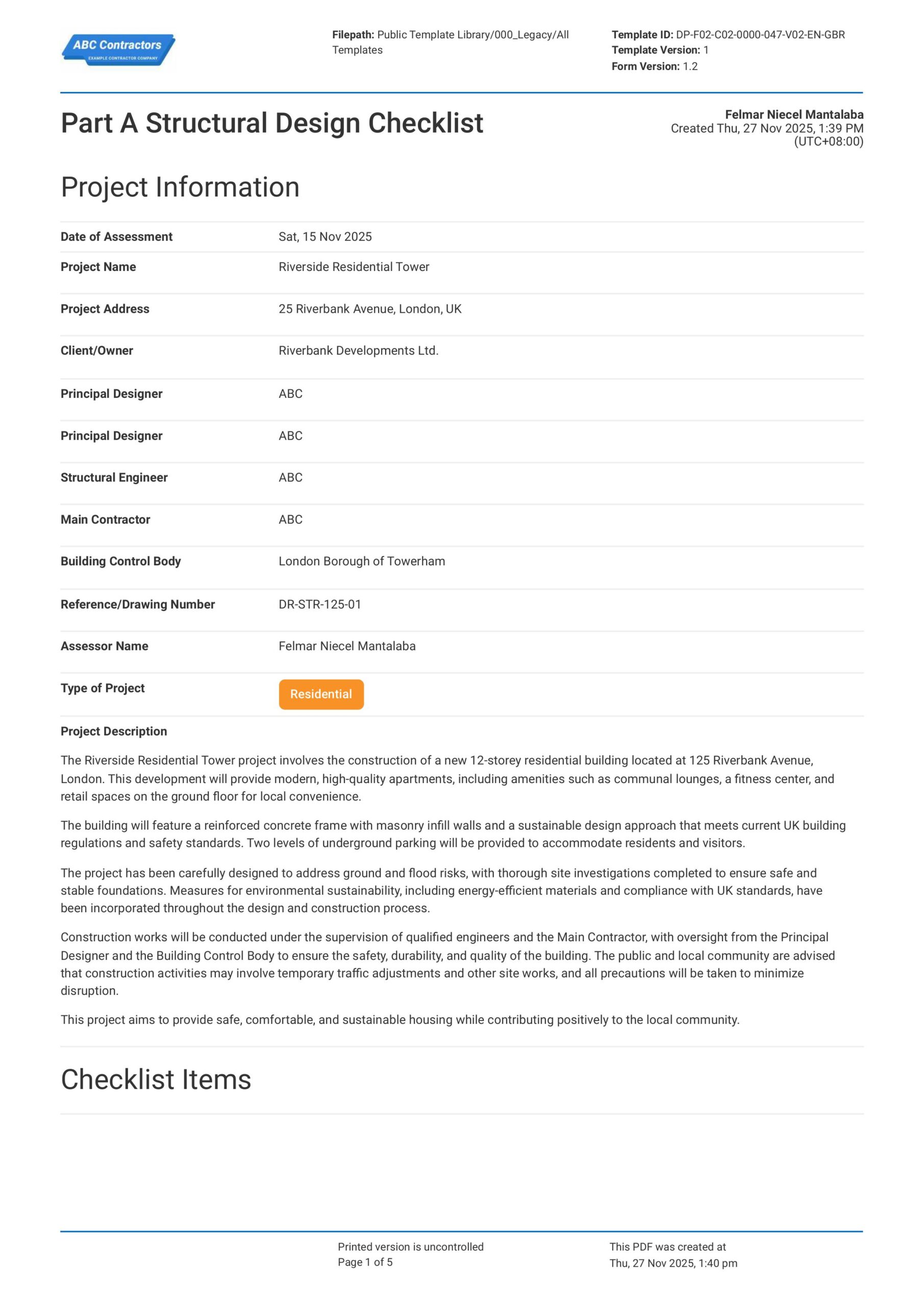
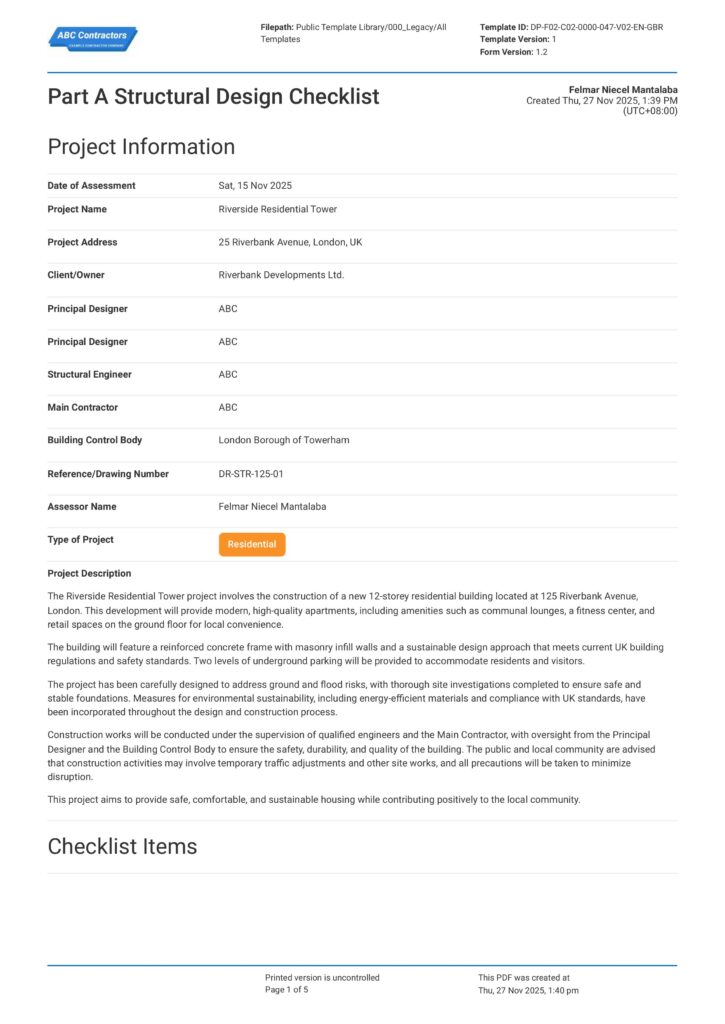
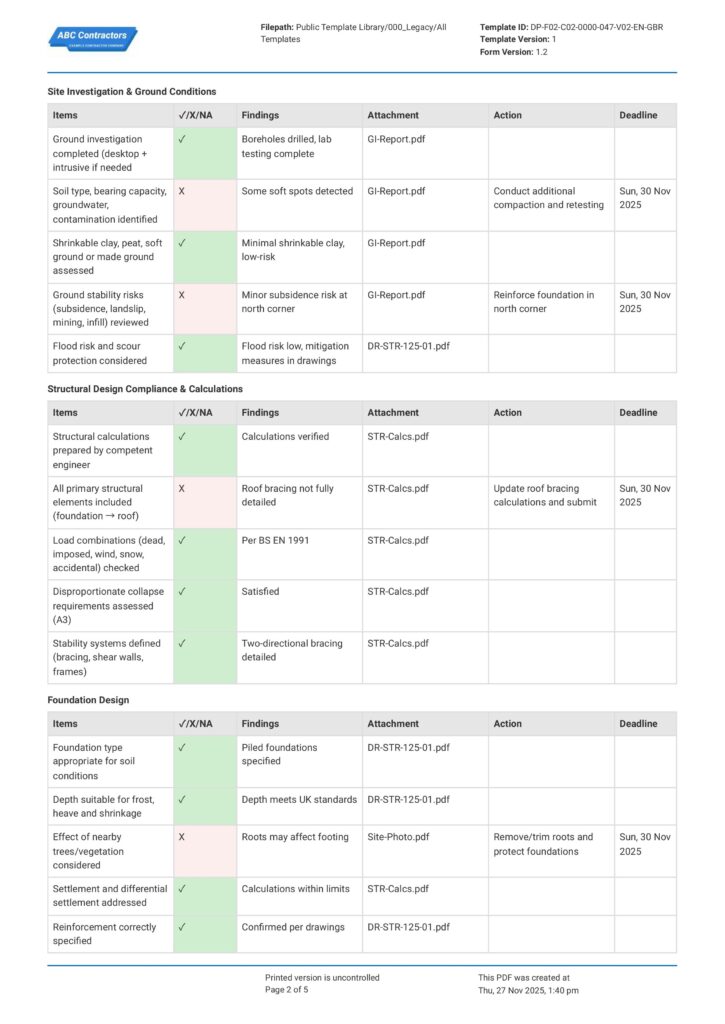
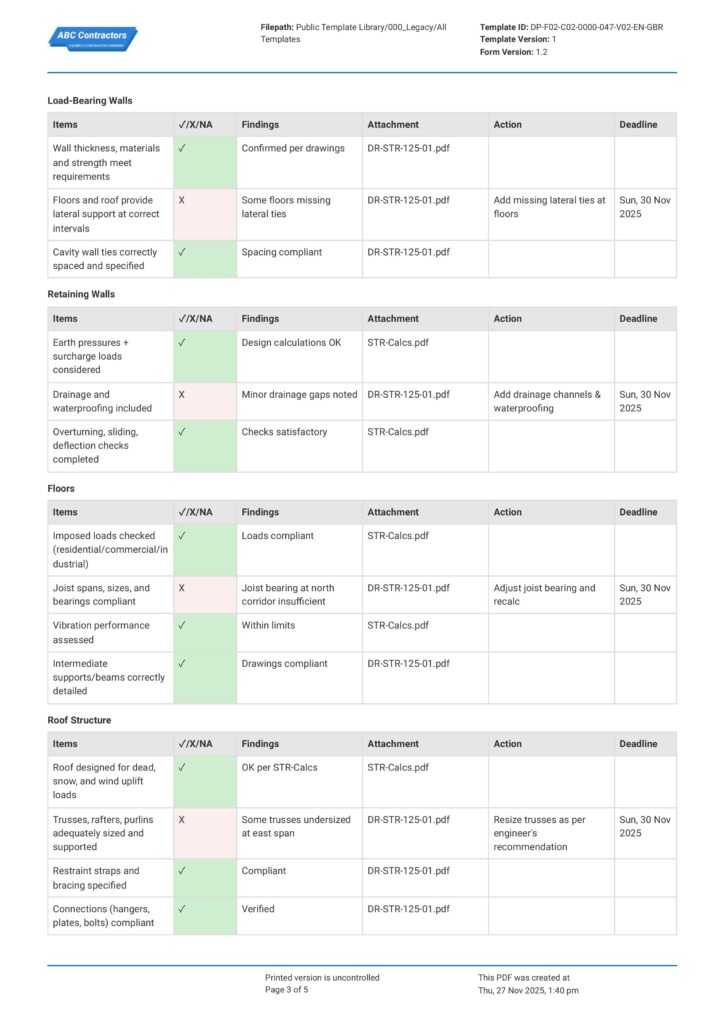
The Part A Structural Design Checklist serves as a valuable tool for both the final review of construction project plans and specifications and design development. This checklist guarantees the safety, robustness, and compliance of the proposed structure with the UK's building regulations.
Having said that, the checklist plays a crucial role in providing inspectors with guidance on the critical design factors necessary for a building that is both sound and compliant. It should include all the necessary fields required by Approved Document A to ensure the construction of a building that meets quality and safety standards. Visit the example below to gain a deeper understanding of the format's design.
Free Part A Structural Design Checklist Template
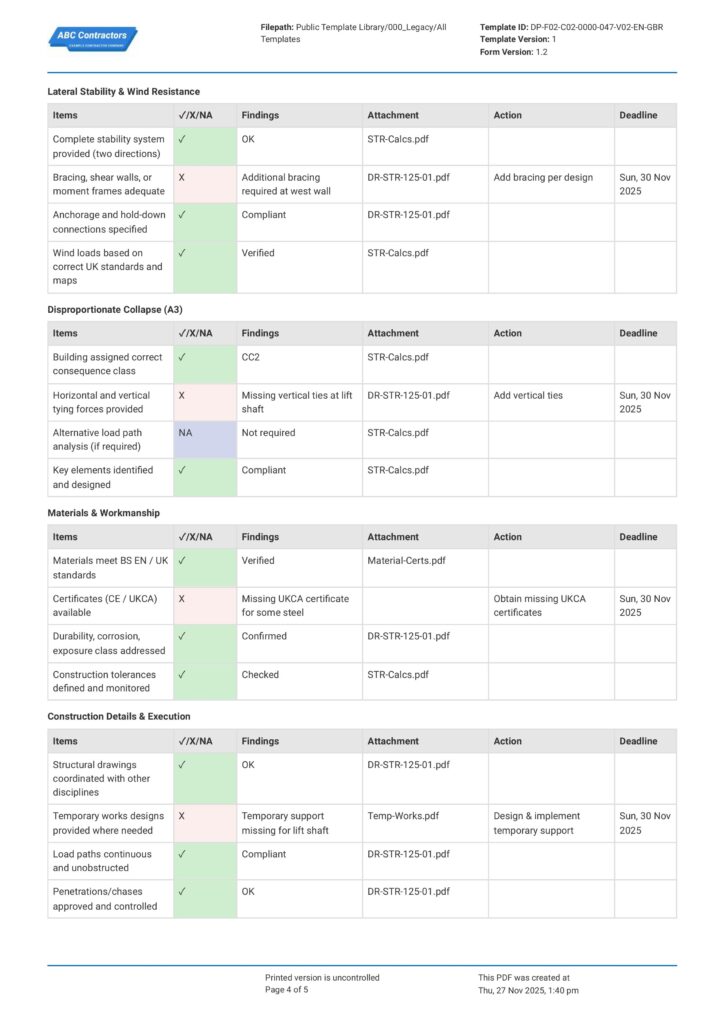
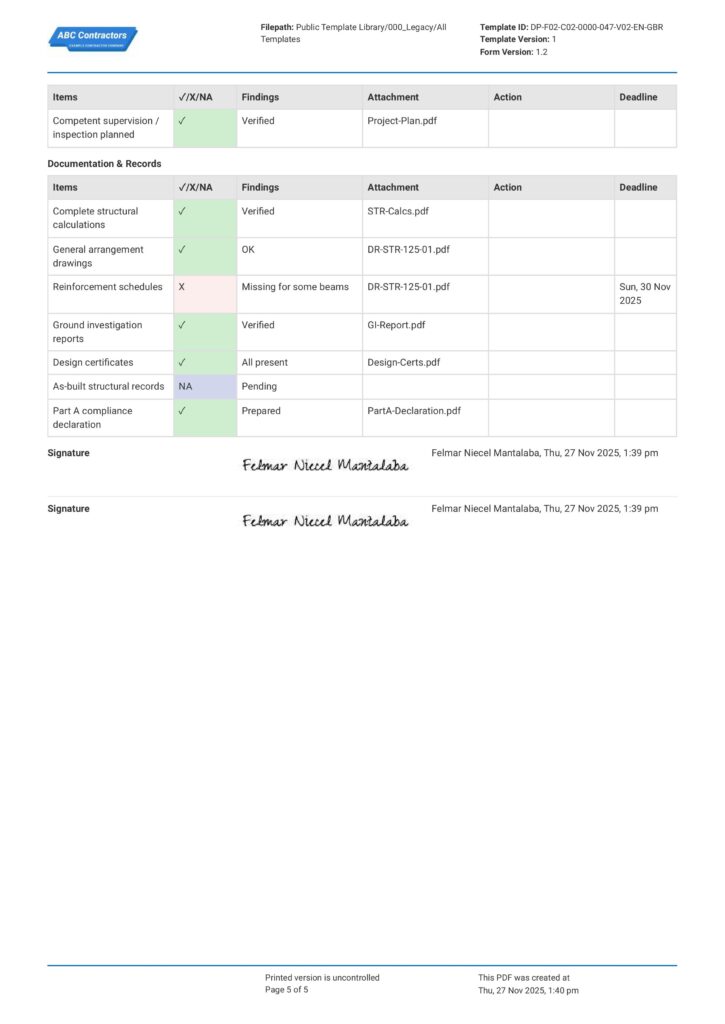
Use this Part A Structural Design Checklist for free
What is inside Approved Document A of the Building Regulations?
Approved Document A of the UK Building Regulations primarily focuses on the structural requirements of a building. It specifically outlines mandates that begin during the design phase of the building and continue through to construction, covering everything from the foundation to the final finish. It establishes design standards for all buildings and provides simple design guidelines for most masonry and timber elements in traditional home buildings. It includes structural diagrams such as roof frames and brick walls, as well as material strength calculations. To fully establish these standards, it would be proper to conduct a Structural Design Checklist that covers all these Part A Requirements.
Aside from providing regulations for constructing the building itself, Approved Document A also wants to place emphasis on environmental considerations that affect a structural building. Environmental factors such as snow, rain, and ambient temperature play a significant role in the structural load on the building, which Part A wants construction companies to greatly consider. Another environmental factor is the ground condition where the building must be constructed. A Ground Condition Report must be fully implemented to help design a stable and safe building. Part A, Building Regulations, is simply a guideline to help engineers know what to consider in constructing a building anywhere in the UK. It provides them access to mandates that help create buildings that will last for generations.
Building Regulations Approved Document A: Important aspects
UK Building Regulations Approved Document A is a really meticulous regulation. It instills safety and quality in every aspect of building construction. That being said, it establishes rigorous standards and requirements for both the construction process—specifically, the methods of constructing and designing buildings—and the materials used in construction. One strong example of the mandates provided in Part A is the requirement for masonry.
UK Building Regulations wants to ensure that only approved and certified quality materials are used for masonry constructions, and multiple standards need to be considered and integrated when constructing masonry elements. Construction companies should always verify these through a Quality Control Plan and a thorough Masonry Inspection to ensure compliance with Part A regulations.
Approved Document A: structure standards
Approved Document A provides a requirement for defining building robustness. It stated that buildings should be designed so that if a structural component fails or a portion falls, the entire structure will remain intact. To prevent a total collapse, the building should be designed with redundancy, ties, load routes, and alternative load-sharing. Furthermore, to fully verify if structural elements are sufficient to carry all static and imposed loads, building inspections on both Framing Elements and Structural Members should be integrated into the quality check process. Including these in the Approved Document A pdf files would be beneficial for future audits.
Approved Document A explained
Part A provides guidelines on the structural stability and safety of buildings, from foundations to walls and roofs. The standard revolves around three major key items, which are the following: All imposed loads in the building will be transmitted to the ground, ensuring the building and adjoining buildings remain stable; Buildings must be built in a way that ensures no collapse disproportionate to its cause;
Ground movement, such as subsoil freezing, will not damage the building's stability. Checking these items through a Design Review will ensure that Approved Document A is fully integrated into the Building design.
Approved Document A consequence class
Approved Document A has three consequence classes based on the building type and occupancy. The first consequence class includes houses up to 4 storeys, agricultural buildings, and buildings where people rarely go (provided that no part of the building is closer to another building or area where people actually go with a distance of 1.5 times a building’s height).
The second consequence class is divided into two, which are the Low Risk Group and the High Risk Group. The Low Risk Group includes 5-story single occupancy houses, offices, hotels, apartments and flats not exceeding 4 storeys, industrial buildings not exceeding 3 storeys, retail premises with less than 2000m² of floor area per story and not exceeding 3 storeys, single-story educational buildings, and all buildings not exceeding 2 storeys that admit members of the public and have floor areas not exceeding 2000m² per story.
The High Risk Group, on the other hand, includes offices, hotels, apartments, and flats that exceed 4 storeys but not exceed 15 stories; educational buildings greater than 1 storey but not exceeding 15 storeys; retail premises exceeding 3 storeys but not exceeding 15 storeys, hospitals not exceeding 3 storeys, car parks not exceeding 6 storeys, and all buildings to which members of the public are admitted that contain a floor area greater than 2000m² but not exceediing 5000m² at each storey.
The last consequence class includes buildings that fall beyond the three classes mentioned earlier, grandstands that accommodate 5,000 seats, and buildings that contain hazardous substances. One thing that these classes need in common is that they need to be inspected for work quality, especially on the Structural Load Path and their Retaining walls.
Making compliance with Part A requirements a walk in the park
Approved Document places a strong emphasis on needing to follow the standards and requirements they have provided. However, complying with documents in paper format is slow and can sometimes disrupt processes, particularly during compilation and recording. It has become obsolete, inefficient, and quite frankly requires more attention than the actual construction work in the field.

Fortunately, technology found a way. The Quality Inspection Software streamlines and enhances your compliance inspection process. The application generates standard-compliant forms that you can conveniently fill out and save in one location. The app's user-friendly design makes compliance evaluations easier to perform. Thanks to advances in technology, compliance tests are more efficient than ever, guaranteeing that your finished buildings are safe and compliant with Approved Document A.
Summary of Approved Document A Building Regulations
The UK British Regulations Approved Document A was created to provide standards and requirements for creating safe and robust buildings. The regulation specifically targets the structural elements, stability, loading, and disproportionate collapse and makes sure buildings are structurally safe and sturdy, without jeopardizing the stability of other buildings. Construction companies are required to follow and integrate the regulations and standards into their processes so that finished buildings are not only strong and sturdy but also compliant and aligned with them.
Frequently Asked Questions
Is a Structural Design Inspection required for new buildings?
Yes — this process is required under the Building Regulations 2010 (as amended), specifically Approved Document A (Structure), in the UK. You can easily comply with these regulations by having the structural design prepared and checked by a Chartered Structural Engineer, submitting calculations and drawings to Building Control for approval, and carrying out documented structural design inspections to verify the works are built in accordance with the approved design.
How is technology changing how people do sturctural inspections?
Technology is transforming structural inspections by replacing paper checklists, manual reports, and disconnected spreadsheets with digital solutions like Dashpivot. Teams can now complete inspections on site using mobile devices, capture photos and notes in real time, automate reports and approvals, and keep all inspection records centrally stored and easily accessible. This leads to significant time savings, more accurate and consistent data, improved compliance with standards and regulations, and safer, better-managed worksites.
Does Sitemate offer templates for ensuring masonry works?
Yes — Sitemate offers ready-to-use and editable templates, including the Masonry Quality Control Plan, that can also be adapted to suit your workflow. Companies of all sizes in the construction and civil engineering industry are using these templates right now to streamline their masonry quality assurance and inspection processes. This template helps teams inspect, document, and verify masonry works against approved drawings, specifications, and standards, ensuring issues are identified early and quality is consistently maintained on site.
Related resources
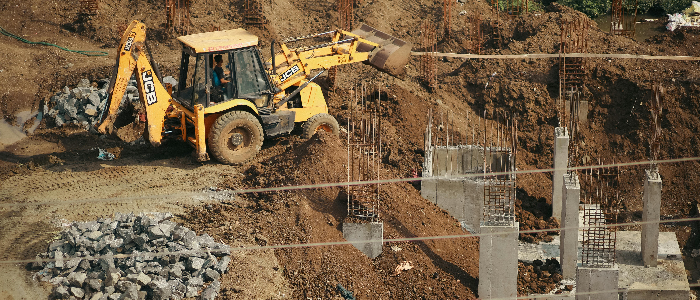
Ground Condition Report
Examine the soil and ground conditions thoroughly and correctly before beginning construction.

Retaining Wall Inspection Report
Verify if the retaining walls and their elements are within the permitted design limitations and comply with UK Building Regulations.

Framing Inspection Checklist
Ensure that the framing elements are built with the highest quality and comply with UK regulations.
Sitemate builds best in class tools for built world companies.


 English (United States)
  English (Australia)
  English (UK)
  English (New Zealand)
  English (South Africa)
  German