Output: RAMS
Applies to: Construction (Commercial), Construction (Residential), Heavy & Industrial Manufacturing, Agriculture & Forestry
Updated on: August 27, 2026
Method Statement and Risk Assessment
This article explains what a RAMS is and when one is needed, whether that is ahead of a high-risk task, following an accident or near-miss, or before an unplanned activity. It then walks through how to complete a RAMS through systematic planning and a clear understanding of the work processes and their risks. Finally, it sets out what separates a comprehensive RAMS document: accurate risk scoring, a workflow that reflects the actual task, all essential fields, and version control tracking.


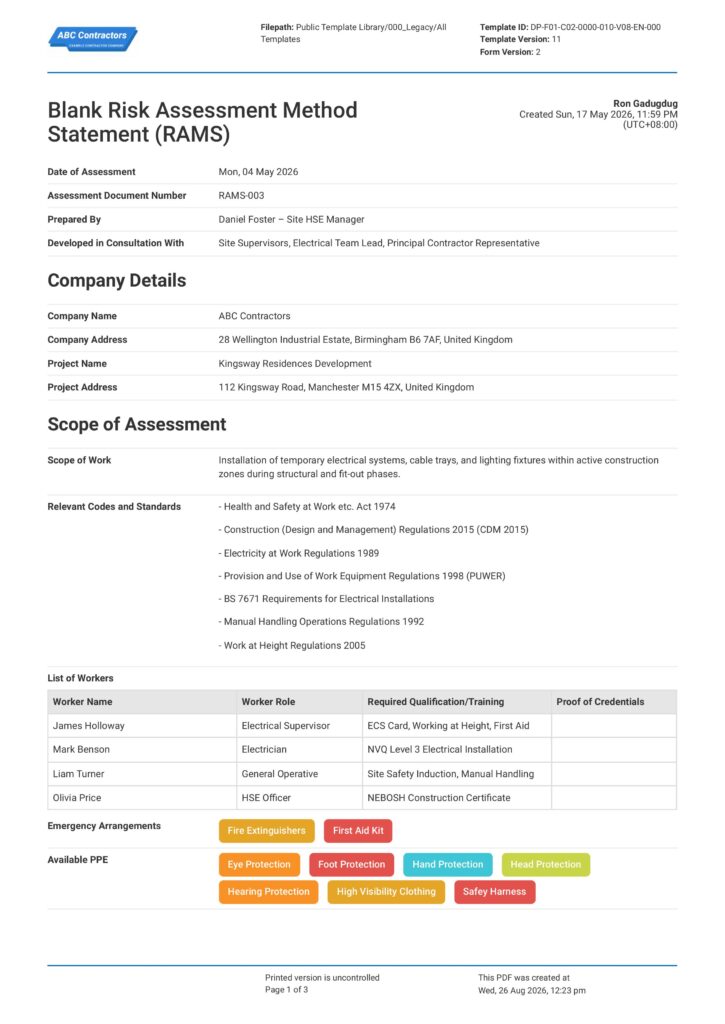
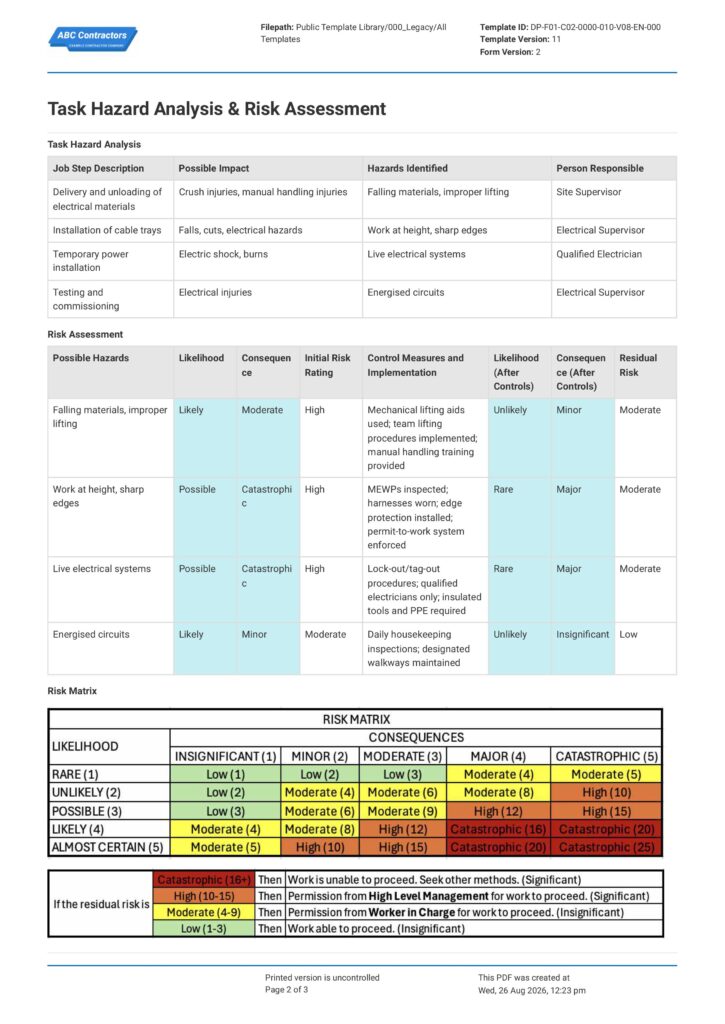
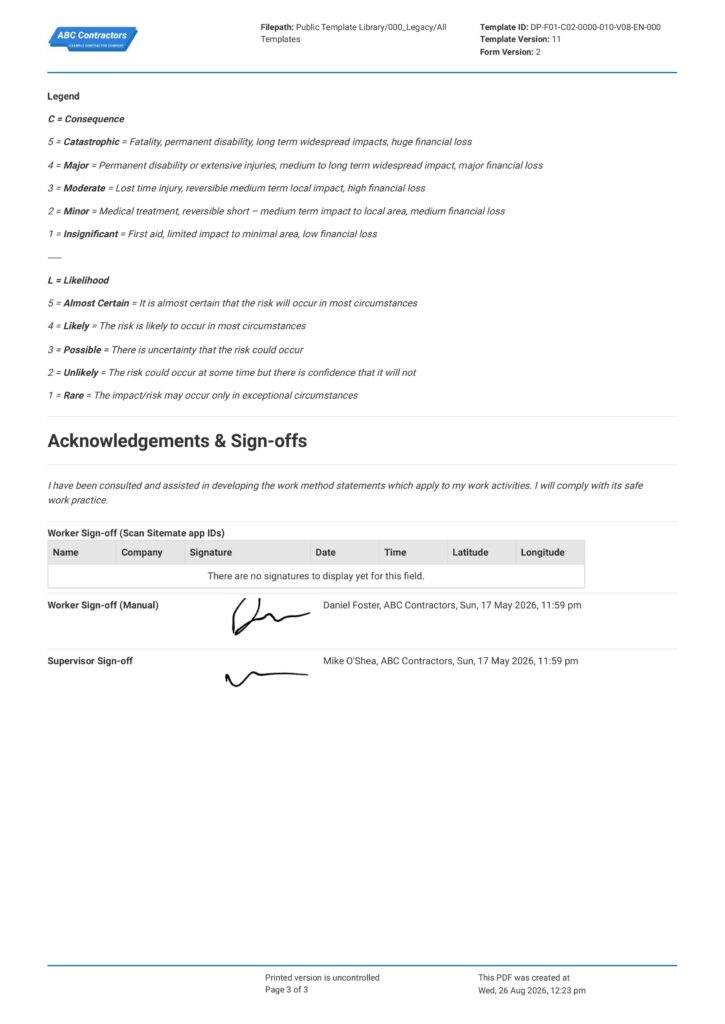
Table of Contents
- Summary
- What Does Method Statement and Risk Assessment Mean?
- When Does Method Statement and Risk Assessment Apply?
- Prerequisites: What You Need Before Starting Method Statement and Risk Assessment Compliance Work
- Step-By-Step: How To Run The Method Statement and Risk Assessment Process
- Evidence Checklist: What Good Method Statement and Risk Assessment Documentation Looks Like
- Decision Points And Common Pitfalls
Summary
- A risk assessment is a safety procedure that helps manage hazards by proactively identifying them and providing control measures to contain them.
- Integrating a method statement into the risk assessment ensures that the safety control measures provided are continuously implemented.
- A RAMS is needed when a high-risk task needs to be performed, an accident or a near-miss incident occurs, and an unplanned activity needs to be performed.
- Completing a RAMS requires systematic planning and thorough understanding of work processes and associated risks. Following the correct procedures ensures that the correct safety measures are in place and continuously implemented.
- A comprehensive RAMS document has accurate risk scoring, reflects the workflow, contains all essential fields, and has version control tracking.
What Does Method Statement and Risk Assessment Mean?
What is a risk assessment?
A risk assessment is a safety management procedure that identifies hazards in a certain workplace activity, especially the construction and engineering industry. The hazards are assessed based on their likelihood and potential consequences to determine the equivalent risk score. The risk score determines the appropriate safety measures to effectively and efficiently control the hazard, ensuring workers are safe when performing the activity.
Risk assessments are vital, especially in high-risk industries like construction. This safety procedure is the foundation for building a strong safety culture in the company, as all employees are required to provide their input to ensure the best possible safety control measures are in place to effectively eliminate hazards or mitigate their impacts. Continuously conducting risk assessments will also ensure that businesses stay compliant with the Health and Safety at Work regulations, boosting their reputation for upholding quality safety management.
Why include a method statement in the risk assessment?
Safety controls will only be effective if they are implemented properly. Conducting risk assessments is only half the job of creating an effective safety management system. Businesses must still create ways to ensure proper implementation of the decided control measures, which is why integrating a method statement will be the best option to achieve this goal.
A method statement details the exact step-by-step process of performing an activity. With the safety control measures already present from the risk assessment, supervisors will only need to integrate them into the method statement to ensure that each step followed by the employees already has the necessary safety measures. For example: Before replacing the old motor with the new one, employees are to conduct a thorough inspection of the equipment to ensure operability and safety. The safety measure integrated into the procedure is the thorough inspection, which helps prevent the installation of defective motors that could malfunction when the equipment is operating. As you can see, having the method statement in a risk assessment ensures that all safety measures generated from the risk assessment are continuously and correctly implemented.
When does Method Statement and Risk Assessment apply?
A high-risk task needs to be performed
High-risk tasks are those activities that involve risks that could seriously injure employees or even cause fatalities. Businesses are required to perform a thorough risk assessment for these tasks and ensure that safety controls are assessed for effectiveness before integrating them into the procedures of the method statement.
Having a dedicated risk assessment method statement for high-risk tasks ensures that all the procedures from start to finish include the necessary control measures to effectively eliminate any possible risk that poses a threat to an employee’s health and safety.
An accident or a near-miss occurs
Accidents or near-miss events are evidence that the provided safety control measures are not effective. Once an incident investigation is completed, businesses should conduct a new risk assessment and revise the method statement to integrate the new safety control measure in the procedures. Conducting a new risk assessment and revising the method statement ensures that procedures are updated to prevent the recurrence of an accident or a near-miss.
An unplanned activity is conducted
Unplanned activities are those that are outside the original plan, meaning they were not assessed for hazards and have no control measures to ensure the safety of the activity. To prevent unwanted incidents from happening, a RAMS needs to be created. Creating a RAMS before an unplanned activity establishes a standard procedure, assesses hazards, and integrates necessary safety controls to protect employee health and safety.
Prerequisites: What You Need Before Starting Method Statement and Risk Assessment Compliance Work
Prerequisites before making a risk assessment
Here are the things needed before making a RAMS:
- Employees involved in performing an activity
- A safety consultant or officer
- Activity procedures
- Environment inspection report
- Weather report
- Industrial hygienist area investigation report
- Equipment inspection report
Prerequisites before making a method statement
Here are the items needed before making the method statement:
- Identified safety control measures from the risk assessment
- Activity procedures
- Project drawings
- List of equipment involved in the activity
- Needed PPE for the activity
- Certifications
Step-by-step: How to run the Method Statement and Risk Assessment process
Completing a RAMS requires systematic planning and thorough understanding of work processes and associated risks. Follow these structured steps to develop a comprehensive RAMS that meets the HSE regulatory requirements and protects worker safety.
Establishing roles and responsibilities
Making a complete and effective RAMS requires the input of all employees involved in the tasks. To achieve that, the following things must be done:
- Gather all involved personnel.
- Establish the work scope.
- Establish roles and responsibilities.
- Identify the hazards.
- Establish the method statement.
- Agree that they have understood and will implement the decided measures.
Risk assessment process
To make a complete and compliant risk assessment, the following steps must be completed:
- Prepare the activity procedure.
- Identify hazards for each step of the procedure. All involved personnel must take part in this step.
- Score the likelihood and potential consequence of the hazard. It would be helpful to score them quantitatively so that you can easily obtain the equivalent risk score.
- Obtain the risk score of each hazard by multiplying their likelihood score and potential consequence score.
- Decide the appropriate safety control measure based on the risk score of the hazard. You can follow the hierarchy of control measures: elimination, substitution, engineering controls, administrative controls, and personal protective equipment.
- Let the safety consultant or safety officer review and approve the safety control measures.
Making the method statement
A method statement would serve as a guide for all employees on how to complete an activity safely. To achieve that, the following must be done:
- Ensure that the safety consultant has already reviewed and approved the safety control measures.
- Integrate the safety control measures into the activity procedures. Make sure that the safety measures are integrated into the proper activity steps.
- Let the supervisor review and approve the method statement.
Approval and agreement
After conducting the risk assessment and completing the method statement, the following things must be done to complete the whole process.
- To validate each review and approval process, all relevant personnel must affix their signature. This ensures that evidence is provided.
- Conduct a brief meeting discussing the risk assessment process and the established method statement.
- Have all employees agree with the current RAMS. This ensures that they all understand the established safety process and agree to all the procedures they need to perform to complete the activity.
- Constantly monitor the safety control measures.
Evidence Checklist: What Good Method Statement and Risk Assessment Documentation Looks Like
Accurate risk scoring
This is the most crucial part of the risk assessment method statement document because the safety control measure is dependent on it. The RAMS document must contain a guide to help employees measure the likelihood score and the potential consequence score.
Reflects the workflow
The RAMS document requires multiple steps to complete the whole process. A good RAMS document must reflect the whole workflow process, especially on reviews and approvals.
Contains all essential parts
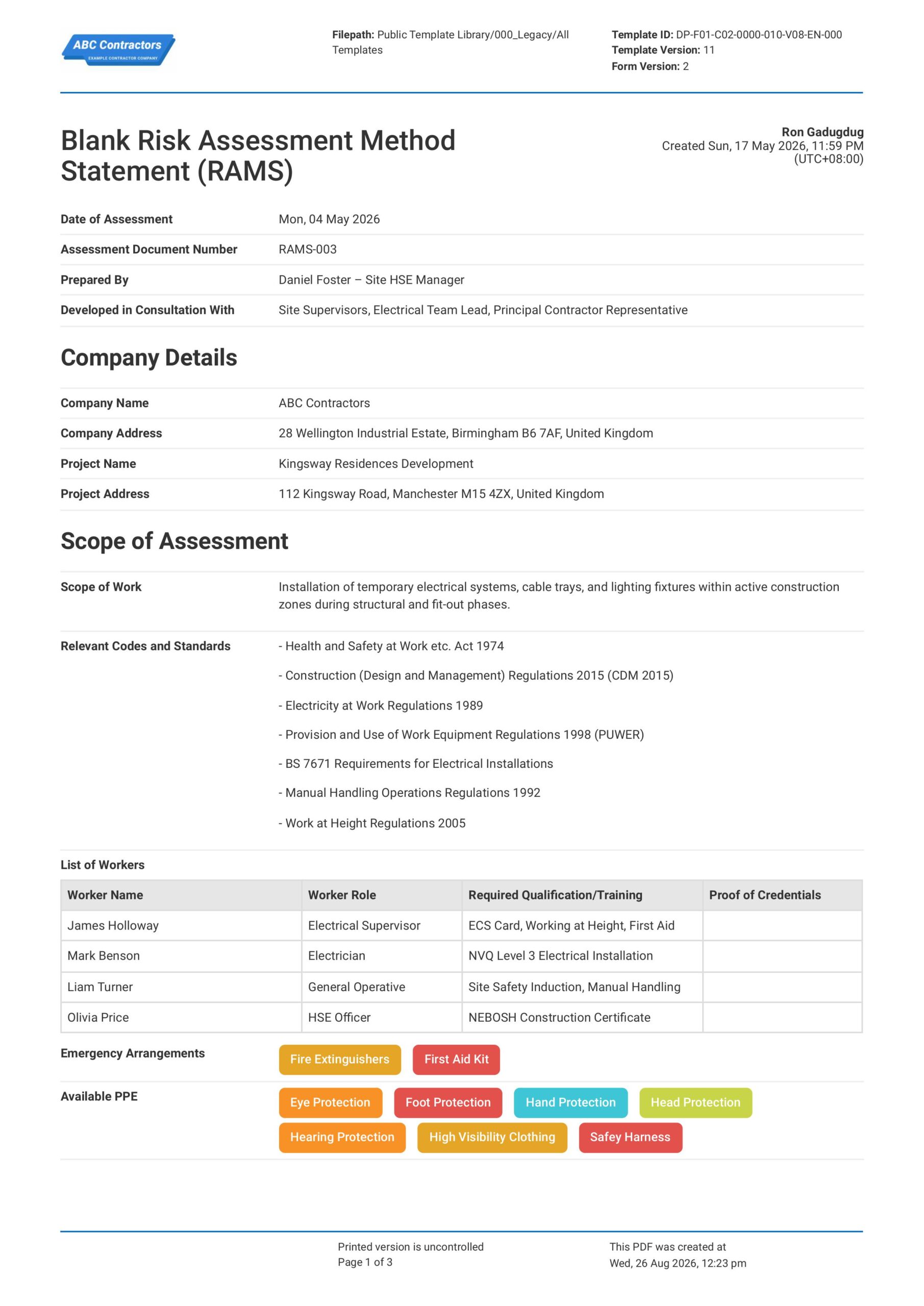
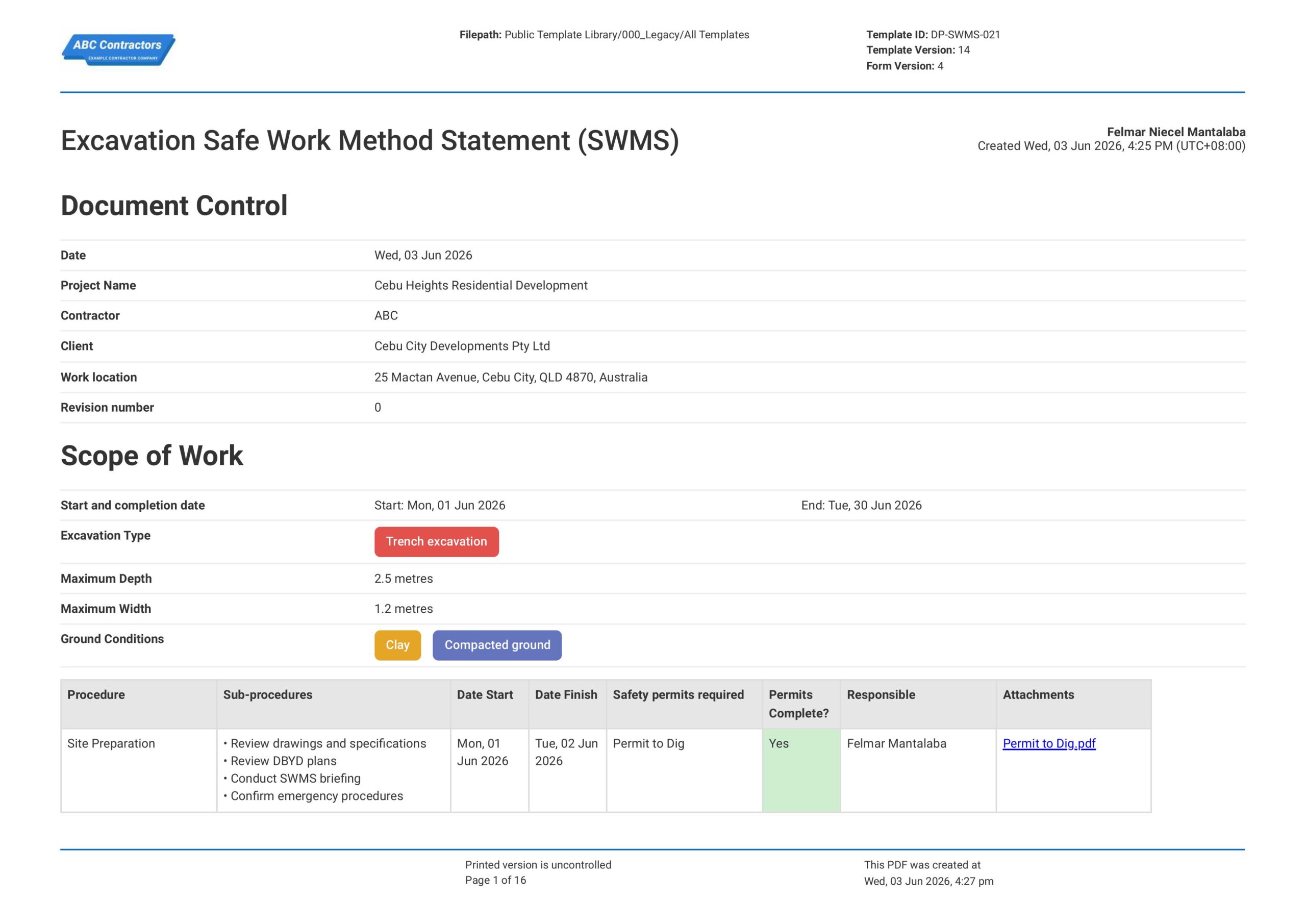
A RAMS document must have all the essential parts, which include project details, risk assessment, method statement, emergency procedures, and signatories.
Has version control tracking
Having version control tracking ensures that all distributed documents are up to date. This also provides a solid history of version updates, which is essential for internal and external audits.
Decision Points And Common Pitfalls
Boundaries of the scope
This leaves the question of where the team’s responsibility ends and the principal contractor’s begins. Companies must explicitly define the exact physical and operational limitations of the work area.
Standard competency level
Writing the method statement should be based on an established competency level. Writing a method statement that only a 15-year veteran would understand is an ineffective method statement.
Only relying on PPE as a safety measure
There is a reason why personal protective equipment is found in the lowest part of the hierarchy of safety measures. It should be used only if the other four safety measures cannot be implemented. PPE cannot contain hazards. It can only reduce the impact of the hazards but cannot eliminate the risks.
Treating RAMS as a compliance document
Treating RAMS as a compliance document is a very common occurrence across many industries. RAMS are created only to serve as compliance for audits, not as an effective safety management procedure. Such a method totally defeats the purpose of creating the RAMS and shows complete disregard for the safety and health of employees.
Frequently Asked Questions about Method Statement and Risk Assessment
What is a Risk Assessment Method Statement (RAMS)?

A RAMS is a document that identifies hazards and risks associated with a work activity and explains the safe system of work, including the control measures that workers must follow.
Who should prepare a RAMS?
A competent person with suitable knowledge and experience of the work should prepare the RAMS. Relevant workers and supervisors should also be involved to ensure the document reflects actual site conditions.
When should a RAMS be reviewed?
A RAMS should be reviewed before work starts and whenever there are significant changes to the work, equipment, site conditions, personnel, or identified risks. It should also be reviewed following an incident or near miss.
Do workers need to read and understand the RAMS?
Yes. Workers should be briefed on the RAMS before starting the activity and must understand the hazards, control measures, PPE requirements, and emergency procedures relevant to their work.
About the author

Felmar Mantalaba
Engineering Content Writer

Education:
Cebu Institute of Technology - University - Mechanical Engineering with Mechatronics
Bio:
Felmar is a mechanical engineer, whose four years of experience in the mining industry inspired him to write and share stories to progress the revolution of new technologies and create smarter, smoother ways of living.
Project Details:
Safety, Health, and Environment Management System (SHEMS) Coordination
SHEMS Coordinator at Atlas Consolidated Mining, ensuring organizational compliance with ISO 14001 and ISO 45001 standards, performing risk assessments, developing policies, and conducting audits and inspections to maintain a safe and environmentally responsible workplace.
Maintenance Management and Optimization
Senior Maintenance Manager (OIC) leading equipment maintenance and operational efficiency initiatives, reducing downtime by 10%, improving Mean Time Between Failure (MTBF) and Mean Time To Repair (MTTR) for major equipment, and managing maintenance schedules, manpower, and materials, while overseeing capital project optimization.
Inspection Engineering and Equipment Reliability
Inspection Engineer responsible for technical blueprint interpretation, vendor collaboration, preventive maintenance scheduling, and data collection for vibration and temperature readings, delivering actionable recommendations and comprehensive reports to improve equipment reliability and operational performance.
End-to-End Operational Oversight in Mining Engineering
Contributed to multiple facets of operational management, including SHEMS compliance, maintenance optimization, inspections, and capital project evaluation, integrating safety, reliability, and efficiency improvements across all stages of copper production operations.
Version History:
Other popular templates you can use and edit for free

 English (United States)
  English (Australia)
  English (UK)
  English (New Zealand)
  English (South Africa)
  German