

Taking AI To The Front Line
Preface - An AI Red Ocean
In their book Blue Ocean Strategy, W. Chan Kim and Renée Mauborgne describe two kinds of markets;
Blue oceans are the open, uncontested spaces where you create new demand, set the rules, and compete on a different axis.
Red oceans are the crowded spaces where competitors fight over the same customers with the same playbook - and the water turns red, it’s a zero sum game.
Right now, a huge chunk of AI tooling investment is racing straight into a red ocean.
There is already, and will continue to be, an explosion in back-office, agentic workflow automation tooling; agent frameworks, orchestration layers, copilots, agent-building platforms, internal enterprise teams wiring up their own Azure/Databricks stacks, and a constant stream of new startups pitching “AI that runs your operations.”
It’s impressive, it’s exciting, and most importantly - it’s (mostly) real.
But, it’s also increasingly horizontal - and horizontal is where the trap is for Sitemate.
The temptation is obvious; build “general AI” features because they look powerful in a demo, because the market is loud, and because everyone else is doing it. But if we try to win by becoming another generic reasoning layer, we’ll get commoditized fast, eaten by the platforms, the copilots, and the infrastructure vendors whose entire business model is to outspend and out-distribute everyone in that layer.
This is why Sitemate’s AI strategy is firmly anchored to our Mission, and aligned to our core competencies.
We are at the start of an AI gold rush. The companies that win won’t be the ones who sprint into every shiny surface area - they’ll be the ones who find the few seams where they can creating compounding advantage for years.
For Sitemate, that seam is clear; we win by sticking to what we’re uniquely good at, and by aligning all of our energy to our Mission to Multiply The Engineering Power Of The Built World; Multiplying The Engineering Power Of The Built World — The Sitemate Manifesto.
Because when we make data capture and process execution faster, easier, and higher-quality, everything downstream gets better; copilots get smarter, workflows get cleaner, and the engineering power of the built world multiplies.
That brings us to the simplest, most clarifying distinction;
IT teams are relevant - but they are not Sitemate’s customer, not really.
Our customer is the person collecting the data that those teams are screaming for.
Enterprise customers will keep building their own AI. They’re already merging data, summarizing, and automating reporting with horizontal tooling. They’re not waiting around. Which is exactly why we shouldn’t try to out-horizontal the horizontals.
Instead, Sitemate will take AI to the coal face, take AI to the front line, where the work is real, the environment is brutal, and the value is defensible.
We will take AI to the places where no-one else wants to, and to the places where no-one else can reach.
What Happens At The Front Line?
The front line isn’t about “being on site” - it’s a sequence of moments where real, tangible, work is happening.
The front line is cold, windy, dusty, hot, busy, noisy and dirty - the front line is the polar opposite of a knowledge worker sitting at their desk, sipping on a matcha, with their mac book pro in front of them.
Imagine an electrician that is mid-swap on a switchboard - the power is isolated, lockout/tagout is on, the team is moving fast because downtime costs money, and the environment is cramped and loud. Their phone is either in a pocket or balanced somewhere it shouldn’t be.
The proof they need isn’t “a form” - it’s a chain of reality; isolation confirmed, correct board identified, controls applied, test results recorded, photos taken, sign-off captured, and the job tied to the right asset, site, and work order. If anything goes wrong later, everyone will need to return to this trail of evidence.
Most traditional software breaks here because it assumes attention and clean input - it asks them to type, choose from dropdowns, remember IDs, attach the right photos, and complete fields in a neat sequence. If reception is poor or the UI is slow, they do what humans always do; they’ll finish the work and “do the admin later” - which is where proof degrades into half-truths and missing context.
Next, imagine a welder who is running a job in the heat, glare, and dust. Gloves on. Face shield down. Noise and vibration. Any interaction with a phone is friction, and friction gets skipped.
The proof requirement is still brutal; weld procedure followed, inspection completed, photos captured, measurements recorded, defects logged, NCRs raised when needed, signatures captured, actions created and assigned.
Not because someone loves compliance - because rework and risk are expensive.
Traditional software breaks here because it enforces “capture” by typing - it makes the user stop the job, clean hands, navigate fields, and translate physical reality into a clean digital schema. The result is either junk data, missing evidence, or no data at all.
Across these two hypothetical stories - the point is the same; the front line is where software usually fails because reality is messy, fast, physical, and unforgiving.
The best real story I have ever heard of this at Sitemate came completely unexpectedly - during a demo that I was running in North America.
I hopped on with a guy called Caleb, a regional safety manager for a company called Chapparall - an outfit that does commercial mechanical and electrical installation work in Texas and a few other states.
Caleb described a scenario to me, that is likely very common, but he did it in a way that made the opportunity for Sitemate so clear.
“The issue we have Hartley, is that our workforce can only speak Spanish.
And all of them, well not all of them, but many of them, are illiterate in their own native language.
Meaning they can’t read or write, even in Spanish.
Even with our foremen speaking both English and Spanish, this means that something as simple as getting an incident report done, can quickly turn into a culmination of chaos.”
A big part of my vision for Sitemate became clear to me from that call onward, in future we will support scenarios where a worker is called over the phone to complete an induction in Spanish, they provide all of their details to the voice agent (in Spanish), we translate that and submit it into a form that can be viewed in both English and Spanish, side by side.
Most technology companies will run away from this challenge - Sitemate is running towards it.
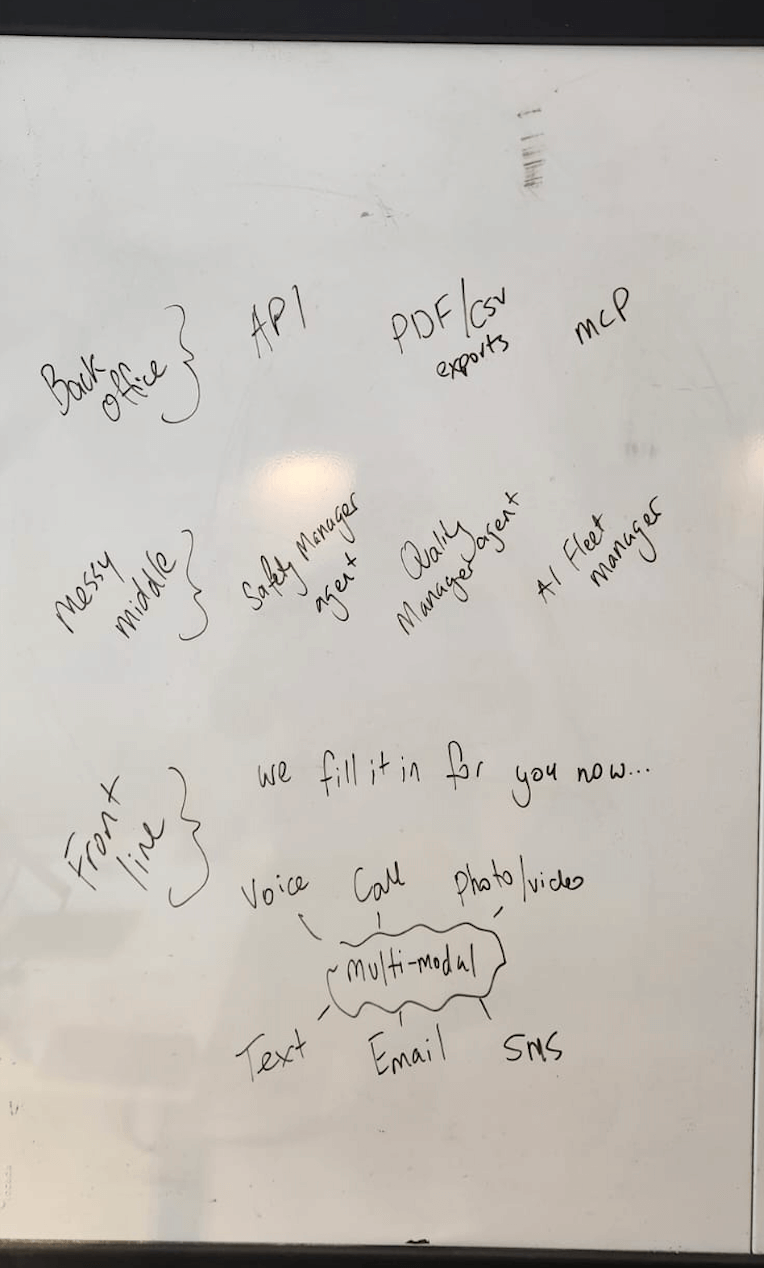
Mapping - Back Office → Messy Middle → Front Line
In order to navigate, we need a map - with so much happening, and so quickly, here’s the map I’m using for Sitemate.
The Back Office: enterprise plumbing (API, MCP, data warehousing)
In the AI Era, the back office is the world of;
- APIs and predictable integrations into systems-of-record.
- MCP (and similar connector patterns) as the integration interface layer between copilots/agents and tools.
- Data warehousing and the analytics/reporting gravity wells inside large companies.
- Agentic automation everywhere.
This layer is important, it’s often the ‘customer’ of the data that Sitemate generates; governed, auditable, connected - to be used by other systems.
But it’s not the wedge, and it’s also where the “horizontal AI” red ocean is the bloodiest; orchestration, copilots, internal platform teams, “reasoning layers” that sit above a warehouse and try to automate decisions.
Those players will keep getting better - and they’re designed to win that layer through distribution and spend.
Our stance here is pragmatic:
- We prioritize connection to dominant back office providers.
- We integrate cleanly.
- We let external copilots reason over Sitemate data.
MCP is a great example of the distinction; it can be a useful connector, but a connector is not a strategy. It’s plumbing - and plumbing only matters if what’s flowing through the pipes is valuable.
The Messy Middle: the horizontal vs vertical agentic battleground
Between the back office plumbing and front line execution is what I’ll call the messy middle.
This is the hybrid zone where two forces collide;
1- Horizontal agentic workflows - generic tools that can “do a bit of everything”
- Copilots, orchestrators, generic agents, LLM-powered routing, summarization tools → actions.
- Great demos, broad applicability, fast iteration.
2 - Vertical agentic workflows - category-specific tools where domain accuracy is non-negotiable
- Safety management; triage → investigate → corrective actions → verification → learn
- Quality management; NCRs → classification → root cause → approvals → rework/close-out
- Maintenance/reliability; backlog grooming → prioritisation → planning → execution assurance → close
And this is where reality bites.
People will try, as they should, to stretch horizontal tools into vertical use cases. It’s rational. It’s cheaper. It’s fast. It’ll work for the “good enough” edges; drafting, summarizing, suggesting, accelerating.
But the messy middle is where accuracy, domain semantics, and traceability start to matter more than cleverness.
Because these workflows produce outcomes that can become contractual artifacts, safety records, compliance evidence, or the reason a job gets shut down. In those moments, “mostly right” isn’t good enough.
This is exactly why the messy middle is both a huge opportunity and a trap. It’s where generic tools will be stretched to their limits, and where vertical products and services with deep workflow primitives can win.
This will be the most difficult layer to win as a vertical solution, as you’ll need to be close-to on-par with the capability of horizontal providers' ease of use, reliability and customization, yet with significant domain alpha and capability to differentiate, stand out, and win.
The Front Line: mobile, cross-party, individuals (where truth is created)
At the bottom is the front line.
This is the world of:
- Mobile workflows; executed in the moment.
- Cross-party reality; contractors, subs, client reps, multiple orgs, messy boundaries.
- Individuals; varying literacy, language, confidence with tech, and wildly different devices.
And this is the core distinction that matters in the AI era;
The Back Office connects systems and executes org level reasoning.
The Messy Middle manages execution and outcomes.
The Front Line supplies truth as if it were oxygen.
AI doesn’t become defensible because it can “reason” - ‘every man and their dog’ now has access to good reasoning.
AI becomes defensible when it helps create high-integrity truth in an otherwise messy reality, at volume, with near-zero friction.
Core Competency As The Guide
When you zoom out, this is the way we’ll keep ourselves honest;
Our core competency is making the capture of truth within the built world easier, faster, higher-volume, and higher-quality - and executing workflows in the moments that matter.
That’s the hard thing. Not “reasoning”. Not “orchestration”. The hard thing is building product that works when reality is hostile; when the user is moving, when there’s noise and dust, when reception drops, when gloves are on, when it’s cross-party, multilingual, low-literacy, and high-consequence.
Generic AI can help around the edges of that, but it can’t replace it without product craft + front line distribution + trust.
Most of the market is building from the top down; connect more tools, reason over more data, orchestrate more workflows, and that’s great - it’s just not Sitemate.
We’re building from the bottom up; make truth creation and capture effortless, then let everything above it compound.
Closing - The Moat Is Being Where No-One Is
Most AI products will win by getting better at reasoning over existing information.
Sitemate will win by getting better at creating the information worth reasoning over.
Because in the built world, the truth is not sitting neatly in a warehouse waiting to be summarized.
Truth is created in moments;
- When the power is isolated.
- When the weld is still hot.
- When the inspection is happening in the rain.
- When the foreman is trying to get a crew moving.
- When the defect is discovered and either becomes an action… or becomes rework.
If we make capture and execution at the front line near-zero friction, or zero click; Zero Click Forms, then two things happen;
- Data volume explodes (because it finally fits reality).
- Data integrity rises (because the moment is captured while it’s still true).
And then everything downstream compounds; the messy middle gets cleaner; less chasing, less ambiguity, fewer orphaned actions, fewer “compliance theatre” records. The back office gets more valuable; not because we built better plumbing, but because the water is now worth flowing.
That’s the inversion:
If we win the truth layer, we become the system other systems rely on — not the other way around.
Staging Order
This is the stating order in which Sitemate will attack these layers, and it’s deliberate;
- The front line first - because this is the differentiator. This is where reality is hostile, where most software fails, and where we have the right to win. It’s also where user love is created.
- The back office next - because integrations reduce adoption friction, increase close rates, and deepen retention. We integrate cleanly, and we make Sitemate data usable everywhere.
- The messy middle after - because it’s where bigger category bets live; safety, quality, maintenance - and it will only compound if the truth layer is strong. This is where our category teams and AI platform teams may likely converge over time.
We are taking AI to the front line because that is where the pain that triggered Sitemate’s founding, and our Mission, originates from.
About the author

Hartley Pike
CEO & Co-founder

Education:
University of Technology Sydney - Master of Business Administration in Entrepreneurship (Dropped Out)
University of Technology Sydney - Bachelor of Engineering (BE), Diploma in Engineering Practice, Civil Structures
Bio:
Hartley is the Founder and CEO of Sitemate, where he turns real-world construction and infrastructure experience into software products that site teams want to use. With a background in civil engineering across major transport infrastructure projects, manufacturing, and large-scale site operations, he brings experience to product strategy and development.
He applies lean principles to improve productivity and efficiency across complex, high-risk operational workflows. Today, he leads Sitemate’s product strategy and growth, building platforms such as Dashpivot, Flowsite, Gearbelt and more that transform standard operating procedures into structured, data-driven workflows, helping teams deliver work more reliably, safely, and on time.
Version history:
First published on 01/19/2026, template version 25-11-v2


 English (United States)
  English (Australia)
  English (UK)
  English (New Zealand)
  English (South Africa)
  German