Free Field Reporting template
Noise Monitoring Report Template
No credit card required.
Monitoring noise levels on your construction project or workplace? Looking for a noise monitoring report sample to help guide your own reporting process? This Noise Monitoring Report Template helps teams record noise measurements, assess noise exposure, and identify areas where additional noise controls may be needed.
This Noise Monitoring Report Template is an easy-to-use form that your team can use to record and assess noise levels during construction, industrial, or other workplace activities. Record important details such as the monitoring date, location, noise sources, monitoring equipment, measurement duration, noise levels, applicable limits, and recommended corrective actions, then attach supporting photos, files, and sign-offs - all in one free form. Plus, you can even export your completed reports to PDF or CSV for easy sharing with safety managers, environmental officers, contractors, and other stakeholders.
- 100% fully editable Noise Monitoring Report
- Export your Noise Monitoring Report to PDF or CSV
- Access your Noise Monitoring Report on mobile, tablet or computer
- Thousands of templates including other Field Reporting templates
 Click to preview
Trusted by thousands of companies, projects & teams worldwide















Compare this Noise Monitoring Report to reports made on other formats
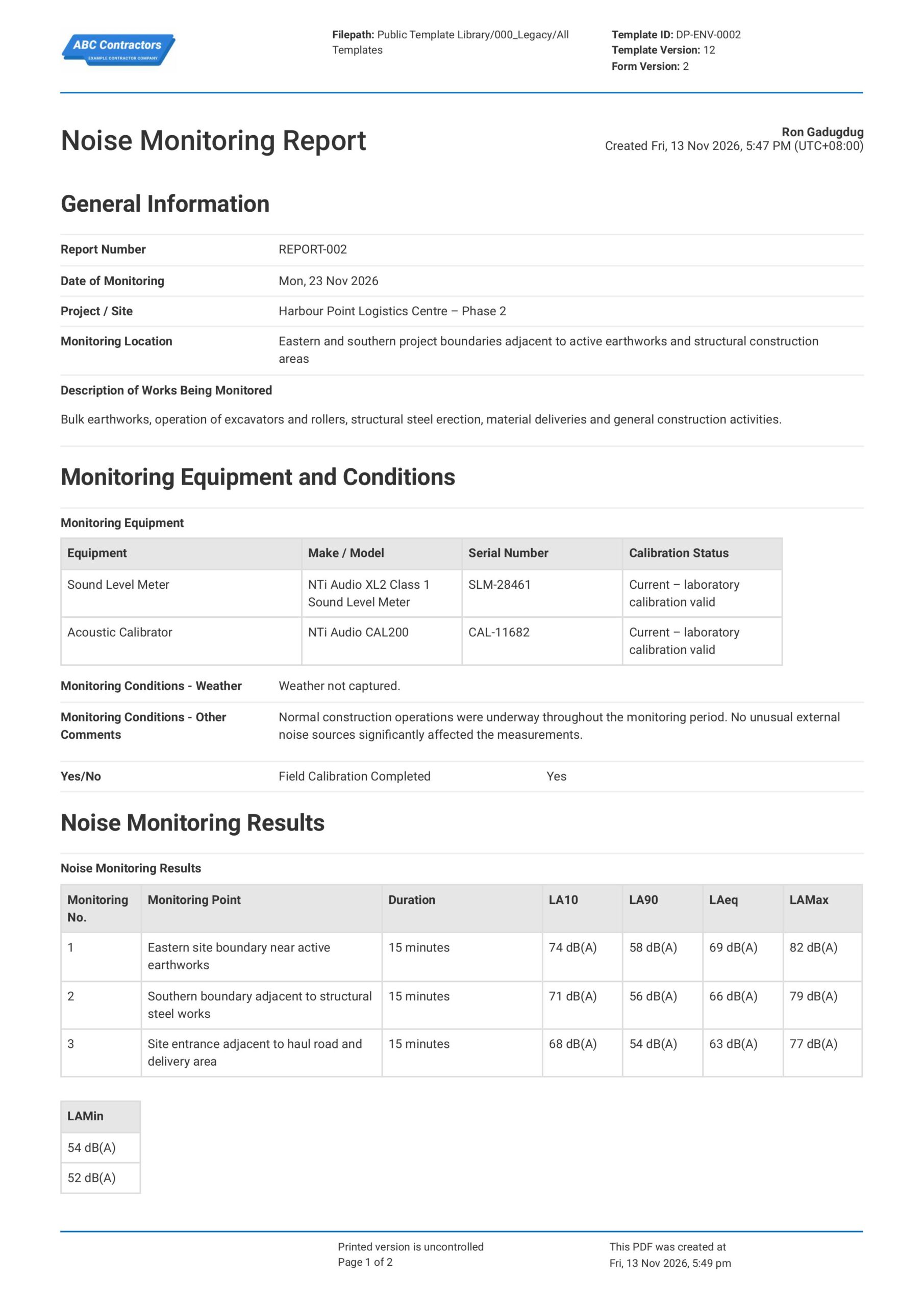
Curious how this report works? Check out the example below to see how you can generate your own version, export it as a custom form with your company details, and fill in your information to have a Noise Monitoring Report ready-to-use in minutes. No more starting from scratch like you would on Excel or Word-based forms.


This report was generated using Dashpivot, where you and your team can create smart documents that allow photos and video attachments, conditions, and more tailored to the needs of all your work tasks.
- Access, edit and complete your Noise Monitoring Report from any device - mobile, tablet or computer.
- Print, download or send your Noise Monitoring Report as perfectly formatted PDF documents with your company logo.
- Store your Noise Monitoring Report securely online, where they can be searched and found in seconds
- Invite internal and external parties to see, edit and sign off on Noise Monitoring Report online.
Need a version for your own site?
Storm, the AI agent in Dashpivot, can build one from a short description or the form you already use.


 GLOBAL


What is a Noise Monitoring Report?
A Noise Monitoring Report is a document used by safety managers, environmental officers, engineers, and site supervisors to record and evaluate noise levels generated by workplace or project activities. This report usually includes details on noise sources, monitoring locations, measurement equipment, noise readings, exposure duration, applicable noise limits, and recommended control measures.
Due to the risks that come with excessive noise exposure, monitoring is important for identifying potential hearing hazards, noise disturbances, and impacts on surrounding communities. This makes Noise Monitoring Reports highly relevant in construction, manufacturing, mining, infrastructure, utilities, and industrial projects where heavy equipment, machinery, and other work activities can generate high noise levels.
Applicable Standards and Policies for Noise Monitoring Report
There are generally no explicit universal formatting requirements for a Noise Monitoring Report. However, most workplace safety laws require businesses to assess noise exposure, monitor hazardous noise levels, and document controls to protect workers from hearing damage. A Noise Monitoring Report is a good document to support compliance with these requirements. Here are examples of common regulations referenced around the world:
- OSHA 29 CFR 1910.95 covers occupational noise exposure in general industry in the USA
- OSHA 29 CFR 1926.52 covers noise exposure requirements for construction work in the USA
- UK Control of Noise at Work Regulations 2005 require employers to assess and control workplace noise
- Safe Work Australia Managing Noise and Preventing Hearing Loss at Work Code of Practice covers noise assessments and controls
- Local WHS laws commonly require noise exposure assessments, hearing protection, and related records
Staff Members and Parties That Use the Noise Monitoring Report
A Noise Monitoring Report is primarily used by businesses and project teams that assess noise levels from construction activities, machinery, industrial equipment, and other work that may expose workers or nearby communities to excessive noise. Here are examples of common parties that use a Noise Monitoring Report:
- Health and safety teams
- Site supervisors and project managers
- Industrial hygienists and noise monitoring specialists
- Environmental officers and consultants
- Contractors and subcontractors
Business Risks Reduced by the Noise Monitoring Report
Using a Noise Monitoring Report helps businesses identify issues such as excessive noise exposure, poor hearing protection, ineffective noise controls, and noise complaints before they develop into more serious problems. Without proper noise monitoring and documentation, businesses may be exposed to risks such as:
- Worker hearing loss and other noise-related health issues
- Non-compliance with workplace noise exposure limits
- Regulatory fines, legal claims, and compensation costs
- Noise complaints and disputes with nearby communities
- Project delays caused by inspections, restrictions, or shutdowns
Business Opportunities Created by the Noise Monitoring Report
A well-prepared Noise Monitoring Report helps businesses improve workplace safety, noise control, and environmental performance across different projects and worksites. Here are some ways a Noise Monitoring Report can help businesses:
- Identify recurring noise issues and improve control measures
- Improve planning of noisy work activities and equipment use
- Strengthen safety audit readiness and contractor prequalification
- Build client confidence through documented noise monitoring and compliance
What does a completed noise monitoring report template cover?
There are no single global requirements that cover the exact format of a Noise Monitoring Report. Rather, requirements can vary depending on the region, industry, project type, noise exposure limits, and environmental regulations. However, there are some core elements that are typically included that you should know about:
- Monitoring details such as site location, date, time, weather conditions, and responsible persons
- Noise sources such as construction equipment, mobile plant, power tools, demolition activities, and nearby traffic
- Noise measurement results, including decibel levels (dB), equivalent continuous sound levels (LAeq), and exposure duration
- Monitoring equipment, measurement locations, calibration records, and applicable noise limits
- Identified noise exceedances, corrective actions, responsible parties, and follow-up monitoring requirements
How to Create a Noise Monitoring Report
Creating an effective Noise Monitoring Report should start with a foundation of knowledge on noise monitoring and inspection processes. In this section, we discuss important steps so you can create your own Noise Monitoring Report.
Before starting your Noise Monitoring Report form, the following pre-requisites should be ready.
- Project or site details are required.
- Monitoring date, time, and locations must be recorded.
- Noise sources and work activities must be listed.
- Sound level meter details and calibration records must be available.
- Noise measurements, including dB(A), LAeq, and peak levels, must be recorded.
- Applicable noise limits and exposure criteria must be stated.
- Monitoring findings and corrective actions must be included.
Start with Project and Monitoring Information
First, you need to place high-level general information at the beginning of your Noise Monitoring Report to help establish context for the monitoring activities being conducted. Here are some examples of core elements that you can use:
- Project name and site location
- Date and time of noise monitoring
- Name and role of the person conducting the monitoring
- Work area or location being assessed
- Noise monitoring equipment and reference number
Identify Noise Sources and Monitoring Locations
Next, you will want to identify the main sources of noise and determine where measurements should be taken. This helps establish which workers, work areas, or nearby locations may be affected by noise exposure. Here are some examples of information that you should record:
- Noise sources, such as machinery, equipment, vehicles, or construction activities
- Specific monitoring locations or measurement points
- Workers, nearby properties, or public areas that may be affected
- Distance between noise sources and monitoring points
- Duration and frequency of noise-generating activities
Conduct Noise Monitoring and Record Measurements
After the monitoring locations are identified, you will want to conduct noise measurements using suitable equipment and record the results. For example, you will want to list the following information in your Noise Monitoring Report:
- Equivalent continuous sound level (LAeq)
- Maximum sound level (Lmax)
- Peak sound pressure level (Lpeak)
- Noise exposure duration or time-weighted exposure, where applicable
- Equipment calibration checks and measurement conditions
Assess Noise Levels and Identify Potential Risks
It is important that the recorded noise levels are assessed to determine whether they exceed applicable exposure limits or environmental noise requirements. Common information that you should review and document includes:
- Recorded noise levels against applicable limits or thresholds
- Work activities or equipment producing excessive noise
- Workers or nearby areas exposed to elevated noise levels
- Existing noise control measures
- Recommended corrective actions to reduce noise exposure
Complete Review, Recommendations, and Sign-Off
Complete your Noise Monitoring Report with a review and sign-off section to confirm that the monitoring results have been checked and any outstanding noise-related issues have been addressed or assigned for further action. Here are some examples of fields you can include:
- Summary of noise monitoring findings
- Recommended noise control measures
- Outstanding corrective actions and responsible personnel
- Names and roles of reviewers and approvers
- Date of review and final sign-off
Why are Noise Monitoring Reports Important?
Noise Monitoring Reports should include measurements that show how loud the noise is, how long people are exposed, and whether noise levels exceed applicable limits. This is especially important on construction, civil, demolition, and industrial sites where machinery, power tools, and other activities can create both continuous and sudden high noise levels.
Common measurements include the equivalent continuous noise level (LAeq), maximum noise level (LAmax), peak sound pressure level (LCpeak), and daily personal noise exposure (LEX,8h or TWA). Additionally, environmental monitoring may include LA10 and LA90 measurements to assess fluctuating noise levels and background noise near surrounding communities. Essentially, these measurements help project teams assess worker exposure, environmental noise impacts, and compliance with applicable noise regulations and exposure limits.
How to Create Your Noise Monitoring Report in an App or Software System
A well-designed Noise Monitoring process helps site teams track noise levels, monitoring locations, sources, and exceedances, while keeping results structured for easy review, comparison, and sharing.
Start your Noise Monitoring Report with General Information
It is important to begin your Noise Monitoring Report with key project, site, date, location, and monitoring activity details so the document can be traced to the correct noise monitoring assessment. This section should use simple text, date, and multi-line text fields for fields such as:
- Text field or Automatic Form Counter for Report Number
- Date selector field for Date of Monitoring
- Text field for Project / Site
- Text field for Monitoring Location
- Multi-line text field for Description of Works Being Monitored
Create a Table for Monitoring Equipment
Next, create a section where users can record the sound measurement equipment used during the monitoring activity, including equipment identification and calibration status. We highly recommend using a table for this section so each piece of equipment can be documented with the following columns:
- First column for Equipment
- Second column for Make / Model
- Third column for Serial Number
- Fourth column for Calibration Status
- Pre-filled rows for Sound Level Meter and Acoustic Calibrator
Create a Section for Monitoring Conditions
After recording the monitoring equipment, add a section where users can document weather conditions, other environmental factors, and whether field calibration was completed. For simplicity, we recommend using the following fields:
- Text field or Automatic Single Day Weather capture for Monitoring Conditions - Weather
- Multi-line text field for Monitoring Conditions - Other Comments
- Yes/No selector field for Field Calibration Completed
Create a Table for Noise Monitoring Results
Users will next need to record noise measurements collected at different monitoring points across the site. We highly recommend using a table for this section so each measurement can be documented alongside its location, duration, and recorded sound levels, with the following columns:
- First column for Monitoring No.
- Second column for Monitoring Point
- Third column for Duration
- Fourth column for LA10, measured in dB(A)
- Fifth column for LA90, measured in dB(A)
- Sixth column for LAeq, measured in dB(A)
- Seventh column for LAMax, measured in dB(A)
- Eighth column for LAMin, measured in dB(A)
Create a Section for Results Assessment and Findings
Next, create a section where users can assess the recorded noise measurements and document any significant findings or recommended actions. We recommend using multi-line text fields so users can provide detailed explanations of the monitoring results and any actions required.
- Multi-line text field for Assessment of Results
- Multi-line text field for Findings and Recommended Actions
Create a Section for Photos of Monitoring Location
After the results assessment, add a section where users can attach photos showing the monitoring equipment, measurement locations, and surrounding site activities. If your app or software allows, we recommend using photo capture fields with automatic details such as:
- Photo upload or capture fields for Photos of Monitoring Location
- Optional text field for Photo Description
- Optional automatic date and time stamp for captured photos
- Optional automatic GPS location capture for monitoring photos
End your Noise Monitoring Report with Acknowledgment and Sign-offs
Finally, complete the Noise Monitoring Report with an acknowledgment statement and sign-off fields for the personnel responsible for conducting and reviewing the noise monitoring assessment. If your app or software allows, use a pre-filled acknowledgment statement and automatic e-signature fields to keep the sign-off process digital.
- Pre-filled text field for Acknowledgment Statement
- E-signature field for Monitor Sign-off
- E-signature field for Reviewer Sign-off
- Automatic date and time stamp fields for each sign-off
Frequently Asked Questions
What is a Noise Monitoring Report used for?
A noise monitoring report is used to record and assess noise levels from construction, industrial, and other work activities. This is important for projects where loud equipment, machinery, or site operations may expose workers and nearby communities to excessive noise. The report helps teams track noise exposure, identify high-noise activities, and check compliance with applicable noise limits.
Are there any regulations or legislation that govern how a Noise Monitoring Report is structured?
There is no single required format for a Noise Monitoring Report across all regions. However, workplace noise regulations, environmental permits, and local noise limits may set requirements for how noise measurements are taken and recorded. Standards such as ISO 9612 for occupational noise and ISO 1996 for environmental noise can also guide measurement methods and reporting.
What should be included in a Noise Monitoring Report?
A Noise Monitoring Report should include the site details, monitoring locations, date and time, noise sources, measuring equipment, calibration records, noise readings in dB(A), equivalent continuous sound levels (LAeq), peak noise levels where applicable, and monitoring duration. A noise level monitoring report or noise measurement report should also compare results against applicable limits and record any required corrective actions.
How is AI helping teams create Noise Monitoring Reports?
AI can help teams create Noise Monitoring Reports by turning noise readings, monitoring logs, and site notes into clear report drafts. It can also help identify noise trends, flag readings above set limits, and prepare summaries for environmental and workplace safety reviews.
About the Author

Ron Gadugdug
Content Engineer
 LinkedIn
Education
Cebu Institute of Technology - University - Civil Engineering
Bio
Ron is a Civil Engineer with 6 years of experience in the construction industry, primarily focused on quantity surveying, cost estimation, project management, quality control, contract administration, and property & engineering insurance. At Sitemate, he writes about practical applications of evolving technologies and digital solutions that support construction professionals in improving efficiency, compliance, and project delivery across the built world.
Past Projects
Quantity Surveying & Cost EngineeringPerformed quantity take-offs of several high-rise and horizontal structures using sheets and applications like Revit and Bluebeam Revu, and spearheaded trials with Building Information Modeling (BIM) software.
Project Management & ConsultancyCoordinated with project management teams during the construction of local projects such as a 4-tower hotel & resort, a 22 storey condominium project, and a school dormitory project.
Contract AdministrationAssisted during contract biddings and negotiations with general contractors and sub-contractors, and oversaw progress reporting, billings, and payment.
Property & Engineering InsuranceDedicated non-life claims handler, overseeing property and contractor all-risk insurance claims, risk management, and bonds.
Version history
Last edited on 13 November 2026, template version 25-11-v2