
Ground Condition Report
Start with a free 30-day trial. No credit card required.
 100% fully editable Ground Condition Report
Export your Ground Condition Report to PDF or CSV
Access reports on mobile, tablet or computer
Thousands of templates including other quality templates

~10,000 employees

~500 employees

~25,000 employees

~20 employees

~50 employees

~1,500 employees

~20 employees
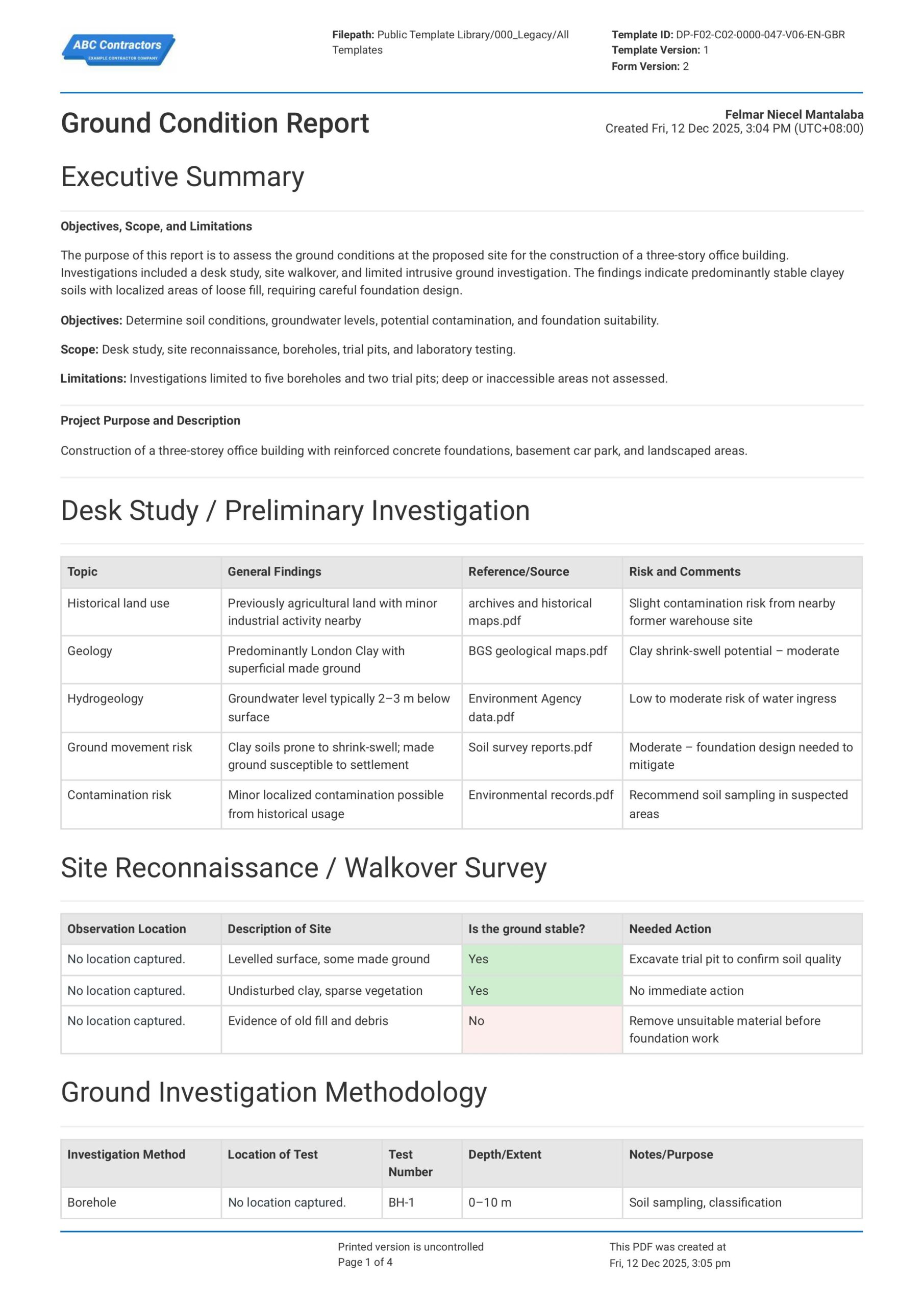
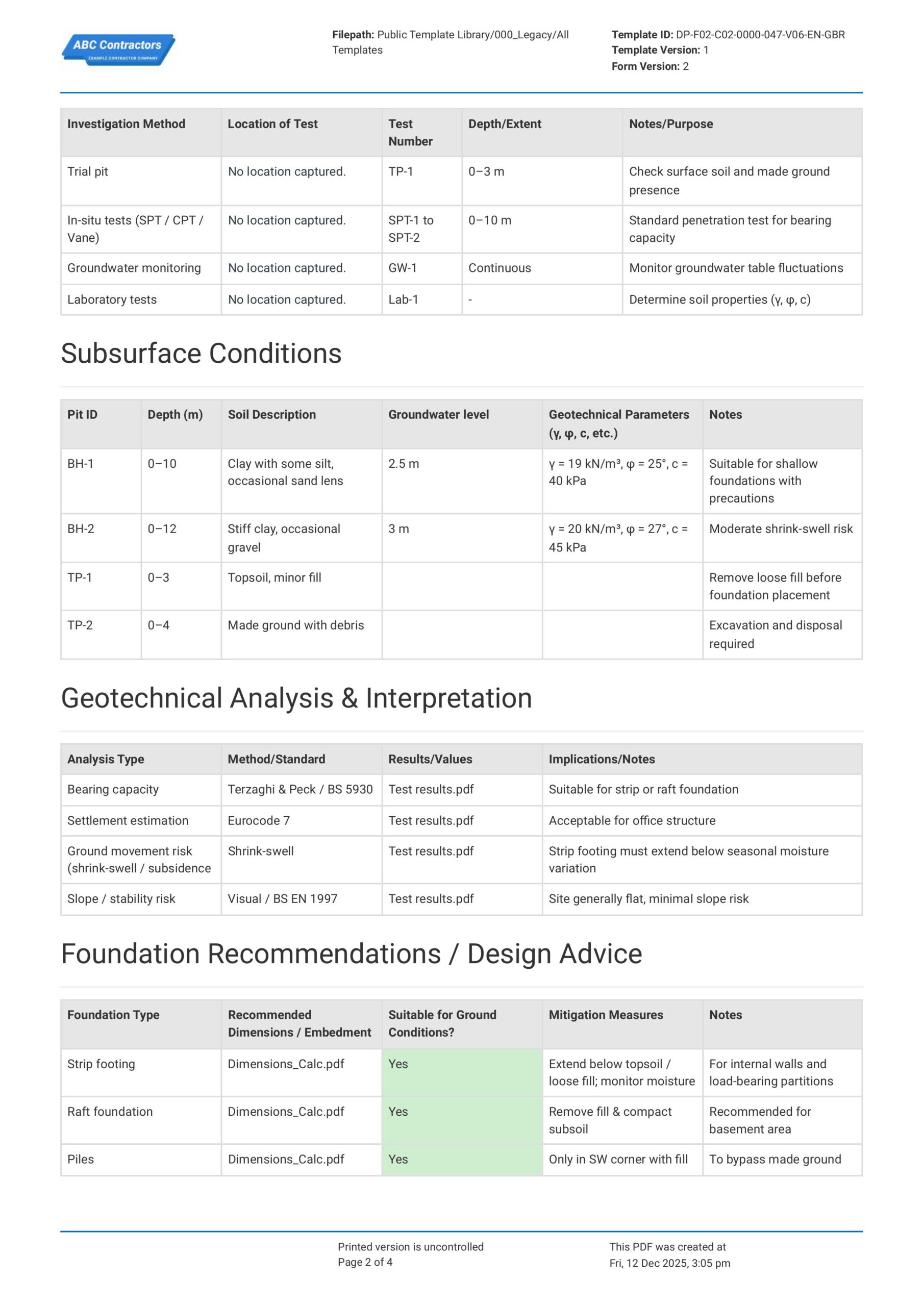
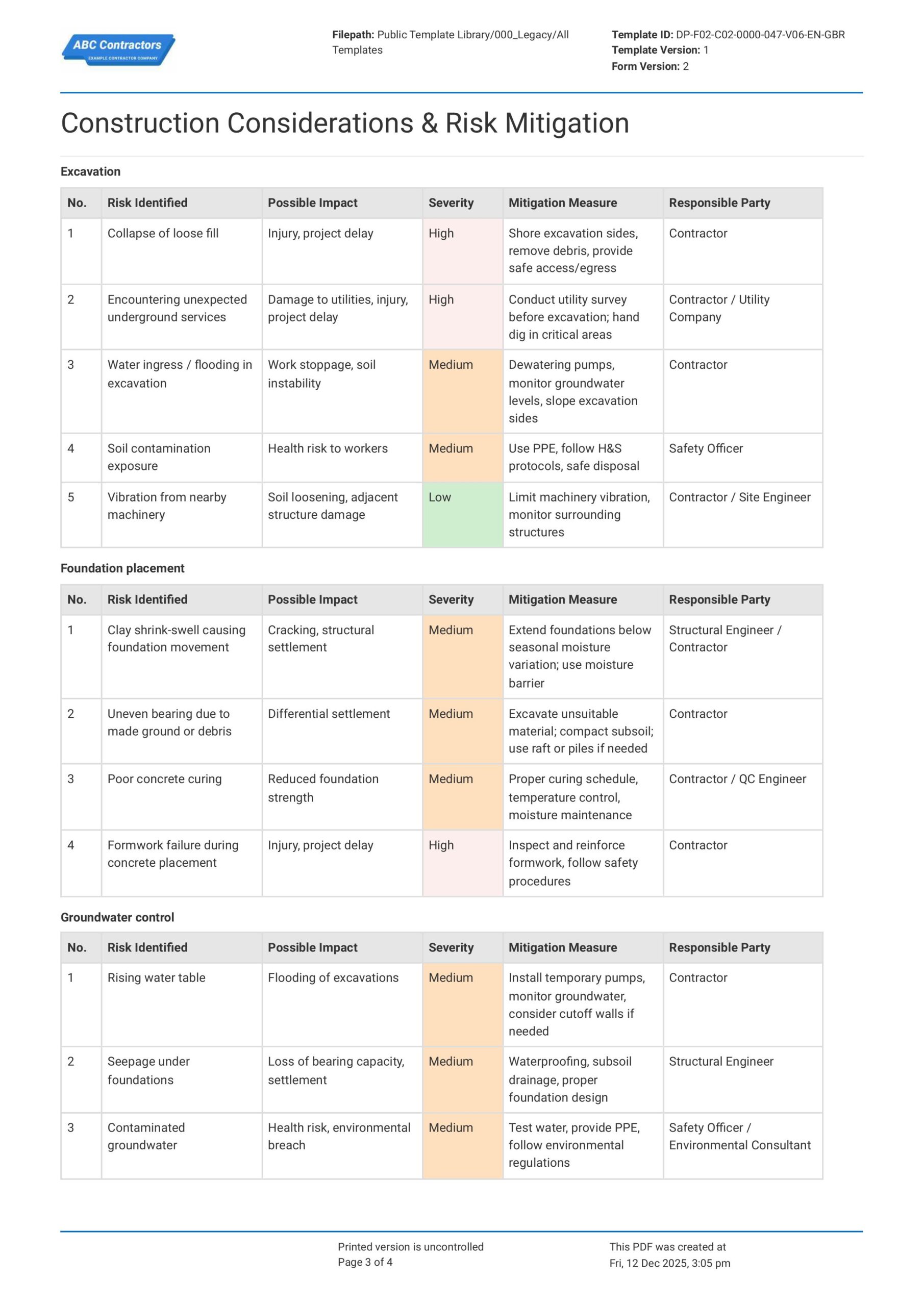
What is a Ground Condition Report?
A Ground Condition Report is used to examine ground conditions to identify a site's ground specifications and subsurface structure, ideally before construction work begins. It gives precise data and insight about the soil, rock, and groundwater underlying the site, assisting engineers, planners, and developers in designing safe, stable, and compliant structures, which is critical to the success of the construction process.
Compare this Ground Condition Report to paper-based forms created from Word, Excel, or PDF
Use this Ground Condition Report template for free.
Different Geotechnical Ground Condition Test Methods
When constructing a building, one of the most important things to consider is the ground condition. The ground receives all the loads from a building. Any sign of instability from the ground is a fatal flaw for a building, since it could lead to a structural collapse. To avoid such matters, construction companies should include ground condition tests as a preliminary step before constructing a building. There are 4 methods for testing ground conditions, namely:
Boring
Borings, which are conducted by drilling contractors, can have different diameters, which allow for density evaluation via standard penetration testing (SPT) to physically remove soil or rock samples for assessment and testing. Borings offer the advantage of evaluating field density and observing the removed materials. Soil samples from the above tests are often taken to a lab for analysis. Borings allow stakeholders to install piezometers to monitor seasonal groundwater table instability.
Test pits
Trial pits are an intrusive site examination type of test that determines ground conditions across a site to assess or sample the subsurface structure and composition. A pit is dug, either manually or with a machine, to obtain a sample of the subsurface conditions at the required depth. Sampling procedures to be enabled include contamination tests, vane shear tests, infiltration tests, and CBR testing (in accordance with the guidance set out in BRE 365).
Trenching
Trenching follows the same process as test pits, but the excavation is extended over a distance to assess how subsurface conditions vary across the worksite. This approach enables the identification of various sedimentary changes over a larger distance. Trenching is also particularly beneficial in identifying ground models related to landslides, identifying old fill and disturbed material, and determining the depth of soft sediments.
In Situ Testing
In situ testing methods include drilling-based penetration tests such as Standard Penetration Tests (SPT), percussion-based inquiry techniques, sonic vibratory drilling methods, and various static direct push Cone Penetrometer Testing (CPT). In situ testing can produce a more accurate assessment of subsurface conditions, which allows for better data interpretation and informed geotechnical design.
In situ tests can be classified into three types. The first type is the empirical tests, where no basic analysis is possible because stress routes, drainage conditions, and rate of loading are either uncontrolled or inappropriate (for example, SPT). The second type is "semi-experimental testing.” Semi-empirical tests are those in which a limited relationship between parameters and measurements can be created. Lastly, the analytical studies regulate stress pathways but often do not regulate strain levels and drainage (vane shear strength, pumping tests, and packer permeability are some examples).
Part A: Conditions relating to the ground
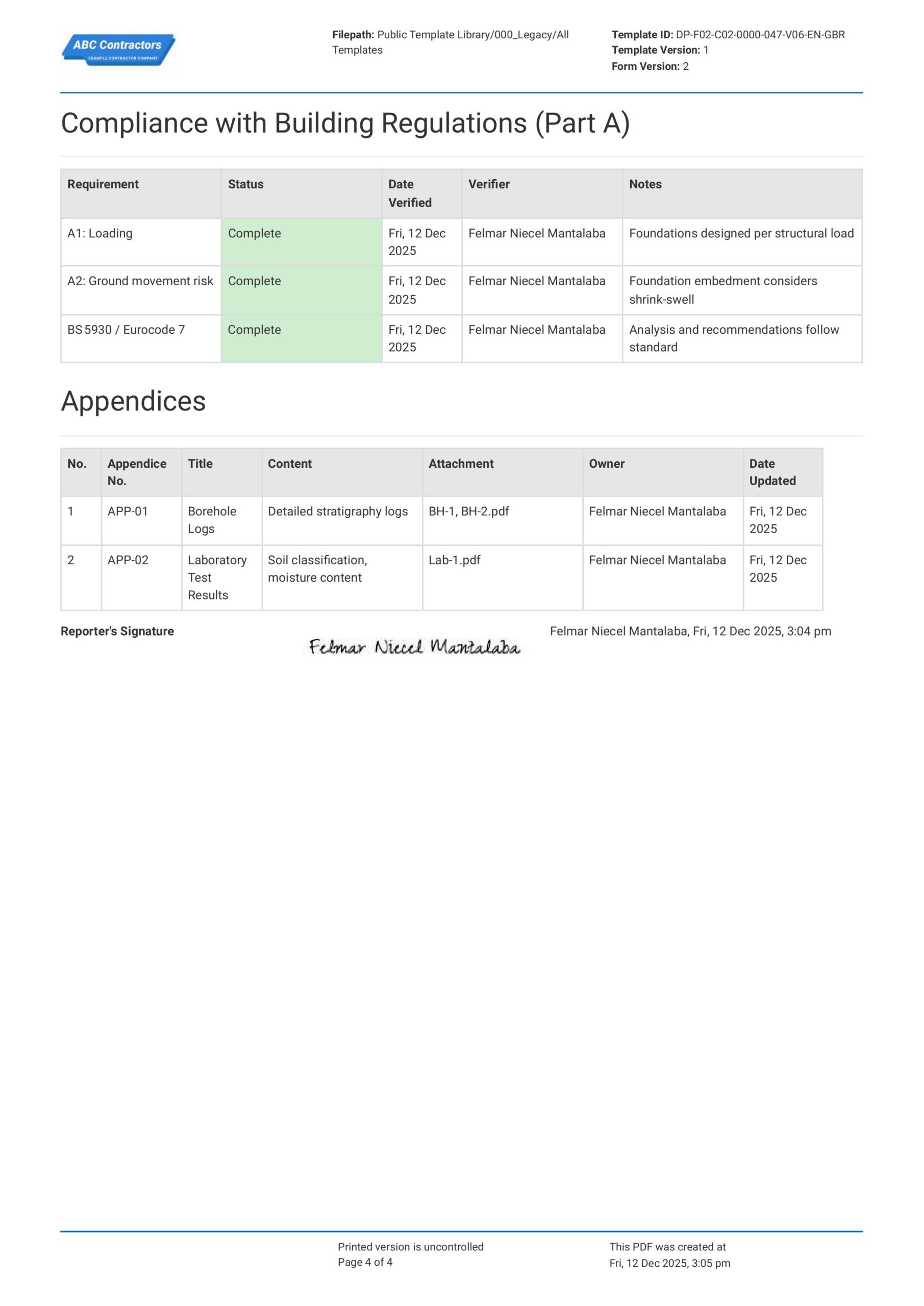
Section 2E1 of the UK Building Regulations Approved Document A has mandated a provision on the requirements of the conditions related to the ground where the foundation will be constructed. It states that there should not be a non-engineered fill (described in BRE Digest 427) or wide variation in the ground conditions within the loaded area. Furthermore, Part A also doesn’t allow any weaker or more compressible ground at such a depth below the foundation, as it could impair the stability of the structure.
Frequently Asked Questions
Why is this the best Ground Condition Report template?
Sitemate’s Ground Condition Report template is the best ground condition reporting template because it is already proven by thousands of construction, civil engineering, and geotechnical companies worldwide. It comes pre-built to align with industry best practice for site investigation, risk identification, and documentation, and is quick and easy to use for any type of worker — whether in the field or the office.
Is this template compliant with Part A standards?
Yes — this template is already configured to align with Part A (Structure) requirements of the Building Regulations and relevant British Standards. It is actively used by certified contractors, engineers, and consultants across the construction and civil engineering industry to demonstrate compliance, support audits, and maintain high standards of structural safety and documentation.
Can I edit this Ground Condition Report for my project or company?
Yes — the template is fully editable with intuitive drag-and-drop functionality. You can design countless document layouts using a variety of field types, including tables, formulas, sketches, photos, and more, to handle any kind of data capture. It also allows you to incorporate your company logo, headers, and other key structural elements. All of this is made simple and efficient through Dashpivot’s powerful template builder.
On what platforms can the report be accessed?
This template works seamlessly across all devices — computer, mobile, and tablet. You can complete Ground Condition Report forms in the office on your computer or directly in the field using a mobile device. Once submitted, all records can be generated or exported as PDF or CSV, giving you the functionality of Word, Excel, and PDF combined with the efficiency and power of modern software.

Other popular templates you can use and edit for free

Part A Structural Design Checklist
Streamline the process of inspecting important structural design elements needed for a building to meet standards.

Part A Structural Inspection Checklist
Thoroughly assess if all structural members of the building are built by design and are compliant with Part A regulations in the UK.

Structural Load Path Verification Checklist
Confirm that a building's load path complies with the approved design and efficiently supports and transmits loads to the ground.

This Ground Condition Report was generated with Dashpivot
Build better foundations by effectively assessing the ground. This Ground Condition Report is designed with a user-friendly interface that allows users to complete the report in a few taps and clicks without sacrificing quality.
- Complete, edit, and review the Ground Condition Report form from any device.
- Export and send inspection records as perfectly formatted PDF documents with your company logo.
- Securely store and manage your mobile tower inspection checklist for easy searching and finding.
- Pinpoint locations accurately by using the location function inside the form.

Sitemate builds best-in-class software tools for built world companies.

 English (United States)
  English (Australia)
  English (UK)
  English (New Zealand)
  English (South Africa)
  German