Environmental Risk Assessment Template

Start with a free 30-day trial. No credit card required.
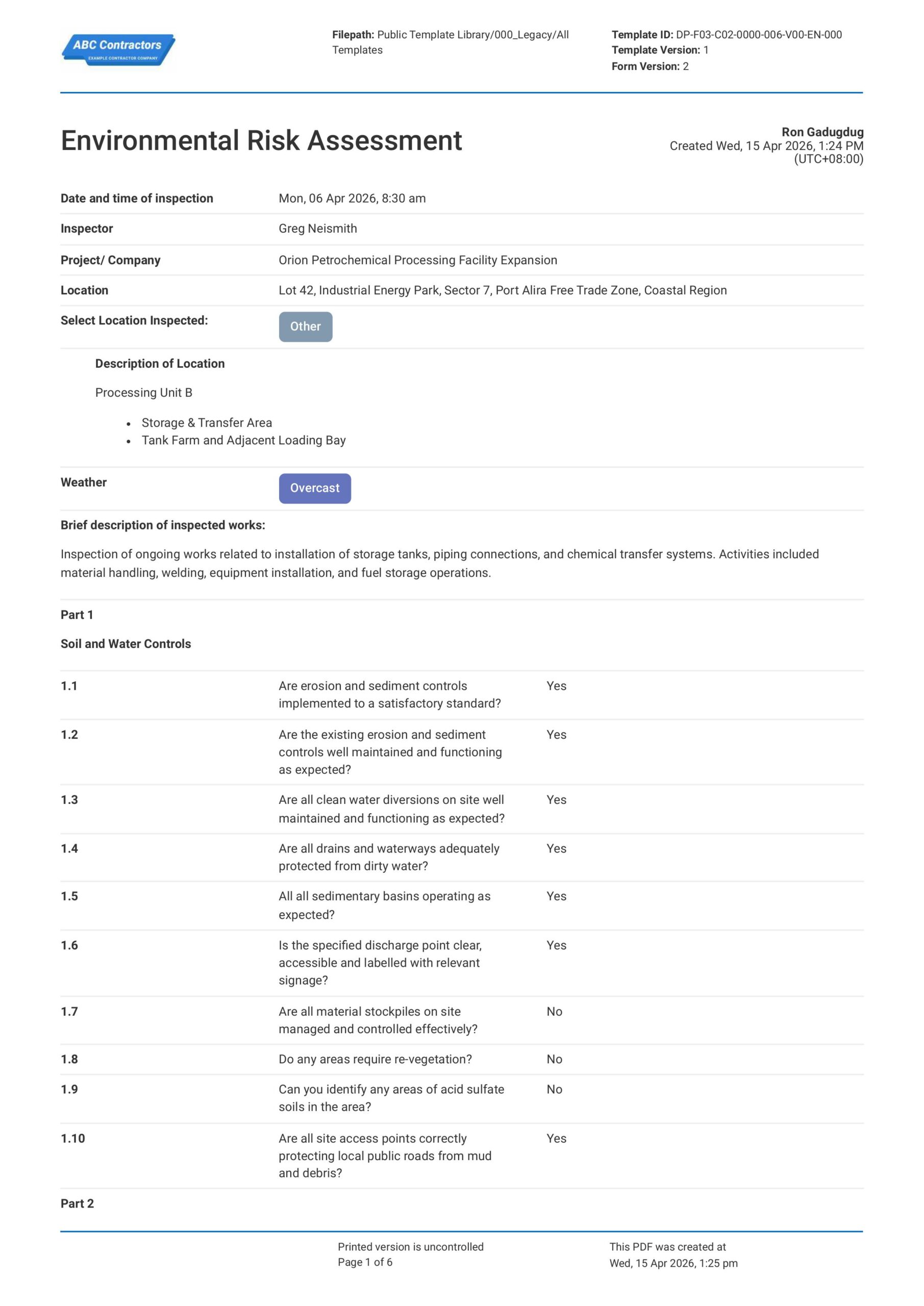
Want a complete Environmental Risk Assessment you can adapt to any project? This template comes pre-built with sections for documenting weather conditions, working through comprehensive checklists, attaching photos and supporting documents, and capturing sign-offs, so potential pollution to land, sea, and air, as well as noise pollution, is covered in one place. You can edit any part of it to match your company's processes, project types, or site conditions, and the assessment will still hold up against the environmental safety regulations you'd be audited on.
This Environmental Risk Assessment is an easy-to-use form that your workers can use to identify, evaluate, and manage the environmental hazards that arise from construction and industrial projects. Teams can record inspection notes, back up their findings with attachments, confirm the project is environmentally safe, and then export and share the completed assessment as a PDF or CSV.
 100% fully editable Environmental Risk Assessment
Export your Environmental Risk Assessment to PDF or CSV
Access your Environmental Risk Assessment on mobile, tablet or computer
Trusted by companies, projects and teams of all sizes















What is Environmental Risk Assessment?
An Environmental Risk Assessment is a document that engineers and site supervisors use to identify and evaluate potential environmental hazards and how these hazards could affect project activities, surrounding ecosystems, and human well-being. These assessments usually include several tests and inspections to test for soil contamination, water pollution, emissions, noise pollution, and waste generation, for instance.
An Environmental Risk Assessment is relevant to industries whose work may involve negative impact on the environment. For example, the construction and industrial industries, manufacturing plants, and even marine engineering and transportation all produce varying forms of pollutants that could have adverse effects on their immediate surroundings. An Environmental Risk Assessment helps the organizations who oversee these projects stay eco-friendly, comply with regulations, identify mitigation measures, and develop environmental management plans.
Compare this Environmental Risk Assessment to Other Formats like Word or PDF
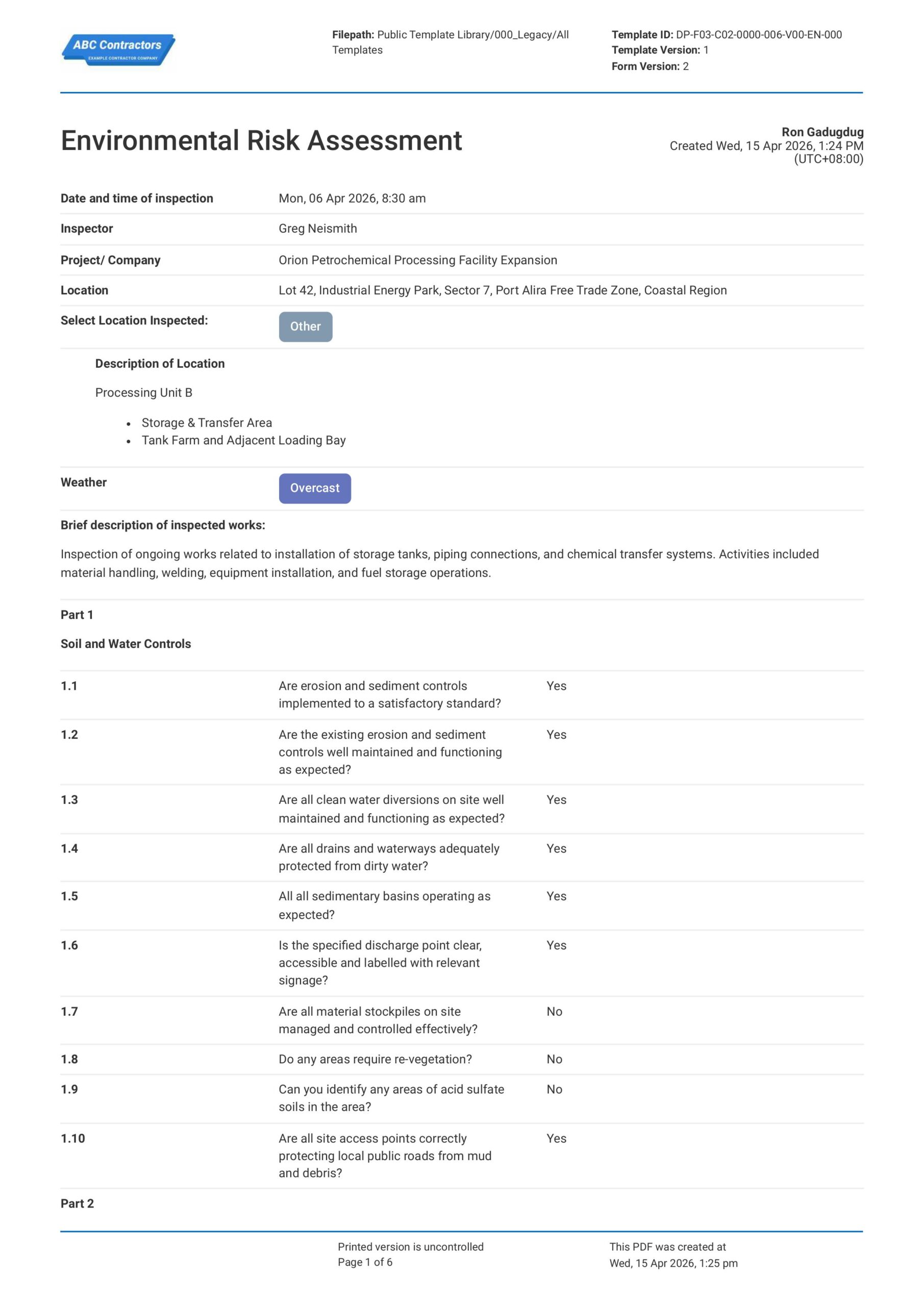
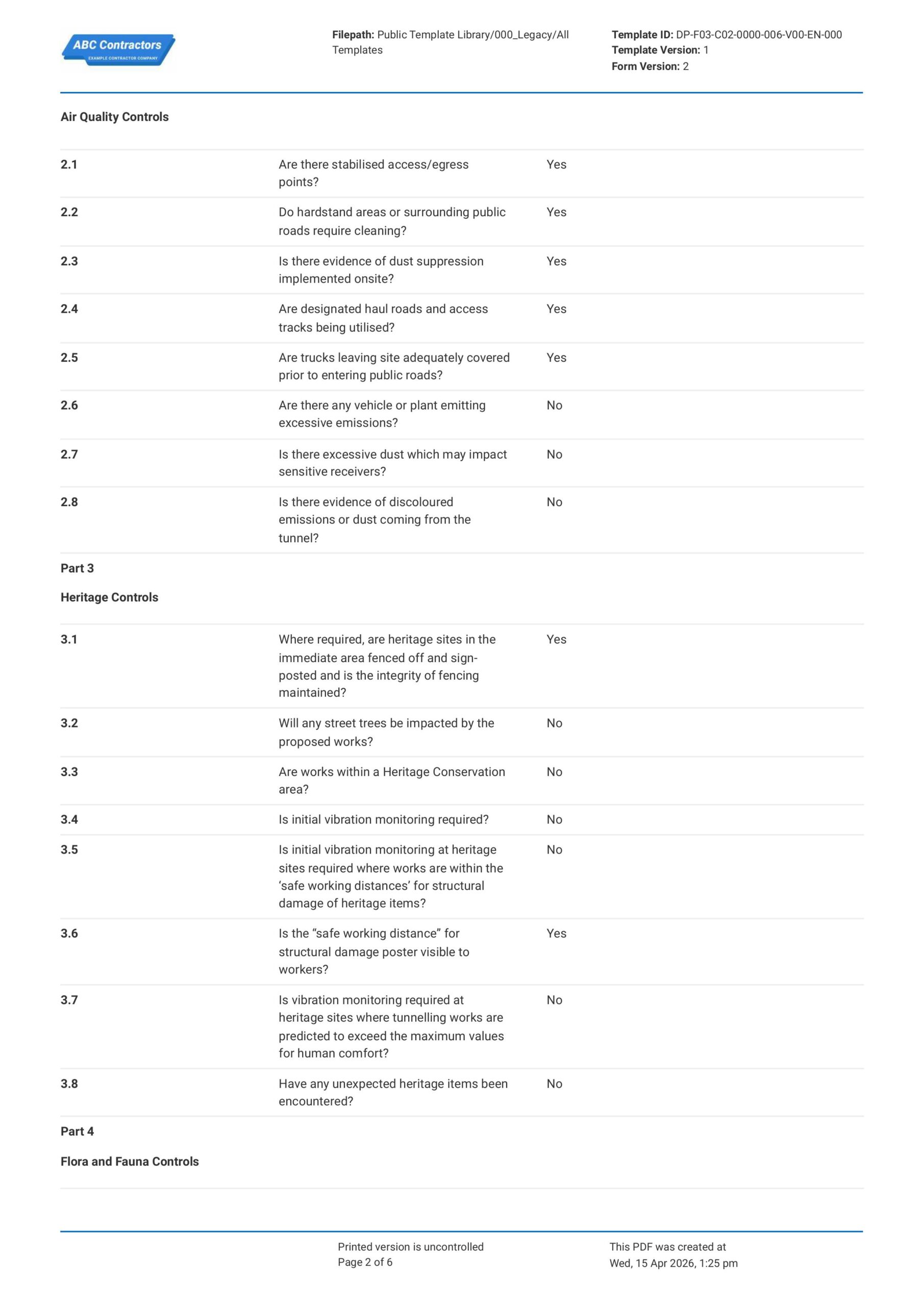
Curious how this Environmental Risk Assessment works? Check out the example below to see how inspection notes, attachments, and sign-offs all sit together in a single form. You can generate your own version, export it as a custom form with your company details, and fill in your project information to have a ready-to-use Environmental Risk Assessment in minutes.
Use this Environmental Risk Assessment template for free

Generate this template automatically with Storm
You don't have to build the Environmental Risk Assessment field by field. Let Storm, the AI Data Capture Agent inside Dashpivot, build the template for you in seconds.
Describe what you need
Tell Storm the form you want in plain language and it builds a structured digital template from scratch, with fields, tables, and signatures in place.
Upload what you already use
Drop in your existing PDF, Word, Excel, or even a photo of a paper form. Storm rebuilds it as a smart digital template with the structure intact.
 Storm
Storm
Generate a Environmental Risk Assessment form template that I can use for my business
Applicable Standards and Policies for Environmental Risk Assessment
In the modern world, there are several regulations and legislation that covers the performance and creation of environmental risk assessments. It is important you check in with your local governing body in your jurisdiction, as requirements will differ across regions. For example, in the USA, these are some of the regulations that apply:
- ISO 14001 Environmental Management Systems
- EPA Risk Assessment Guidelines
- OSHA Environmental Health Standards, Construction (Design and Management) Regulations
- National Environmental Policy Act (NEPA)
- State Environmental Quality Review Act (SEQRA)
Staff Members and Parties that use Environmental Risk Assessment
Several direct and third parties make use of a project’s Environmental Risk Assessment for various reasons. For example, a contractor or client may use it to ensure that the project is compliant with regulations, or to perform adjustments to reduce environmental impact. On the other hand, regulators and inspectors may use these risk assessments to perform audits.
Here are some of the most common parties that you can expect to use an Environmental Risk Assessment:
- Environmental Health and Safety Officers
- Project Managers, Site Supervisors
- Environmental Consultants
- Regulatory Compliance Officers, Environmental Scientists, Health and Safety Coordinators
Business Risks Reduced by Environmental Risk Assessment
An Environmental Risk Assessment significantly reduces exposure to regulatory, financial, and reputational risks by identifying environmental hazards proactively and ensuring mitigation procedures are implemented. Without a proper Environmental Risk Assessment, you and your team are exposed to:
- Potential fines or project shutdowns due to non-compliance
- Liability and remediation costs due to damage to surrounding environment
- Unanticipated environmental constraints that lead to delays and disruption
- Reputational damage or community opposition due to environmental damage
Business Opportunities Created by Environmental Risk Assessment
Performing an Environmental Risk Assessment opens up avenues for improved sustainability, profitability, stakeholder trust, and could potentially even grant access to capital from environmentally-conscious investors. It also enables organizations to optimize project design and operations for long-term environmental and economic benefits. Here are some of the opportunities you should look out for:
- Potential eligibility for green financing and ESG-linked investments
- Competitive advantage during contract bidding that require environmental compliance
- Cost savings through resource efficiency and waste reduction
Essential Elements for an Environmental Risk Assessment Template
The process of creating an Environmental Risk Assessment may differ across regions and industries. One project may require environmental safety inspections that aren’t exactly relevant to another project at a different site. However, there are some elements that are common across these formats that you will have to know:
- Identification of site boundaries, baseline conditions, and regulatory requirements
- Mapping of sensitive environmental receptors and key impact zones
- Assessment of risks to air, water, soil, noise, biodiversity, and waste systems
- Evaluation of risk likelihood and consequences using structured matrices
- Definition of mitigation measures and environmental controls
- Establishment of monitoring, review processes, and emergency response plans
- Documentation and communication with relevant stakeholders
Why is it Important to Have a Proper Environmental Risk Assessment?
A proper Environmental Risk Assessment is essential for identifying potential environmental impacts before they occur, allowing organizations to prevent damage rather than react to it. By understanding risks to surrounding air, water, soil, and natural ecosystems early, projects can be managed in a way that minimizes negative impact and ensures compliance with local environmental regulations.
Further, good environmental risk assessments also support better decision-making and accountability throughout a project’s lifecycle. With a clear mitigation strategy in place, companies can reduce the legal, financial, and reputational risks tied to their field of work, while demonstrating responsibility to stakeholders and the surrounding community.
How to Create an Environmental Risk Assessment
Creating a comprehensive Environmental Risk Assessment requires thorough evaluation of the potential environmental hazards your project could produce. Below, we discuss the step-by-step process that ensures proper documentation and regulatory compliance.
Before creating an Environmental Risk Assessment, you will need the following information:
- Site location details and geographical coordinates
- Project scope and planned activities description
- Environmental baseline studies and historical data
- Applicable environmental regulations and permits
- Sensitive environmental receptors mapping
- Previous environmental incident reports
- Emergency contact information for environmental agencies
- Weather conditions and seasonal considerations
-
Establish Document Structure and Scope
First, make sure you identify the purpose, scope, and layout of the Environmental Risk Assessment to ensure clarity and consistency. Make sure to list these general information at the very start of your assessment:
- Document purpose, objectives, and scope statement
- Project overview and key activities
- Site location and boundaries
-
Compile and Organize Baseline Inputs
Baseline data from inspections and site visits are the backbone of any Environmental Risk Assessment. These inputs give the assessment context, allowing readers and stakeholders to better understand the conditions on the ground. Here are some examples of information you can include:
- Description of weather conditions
- Description of site conditions
- Description/s of the tasks being done at site
- Other documents such as site maps, plans, and supporting visuals
-
Document Risk Identification
Record all potential environmental risks associated with project activities. You will need to focus on clearly linking activities to their possible impacts. Here are some of the most common environmental risks that are produced from built-world projects:
- Damage to the surrounding land (flora and fauna)
- Water pollution
- Emissions into open air
- Noise pollution
- Hazardous material or waste storage and disposal
-
Record Risk Evaluation and Supporting Documentation
Next, evaluate each identified risk and identify appropriate mitigation measures within the report. You will also need to attach supporting documentation to support the evaluation as well. Here are some of the important information you will need to include:
- Risk assessment methodology (e.g., matrix, scoring system, or qualitative)
- Overall risk ranking or prioritization, including comments on control measures
- Supporting documentation such as photos, videos, or inspection forms
-
Review and Approval of the Assessment
Finally, you will need to include sections where approving personnel can acknowledge and sign-off on your assessment. Be sure to include the following sections:
- Recommendations for Immediate Action
- Due dates for any Immediate Action
- Final Comments or Remarks
- Signature Fields
Frequently asked questions
How to create your Environmental Risk Assessment in an App or Software System
Digital environmental risk assessment tools significantly enhance the traditional process by enabling real-time data collection, GPS location tracking, and instant photo documentation of environmental conditions. Mobile-enabled platforms allow environmental professionals to conduct assessments directly in the field, capturing accurate site conditions and immediately uploading findings to centralized databases for review and approval.
The digital transformation of environmental risk assessment processes improves accuracy through mandatory field validation, reduces assessment completion time through automated calculations and risk matrices, and enhances regulatory compliance through built-in standards compliance checking and audit trail maintenance. Integration with environmental management systems enables seamless workflow coordination and ensures environmental risk findings are immediately actionable across project teams.
45 minutes
Medium difficulty
-
Start your Environmental Risk Assessment with General Information
It is important to place important general information at the very beginning of your assessment form so other users can easily identify and understand the context of your document. Be sure to include the following fields:
- Date selector fields for time and date of your inspection
- Text fields for users to specify the project name, location, and inspector name
- Use multi-line text fields for input on scope of description of work
- Optional: Use multiple choice or drop down fields to easily select repeated data like weather conditions
-
Add Checklist Items for Each Risk
Identifying risks present at site is the core of any proper Environmental Risk Assessment. We recommend using a checklist to ensure a comprehensive analysis can be made based on inspection findings. In this case, you will need to add checklists for the following risks:
- Soil and Water Controls
- Air Quality Controls
- Heritage Controls
- Flora and Fauna Controls
- Hazardous Material Controls
- Noise / Vibration Controls
- Waste Management Controls
- Water Treatment Controls
-
Next, Add a Table to Record Issues or Deficiencies
If your app or software allows, we highly recommend using a table to record the issues and deficiencies found during the inspection and analysis phases of your assessment. Structuring your table as follows can clarify the results of your assessment:
- The first column should indicate the item or issue reference number
- Second column should indicate the issue description
- Third column should contain photos of the issue
- Fourth column should indicate whether immediate action is required
- Fifth column should indicate the Due Date of resolution to the issue
- Final column should contain any notes or remarks on the issue
-
Add a Section for Attachments
Next, you should add a section where users can attach other relevant documentation to support the assessment. If your app or software allows, you can add drag-and-drop functions or “upload” buttons to accommodate the following files:
- Other photos or videos relevant to the assessment
- Results of third-party tests and inspections
- Government permits and official forms
- Other supporting documentation file types (PDF, Word, Excel)
-
Finish Your Assessment with a Approvals and Acknowledgements
This section is where approving personnel can sign-off and acknowledge the assessment. Here are some of the most important sections to include:
- Multi-line text fields for final remarks or recommendations
- E-signature fields for quick sign-offs
About the author

Ron Gadugdug
Content Engineer
 LinkedIn
Education
Cebu Institute of Technology - University - Civil Engineering
Bio
Ron is a Civil Engineer with 6 years of experience in the construction industry, primarily focused on quantity surveying, cost estimation, project management, quality control, contract administration, and property & engineering insurance. At Sitemate, he writes about practical applications of evolving technologies and digital solutions that support construction professionals in improving efficiency, compliance, and project delivery across the built world.
Past Projects
Quantity Surveying & Cost EngineeringPerformed quantity take-offs of several high-rise and horizontal structures using sheets and applications like Revit and Bluebeam Revu, and spearheaded trials with Building Information Modeling (BIM) software.
Project Management & ConsultancyCoordinated with project management teams during the construction of local projects such as a 4-tower hotel & resort, a 22 storey condominium project, and a school dormitory project.
Contract AdministrationAssisted during contract biddings and negotiations with general contractors and sub-contractors, and oversaw progress reporting, billings, and payment.
Property & Engineering InsuranceDedicated non-life claims handler, overseeing property and contractor all-risk insurance claims, risk management, and bonds.
Version History:
Related apps and templates
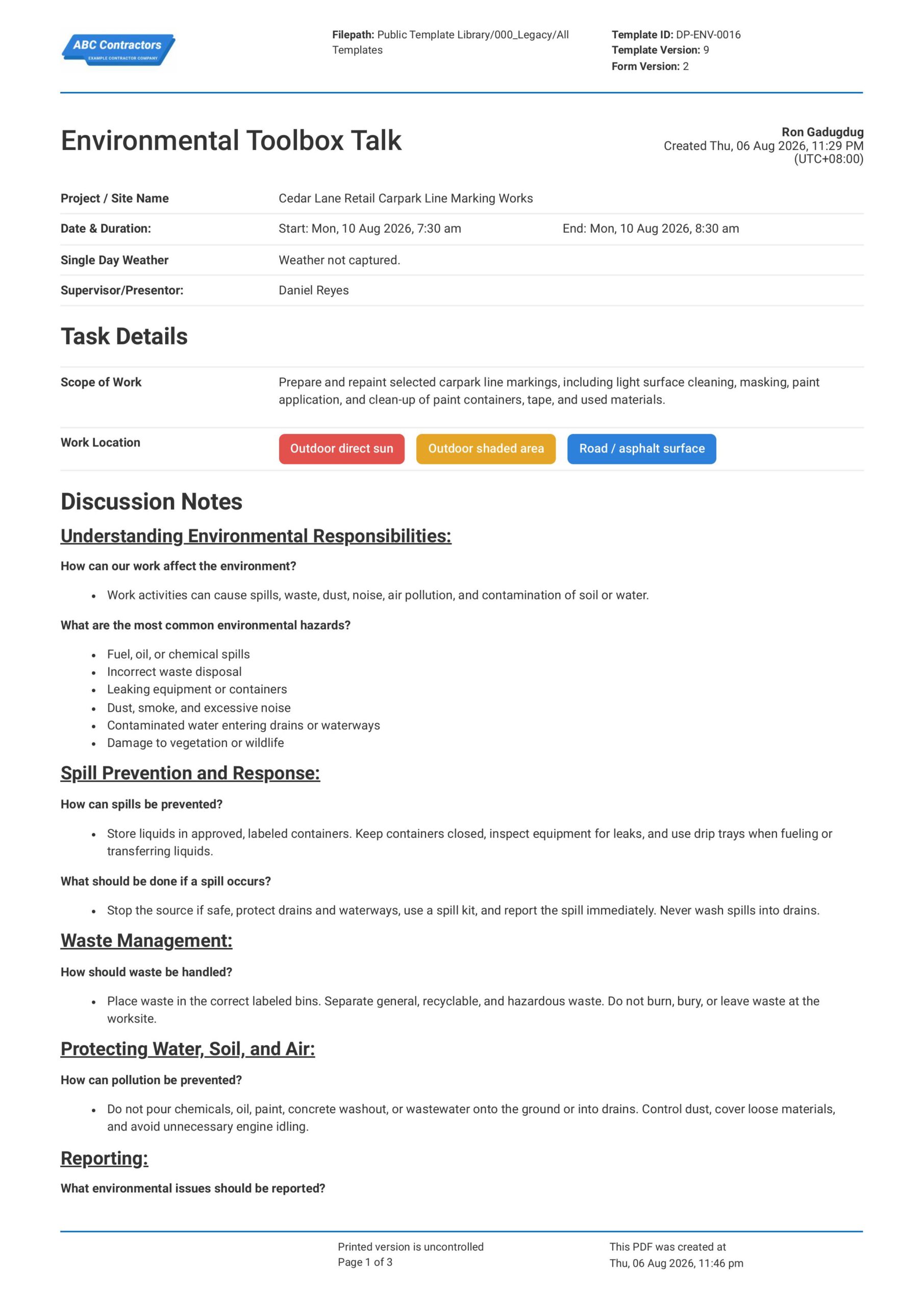
Environmental Toolbox Talk
This Environmental Toolbox Talk is an easy-to-use form that your workers can use to discuss environmental hazards, site rules, and basic environmental controls before starting work. Record important toolbox talk details
View template
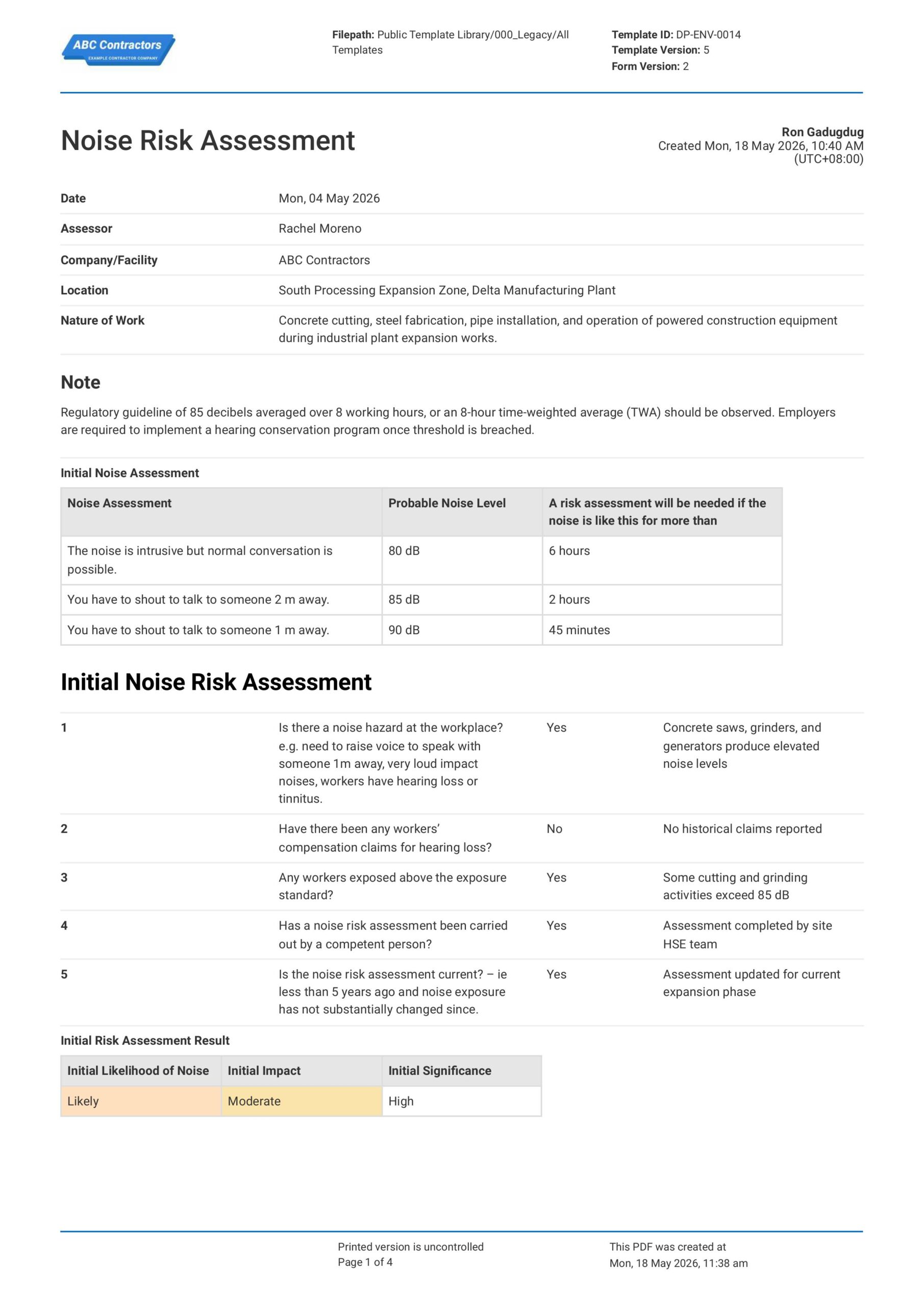
Noise Risk Assessment
This Noise Risk Assessment is a form that can help your team protect workers, adjacent properties, and the environment by mitigating the effect of disruptive noise that comes from construction works. With this form,
View template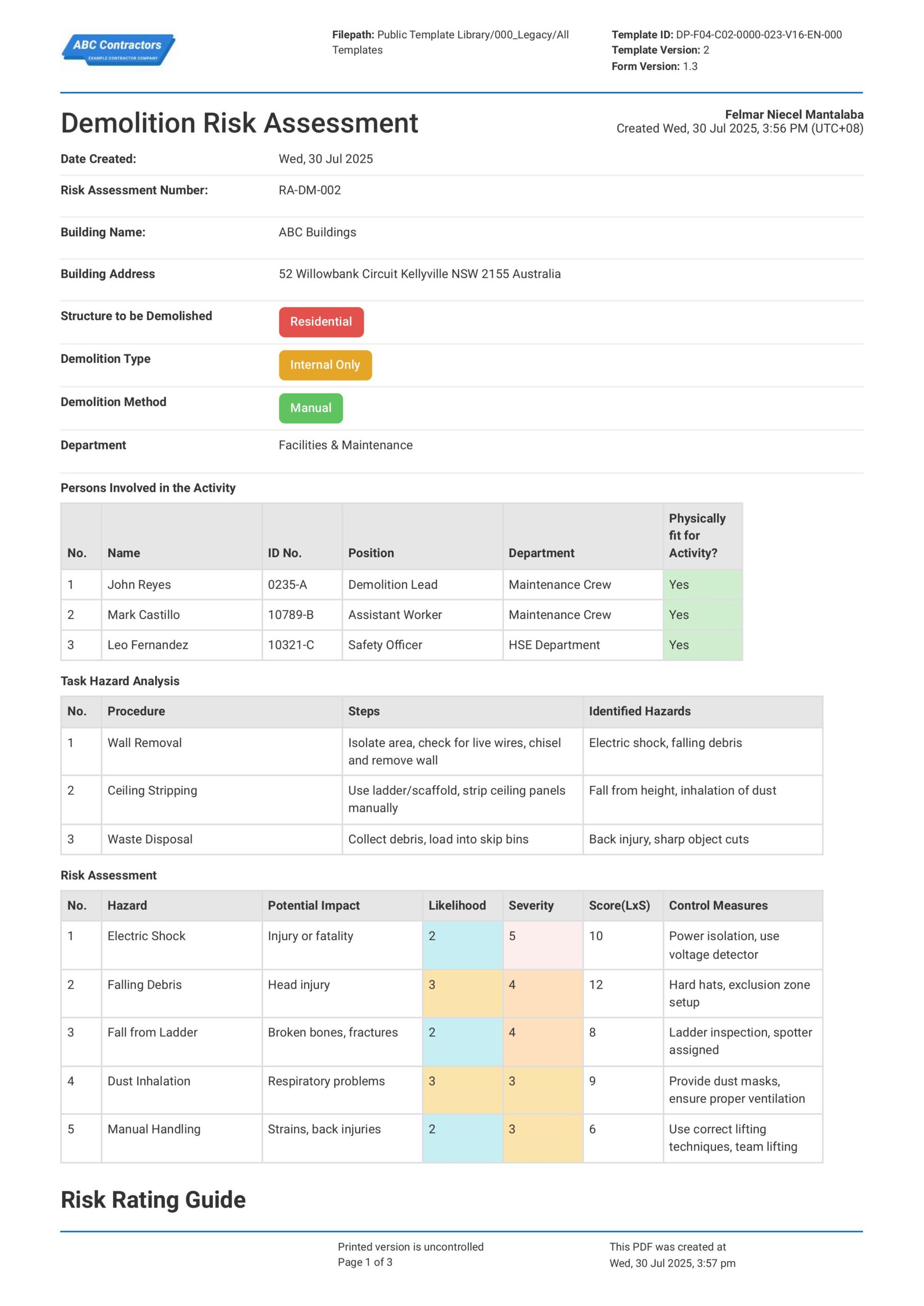
Risk Assessment for Demolition
This downloadable Demolition Risk Assessment is readily available to help you effectively manage safety risks on your demolition projects. It has all the standard features of a demolition risk assessment, ensuring your
View templateThis assessment was generated with Dashpivot software
- Access, edit and complete your Environmental Risk Assessment from any device - mobile, tablet or computer.
- Print, download or send your Environmental Risk Assessment as perfectly formatted PDF documents with your company logo.
- Store your Environmental Risk Assessment securely online, where they can be searched and found in seconds
- Invite internal and external parties to see, edit and sign off on Environmental Risk Assessment online.
