Concrete Safety Toolbox Talk Template

Start with a free 30-day trial. No credit card required.
This Concrete Safety Toolbox Talk is an easy-to-use form that your workers can use to discuss concrete work hazards and safe work practices before starting concrete-related tasks. Record important toolbox talk details such as the work activity, concrete handling risks, dust exposure, wet concrete contact, plant and equipment hazards, PPE requirements, worker questions, attendance, and sign-offs in this free form.
Working with wet concrete, concrete dust, pumps, mixers, vibrators, or other concreting equipment on your site? Looking for a concrete safety toolbox talk sample to help guide your next site meeting? This Concrete Safety Toolbox Talk helps teams document important discussion points such as skin and eye protection, silica dust controls, safe manual handling, equipment exclusion zones, washout areas, and emergency response. Then, you can even share the completed toolbox talk with supervisors, contractors, and other stakeholders by exporting it to PDF or CSV.
 100% fully editable Concrete Safety Toolbox Talk
Export your Concrete Safety Toolbox Talk to PDF or CSV
Access Concrete Toolbox Talk on mobile, tablet or computer
Trusted by companies, projects and teams of all sizes















What is Concrete Safety Toolbox Talk?
A Concrete Safety Toolbox Talk is a document used by supervisors, safety managers, and site teams to guide short safety discussions before concrete work begins. This toolbox talk usually includes discussion points on wet concrete contact, concrete dust, manual handling, moving plant, concrete pumps, formwork areas, PPE, washout controls, and worker responsibilities.
Due to the risks that come with concrete work, workers need to understand how to avoid skin burns, eye injuries, silica dust exposure, strains, struck-by incidents, and poor housekeeping before the task starts. This makes Concrete Safety Toolbox Talks highly relevant in construction, civil works, infrastructure, utilities, roadworks, and industrial projects, where concrete pouring, cutting, pumping, mixing, or finishing work is common.
Compare this Concrete Safety Toolbox Talk form to traditional Word and PDF documents
Wondering how this Concrete Safety Toolbox Talk form works? Check out the preview below for free.
Use this Concrete Safety Toolbox Talk template for free

Generate this template automatically with Storm
You don't have to build the Toolbox Talk Process field by field. Let Storm, the AI Data Capture Agent inside Dashpivot, build the template for you in seconds.
Describe what you need
Tell Storm the form you want in plain language and it builds a structured digital template from scratch, with fields, tables, and signatures in place.
Upload what you already use
Drop in your existing PDF, Word, Excel, or even a photo of a paper form. Storm rebuilds it as a smart digital template with the structure intact.
 Storm
Storm
Generate a Toolbox Talk Process form template that I can use for my business
Applicable Standards and Policies for Concrete Safety Toolbox Talk
There are generally no explicit formatting requirements for a Concrete Safety Toolbox Talk. However, most construction and workplace safety laws require employers to train workers on concrete-related hazards, PPE, manual handling, silica dust, chemical burns, and safe work practices. A Concrete Safety Toolbox Talk is a good document to support compliance to this.
- OSHA 29 CFR 1926 Subpart Q covers concrete and masonry construction in the USA
- OSHA 29 CFR 1926.1153 covers respirable crystalline silica in construction work in the USA
- UK COSHH Regulations 2002 require control of hazardous substances such as cement dust and wet concrete
- Safe Work Australia guidance covers concrete construction hazards and control measures
- Local WHS laws commonly require training, PPE, and safe systems for concrete work
Staff Members and Parties that use Concrete Safety Toolbox Talk
A Concrete Safety Toolbox Talk is primarily used by project teams that manage concrete pouring, cutting, grinding, finishing, formwork, or other concrete-related work. Here are examples of other common parties that use a Concrete Safety Toolbox Talk:
- Site supervisors and project managers
- Concrete workers and finishers
- Formwork and rebar crews
- Health and safety teams
- Contractors and subcontractors carrying out concrete work
Business Risks Reduced by Concrete Safety Toolbox Talk
Using a Concrete Safety Toolbox Talk helps reduce the risk of hazards such as concrete burns, silica dust exposure, manual handling injuries, slips, trips, falls, struck-by incidents, and unsafe use of concrete equipment. Ultimately, this can help businesses to:
- Reduce risk of injury, illness, or concrete-related incidents
- Avoid non-compliance with construction and workplace safety requirements
- Prevent unsafe work caused by poor PPE use, dust control, or manual handling
- Lower exposure to legal claims, enforcement action, and incident-related costs
- Reduce project delays caused by injuries, inspections, or shutdowns
Business Opportunities Created by Concrete Safety Toolbox Talk
A well-prepared Concrete Safety Toolbox Talk helps businesses improve worker awareness and control over common concrete work hazards. Here are some ways a well-designed Concrete Safety Toolbox Talk can help businesses:
- Improve worker confidence before concrete work begins
- Strengthen contractor prequalification and tender-offer competitiveness
- Improve coordination between supervisors, concrete crews, safety teams, and subcontractors
- Build trust with clients, regulators, insurers, and project stakeholders
What Should be Included in a Concrete Safety Toolbox Talk?
There are no single global requirements that cover the exact format of a Concrete Safety Toolbox Talk. Rather, requirements can vary across regions, industries, project types, and site safety rules. However, there are some core topics that are typically included that you should know about:
- Common concrete work hazards such as wet concrete exposure, silica dust, heavy lifting, and moving plant
- PPE requirements such as gloves, eye protection, long sleeves, safety boots, and respiratory protection where needed
- Safe handling procedures for pouring, pumping, vibrating, cutting, grinding, and finishing concrete
- Controls for washout areas, formwork, reinforcement, access, and exclusion zones
- Worker responsibilities for reporting unsafe conditions, damaged tools, skin contact, and dust exposure
Why are Concrete Safety Toolbox Talks Important?
Concrete Safety Toolbox Talks are important because concrete work can expose workers to chemical burns, silica dust, manual handling injuries, slips, trips, and struck-by risks from pumps, trucks, and equipment. This is especially important on construction and civil sites where concrete is poured, cut, drilled, finished, or removed near other trades and moving plant.
Essentially, a Concrete Safety Toolbox Talk helps remind workers of the hazards, PPE, site controls, and safe work steps before concrete work begins. Additionally, it gives supervisors and project management teams clear documentation that concrete safety risks were discussed, supporting due diligence and compliance with relevant workplace safety requirements.
How to Create a Concrete Safety Toolbox Talk
A proper Concrete Safety Toolbox Talk form should allow your team to easily create and quickly re-use forms directly at site. Here are the most important steps you need to consider.
Make sure these pre-requisites are in place before starting on a Concrete Safety Toolbox Talk form.
- Project or site details are required.
- Concrete work activities must be listed.
- Main hazards from wet concrete must be covered.
- PPE needs for skin, eye, and breathing protection must be stated.
- Manual handling and equipment safety must be included.
- Washout, spill control, and waste handling rules must be noted.
- Attendee names and signatures must be recorded.
-
Start with Toolbox Talk and Worksite Information
First, you need to place high-level general information at the beginning of your Concrete Safety Toolbox Talk to help establish context for the discussion. Here are some examples of core elements that you can use:
- Project name and site location
- Date and time of the toolbox talk
- Concrete work activity being discussed
- Work area or pour location
- Name and role of the person leading the talk
-
Identify Concrete Work Hazards
It is important that potential hazards are identified before concrete work starts so the appropriate safety control measures can be implemented. Common hazards that you should look out for include:
- Wet concrete contact with skin or eyes
- Manual handling of heavy tools, forms, or materials
- Concrete trucks, pumps, and moving equipment
- Slips, trips, and falls around wet or uneven surfaces
- Dust exposure during cutting, drilling, or grinding
-
Discuss Concrete Handling and PPE Requirements
After the hazards are identified, you will want to determine the PPE and handling controls needed to reduce risks for your workers. For example, you will want to cover the following information in your Concrete Safety Toolbox Talk:
- Waterproof gloves and long sleeves
- Safety glasses or face protection
- Rubber boots or suitable foot protection
- Safe lifting and carrying practices
- Washing facilities for wet concrete exposure
-
Record Equipment, Access, and Work Area Controls
Next, you will want to confirm that concrete equipment and work areas are set up safely before the task begins. Be sure to document the following information in your toolbox talk:
- Safe access around the pour area
- Exclusion zones around pumps, trucks, and placing booms
- Inspection of hoses, tools, and equipment before use
- Clear communication between workers and operators
- Housekeeping controls for slurry, waste, and trip hazards
-
Complete Attendance, Questions, and Sign-Off
Complete your toolbox talk with attendance, worker questions, and a sign-off section to confirm that the concrete safety discussion was delivered and understood. Here are some examples of fields you can include:
- Names and signatures of attendees
- Questions or concerns raised by workers
- Actions assigned after the discussion
- Supervisor or facilitator sign-off
- Date and time of completion
Frequently asked questions
How to create Toolbox Talk Process in an App or Software System
A well-designed toolbox talk process ensures that workers are well-informed and well-equipped to deal with possible risks at the job site, and that your team can easily document and share outcomes of the talks.
15 minutes
Easy difficulty
-
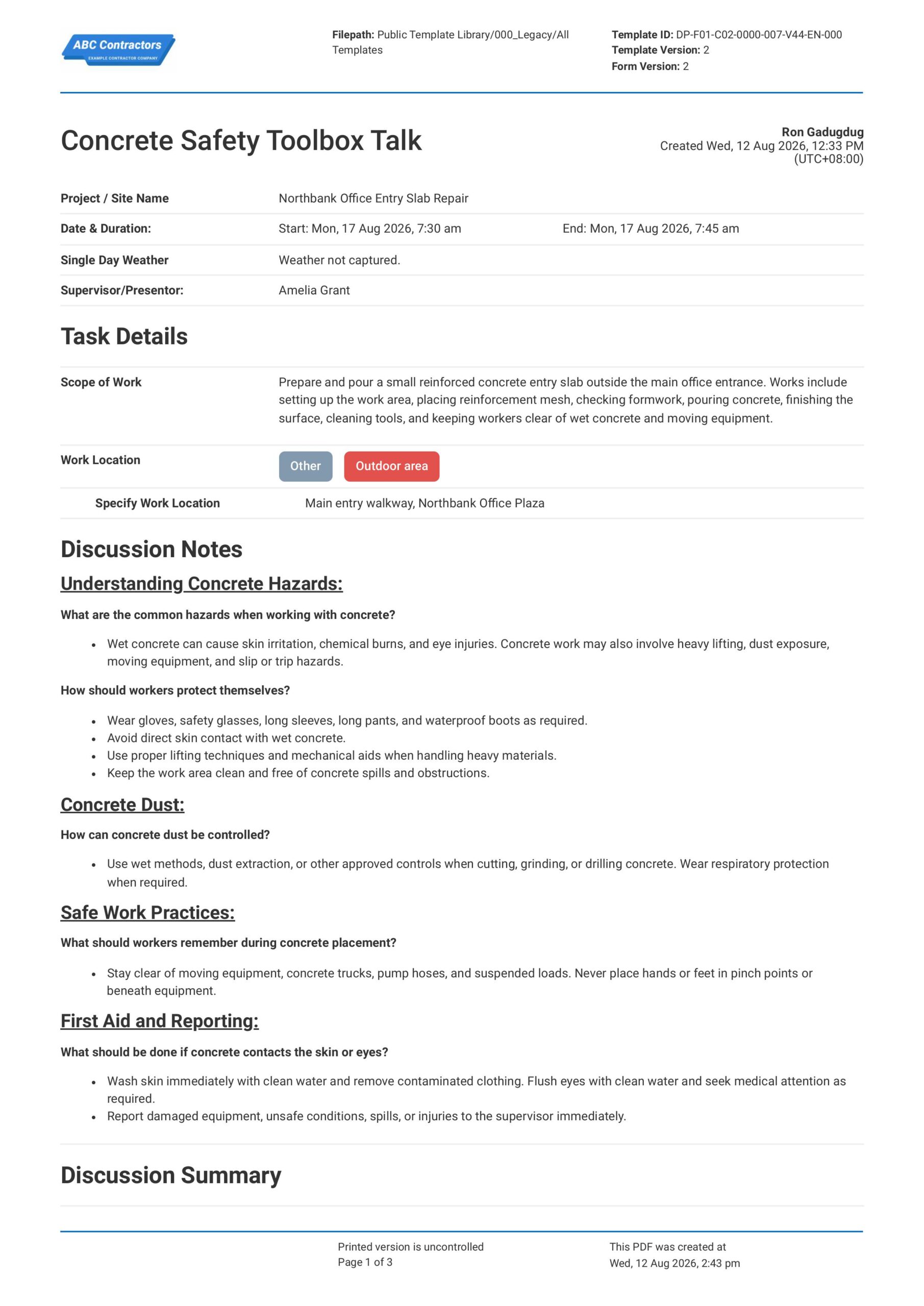
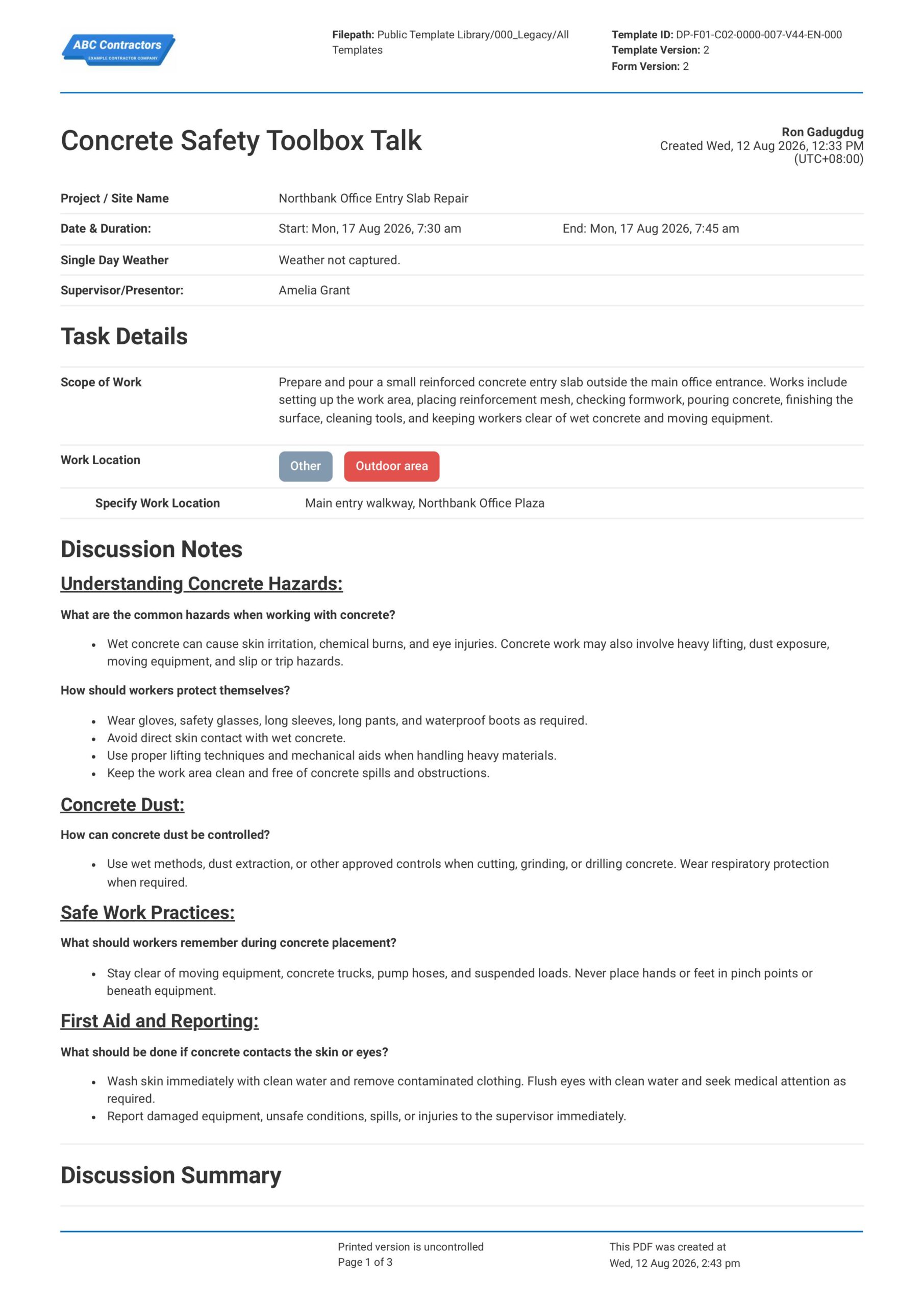
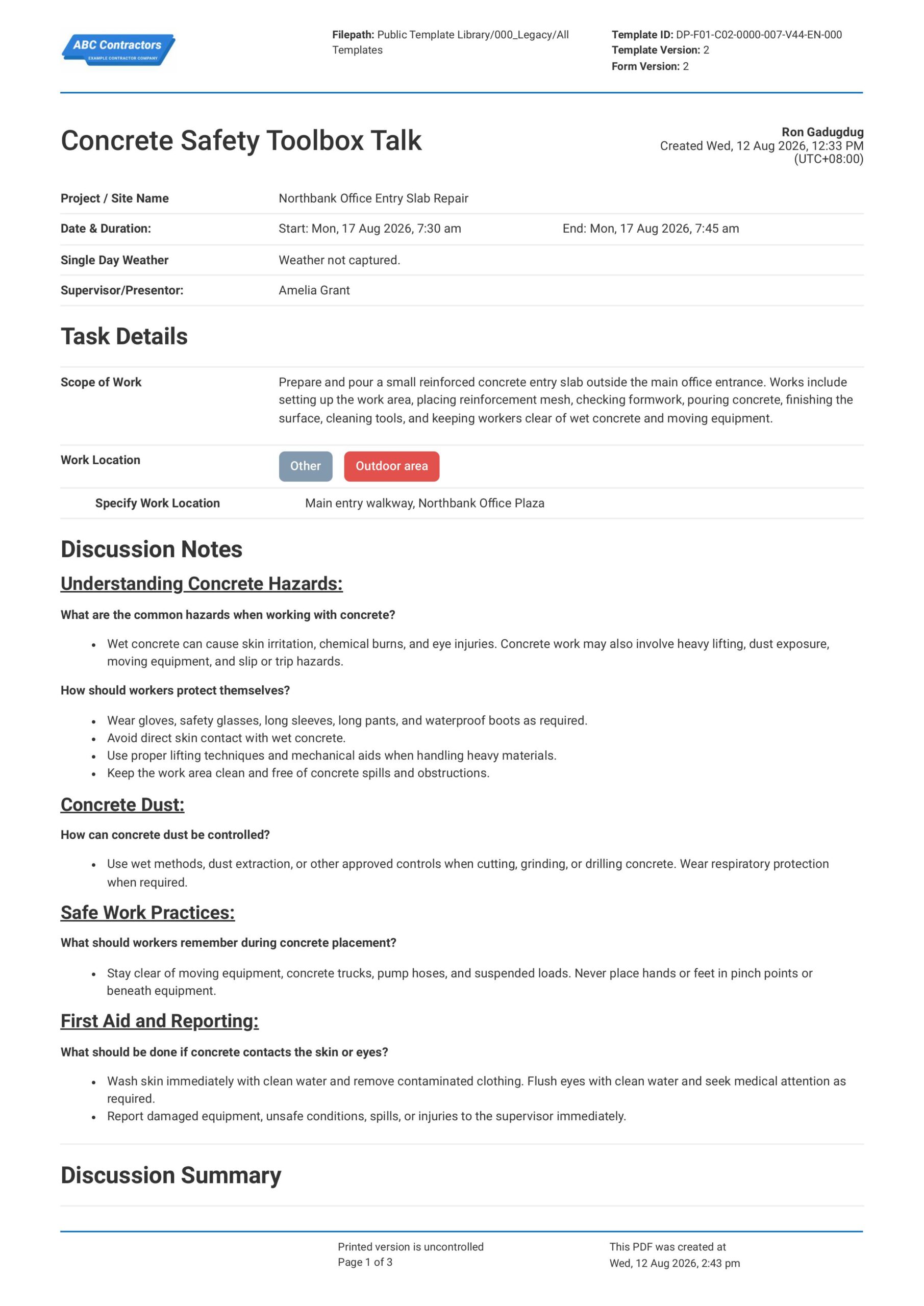
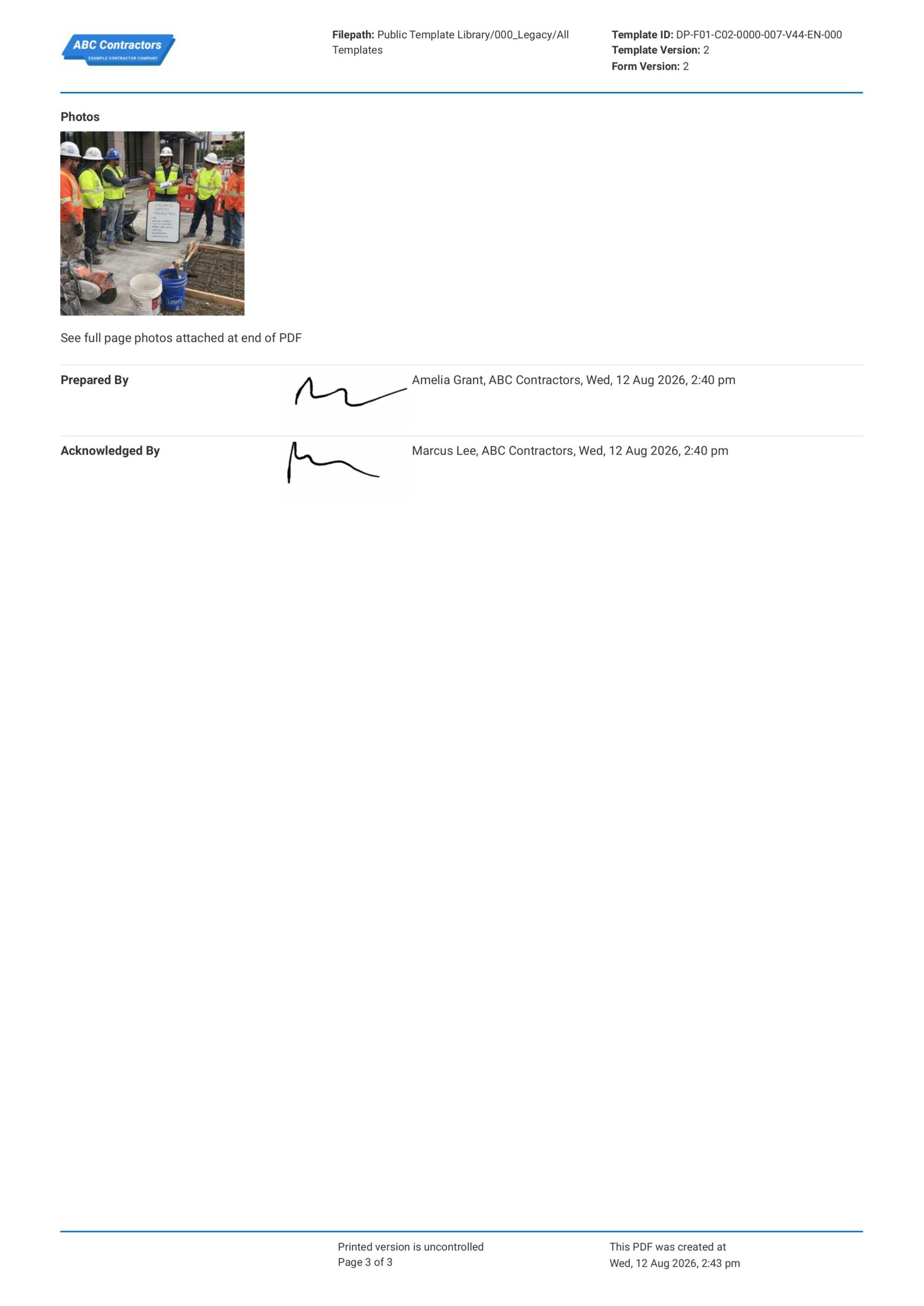
Start your Toolbox Talk with General Information and Task Details
It is important to begin your Concrete Safety Toolbox Talk with key project, timing, supervisor, and work activity details so the talk can be traced to the correct site and crew. This section should use simple text, date, and location selector fields for fields such as:
- Text field for Project / Site Name
- Date and time selector fields for Date & Duration Start and End
- Text field for Single Day Weather
- Text field for Supervisor/Presenter
- Multi-line text field for Scope of Work, with a multiple-choice selector field for Work Location and a conditional text field for Specify Work Location
-
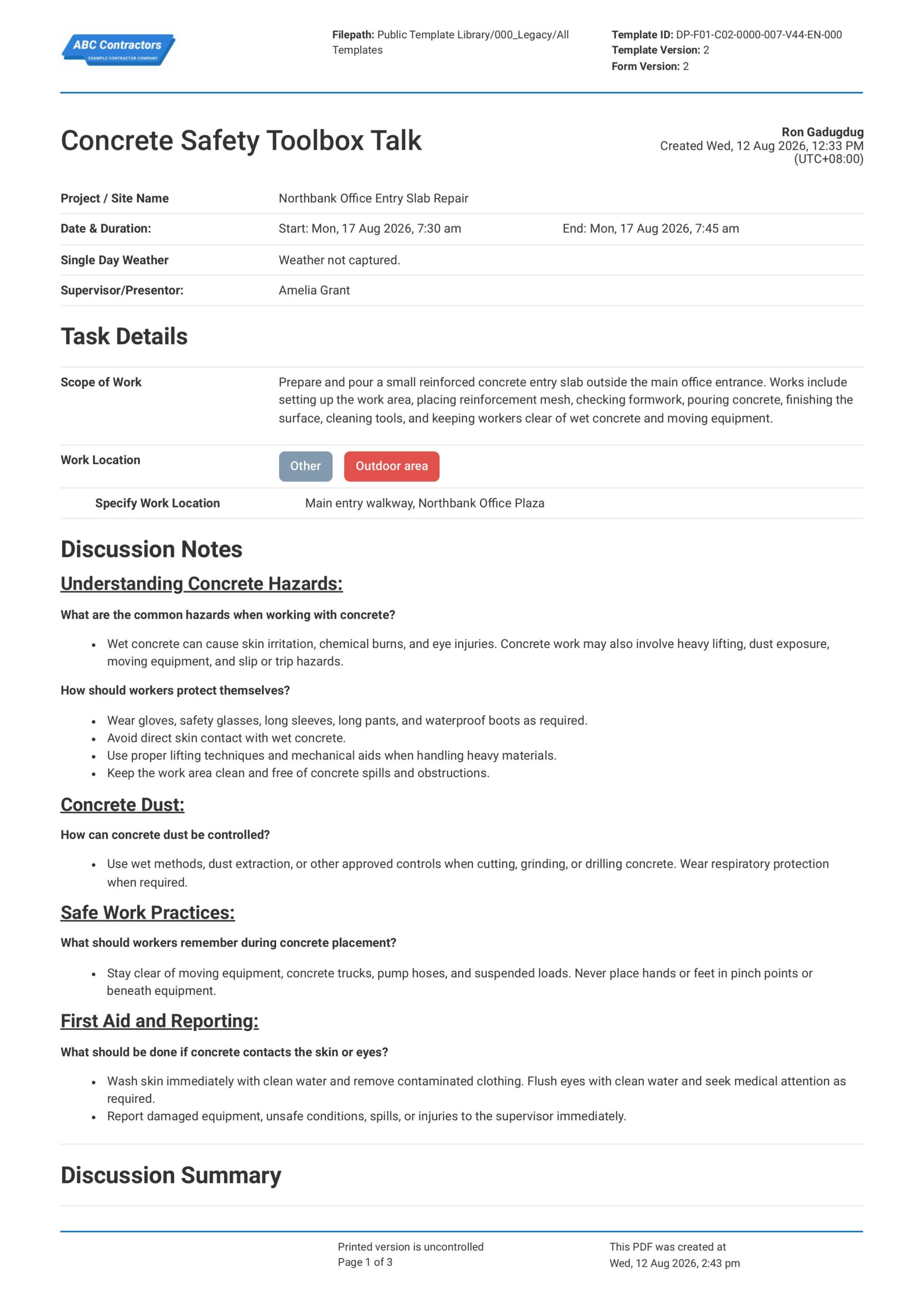
Create a Section for Concrete Safety Discussion Notes
Next, create a section where users can input discussion points they can use on all their concrete safety toolbox talks. Presenters can use these notes to guide the talks, so be sure to add pre-filled text fields for:
- Concrete hazards, including wet concrete contact, chemical burns, eye injuries, heavy lifting, dust exposure, moving equipment, and slip or trip hazards
- Worker protection measures, including gloves, safety glasses, long sleeves, long pants, waterproof boots, and avoiding direct skin contact with wet concrete
- Concrete dust controls, including wet methods, dust extraction, and respiratory protection when required
- Safe work practices during concrete placement, including keeping clear of moving equipment, pump hoses, suspended loads, and pinch points
- First aid and reporting steps for skin contact, eye contact, damaged equipment, unsafe conditions, spills, or injuries
-
Create a Table for the Topic Summary
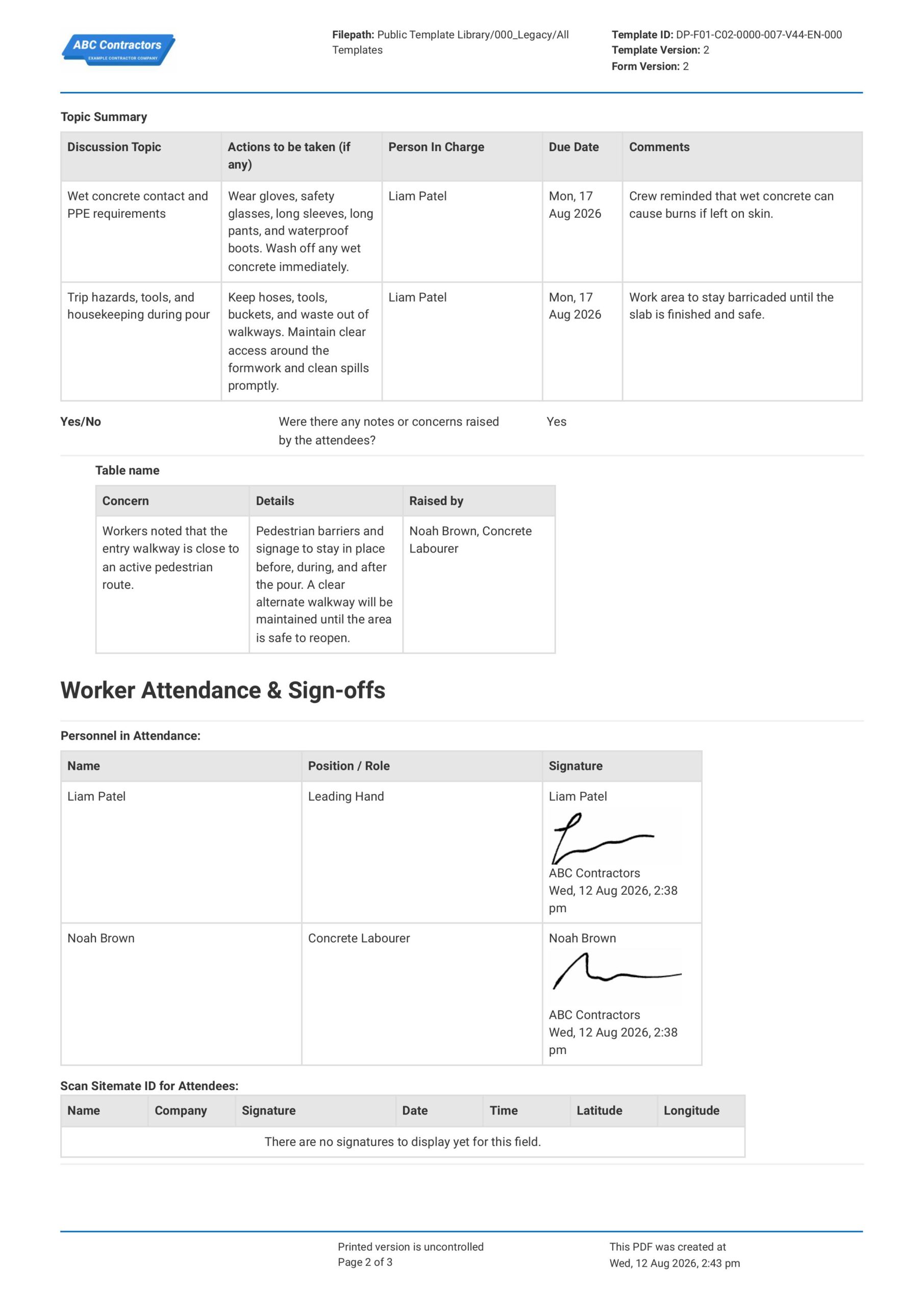
Users will next need to list down the main discussion topics that were discussed during the toolbox talk. We highly recommend using a table for this section, with the following formatting for the columns:
- First column for Discussion Topic
- Second column for Actions to be taken
- Third column for Person In Charge
- Fourth column for Due Date
- Fifth column for Comments
-
Create Sections for Notes, Concerns, Worker Attendance, and Photos
After the topic summary, add fields where users can record whether workers raised any notes or concerns during the toolbox talk. If your software or app allows, we highly recommend using a Yes/No ticker field with conditional logic so the concern table only appears when attendees raise a concern.
- Yes/No field for if there were any notes or concerns raised by the attendees
- Conditional table for attendee concerns when Yes is selected, with columns for Concern, Details, and Name of the attendee who raised the concern
- Scan ID Sign-on table for Attendees
- Alternate Manual Sign-on Table for Personnel in Attendance with columns for Name, Position / Role, and Signature
- Photo upload field for Photos
-
End your Toolbox Talk with Supervisor Sign-offs
Finally, complete the Concrete Safety Toolbox Talk with sign-off fields for the personnel preparing and acknowledging the talk. If your app or software allows, use automatic e-signature fields and include fields like:
- E-signature field for Prepared By
- E-signature field for Acknowledged By
- Company field for each sign-off
- Automatic date and time stamp fields for each sign-off
About the author

Ron Gadugdug
Content Engineer
 LinkedIn
Education
Cebu Institute of Technology - University - Civil Engineering
Bio
Ron is a Civil Engineer with 6 years of experience in the construction industry, primarily focused on quantity surveying, cost estimation, project management, quality control, contract administration, and property & engineering insurance. At Sitemate, he writes about practical applications of evolving technologies and digital solutions that support construction professionals in improving efficiency, compliance, and project delivery across the built world.
Past Projects
Quantity Surveying & Cost EngineeringPerformed quantity take-offs of several high-rise and horizontal structures using sheets and applications like Revit and Bluebeam Revu, and spearheaded trials with Building Information Modeling (BIM) software.
Project Management & ConsultancyCoordinated with project management teams during the construction of local projects such as a 4-tower hotel & resort, a 22 storey condominium project, and a school dormitory project.
Contract AdministrationAssisted during contract biddings and negotiations with general contractors and sub-contractors, and oversaw progress reporting, billings, and payment.
Property & Engineering InsuranceDedicated non-life claims handler, overseeing property and contractor all-risk insurance claims, risk management, and bonds.
Version History:
Related apps and templates
Toolbox Talk App
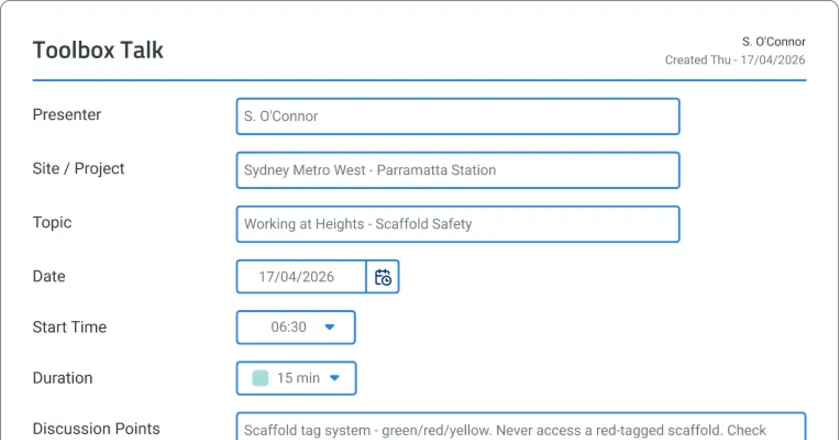
Toolbox Talk App by Sitemate captures digital attendance, voice-recorded safety discussions, and audit-ready records as the briefing happens. Try
View app
Concrete Safe Work Method Statement (SWMS)
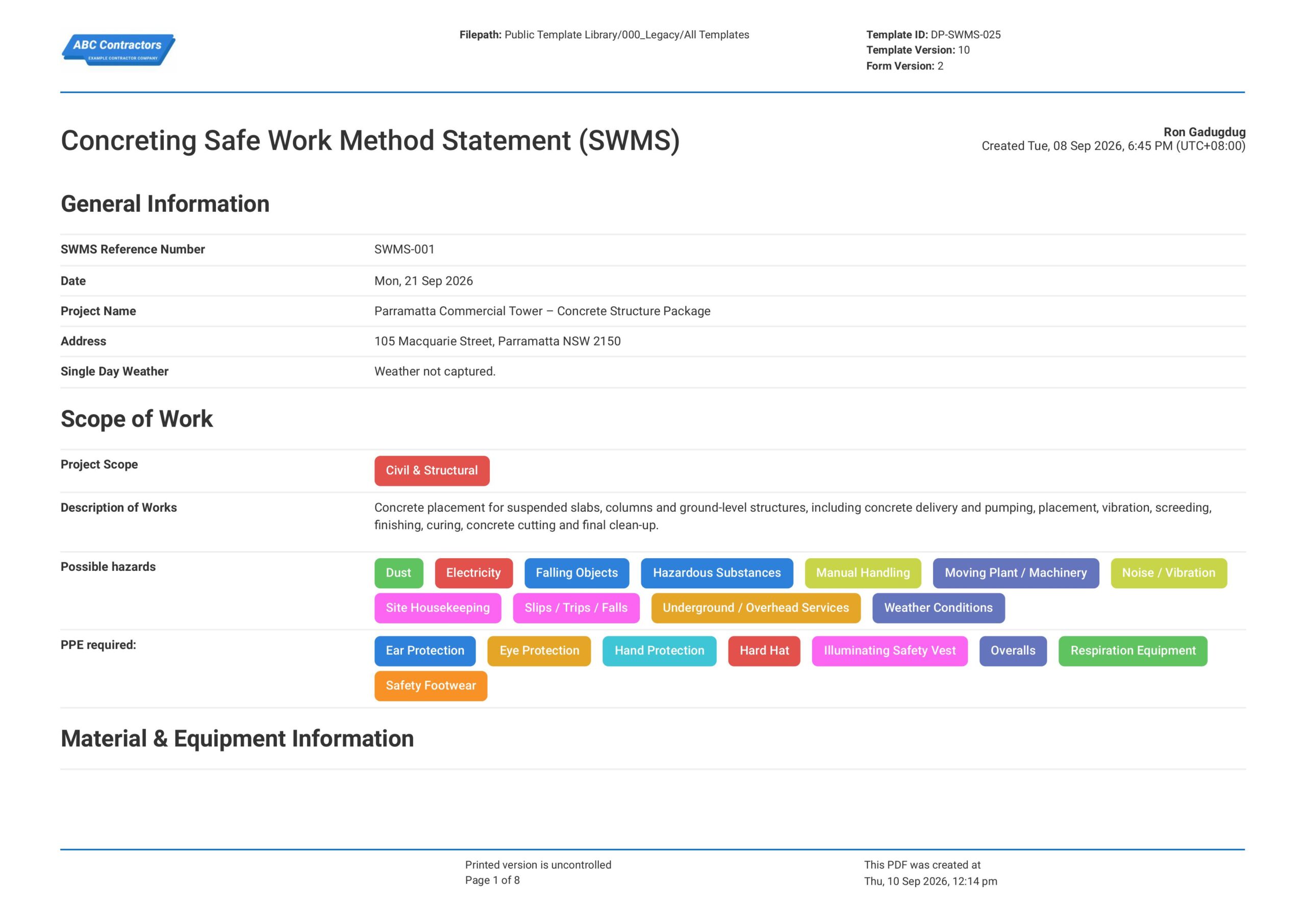
This Concrete Safe Work Method Statement, or Concrete SWMS, is an easy-to-use form that your workers can use to plan and manage concreting risks before pouring, placing, finishing, or cutting concrete. Easily select the
View template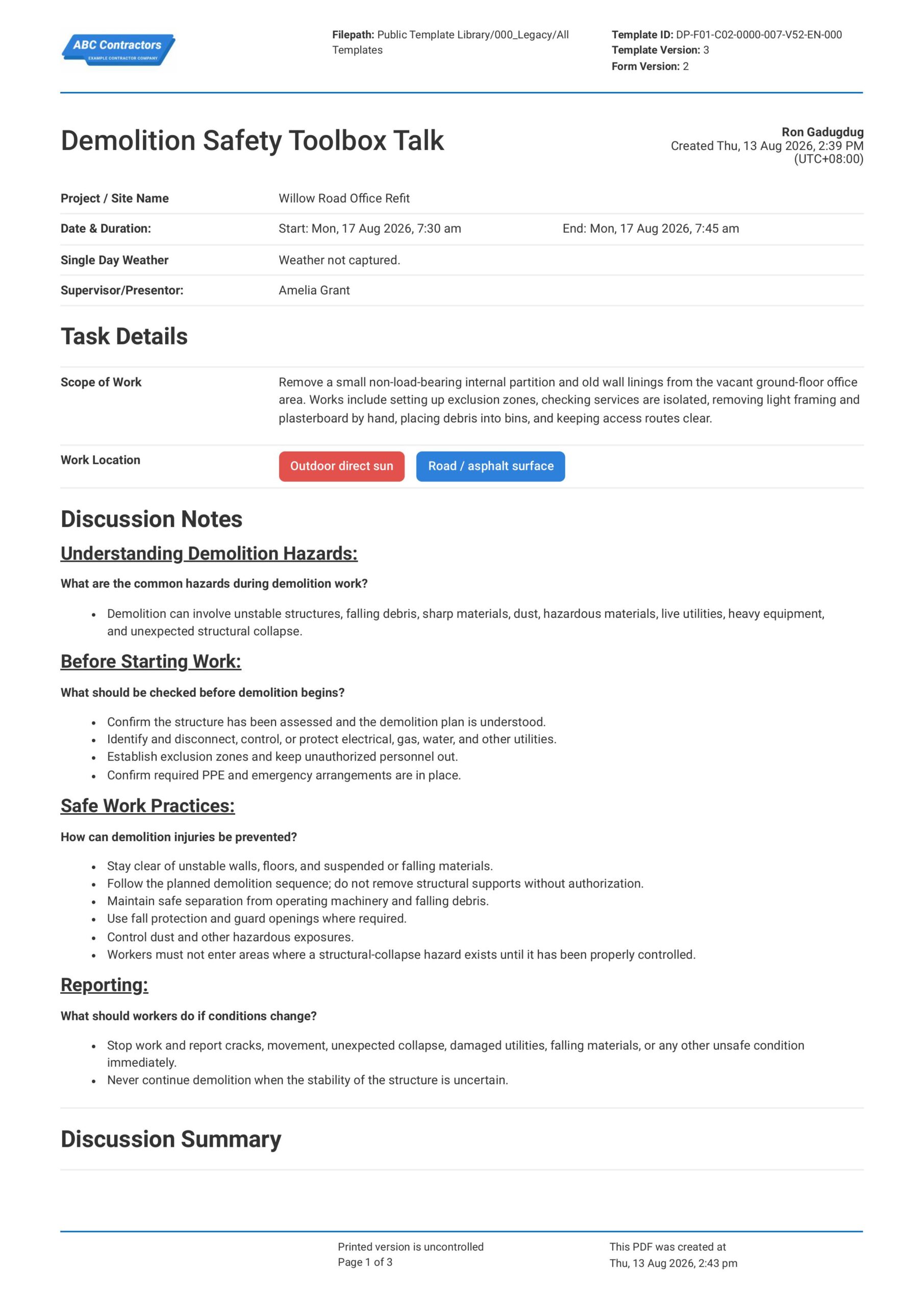
Demolition Safety Toolbox Talk
This Demolition Safety Toolbox Talk is an easy-to-use form that your workers can use to discuss demolition hazards and safe work practices before dismantling, breaking, or removing structures. Record important toolbox
View templateThis toolbox talk form was generated with Dashpivot software
- Access, edit and complete your Toolbox Talk Process from any device - mobile, tablet or computer.
- Print, download or send your Toolbox Talk Process as perfectly formatted PDF documents with your company logo.
- Store your Toolbox Talk Process securely online, where they can be searched and found in seconds
- Invite internal and external parties to see, edit and sign off on Toolbox Talk Process online.

 English (United States)
  English (Australia)
  English (UK)
  English (New Zealand)
  English (South Africa)
  German