Part M Internal Circulation Checklist Template
Start with a free 30-day trial. No credit card required.
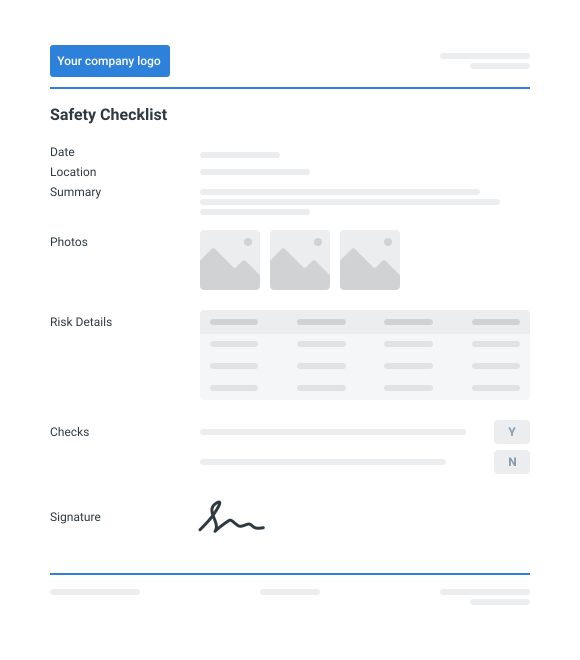
 Fully editable Part M Internal Circulation Checklist
Export your checklist to PDF or CSV
Access checklist on your phone, tablet, laptop, or computer
Check out hundreds of other safety checklists

~10,000 employees

~500 employees

~10 employees

~25,000 employees

~200 employees

~1,500 employees

~1,500 employees
What is a Part M Internal Circulation Checklist?
A Part M Internal Circulation Checklist is a form that is used to track inspection points and regulatory requirements for internal circulation routes, or how people get around inside a building. Specifically, the Building Regulations Part M UK covers features such as hallways, corridors, doors and doorways, indoor stairs, indoor ramps, etc.
Primarily, Part M building regulations set out to ensure the safety and comfort of access for building occupants. This includes people using wheelchairs, people with limited mobility or physical impairments, elderly occupants, or people carrying heavy loads on things like pushcarts. These regulations apply to buildings used as dwellings or for other purposes such as schools, hospitals, office buildings, and even government buildings. Engineers and architects use tools like checklists to ensure that they stay on top of all the numerous regulations and standards, as compliance is also a legal requirement under the regulation itself.
Compare this Part M Internal Circulation Checklist template to other forms (PDF, Word, Excel)
Use this Part M Internal Circulation Checklist template for free.
What is Internal Circulation?
Internal Circulation, in the context of building design and the Part M building regulations, refers to the movement of people within a building. It is an important concept in building design and accessibility planning as it ensures people can move through accessways safely, comfortably, and independently. Further, this is especially important to people with disabilities, physical impairments, or limited mobility, as regular traversing across the building space is more difficult and risky.
Internal circulation in dwellings usually covers elements like hallways, doorways, indoor stairs. However, buildings used for commercial settings like offices, malls, schools, and hospitals normally have more elements covered. Specifically, Part M also covers features such as entrance ways, car parks, reception areas, lobby areas, and indoor ramps among others.
Examples of elements used as internal circulation are the following:
- Corridors & Hallways: Connect rooms and different functional areas.
- Doors & Doorways: Provide access between rooms; must allow sufficient clear width and easy operation.
- Stairs: Enable vertical circulation between floors; must have consistent risers, handrails, and landings.
- Ramps: Provide accessible routes where there are changes in level.
- Lifts (Elevators): Essential for step-free access between floors.
- Lobbies & Landings: Serve as transition or waiting areas that support movement between circulation routes.
How do Part M and Other Building Regulations Align on Internal Circulation?
At the core, Part M focuses on regulations regarding the Access to and Use of Buildings, ensuring the buildings and its features are easily accessible for its users. However, you may notice that some other Parts within the UK Building Regulations may also cover the same building elements that Part M covers. For example, Part K and Part B also covers regulations on stairs and ramps.
However, it is important to note that while these parts may seem to “overlap”, there is clear distinction in the intent of each part. Part M focuses on accessibility of the building and its features so everyone can move freely. On the other hand, other Building Regulation Parts focus more on the safety aspect of these elements, so everyone can move safely. These intentions are very closely related, and usually interconnected. That is why you may sometimes see Part M regulations refer to these other regulation Parts for compliance as well.
Frequently Asked Questions
Why should I use this Part M Internal Circulation Checklist rather than other formats?
Sitemate’s Part M Internal Circulation Checklist allows you to directly cross reference specific regulations with actual inspection notes all on the same form. Just select the appropriate regulation set and category, and you’ll be able to see specific regulations for that category.
Is this Part M Internal Circulation Checklist compliant with Building Regulations?
Yes, this checklist was created based entirely on the UK Building Regulations Approved Document M, or Part M.
Can I edit the template contents to add or remove checklist points?
Yes, you can edit, add, or remove any checklist content to better suit your company’s needs. You can use Dashpivot and its no-code template builder to edit or re-create this template, and even add your company logo and letterhead.
How do I access the checklists I make?
You can access these checklists just about on any device. This means you can create fresh checklists, ready for your next inspection, on your phone at the job site. After you save the checklist, you can access it again automatically on your laptop or computer at the office for edits and sign offs.

Other popular templates you can use and edit for free

Part M Compliance Report
Capture and present Part M compliance results by consolidating accessibility checks, observations, and outcomes into this compliance report template.

Part M Handrail Compliance Checklist
Document Part M accessibility compliance along with assessment findings and outcomes with this convenient compliance report template.

Part M Passenger Lift Compliance
Assess Part M passenger lift compliance by using a smart checklist to review dimensions, controls, and access features.

This checklist was generated with Dashpivot software
Take your work flow online with Dashpivot. Digital tools are helping engineers and architects around the world streamline repetitive tasks without compromising quality.
- Access, edit and complete Part M Internal Circulation Checklists from any device - mobile, tablet or computer.
- Print, download or send your checklists as perfectly formatted PDF documents with your company logo.
- Store your checklists securely online, where they can be searched and found in seconds
- Invite internal and external parties to see, edit and sign off on checklists online.
Sitemate builds best-in-class software tools for built world companies.
 English (United States)
  English (Australia)
  English (UK)
  English (New Zealand)
  English (South Africa)
  German