
Fire Escape Inspection Report Template
Start with a free 30-day trial. No credit card required.
 Fully editable Fire Escape Inspection Report
PDF or CSV - save and export your reports to other formats
Fully accessible on your phone, tablet, laptop, or computer
Discover thousands of other safety inspection reports

~10,000 employees

~500 employees

~10 employees

~25,000 employees

~200 employees

~1,500 employees

~1,500 employees
What is a Fire Escape Inspection Report?
A Fire Escape Inspection Report is a form that collates findings, track progress, and document compliance of fire escape routes. For example, engineers, architects, and site personnel make use fire safety inspection reports to ensure the quality construction of these safety features. As a result, the safety and wellbeing of building occupants are ensured if ever they need to escape the building in the event of a fire.
Specifically, a good fire escape inspection report should allow you to directly reference requirements and check off on important safety & structural requirements, list down inspection notes, track any resolved or ongoing issues, and verify compliance. As such, this is relevant to dwellings, non-dwellings, and other building types, since fire escape routes are universally found in almost all of modern building design. In the UK, the Approved Document B of the building regulations contain the requirements on fire escape route design.
Compare this Fire Escape Inspection Report with other traditional formats (PDF, Word)
Use this Fire Escape Inspection template for free.
Why is Fire Escape Inspection Important?
Fire Escape Inspection is important because it ensures that escape routes are safe, up to standard and compliant with building regulations Approved Document B. To this end, Building engineers are responsible for ensuring the construction of these fire escapes are within parameters set by Part B. Specifically, route travel distance, geometry (widths, heights, slopes, etc.) of hallways, stairs, and ramps, the fire-resistance features added to these routes, and even emergency lighting and visibility are all monitored and should be taken into serious consideration during building design.
What do Fire Escape Inspectors Look For When Performing Inspections?
In the past, the Fire Department in the UK used to issue Fire Certificates to building operators as certifications of quality for a building's fire safety systems. Specifically, these systems included fire detection, escape routes, and emergency response systems, for instance. However, since 2006, Building Control officials (during construction) and the Responsible Person or the building operator (post-construction) are responsible for the creation and maintenance of these safety features.
For example, here are a few key points fire escape inspectors look for during inspection:
- Escape route condition and layout
- Fire doors and fire-resisting construction
- Fire-stopping and penetrations
- Vertical escape elements
- External escape routes
- Emergency escape lighting
- Escape signs
- Building use, risks, and changes
Fire Escape Requirements for Compliance
Building Control and safety officials in the modern day strictly monitor the delicate tasks of planning, constructing, and maintaining fire escape routes. In the UK, the Approved Document B Fire Safety covers regulations on fire escape routes and other fire safety features. So, whether you're a home owner, a building manager, a site engineer, or a design architect, you should be aware of these requirements and standards in order. As a result, this ensures compliance and helps to avoid unnecessary penalties, losses, or even serious risks during an actual fire.
Brief Fire Escape Testing Guide
According to the UK Approved Document B building regulations, here are some key tasks that you should incorporate into your testing common practices and operating procedures:
- Regular inspection of escape routes to ensure they remain clear and unobstructed
- Routine testing of final exit doors to confirm they open easily without keys or special knowledge
- Periodic testing of fire-resisting doors on escape routes, including self-closing devices
- Verification of fire-stopping integrity around service penetrations along escape routes
- Condition checks of stairways, ramps, and handrails used for vertical escape
- Testing of emergency escape lighting for operation and required duration
- Inspection of escape route signs for visibility and correct placement
- Examination of external escape stairs and routes for safety, guarding, and structural condition
- Confirmation that travel distances and internal layouts still comply after any building changes
- Review of evacuation routes in relation to occupancy levels and updated fire risk assessments
How Often Do Fire Escapes Need to be Inspected?
In the UK, there is no single fixed interval required for when you need to have your fire escape routes inspected. The Approved Doc. B regulations do not point out explicit time intervals in any official guidelines. However, the Responsible Person (home owner, building operator or manager) is explicitly required to continuously keep fire escape routes maintained, along with other fire safety features. Therefore, whether you need to perform daily, weekly, monthly, quarterly, or annual inspections will largely be up to you and your specific conditions.
Frequently Asked Questions
Why should I be using this Fire Escape Inspection Report over other forms?
Sitemate’s Fire Escape Inspection Report allows you to record information on each and every escape route in your building, is ready with relevant checklist items created directly from the Approved Document B, tracks non-compliance issues, and serves as a certification of inspection and compliance. Create a holistic inspection report, all in just a few clicks.
Does this inspection report comply with building code regulations?
Yes, this Fire Escape Inspection Report was based entirely on the Approved Doc. B requirements used in the UK Building Regulations. Specifically, it takes context from Requirement B1: Means of Warning and Escape found on both Volumes 1 and 2 of Part B.
Can I add or remove some portions of the report template to suit company specific needs?
Yes, you can easily add, remove, or edit any portion of the template with Dashpivot. Its intuitive, no-code template builder allows you to edit in any new requirements, and even allows you to add your company logo and letterhead to really tailor-fit your company’s needs.
Where do I access the reports I make?
You can access your reports on just about any device - phone, laptop, tablet, or desktop computer. This means you can take your report out to the jobsite with you on your phone to check on inspection findings, perform necessary edits, take and attach photos, and save and export to other formats like PDF or CSV.

Other popular templates you can use and edit for free
Smoke Test Checklist
Quickly log smoke test results and observations to validate system performance without slowing down site progress.
Fire Stopping Inspection Report
Document fire stopping works with clarity, making defects easy to identify, track, and close out.
Fire Safety Pre Plan
Define key fire safety systems and emergency procedures early in the design phase to support compliance and smoothen project coordination.

This report was generated with Dashpivot software
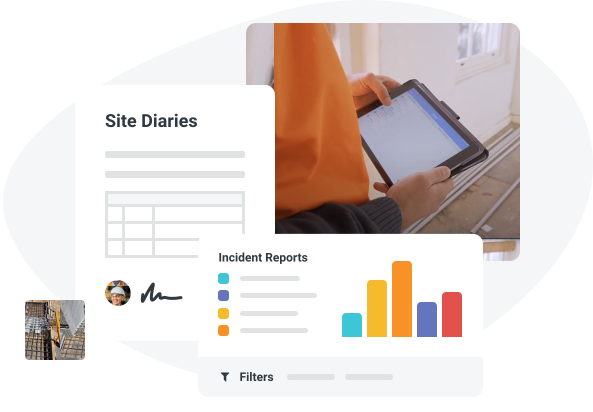
Streamline your workflow by taking your tasks digital. Less time pushing papers means more time you can focus on the actual work:
- Access, edit and complete inspection reports from any device - mobile, tablet or computer.
- Print, download or send your reports as perfectly formatted PDF documents with your company logo.
- Store your reports securely online, where they can be searched and found in seconds
- Invite internal and external parties to see, edit and sign off on reports online.

Sitemate builds best-in-class software tools for built world companies.
 English (United States)
  English (Australia)
  English (UK)
  English (New Zealand)
  English (South Africa)
  German