Free Field Reporting template
Monthly Construction Progress Report Template
No credit card required.
Need a Monthly Construction Progress Report template that makes it easier to record and track construction activities in the field?
This Monthly Construction Progress Report template is a structured, field-ready document for recording completed work, schedule progress, budget performance, safety, quality, and upcoming activities. It helps you keep all important project updates and details in one place, making it easier to monitor construction progress. Download and try Sitemate's Monthly Construction Progress Report to make your reporting faster and more efficient.
- 100% fully editable Monthly Construction Progress Report
- Export your Monthly Construction Progress Report to PDF or CSV
- Access your Monthly Construction Progress Report on mobile, tablet or computer
- Thousands of templates including other Field Reporting templates
 Click to preview
Trusted by thousands of companies, projects & teams worldwide


See how this Monthly Construction Progress Report compares to traditional Word, Excel, and PDF-based processes
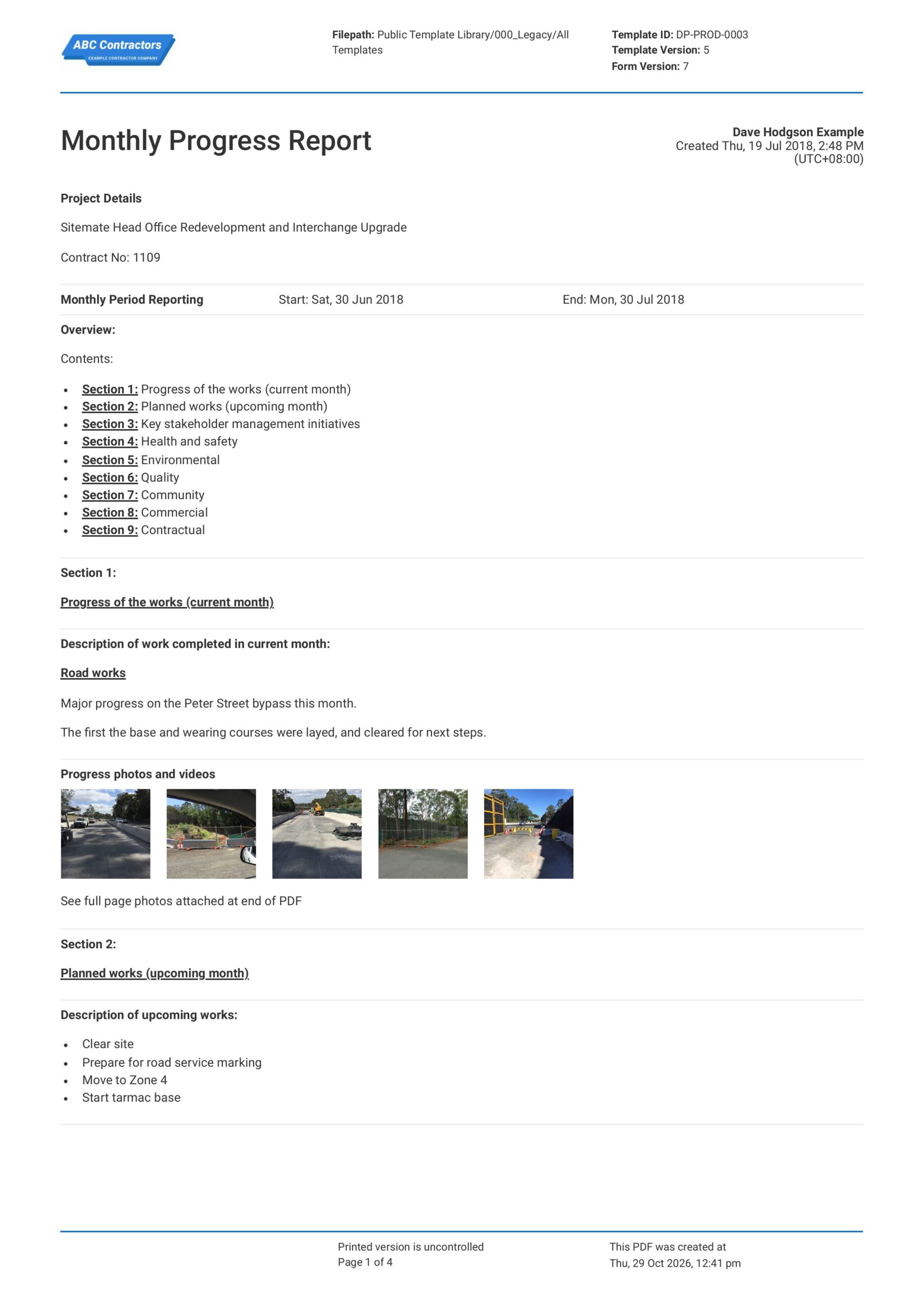
Curious how this Monthly Construction Progress Report works? Check out the example below to see exactly what comes pre-filled and how the report is structured across sections covering progress, schedule, budget, safety, and upcoming activities. You can generate your own version just as quickly, export it as a custom report with your company branding and project details, and have a finished, ready-to-distribute Monthly Construction Progress Report in your hands within minutes.

This Monthly Construction Progress Report Sample Was Generated With Dashpivot

This Monthly Construction Progress Report template was built using Dashpivot, where project teams can create structured field reports with photo attachments, e-signatures, automated workflows, and real-time data capture across any device. The template follows the section structure and reporting requirements commonly used in commercial, civil, and infrastructure construction projects.
- Access, edit and complete your Monthly Construction Progress Report from any device - mobile, tablet or computer.
- Print, download or send your Monthly Construction Progress Report as perfectly formatted PDF documents with your company logo.
- Store your Monthly Construction Progress Report securely online, where they can be searched and found in seconds
- Invite internal and external parties to see, edit and sign off on Monthly Construction Progress Report online.
Need a version for your own site?
Storm, the AI agent in Dashpivot, can build one from a short description or the form you already use.


 GLOBAL


What is a Monthly Construction Progress Report?
A Monthly Construction Progress Report is a structured document used by contractors, project managers, and site teams to document the status of a construction project at the end of each calendar month. It typically covers work completed during the reporting period, progress against the project schedule, budget and cost performance, subcontractor and labor activity, safety statistics, quality findings, outstanding issues, and planned activities for the following month. It is the primary communication tool between the project team and external stakeholders, including clients, owners, financiers, and regulatory bodies, and forms part of the formal project record.
Applicable Standards and Policies for Monthly Construction Progress Report
Making progress reports helps maintain quality project management. The report provides the exact details of what is currently in progress and other information that is vital to the completion of the project. The data in this report provides vital information for stakeholders, especially for making crucial decisions. Furthermore, the report complies with the following regulatory provisions:
- AIA A201 General Conditions of the Contract for Construction
- NEC Engineering and Construction Contract (ECC)
- FIDIC Conditions of Contract
- AS 4000-1997 General Conditions of Contract (Australia)
- Project Management Institute (PMI) PMBOK Guide
- ISO 21500: Guidance on Project Management
- Lender and financier requirements
Staff Members and Parties That Use the Monthly Construction Progress Report
Monthly Construction Progress Reports require personnel who understand the processes behind every construction activity conducted. In order for the report to be accurate and useful, the following staff members should be involved in making a Monthly Construction Progress Report:
- Field engineers: These are the personnel who primarily fill out the report. They record every detail of the activity while it is in progress on site. They record the work performed, the findings, and the total time spent on the activity.
- Managers and supervisors: These personnel watch and lead the construction activity according to the approved plan. It is in their jurisdiction that tasks are completed based on quality and safety standards.
- Safety and quality compliance coordinators: These personnel audit the quality of the job and the safety measures provided to control hazards.
Business Risks Reduced by the Monthly Construction Progress Report
The Monthly Construction Progress Report is a necessary document for checking both the quality and safety of a construction activity by proactively recording vital details. The record will serve as a guide for the decisions needed for the project to move forward without any delay. Failing to make this report or producing an inaccurate one could lead to the following business risks:
- Cash flow friction
- Delayed invoicing
- Unattained targets and quotas
- Customer disputes and loss of trust
- High costs for non-compliance
- Damaged reputation
- Low chances of winning future bids
Business Opportunities Created by the Monthly Construction Progress Report
Completing a Monthly Construction Progress Report can provide more than just information about an ongoing or completed construction activity. The report will serve as a guide in moving the activity or project much more efficiently and help identify potential problems that can be mitigated before they escalate into something major. The Monthly Construction Progress Report will also present the following business opportunities:
- Data-driven decisions
- Bad-performing equipment is easily identified and replaced
- Predictive service plans
- Smarter scheduling
- Plans are tracked accurately
- More efficient performance
- Workplace injuries are eliminated
- Good company reputation
Vital key items in a Monthly Construction Progress Report
- Progress of the works
- Planned works
- Key stakeholder management initiatives
- Health and safety
- Environmental
- Quality
- Community
- Commercial
- Contractual
How to Create a Monthly Construction Progress Report
Building a consistent and effective Monthly Construction Progress Report requires the right structure, reliable input data, and a clear understanding of what your client or contract requires. The following steps walk through how to create a Monthly Construction Progress Report from scratch, whether you are building a template in a document editor or setting one up in a digital form platform.
Prerequisites before making a Monthly Construction Progress Report
- Contract or project brief, including reporting frequency and format requirements specified by the client or head contractor
- Current project plan or baseline schedule, including milestone dates and critical path activities
- Cost plan or budget baseline, including approved variations and contingency allocation
- Safety incident and near-miss data for the reporting period, sourced from your site safety register
- Subcontractor progress data and any sub-reports submitted for the period
- Site photographs taken throughout the reporting month, structured by work area or trade
- Quality inspection records, NCRs, and hold point sign-offs completed during the period
- Previous Monthly Construction Progress Report, so you can track cumulative figures and update outstanding actions
Add the information section
This section provides information about the report. It should have the following fields:
- Reporting Date
- Table of contents of all sections
Add the process of works section
This section would detail completed work for the month being reported. It should have the following fields:
- Description of work completed in the current month.
- Photos depicting the progress
Add the planned works section
This section will provide information on the activities planned for the following month. It should have the following:
- Description of upcoming works
- Photos of the location for the upcoming works
Add a key stakeholder management initiatives section
This section shows the satisfaction score of local stakeholders. It should have the following:
- Verification of whether local stakeholders raised any concerns.
- List of stakeholders
- Satisfaction score
- Likelihood of complaint
Add the health and safety section
This section provides an overview of health and safety performance. It should have the following fields:
- Key performance indicators
- Key performance indicator score
- Current month to date score
- Corrective action summary
Add the environmental section
This section provides a summary of when rain occurred during the month. It should have the following fields:
- Date of rain event
- Rainfall volume
- Photos of site
Add the quality section
This section provides an overview of quality performance. It should have the following fields:
- Key performance indicators
- Number of open items
- Number of closed items
Add the community section
This section provides a summary of community queries and complaints.
- Provide a community comments field
Add the commercial section
This section outlines the progress claim summary. It should have the following fields:
- Month
- Amount
- Status
Add the contractual section
This section outlines the contractual works conducted within the reporting period. It should provide a summary of the following:
- Variations summary
- Extension of time summary
Tracking Monthly Construction Progress
Construction projects involve multiple activities that need to be monitored to ensure that work is completed according to the project schedule. Delays, material shortages, and unexpected issues can affect the project's progress if they are not addressed early. A Monthly Construction Progress Report helps track the work completed during the month, ongoing activities, and upcoming milestones. It also provides a record of any issues encountered, delays, and actions needed to keep the project on track. This helps project managers and stakeholders stay updated on the project's progress, identify areas that need attention, and plan the next steps accordingly.
How to Create Your Monthly Construction Progress Report in an App or Software System
A well-structured digital template captures progress, safety, cost, and quality data in one place throughout the month. Creating a digital Monthly Construction Progress Report with real-time data entry by site supervisors and subcontractors means that by the time the reporting period closes, most of the report is already populated, significantly reducing the time and effort required to complete and distribute the document.
How to make a Monthly Construction Progress Report in an App
Using an app that employs digital forms instead of paper-based ones may help improve the process by:
- Assistance with artificial intelligence (AI).
- Having fewer manual data entries.
- All produced forms are stored in a single access cloud.
- Reformatting is straightforward and can be adapted to new protocols or updated standards.
- Formula integration is much simpler.
- Workflows and notifications may be automated and scheduled.
- Improved template design and look.
Creating the information section
- Add a date range field for the monthly reporting period.
- Add a prefilled text field for the table of contents. Add all the key sections in the table of contents. Here are the key sections: progress of work, planned works, key management initiatives, health and safety, environmental, quality, community, commercial, and contractual.
Creating the process of the works section
- Add a multi-text field for the completed works.
- Add a photo field so users can upload photos as evidence for completed works.
Creating the upcoming works section
- Add a multi-text field for the upcoming works.
- Add a photo field so users can upload photos for the location of upcoming works.
Creating the key stakeholder management initiative section
- Add a field where users can verify whether local stakeholders have raised any concerns. Ensure that users can also provide comments on this field.
- Add a 3-column table where users can freely add rows.
- Format the first column of the table as a text field for the local stakeholders.
- Format the second column as a selection field for the satisfaction score. Use the following selection items: low, medium, and high. You can add colors to each selection item to make the report more professional and appealing.
- Format the third column as a selection field for the likelihood of complaint. Use the following selection items: low, medium, and high. You can add colors to each selection item to make the report more professional and appealing.
Creating the health and safety section
- Add a 3-column table.
- Format the first column as a prefilled text field. Add the key performance indicators for health and safety in the first column.
- Format the second column as a number field for the current KPI score for the current month.
- Format the third column as a number field for the total KPI score for the month to date.
- Add another 3-column table for the corrective action summary. Make sure to format this table in a way where users can freely add rows.
- Format the first column as a text field for the action description.
- Format the second column as a photo field so users can upload photos of items that need the corrective action.
- Format the last column as a selection field for the status of the action. Use the following selection items: completed, pending, and unactioned.
- After creating the second table, add a multiple-text field for additional comments.
Creating the environmental section
- Add a 3-column table where users can freely add rows.
- Format the first column as a date field for the date of the rain event.
- Format the second column as a number field for the volume of rain. Make sure to indicate the unit for uniformity.
- Format the last column as a photo field so users can upload photos of the site when it rained.
- Add a multiple-text field for additional comments.
Creating the quality section
- Add a 3-column table.
- Format the first column as a prefilled text field. Add the key performance indicators for quality in the first column.
- Format the second column as a number field for the number of open items.
- Format the third column as a number field for the number of closed items.
- Add a multiple-text field for additional comments.
Creating the community section
- Provide a multiple-text field for community comments.
Creating the commercial section
- Add a 3-column table for the progress claim summary. Format the table where users can freely add rows.
- Format the first column as a text field for the month
- Format the second column as a number field for the amount. Make sure to specify the denomination.
- Format the last column as a selection field for the status. Use the following selection items: approved, for review, under review, and disapproved. You can add colors to each selection item to make the report more professional and appealing.
Creating the contractual section
- Add a 5-column table for the variation summary. Format this table where users can freely add rows.
- Format the first column as a number field for the variation number.
- Format the second column as a text field for the variation description.
- Format the third column as a date field for date submitted.
- Format the fourth column as a number field for the amount approved. Make sure to specify the denomination.
- Format the last column as a selection field for the status. Use the following selection items: completed and in progress.
- Add another 5-column table for the extension of time summary. Format this table where users can freely add rows.
- Format the first, second, third, and fifth columns the same way as the previous table.
- Format the fourth column as a number field for the days requested.
Frequently Asked Questions
Who should complete a Monthly Construction Progress Report?
A project manager or site manager is typically responsible for completing the report. However, a site engineer, construction supervisor, or other personnel involved in overseeing construction activities can also prepare it. They should gather updates from the team, record the work completed, and document any issues that could affect the project's progress.
When should a Monthly Construction Progress Report be completed?
The report should be completed at the end of each month to document the project's progress during that period. It should be reviewed before project meetings or updates with clients and stakeholders to ensure that everyone is informed about completed work, ongoing activities, and upcoming priorities.
Who should receive the completed Monthly Construction Progress Report?
The report should be shared with the project manager, site manager, client, and other stakeholders who need updates on the project's progress. Depending on the project's requirements, contractors, consultants, and other team members may also receive a copy to help coordinate upcoming activities.
Why is it important to keep Monthly Construction Progress Reports?
Keeping monthly construction progress reports helps project managers track progress over time, identify recurring issues, and monitor whether the project is following the planned schedule. These records also make it easier to review previous activities, communicate updates to stakeholders, and plan the next stages of construction.
About the Author

Felmar Mantalaba
Content Engineer
 LinkedIn
Education
Cebu Institute of Technology - University - Mechanical Engineering with Mechatronics
Bio
Felmar is a mechanical engineer, whose four years of experience in the mining industry inspired him to write and share stories to progress the revolution of new technologies and create smarter, smoother ways of living.
Past Projects
Safety, Health, and Environment Management System (SHEMS) CoordinationSHEMS Coordinator at Atlas Consolidated Mining, ensuring organizational compliance with ISO 14001 and ISO 45001 standards, performing risk assessments, developing policies, and conducting audits and inspections to maintain a safe and environmentally responsible workplace.
Maintenance Management and OptimizationSenior Maintenance Manager (OIC) leading equipment maintenance and operational efficiency initiatives, reducing downtime by 10%, improving Mean Time Between Failure (MTBF) and Mean Time To Repair (MTTR) for major equipment, and managing maintenance schedules, manpower, and materials, while overseeing capital project optimization.
Inspection Engineering and Equipment ReliabilityInspection Engineer responsible for technical blueprint interpretation, vendor collaboration, preventive maintenance scheduling, and data collection for vibration and temperature readings, delivering actionable recommendations and comprehensive reports to improve equipment reliability and operational performance.
End-to-End Operational Oversight in Mining EngineeringContributed to multiple facets of operational management, including SHEMS compliance, maintenance optimization, inspections, and capital project evaluation, integrating safety, reliability, and efficiency improvements across all stages of copper production operations.
Version history
Last edited on 28 October 2026, template version 25-11-v2