Free Field Reporting template
HS2 Construction Noise and Vibration Methodology Report Template
No credit card required.
Are you monitoring construction noise and vibration levels on your HS2 project and looking for an HS2 construction noise and vibration methodology report sample to help guide you?
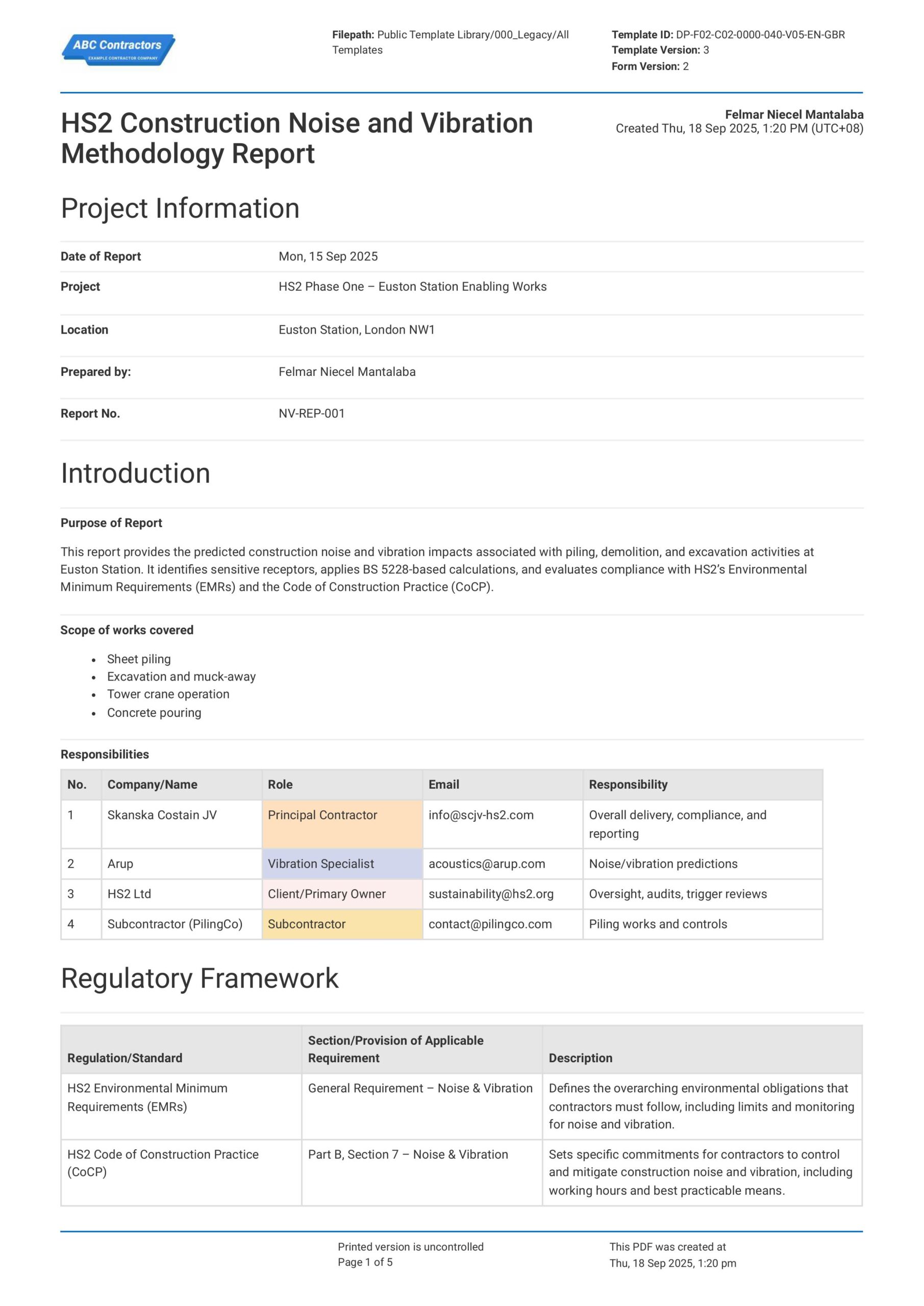
This HS2 Construction Noise and Vibration Methodology Report is an easy-to-use form that your team can use to plan and document noise and vibration monitoring procedures during construction activities. Record important details such as the monitoring scope, construction activities, noise and vibration sources, monitoring locations, equipment, measurement methods, assessment criteria, monitoring frequency, and reporting requirements, then attach supporting photos, files, and sign-offs - all in one free form. Plus, you can even export your completed reports to PDF or CSV for easy sharing with environmental managers, engineers, contractors, and other stakeholders.
- 100% fully editable HS2 Construction Noise and Vibration Methodology Report
- Export your HS2 Construction Noise and Vibration Methodology Report to PDF or CSV
- Access your HS2 Construction Noise and Vibration Methodology Report on mobile, tablet or computer
- Thousands of templates including other Field Reporting templates
 Click to preview
Trusted by thousands of companies, projects & teams worldwide















Compare this HS2 Construction Noise and Vibration Methodology Report to reports made on other formats
Curious how this report works? Check out the example below to see how you can generate your own version, export it as a custom form with your company details, and fill in your information to have an HS2 Construction Noise and Vibration Methodology Report Form ready-to-use in minutes. No more starting from scratch like you would on Excel or Word based forms.

This HS2 Construction Noise and Vibration Methodology Report Sample Was Generated With Dashpivot
This report was generated using Dashpivot, where you and your team can create smart documents that allow photos and video attachments, conditions, and more to tailor-fit the needs of all your work tasks.
- Access, edit and complete your HS2 Construction Noise and Vibration Methodology Report from any device - mobile, tablet or computer.
- Print, download or send your HS2 Construction Noise and Vibration Methodology Report as perfectly formatted PDF documents with your company logo.
- Store your HS2 Construction Noise and Vibration Methodology Report securely online, where they can be searched and found in seconds
- Invite internal and external parties to see, edit and sign off on HS2 Construction Noise and Vibration Methodology Report online.
Need a version for your own site?
Storm, the AI agent in Dashpivot, can build one from a short description or the form you already use.


 GLOBAL


Template guide
Learn More About the HS2 Construction Noise and Vibration Methodology Report
What is a HS2 Construction Noise and Vibration Methodology Report?
An HS2 Construction Noise and Vibration Methodology Report is a document used by environmental engineers, acoustic consultants, contractors, and project teams to establish how noise and vibration from construction activities will be measured, assessed, and reported. This report usually includes details on monitoring locations, equipment, measurement procedures, assessment criteria, noise and vibration trigger levels, monitoring schedules, and reporting requirements.
Due to the noise and vibration impacts that come with major railway construction, monitoring procedures are important for assessing disturbances to nearby buildings, residents, and surrounding communities. This makes the HS2 Construction Noise and Vibration Methodology Report relevant to the UK's High Speed Two railway project, where contractors must monitor construction noise and vibration and prepare reports in line with the HS2 Code of Construction Practice (CoCP) and Environmental Minimum Requirements (EMRs).
Applicable Standards and Policies for HS2 Construction Noise and Vibration Methodology Report
There are specific requirements and guidance for preparing an HS2 Construction Noise and Vibration Methodology Report in the UK. The HS2 Code of Construction Practice requires contractors to monitor construction noise and vibration, while related regulations and standards cover noise assessment, monitoring methods, and environmental controls. Here are examples of common requirements referenced for HS2 construction work:
- HS2 Code of Construction Practice requires noise and vibration monitoring during construction
- HS2 Information Paper E23 covers construction noise and vibration control measures
- Control of Pollution Act 1974 Section 61 covers construction noise
Staff Members and Parties That Use the HS2 Construction Noise and Vibration Methodology Report
An HS2 Construction Noise and Vibration Methodology Report is primarily used by project teams responsible for assessing and monitoring noise and vibration from railway construction, tunnelling, piling, excavation, and other major infrastructure work. Here are examples of common parties that use an HS2 Construction Noise and Vibration Methodology Report:
- Project and construction managers working on HS2 projects
- Environmental officers
- Site inspectors and auditors
- Local authorities reviewing construction noise and vibration output
Business Risks Reduced by the HS2 Construction Noise and Vibration Methodology Report
Using an HS2 Construction Noise and Vibration Methodology Report helps businesses identify issues such as excessive construction noise, ground vibration, poor monitoring practices, and disturbances to nearby properties or communities. Without proper monitoring and documentation, contractors and project teams may be exposed to risks such as:
- Noise and vibration levels exceeding approved limits
- Non-compliance with HS2 construction noise requirements
- Possible damage to nearby structures or sensitive equipment
- Community complaints and possible legal claims
- Project delays caused by construction restrictions, investigations, or work stoppages
Business Opportunities Created by the HS2 Construction Noise and Vibration Methodology Report
A well-prepared HS2 Construction Noise and Vibration Methodology Report helps businesses improve environmental monitoring, construction planning, and compliance across major railway infrastructure projects. Here are some ways an HS2 Construction Noise and Vibration Methodology Report can help businesses:
- Improve planning on mitigation of noisy or vibration-intensive construction activities
- Identify sources of recurring noise and vibration issues
- Build public and stakeholder trust through transparent environmental monitoring
What Should be Included in an HS2 Construction Noise and Vibration Methodology Report?
An HS2 Construction Noise and Vibration Methodology Report should explain how noise and vibration levels from construction activities will be monitored, measured, and assessed throughout the project. The methodology should follow HS2's Code of Construction Practice (CoCP), Environmental Minimum Requirements (EMRs), and relevant British Standards such as BS 5228. Here are some core elements that should be included:
- Monitoring objectives, construction activities, site locations, and nearby noise-sensitive receptors
- Applicable standards, assessment criteria, noise and vibration trigger levels, and local authority consent requirements
- Noise monitoring methods and measurements such as LAeq, LAmax, and background noise levels
- Vibration monitoring methods, including Peak Particle Velocity (PPV), monitoring locations, and equipment requirements
- Data collection, reporting procedures, trigger level exceedances, investigations, and corrective action requirements
How to Create an HS2 Construction Noise and Vibration Methodology Report
There are specific requirements that go into building the HS2 Construction Noise and Vibration Methodology Report. In this section, we discuss important steps so you can create your own report from scratch.
Before starting your HS2 Construction Noise and Vibration Methodology Report, the following pre-requisites should be ready.
- HS2 project details and construction work areas are required.
- Noise and vibration sources and activities must be listed.
- Baseline noise and vibration data must be available.
- Monitoring locations and sensitive receptors must be identified.
- Monitoring equipment, methods, and calibration details must be stated.
- HS2 Code of Construction Practice requirements and trigger levels must be included.
- Reporting, investigation, and corrective action procedures must be defined.
Start with Project and Monitoring Information
Recording general project information at the beginning of your HS2 Construction Noise and Vibration Methodology Report helps establish the scope of the monitoring activities. Here are some examples of core information that you should include:
- HS2 project name and construction site location
- Reporting date and document reference number
- Contractor or monitoring consultant details
- Description of planned construction activities
- Relevant local authority and monitoring area
Identify Noise and Vibration Sources
Next, you will want to identify the construction activities that may generate noise or vibration and the surrounding areas that could be affected. Common sources and locations that should be assessed include:
- Excavation, piling, drilling, or demolition activities
- Heavy machinery, construction plant, and vehicle movement
- Nearby residential properties or other sensitive receptors
- Existing background noise and vibration levels
- Proposed monitoring locations and measurement points
Define Noise and Vibration Monitoring Methods
Establishing a clear monitoring methodology helps ensure that measurements are collected consistently and can be compared against applicable requirements. Here are some examples of information that should be recorded:
- Noise monitoring equipment and calibration requirements
- Vibration monitoring equipment and installation methods
- Equivalent continuous sound levels (LAeq,T)
- Peak Particle Velocity (PPV) and Vibration Dose Value (VDV)
- Monitoring frequency, duration, and measurement conditions
Establish Assessment Criteria and Control Measures
It is important that the assessment criteria are clearly defined so any excessive noise or vibration can be identified and addressed. Be sure to account for the following requirements in your methodology report:
- HS2 Code of Construction Practice (CoCP) requirements
- BS 5228 noise and vibration assessment guidance
- Section 61 consent conditions, where applicable
- Agreed noise and vibration trigger levels
- Best Practicable Means (BPM) and corrective action procedures
Complete Review, Reporting, and Approval
Complete your HS2 Construction Noise and Vibration Methodology Report with a section that confirms the monitoring methodology has been reviewed and the reporting arrangements have been established. Here are some examples of fields that you can include:
- Monitoring data review and reporting procedures
- Process for reporting exceedances and complaints
- Date of review and approval
- Responsible personnel sign-off
What Noise and Vibration Standards Apply to HS2 Construction Works?
HS2 construction works are subject to specific noise and vibration requirements under the project's Code of Construction Practice (CoCP) and Environmental Minimum Requirements (EMRs). These requirements are supported by UK legislation, British Standards, and local authority conditions to manage the impact of construction activities on nearby buildings, residents, and communities.
Key standards include BS 5228-1 and BS 5228-2 for construction noise and vibration control, the Control of Pollution Act 1974 for construction noise management and Section 61 consents, and BS 6472 and BS 7385 for assessing vibration impacts on people and buildings where applicable. Additionally, HS2 contractors must follow relevant monitoring procedures, agreed noise and vibration limits, and Best Practicable Means (BPM) requirements to support compliance with the project's environmental obligations.
How to Create Your HS2 Construction Noise and Vibration Methodology Report in an App or Software System
A well-designed Noise and Vibration Management process helps HS2 project teams document monitoring methods, assessment criteria, control measures, and site findings, while keeping records structured for easy review, compliance checks, and sharing.
Start your HS2 Construction Noise and Vibration Methodology Report with Project Information
It is important to begin your HS2 Construction Noise and Vibration Methodology Report with key project, site, date, reference, and responsible personnel details so the document can be traced to the correct HS2 construction activity and reporting period. This section should use simple text and date fields for fields such as:
- Date selector field for Date of Report
- Text fields for Project and Location
- Text field or Automatic Form Counter for Report Number
Create a Section for Introduction and Scope of Works
Next, create a section where users can explain the purpose of the report and identify the construction activities covered by the noise and vibration assessment. For simplicity, we recommend using multi-line text and multiple-choice selector fields for information such as:
- Multi-line text field for Purpose of Report
- Multiple-choice selector field for Scope of Works Covered, including Piling, Excavation, Crane Operations, and Concrete Pouring
- Conditional text field for additional construction activities not included in the pre-filled choices
Optional: Add Annotations and Formulas as Guides
Optionally, you can add pre-filled text and photos to your standard form that can serve as guidelines for users. This can include important reminders, standards, and formulas that will ensure the right data can be gathered and encoded. Here are some examples that are relevant across subsequent sections:
- HS2 Environmental Minimum Requirements (EMRs), HS2 Code of Construction Practice (CoCP), and HS2 Information Paper E23
- Control of Pollution Act 1974, Environmental Protection Act 1990, BS 5228-1, and BS 5228-2
- Instructions for identifying major plant and equipment and obtaining Sound Power Levels (LwA)
- Noise prediction formula: _Lp = LwA - 20 log10(r) - 11_
- Vibration attenuation formula:_ PPVr = PPVref × (dref / dr)^k_
- Cumulative noise formula: _Ltotal = 10 log10(Σ10^(Li/10))_
Create a Table for the Regulatory Framework
Next, create a section where users can document the environmental requirements, legislation, and technical standards applicable to the noise and vibration assessment. We highly recommend using a table for this section so each requirement can be recorded alongside its relevant provisions and descriptions.
- First column for Regulation/Standard
- Second column for Section/Provision of Applicable Requirement
- Third column for Description
Create a Table for Baseline Conditions
After recording the regulatory requirements, add a section where users can document existing noise and vibration conditions at sensitive receptors near the construction site. We highly recommend using a table for this section so each receptor can be assessed alongside its distance from the works and baseline measurements.
- First column for Item Number
- Second column for Name of Building
- Third column for Receptor Type, with a dropdown field
- Fourth column for Estimated Distance of the receptor from the actual work
- Fifth column for Unit of Measurement(pre-filled text)
- Sixth column for Baseline Noise reading (dB)
- Seventh column for Baseline Vibration reading (mm/s PPV)
Create a Table for Construction Activities
Next, create a section where users can record construction activities that may generate noise or vibration, including the equipment involved, expected sound levels, vibration levels, and activity duration. We highly recommend using a table for this section, with the following formatting for the columns:
- First column for Activity Number
- Second column for Activity
- Third column for Equipment/Plant Involved
- Fourth column for Expected Noise level (dB)
- Fifth column for Expected Vibration level (mm/s PPV)
- Sixth column for Estimated Duration of operation (min)
Create a Section for Noise and Vibration Prediction and Assessment
Users will next need to calculate the predicted noise and vibration levels generated by construction plant and equipment at nearby sensitive receptors. We recommend including pre-filled calculation guidance based on BS 5228-1 and BS 5228-2. We highly recommend providing columns for the following information:
- Item Number
- Activity / Equipment
- Sound Power Level (LwA dB)
- Source PPV at Reference Distance (mm/s)
- Distance to Receptor (m)
- Corrections or Attenuation Factor Applied
- Predicted Noise Level at Receptor (LAeq, dB)
- Predicted PPV at Receptor (mm/s)
- Sensitive Receptor ID
- Threshold Exceeded?, with a Yes/No selector field
Create a Table for Cumulative Assessment
This section is the meat and potatoes of your report, as users will now be recording combined noise and vibration levels caused by multiple construction activities going on all at once. We highly recommend using a table for this section, alongside pre-filled calculation guidance for cumulative noise levels and vibration exposure.
- First column for Item Number
- Second column for Sensitive Receptor ID
- Third column for Number of Sources affecting the receptor
- Fourth column for Source IDs
- Fifth column to document Combined Predicted Noise Level
- Sixth column to document Combined Predicted Vibration Level
- Seventh column for Applicable Threshold/s
- Eighth column to indicate whether threshold was exceeded, with a Yes/No ticker field
Create a Table for Threshold Criteria
After completing the cumulative assessment, add a section where users can document the applicable noise and vibration trigger levels for different sensitive receptors and times of day. We highly recommend using a table for this section so predicted results can be compared against the relevant HS2 requirements and technical criteria.
- First column for Item Number
- Second column for Sensitive Receptor ID
- Third column for Parameter
- Fourth column for Daytime Limit
- Fifth column for Evening Limit
- Sixth column for Night-time Limit
Create a Table for Mitigation and Control Measures
Next, create a section where users can document the noise and vibration control measures required for construction activities. We highly recommend using a table for this section so each mitigation measure can be assigned to a responsible party and tracked alongside its implementation timing and verification status.
- First column for Item Number
- Second column for Vibration or Noise Source ID
- Third column for Mitigation Measures
- Fourth column for Descriptions of possible effects of mitigation
- Fifth column for Name of Responsible Personnel
- Sixth column for Due Date or turnaround time
- Seventh column for Verification Method
- Eighth column for Status, with a dropdown field
Create a Table for Monitoring and Reporting
After recording the mitigation measures, add a section where users can establish the noise and vibration monitoring requirements for different construction activities. We highly recommend using a table for this section so each monitoring activity can be documented alongside its location, frequency, trigger level, and responsible personnel.
- First column for Item Number
- Second column for Activity
- Third column for Location
- Fourth column for Monitored, with a dropdown field for Noise, Vibration, or Both
- Fifth column for Frequency
- Sixth column for Trigger Level
- Seventh column for Name of Responsible Personnel
Create a Table for Documents and Appendices
Next, create a section where users can attach supporting noise and vibration surveys, monitoring reports, technical assessments, and other relevant documents. We highly recommend using a table for this section so each document can be tracked alongside its reference number, submission date, and responsible party.
- First column for Item Number
- Second column for Document Name
- Third column for Document Item Number
- Fourth column for Date Submitted, with a date selector field
- Fifth column for Name of Personnel that submitted the document
- Sixth column for Attachments, with file upload fields
End your HS2 Construction Noise and Vibration Methodology Report with a Reporter's Sign-off
Finally, complete the HS2 Construction Noise and Vibration Methodology Report with a sign-off field for the person responsible for preparing the assessment. If your app or software allows, use automatic e-signature fields to keep the sign-off process digital.
- E-signature field for Reporter's Signature
- Automatic date and time stamp field for Reporter's Signature
Frequently Asked Questions
What is an HS2 Construction Noise and Vibration Methodology Report used for?
An HS2 Construction Noise and Vibration Methodology Report sets out how construction noise and vibration will be measured, assessed, and monitored during HS2 works. This is important because activities such as piling, excavation, and heavy equipment operations can affect nearby properties and communities. The report helps teams follow consistent HS2 noise and vibration monitoring procedures.
Are there any regulations or legislation on how to format an HS2 Construction Noise and Vibration Methodology Report?
There is no single statutory layout for the report. However, HS2's Code of Construction Practice (CoCP) sets requirements for noise and vibration monitoring and reporting. Relevant standards and legislation include BS 5228 Parts 1 and 2 and Section 61 of the Control of Pollution Act 1974. Because of this, reports should follow HS2's published methodology and applicable local authority consent conditions.
How are noise and vibration levels from construction equipment assessed?
It is common to see teams first identify the main sources of noise in construction site activities, such as piling rigs or excavators, and then measure noise and vibration levels using sensors and other equipment. Alternatively, guidance such as BS 5228 or a construction noise handbook can help estimate equipment noise levels. Next, they choose locations to measure these levels, usually around areas where exposure risks to surrounding structures or environment are higher. Finally, after they gather the noise and vibration levels, they check their results against acceptable levels to see if they are compliant.
How is AI helping teams create HS2 Construction Noise and Vibration Methodology Reports?
AI can help teams create HS2 Construction Noise and Vibration Methodology Reports by turning monitoring records, equipment data, site notes, and measurement results into clear report drafts. It can also help identify noise trends, flag readings above agreed limits, and prepare monitoring summaries for environmental and engineering teams.
About the Author

Ron Gadugdug
Content Engineer
 LinkedIn
Education
Cebu Institute of Technology - University - Civil Engineering
Bio
Ron is a Civil Engineer with 6 years of experience in the construction industry, primarily focused on quantity surveying, cost estimation, project management, quality control, contract administration, and property & engineering insurance. At Sitemate, he writes about practical applications of evolving technologies and digital solutions that support construction professionals in improving efficiency, compliance, and project delivery across the built world.
Past Projects
Quantity Surveying & Cost EngineeringPerformed quantity take-offs of several high-rise and horizontal structures using sheets and applications like Revit and Bluebeam Revu, and spearheaded trials with Building Information Modeling (BIM) software.
Project Management & ConsultancyCoordinated with project management teams during the construction of local projects such as a 4-tower hotel & resort, a 22 storey condominium project, and a school dormitory project.
Contract AdministrationAssisted during contract biddings and negotiations with general contractors and sub-contractors, and oversaw progress reporting, billings, and payment.
Property & Engineering InsuranceDedicated non-life claims handler, overseeing property and contractor all-risk insurance claims, risk management, and bonds.
Version history
Last edited on 16 November 2026, template version 25-11-v2