Retaining Wall Inspection Report
Start with a free 30-day trial. No credit card required.
 100% fully editable Retaining Wall Inspection Report
Export your Retaining Wall Inspection Report to PDF or CSV
Access inspection reports on mobile, tablet or computer
Thousands of templates including other quality templates

~10,000 employees

~500 employees

~10 employees

~25,000 employees

~200 employees

~1,500 employees

~1,500 employees
What is a Retaining Wall Inspection Report?
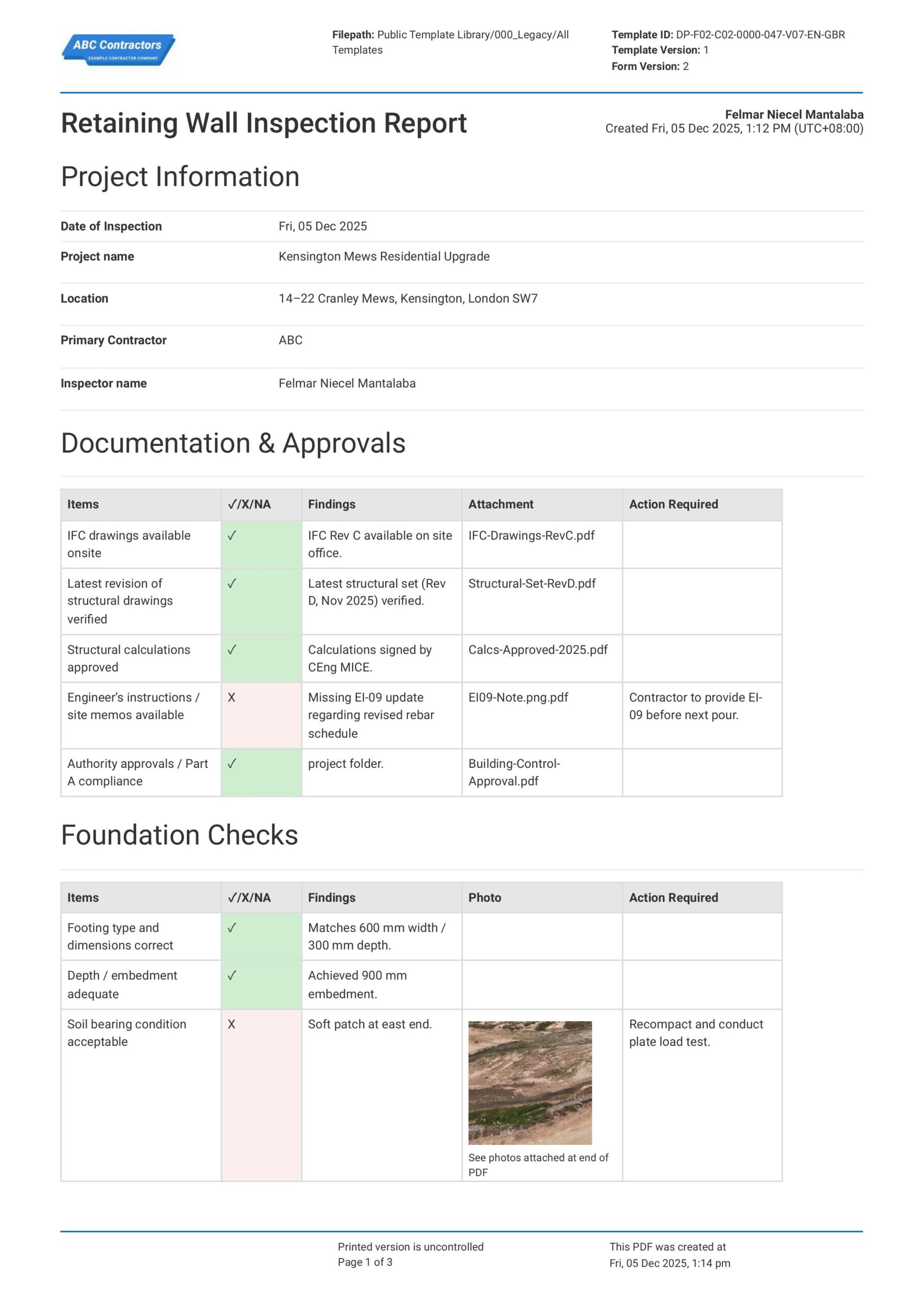
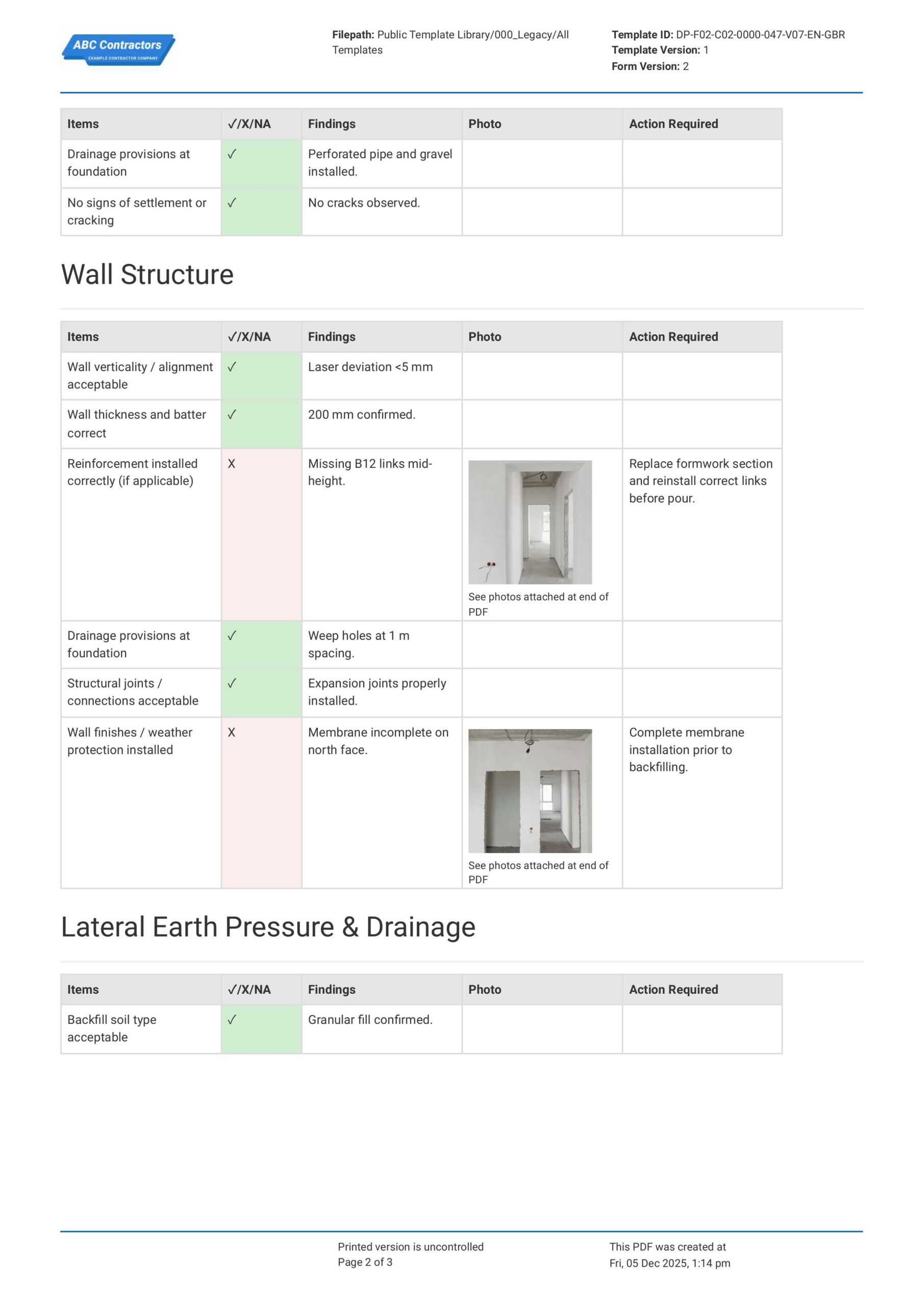
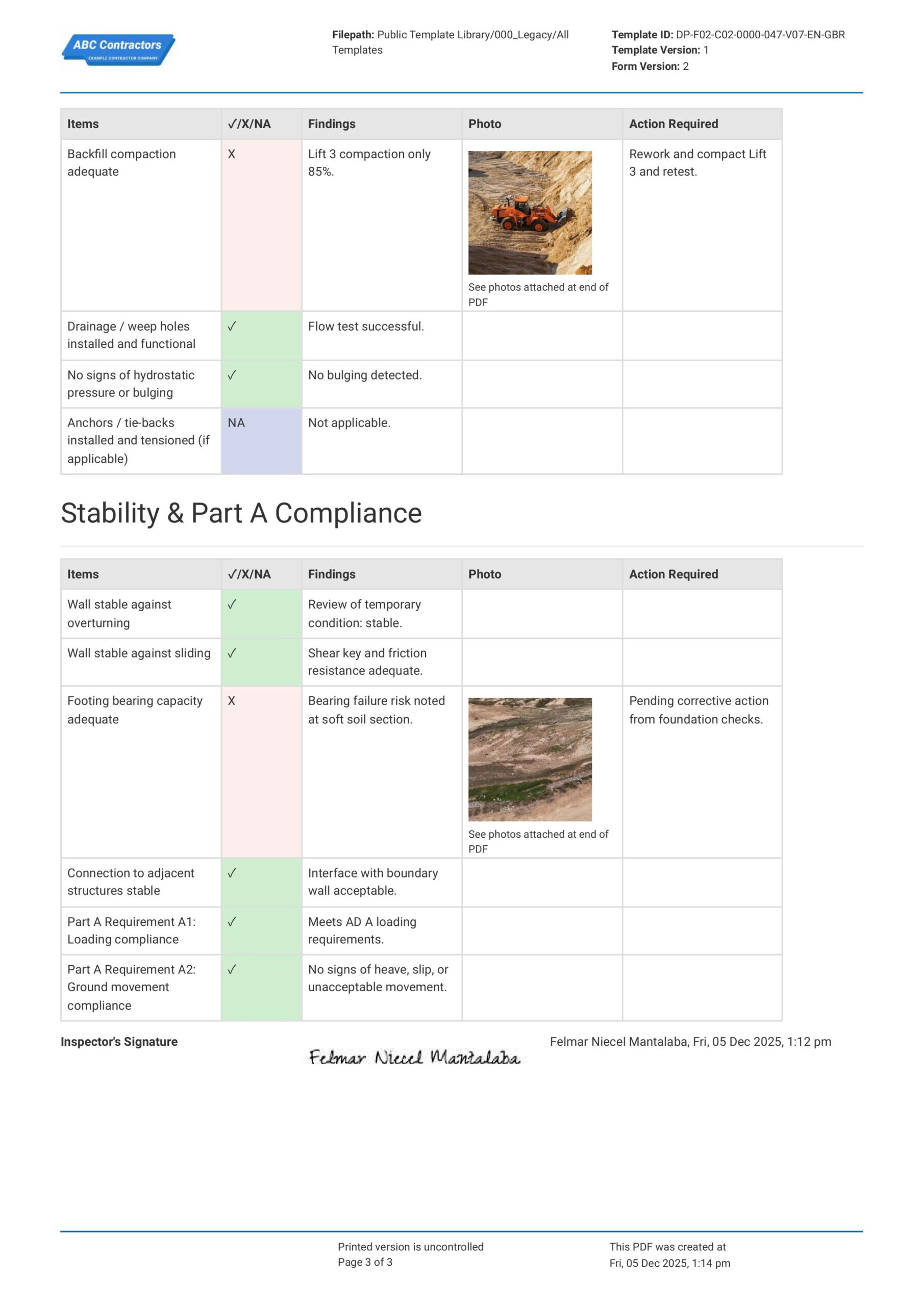
A Retaining Wall Inspection Report is a form useful for inspectors to check the integrity of a building’s retaining walls. They use this report to make a comprehensive assessment of the wall and its components and see if it aligns with the proposed design and regulatory requirements, such as the Approved Document A and British Building Regulations. These inspections will provide the necessary stakeholders with what they need to correct in order to commit to the approved design and UK Building regulations.
Compare this Retaining Wall Inspection Report to paper-based forms created from Word, Excel, or PDF
Use this Retaining Wall Inspection Report template for free.
What should be in a retaining wall inspection?
A retaining wall inspection is a critical procedure that ensures that the wall meets the design specifications and Part A regulatory requirements. However, this can only be achieved if the inspection form contains the right content. To conduct a successful inspection, here are the contents that should be found in the form.
Project information
The inspection form should clearly display the project information. Having complete project information provides stakeholders an overview of what the project is for, who designed the project, where it will be constructed, and who’s going to construct it. When conducting an inspection report, providing these key details about the project ensures that everyone has the necessary context.
A checklist on design and regulatory requirements
Conducting inspection reports primarily aims to verify whether the proposed design adheres to UK regulations and building requirements. The design review form must integrate all regulatory mandates from approved document A, building regulations, and British Standards 1990–1999 Eurocodes to assess compliance with these regulations. To build the structure with the expected integrity and performance, these requirements must be met.
A review on calculations and drawings
Drawings and calculations are the backbone of constructing a building. The calculations will serve as a reference for the specifics of structural members and parts, while drawings will serve as a guide for contractors and subcontractors when building the structure. The inspection report must include a review of these calculations and drawings to ensure they are error-free and completely illustrated.
A quality check on the materials to be used
Good ingredients make delicious food. This universally understood concept also applies to making buildings, since using quality materials makes a sound and sturdy building. The UK government wants to ensure that constructed buildings are of the best quality to ensure the safety of their occupants and their surrounding neighborhood. To achieve this, the inspection report must include a quality examination of the construction materials.
An assessment for the required documents
Audits request these documents because they serve as proof that the proposed design adheres to UK regulatory standards and requirements. To avoid any nonconformance, the completeness of these documents is a requirement; that is why they need to be included during the design review.
Qualifications of a retaining wall inspector
The quality of a Retaining Wall Inspection Report heavily depends on the inspector. The inspector needs to have knowledge of engineering theories and UK building regulations to effectively assess if the built retaining wall passes standards. Given this, it is strongly recommended that retaining wall inspectors possess a civil or structural engineering background.
The retaining wall inspector must also have extensive knowledge and certification in nondestructive testing (NDT). NDT is an analysis method used to evaluate properties of a structure, material, or component without causing damage to it. Inspectors with skills in NDT can provide more accurate and specific data when assessing structural members, such as retaining walls.
Retaining wall inspection requirements
Regulations must always come to mind when constructing a building. Regulatory bodies fabricate them to ensure safety, integrity, and peace of mind from the initial stages of a building's construction until it is fully constructed and operational. These provisions are also so specific that they provided standards for every structural member of a building, including retaining walls. In the UK, the following regulatory bodies provide the requirements for retaining walls.
Local Authority Building Control (LABC)
The LABC is the main regulatory body that inspects if the building is compliant with the UK Building Regulations 2010, especially with Approved Document A. The regulation covers building stability, ground movement, and controls for a collapse. The main purpose of the regulations is safety, which focuses on the prevention of hazardous and deadly building collapse.
Local Planning Authority (LPA)
The Local Planning Authority focuses mainly on how a building affects the neighborhood. A building’s retaining walls can somehow alter the landscape of the surrounding area. It can change ground levels, affect privacy, and even overshadow some properties. To prevent buildings from disturbing the peace in the area, the LPA has provided requirements to control aesthetics, land use, and effects on the surrounding area.
Highway Authority
The UK Highway Authority focuses on ensuring public safety on the highway. They want to ensure that drivers, civilians, and pedestrians on the highway are free from hazardous circumstances, like from a retaining wall collapse. They mandated that the retaining walls must remain stable and not undermine the road foundation. This mandate brings us back to the Approved Document A requirements, where a building or structural member needs to be designed to avoid collapse.
Frequently Asked Questions
Why is this the best Retaining Wall Inspection Report template?
Sitemate's Retaining Wall Inspection Report is a reliable template for retaining wall inspections. Used by thousands of construction and civil engineering teams, it is built to follow industry best practices and is straightforward for any worker to use, on-site or in the office.
Is this template compliant with UK Building Regulations standards?
Yes – this template is fully configured to comply with UK Building Regulations, including Part A structural requirements, and relevant safety legislation. It is trusted by certified contractors in the construction and civil engineering industry to maintain compliance and uphold regulatory standards.
Can I edit this Retaining Wall Inspection Report for my project or company?
Yes – the template is fully editable with simple drag-and-drop functionality. You can create custom document setups using tables, formulas, sketches, photos, and more, while adding your company logo, headers, and structure—all powered by Dashpivot’s template builder.
On what platforms can the Retaining Wall Inspection Report be accessed?
This template works seamlessly across computer, mobile, and tablet, allowing you to complete Retaining Wall Inspection Reports on-site or in the office. Records can be generated or exported as PDF or CSV, combining the flexibility of Word, Excel, and modern software.

Other popular templates you can use and edit for free
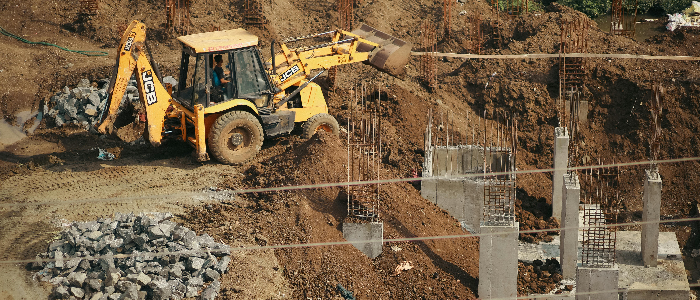
Ground Condition Report
Examine the soil and ground conditions thoroughly and correctly before beginning construction.

Retaining Wall Inspection Report
Verify if the retaining walls and their elements are within the permitted design limitations and comply with UK Building Regulations.

Framing Inspection Checklist
Ensure that the framing elements are built with the highest quality and comply with UK regulations.

This Inspection Report was generated with Dashpivot
Ensure a building's structural parts meet design and UK regulatory criteria. This Part A Structural Inspection Checklist enables stakeholders to quickly identify problems in the structural design, resulting in immediate decision-making and correction.
- Complete, edit, and review the Retaining Wall Inspection Checklists on any device.
- Export reports as perfectly formatted PDF documents with your company logo.
- Invite internal and external parties to see, edit, and review the inspection forms online.
- Include any relevant attachments to provide more extensive information on the findings.

Sitemate builds best-in-class software tools for built world companies.

 English (United States)
  English (Australia)
  English (UK)
  English (New Zealand)
  English (South Africa)
  German