Risk Assessment for Demolition Template

Start with a free 30-day trial. No credit card required.
This downloadable Demolition Risk Assessment is readily available to help you effectively manage safety risks on your demolition projects. It has all the standard features of a demolition risk assessment, ensuring your projects are regulatory compliant. It is equipped with a user-friendly interface, easy-to-fill-out fields, and a quick review process.
Want your demolition risk assessment updates to be recorded? This Demolition Risk Assessment automatically tracks and saves the changes and updates made on existing risk assessment forms. Be always audit-ready with real-time updates, maintain transparency, and save time when referencing old records.
 100% fully editable Risk Assessment for Demolition
Export your Risk Assessment for Demolition to PDF or CSV
Access Demolition Risk Assessment on mobile, tablet or computer
Trusted by companies, projects and teams of all sizes















What is Risk Assessment for Demolition?
A demolition risk assessment is a safety planning document that evaluates possible dangers during the demolition activity and provides the necessary safety controls to mitigate or eliminate them. This evaluation should be completed before any deconstruction or structural alterations begin, and it should be revisited on a regular basis while the project develops.
With a risk assessment, all inherent dangers of a demolition job are effectively controlled, ensuring a safe activity from start to finish.
Preview this free Risk Assessment for Demolition
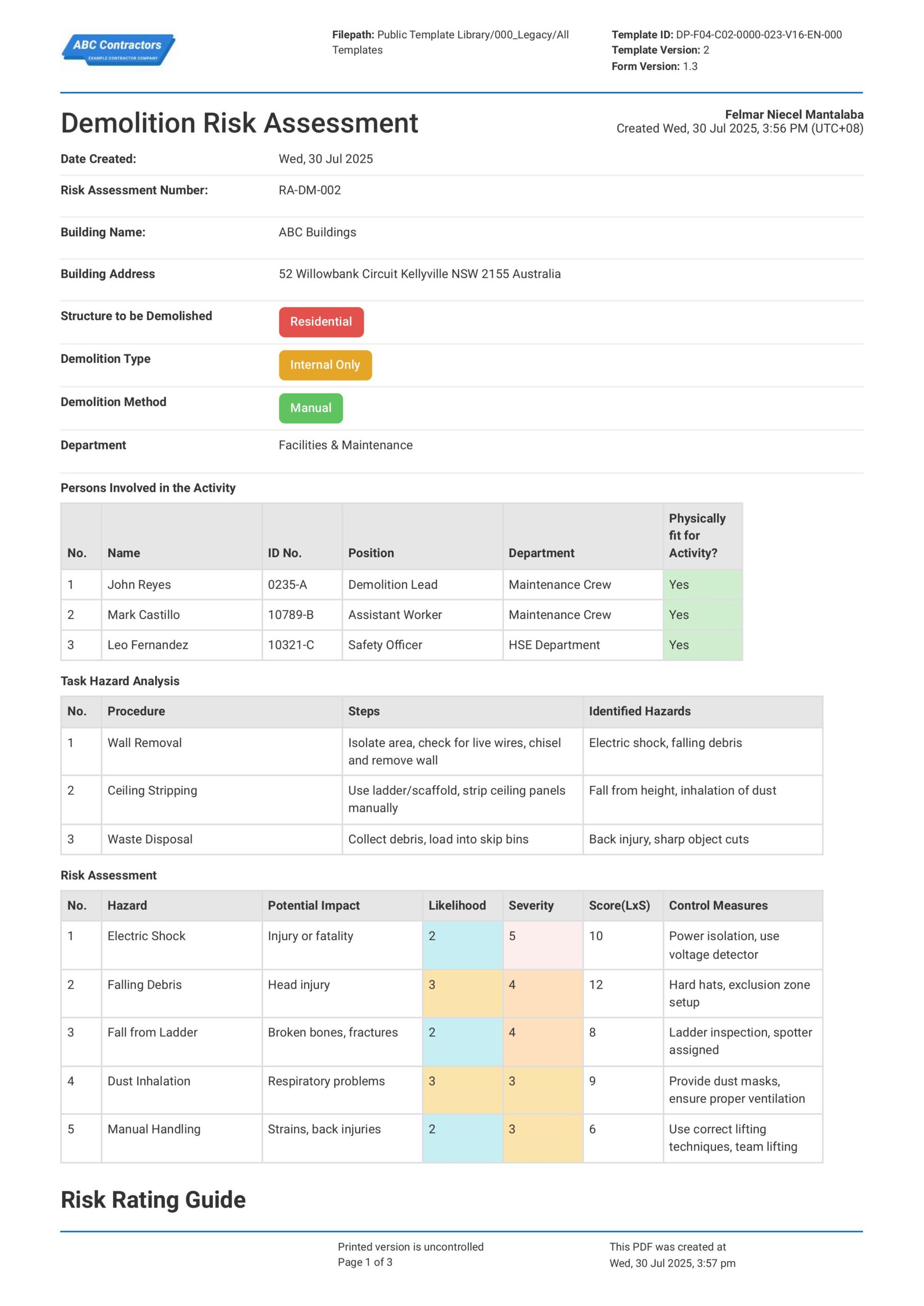
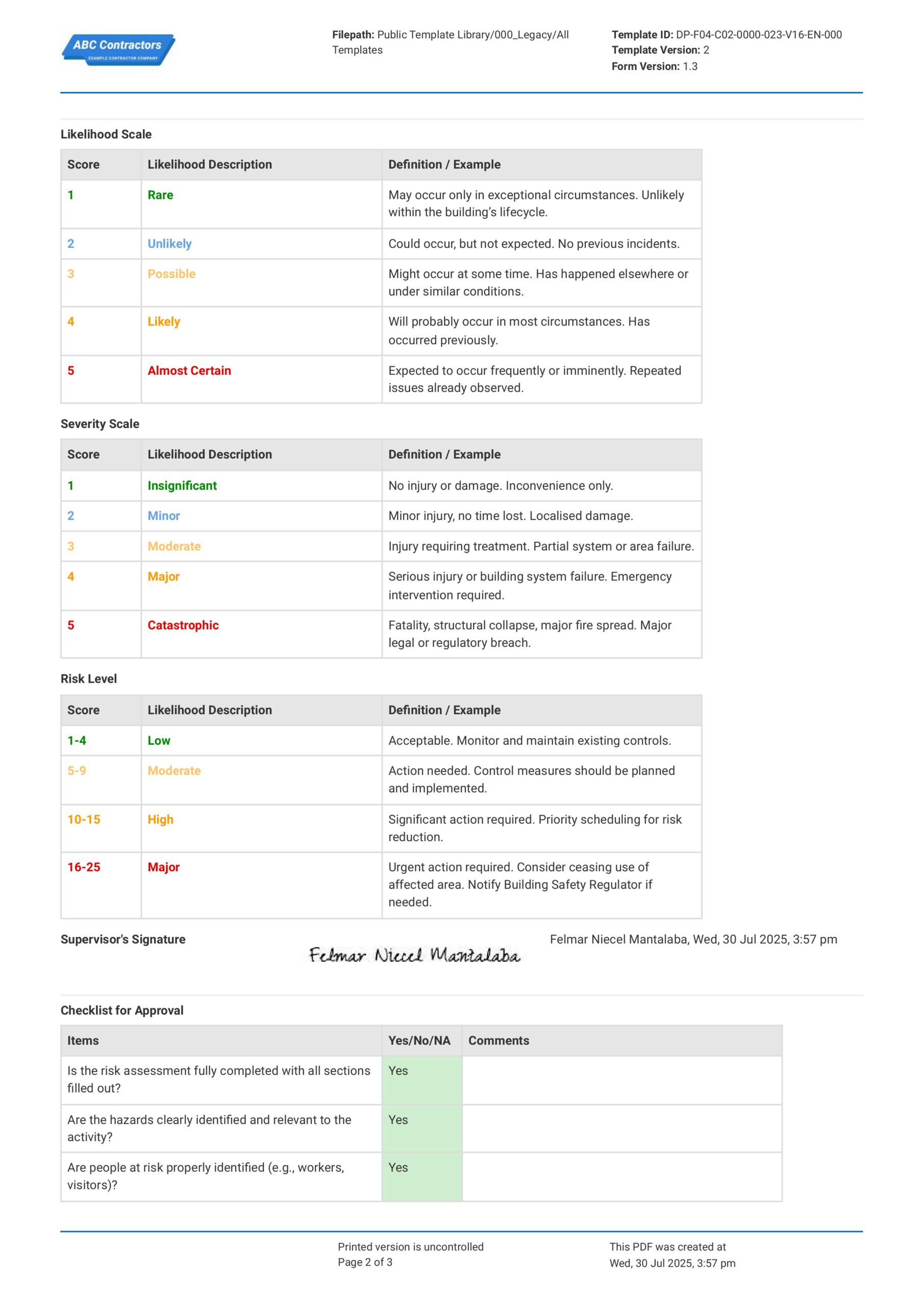
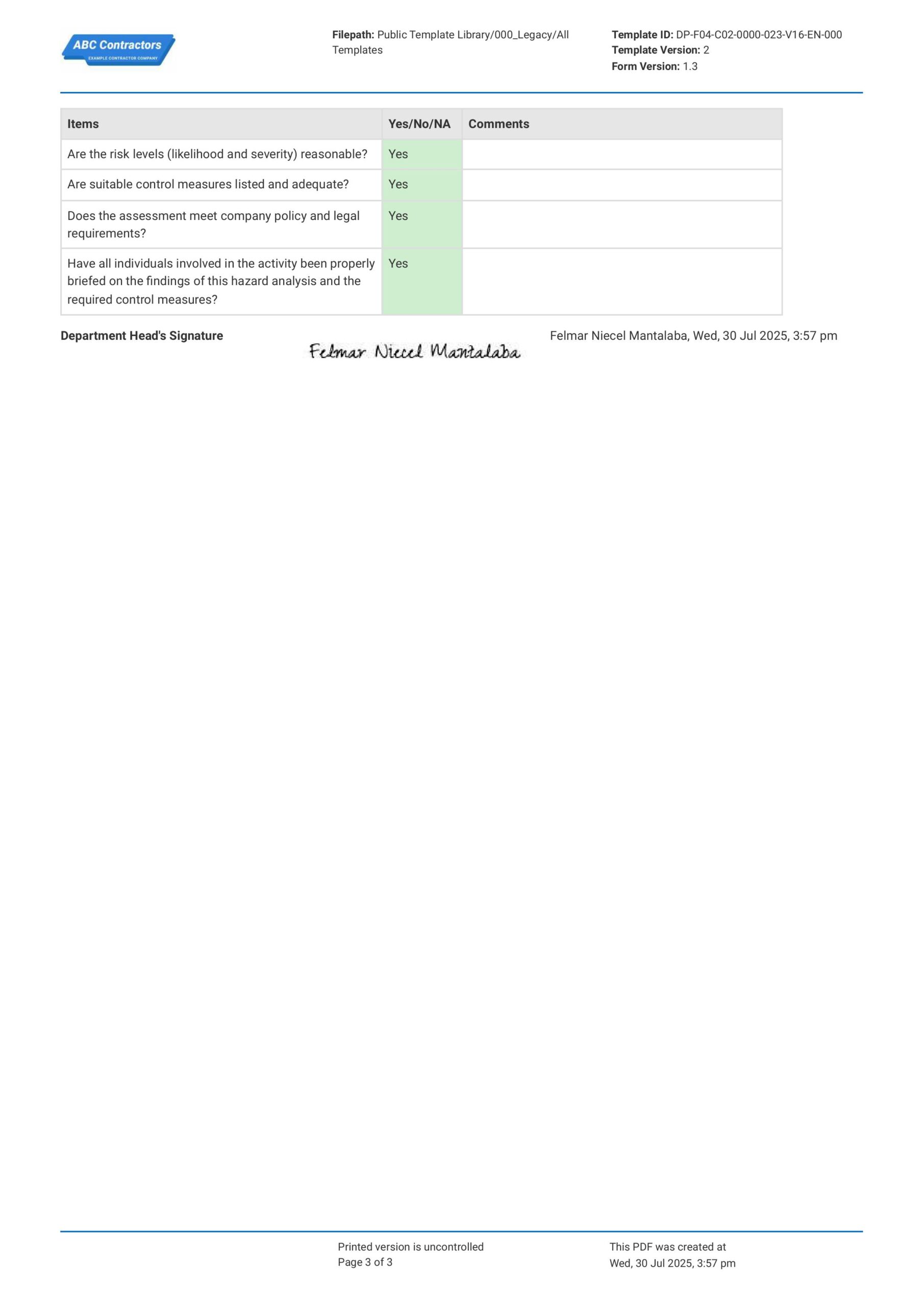
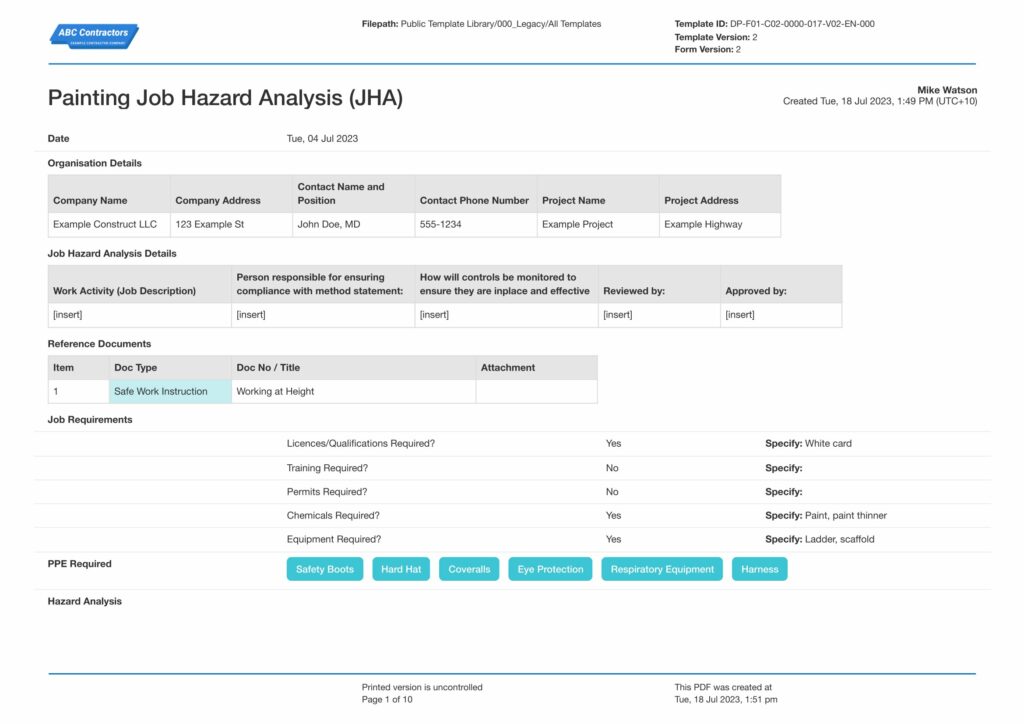
Preview this Risk Assessment for Demolition below and see how it's so much easier to create and navigate the form.
Using paper-based forms slows down the risk assessment process. These manual forms require a substantial amount of time to create and complete, however, this digital example below integrates modern approaches in creating, completing, and storing forms. To find out more, visit the pdf example below.
Use this Risk Assessment for Demolition template for free

Generate this template automatically with Storm
You don't have to build the Demolition Risk Assessment Process field by field. Let Storm, the AI Data Capture Agent inside Dashpivot, build the template for you in seconds.
Describe what you need
Tell Storm the form you want in plain language and it builds a structured digital template from scratch, with fields, tables, and signatures in place.
Upload what you already use
Drop in your existing PDF, Word, Excel, or even a photo of a paper form. Storm rebuilds it as a smart digital template with the structure intact.
 Storm
Storm
Generate a Demolition Risk Assessment Process form template that I can use for my business
Applicable Standards and Policies for Risk Assessment for Demolition
Demolition activities are well-known high-risk activities worldwide. Considering all the inherent risks and hazards of the activity, safety regulatory bodies worldwide have published mandates and provisions to ensure that personnel and assets are well protected while conducting these activities. One of the mandates required by these regulatory bodies is the integration of the risk assessment process in the safety management system.
- United States of America—The Occupational Safety and Health Administration (OSHA) sets the required safety standards in the United States. OSHA 29 CFR 1926 Subpart T-Demolition provides the guidelines and requirements for demolition activities in the USA. It includes the implementation of a comprehensive risk assessment process.
- Australia—Standards Australia is the body responsible for setting safety standards in Australia. AS 2601—Demolition of Structures is the regulatory mandate that provides the legal operation and planning requirements for demolition activities. Additionally, the Model Code of Practice: Demolition Work provides guidelines on the procedures for identifying and controlling hazards.
- Canada—The Canadian Standards Association (CSA) enforces safety regulations in Canada. The CSA, along with the local legislation in Canada, requires demolition works to implement correct and proper safety control measures when conducting demolition works.
- United Kingdom—The Health and Safety Executive is the UK’s primary safety authority. The Construction Regulations 2015 (Design and Management) define the legal framework and regulations for demolition works. The framework includes planning, requirements for risk assessments, surveys, procedures, and temporary works.
Staff Members and Parties that use Risk Assessment for Demolition
The Risk Assessment for Demolition would be considerably improved if everyone involved in the activity participated in the process. All activities would be thoroughly risk assessed and furnished with the needed and vital safety precautions. Ideally, the following individuals are needed for the risk assessment procedure:
- Field Workers: These are the people who conduct the demolition activity. It is their job to meet daily targets and take appropriate safety measures. Integrating appropriate safety management systems is critical to ensuring the safety of all procedures in the demolition activity, notably from structural hazards that could endanger these personnel’s lives. Involving these individuals in the risk assessment discussions would speed up the process of determining which demolition procedures require safety measures.
- Field managers and supervisors: They oversee operations on the ground. They supervise and oversee the construction personnel. As leaders, their major responsibility is to assure the safety of all operations, from start to finish. To achieve 100% safety, they must lead the risk assessment session and bring together all relevant individuals to help identify, evaluate, and control dangers.
- Safety Officers: The safety officer’s primary responsibility is to guarantee that workplace safety rules are followed correctly. They establish guidelines for what is and is not safe. They assess the control systems for tasks involving high-risk building operations. Safety regulators would most likely require the risk assessment to complete their reviews and determine which current measures are in place. These evaluations are crucial since they determine how effective the controls are.
Business Risks Reduced by Risk Assessment for Demolition
The Demolition Risk Assessment protects people from risk and harm. However, this form also safeguards the corporation from commercial hazards that may threaten its financial position and reputation. To prevent the business from collapsing due to such hazards, management must adhere to safety protocols, which is why a Risk Assessment for Demolition is critical. Regular risk assessments can help prevent the following business risks:
- A greater probability of incidents at work, resulting in a higher Lost Time Injury Rate (LTI).
- Medical costs and violation of regulations that prompt financial strain.
- Disrupted operations result in output losses and missed targets.
- Damaged reputation
- Poor trust between employees, employers, and stakeholders.
- Loss of qualifications and accreditation.
Business Opportunities Created by Risk Assessment for Demolition
A corporation would benefit from doing Demolition Risk Assessments on a regular basis. It protects employees and assets while improving the company’s overall reputation. Companies that conduct regular risk assessments prevail over those that do not, contributing to fewer accidents and equipment downtime. Furthermore, it opens up the following possibilities for the company:
- Competitive advantage in bidding.
- Improved cost savings.
- Long equipment and machinery lifespan.
- Better insurance terms.
- Increased gains and output.
Demolition Work Risk Assessment Procedure
A risk assessment is a procedural activity that helps you identify hazards and provide the appropriate controls. To effectively construct a risk assessment, here is an example of the procedures you can integrate into your workflow.
- Determine who is involved
- Analysis of Task Hazards
- Evaluation of Risk
- Review
Demolition works risk assessment: Demolition Hazards
Demolition is inherently a dangerous activity. Personnel should be well versed and aware of all the hazards that come along with this activity to help them use the provided safety controls responsibly and efficiently. Here are some common hazards that demolition projects present.
Structural Failure
Structural failure can often occur when a demolition project is not carefully planned. When workers demolish critical building structures—structures that play a critical role in holding loads—poorly, other parts can topple over. This situation can be very dangerous, especially if the whole building collapses. An administrative control measure in the form of a safety procedure can effectively counter this situation.
Asbestos
Asbestos is a heat-retardant material used in buildings for insulation. However, when you demolish or damage these materials, they release microscopic fibers that, when inhaled, can cause serious, permanent damage to your lungs. Including these variables in the risk assessment can prepare the personnel to wear the correct PPE before demolition.
Falling Objects
Demolition, in its essence, is the deconstruction of a structure. Given this, it’s reasonable to anticipate that undertaking this activity on taller buildings will inevitably lead to falling hazards. Materials that can fall during demolition range from objects as small as grains to large boulders, like slabs, which can critically injure someone if they are struck. A risk assessment can effectively isolate areas where fall hazards are present by implementing proper controls.
Electrical Shock
Buildings contain numerous electrical components and wires. If not managed properly, demolition personnel can electrocute themselves, which can cause second- to third-degree burns or cardiac arrest. These hazardous components must be properly identified and managed through a risk assessment to avoid such unwanted outcomes.
Steps in creating a Risk Assessment for Demolition
This is a complete instruction for creating an effective, thorough, and compliant form for assessing risks in demolition activities.
Prerequisites for creating a Risk Assessment for Demolition
- Determine the activities and personnel involved in the demolition operation.
- Set frequency and schedules for risk assessments.
- Establish risk assessment parameters and methods.
- Define the duties and assignments needed to complete the evaluation.
- Establish legal criteria and document standards.
Procedure review for Demolition Risk Assessment
- Gather all staff who will participate in the demolition activity.
- Examine all existing processes, safety, and health safeguards.
- Provide an orientation to conducting and performing risk assessments.
- Determine all of the required equipment, tools, and machines.
- Conduct a work environment inspection.
Drafting the Risk Assessment for Demolition
- Include a spot to record vital information about the activity.
- Make a section to record all of the participants in the activity.
- Create a section dedicated to job hazard analysis.
- Implement a risk-scoring system or matrix.
- Include a risk assessment table.
- Include a checklist to ensure that the form is complete and accurate.
Providing the risk score
- Make an evaluation system for hazard likelihood. Make sure the scoring system is qualitative and scalable. For example, rate the probability of the hazard occurring on a scale of 1 to 5.
- Create a system for assessing the degree of impact. Make sure the scoring system is qualitative and scalable. For example, use a 1 to 5 scale to assess the hazard’s potential severity.
- Create a legend that represents the risk score. It should include the overall risk score, which is computed by multiplying the hazard’s likelihood and severity.
Implementation and review
- Ensure that all of the data in the form is complete and validated.
- Implement the safety control measures.
- Create schedules for safety control monitoring.
- Create a schedule for form review.
Frequently asked questions
How to create Demolition Risk Assessment Process in an App or Software System
A digital Demolition Risk Assessment from Dashpivot should quickly and effectively provide safety measures for the demolition activity. This integration of selection lists into tables and automatic calculations guarantees that forms are completed quickly and efficiently, which speeds up the implementation of safety measures.
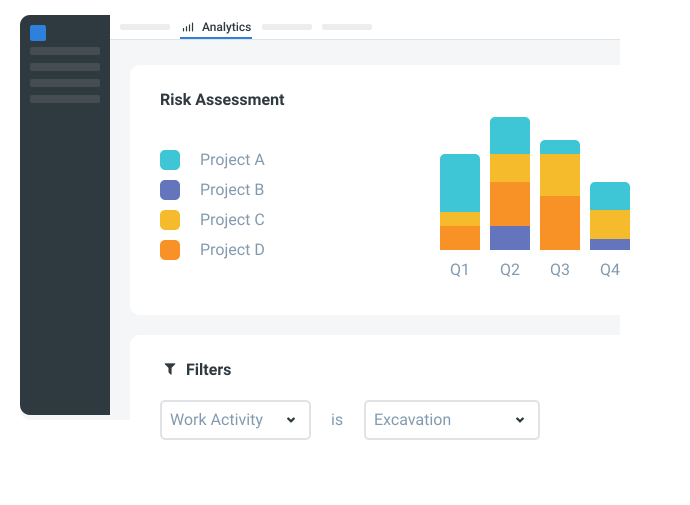
Furthermore, adding automated reporting capabilities enables managers to identify trends in safety issues across several locations, whereas regulatory compliance dashboards provide real-time access to assessment completion rates and pending corrective actions.
30 mins
Medium difficulty
How to create a Demolition Risk Assessment in an app?
Using an app that uses digital forms instead of paper-based forms significantly enhances the form because:
- Creating a single saving point for all produced forms.
- Less manual data entry
- Easy reformatting to accommodate new protocols or updated standards.
- Faster photo and data integration.
- Develop a more defined workflow.
Creating the information section
A Risk Assessment for Demolition Operation form must include the following information fields:
- Date created
- Risk assessment number
- Equipment model
- Equipment specifications
- Department
Creating the persons involved in the activity section
This section provides information for all personnel involved in the activity. The table’s column headers should be as follows:
- Name
- ID number
- Position
- Department
- Proof of physical fitness. The confirmation column can be combined with a yes-or-no list and color-coded for a more professional and appealing appearance.
Creating the task hazard analysis section
This section helps users identify the hazards by investigating the possible hazards for each procedure in an activity.
- Create a 4-column table where users can add rows as needed.
- The first column should display the numeric order of each row.
- The second column should allow users to provide the activity’s procedures.
- The third column should allow users to input the steps of each procedure.
- The fourth column is where all identified hazards in the procedure are placed.
Creating the risk assessment section
The most important aspect of the form is developing the risk assessment section, which is where potential hazards are examined and suitable control measures are implemented.
- Create a 7-column table that allows users to add rows as needed.
- The first column should show the numerical sequence of each row.
- The second column should allow users to enter the identified hazard.
- The third column should allow users to specify the potential impact of the risk.
- The fourth column should allow users to rate the likelihood of the hazard. This fourth column could be included in a list of the digits 1–5. Each choice can be assigned a color to help immediately identify how likely the threat is to occur.
- The fifth column should allow users to specify the intensity of the hazard. This column can be shown as a selection list of the digits 1 through 5. Each selection can be assigned a color to aid in quickly identifying the hazard’s criticality.
- The sixth column should provide the hazard’s risk score. Automate the risk score calculation using the following formula: Risk Score = Likelihood x Severity.
- The final column should allow users to specify the appropriate control measure for the danger.
Creating the guide
This section of the Risk Assessment for Demolition form serves as a guide, assisting users in scoring the hazard. The section should include the following elements:
- Likelihood scale
- Severity Scale
- Risk Score Level
Creating the Likelihood and Severity Legend
- Make a table with 5 rows and 3 columns.
- The first column should show the scale’s likelihood or severity level, which is ranked from 1 to 5 in each row.
- The second column should contain a description of each level in the scale.
- The third column should include a definition or example of each level on the scale.
Creating the Risk Score Level Legend
- Make a table with 4 rows and 3 columns.
- The first column should provide a range of equivalent scores. (1-4, 5-9, 10-15, 16-25)
- The second column must include the description of each range.
- The third column should include a definition or example for each range.
Creating the checklist for approval
This part validates that all risk assessment processes are accurate and complete.
- Create a table with three columns.
- The first column should include all of the checklist elements.
- The second column should be a yes-or-no list in which users can indicate whether or not they have completed the checklist items. This column can also be color-coded to make affirmations simpler to recognize.
- The third column should allow the form reviewer to leave comments.
Adding the signatories section
This section validates the form. The Demolition Risk Assessment form requires the following signature fields:
- Supervisor’s Signature
- Manager’s Signature
About the author

Felmar Mantalaba
Engineering Content Writer

Education:
Cebu Institute of Technology - University - Mechanical Engineering with Mechatronics
Bio:
Felmar is a mechanical engineer, whose four years of experience in the mining industry inspired him to write and share stories to progress the revolution of new technologies and create smarter, smoother ways of living.
Project Details:
Safety, Health, and Environment Management System (SHEMS) Coordination
SHEMS Coordinator at Atlas Consolidated Mining, ensuring organizational compliance with ISO 14001 and ISO 45001 standards, performing risk assessments, developing policies, and conducting audits and inspections to maintain a safe and environmentally responsible workplace.
Maintenance Management and Optimization
Senior Maintenance Manager (OIC) leading equipment maintenance and operational efficiency initiatives, reducing downtime by 10%, improving Mean Time Between Failure (MTBF) and Mean Time To Repair (MTTR) for major equipment, and managing maintenance schedules, manpower, and materials, while overseeing capital project optimization.
Inspection Engineering and Equipment Reliability
Inspection Engineer responsible for technical blueprint interpretation, vendor collaboration, preventive maintenance scheduling, and data collection for vibration and temperature readings, delivering actionable recommendations and comprehensive reports to improve equipment reliability and operational performance.
End-to-End Operational Oversight in Mining Engineering
Contributed to multiple facets of operational management, including SHEMS compliance, maintenance optimization, inspections, and capital project evaluation, integrating safety, reliability, and efficiency improvements across all stages of copper production operations.
Version History:
Other popular templates you can use and edit for free
This form was generated with Dashpivot software
- Access, edit and complete your Demolition Risk Assessment Process from any device - mobile, tablet or computer.
- Print, download or send your Demolition Risk Assessment Process as perfectly formatted PDF documents with your company logo.
- Store your Demolition Risk Assessment Process securely online, where they can be searched and found in seconds
- Invite internal and external parties to see, edit and sign off on Demolition Risk Assessment Process online.
 English (United States)
  English (Australia)
  English (UK)
  English (New Zealand)
  English (South Africa)
  German