Conversational Data Capture
Prefer to listen? Here's the audiobook version.
Preface
Since the beginning of the construction and built world mobile tech era, which began shortly after the release of the first few versions of the iPhone, and then the iPad, every technology company in the built world has been telling themselves lies, including ourselves here at Sitemate.
And this lie goes all the way back to what Sam and I believed when we first got started on this journey.
We've been telling ourselves, all of the software and tech vendors that is, that a nice streamlined app, a polished and ever so "easy to use" interface, would obviously progress the industry forward in leaps and bounds.
With all of our streamlined UX, lots of logic, required fields, formulas, groups, offline mode, marking up of photos and the like, how could we not have transformed the operations of sites across the world?
It's obvious right? Right?!
Stock imagery like the below example became the poster child of "mobile tech in construction", some 'intelligent looking' bozo(s), usually a white dude(s), standing on a site with a suspiciously clean high vis vest overlain on top of a collared shirt, or a polo shirt, holding a tablet (of course WITHOUT a rugged protective case), with a smug smile and eyes gazing out into the distance.
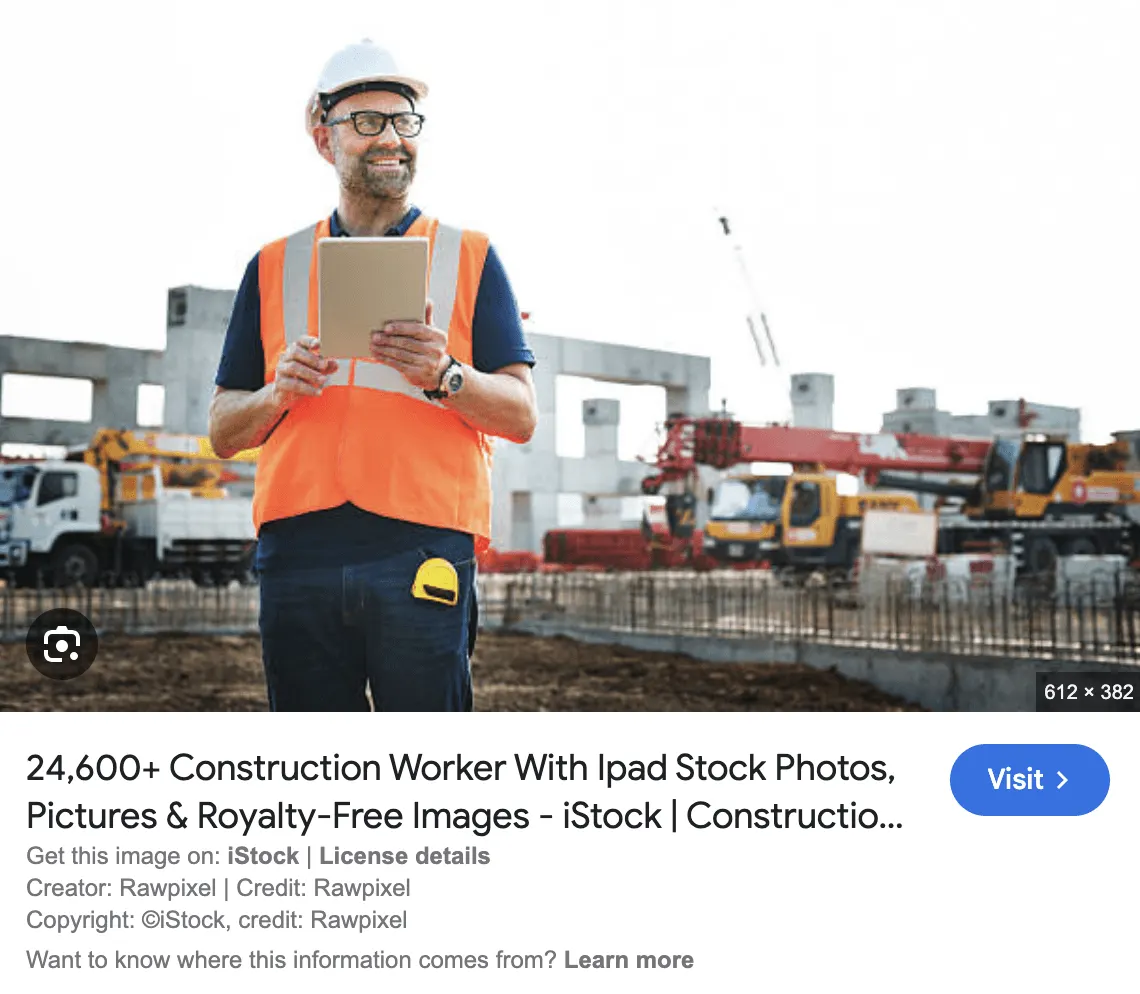
And of course, there's parts of this portrayal that have turned out to be true, we have seen many people adopt this new way of working in the last 15 years or so, where they are creating and accessing information directly from site.
But in reality, the percentage of people that have successfully made the jump into even the digital collaboration era, let alone the AI era, if you include all of the people on site, management and workforce alike, is still quite small.
This is not a critique of any vendor, including ourselves, it's just the best we/any of us could do for construction and the built world with the technology (both hardware and software) that was available during this prior period.
It was just the most convenient way to execute a fundamentally inconvenient (most of the time) yet required task, as you're trying to go about your day as a worker in the built world.
Until now, until the AI era begun.
The Disconnect (Excuse The Communication Pun)
I've been hearing about a disconnect from our users and customers for years, I think I mostly just refused to believe it was really still true.
I kept telling myself that digitizing the paperwork would be enough.
I didn't want to believe that this couldn't be true, because that would have been a narrative violation in my own mind as to what we had been working on, and building, all this time.
But with the arrival of the AI era, and the drafting of The Sitemate Manifesto, I realized that I was holding Sitemate back by fixating on the what we were doing instead of the why we were doing it.
Or, in other words, I was too focused on the how we were currently solving certain problems, instead of working backwards from the problem, and ensuring we construct a solution from first principles, with the latest technology available, to ask - how could we solve these problems for our users and customers now?
The UX vision laid out in Zero Click Forms was the first major move in this direction, post the publishing of The Sitemate Manifesto, and we've now seen the impact of it being delivered through the launch of Storm 1.0 as a Data Capture Agent designed specifically for the front line of the built world, and it's AI Form Fill feature.
Des Traynor, one of the co-founders from Intercom, the creators of the support agent Fin, said it best.
When you have a platform shift, it forces you to go back to fundamentals.
The rules change for everyone.
But, the one thing that typically doesn't change is your customer's Job To Be Done.
You've just got to figure out how to help them achieve their Job To Be Done in new ways, faster, cheaper, with higher quality, a better overall experience.
So, as we enter the AI era - and with the Zero Click Forms vision now delivered, why is there still a disconnect? And what is it?
Language And Literacy
The first major disconnect is that the people closest to the work - the ones who actually know what happened, what is happening, what is and isn't working on site - are very often the people least able to, or without enough time to, write it down.
A large proportion of the front line workforce is illiterate, or doesn't speak English as a first language, or both.
Many can't comfortably read a form in their own native language, let alone fill one out in a second.
And yet, the entire set of available apparatus for reporting, compliance, proof, or documenting "the records", assumes that the person with the information will actually sit down and translate it into neatly structured fields, on either paper or digital, it doesn't really matter at this stage!
In other words - many of these people would be much better off if they didn't need to interact with a system at all, or at least much less than what they do right now.
In my blog Taking AI To The Front Line, I told the story of Caleb, a Safety Manager whose workforce largely spoke only Spanish and many of whom couldn't read or write even in their own language - so that something as basic as an incident report could spiral into chaos.
That one conversation crystallized my Conversational Data Capture vision;
Sitemate is bringing to life a world where a worker can be chatted through, intentionally guided through, or called and conversed through a report, record or form in their own language, and a clean record is delivered out the other side automatically.
The Environment
The other half of the problem is the work itself.
The built world doesn't happen at a desk.
It happens with gloves on, in the rain, in the noise, with reception dropping in and out, across multiple parties and languages, while a foreman is trying to get a crew moving and the project manager is trying to get ten things done before 7am.
Paper was a bad fit for that environment, everyone knows this already.
Digital forms, if we're honest, were only a marginally better fit in many cases - we took the same act of stopping, looking down, inscribing data in, and we moved it onto a pane of glass.
Sure, digital form interfaces solved the latency problem with transferring data from site to office, and they solved the data cleanliness and quality problem.
But, all of this is only solved when the software and apps were actually picked up and used, used well, used correctly, or could even be accessed and used at all.
Admitting this required practising intellectual honesty, which was not a fun journey. But, it was a necessary step in order to open up one's mind during a fundamental re-platforming event that is destabilizing the entire technology sector.
Why Conversational
Conversation is the oldest interface in the built world. Long before the clipboard, work was coordinated by people talking - a foreman briefing a crew, a worker calling in a problem, a supervisor walking a site and describing what they saw.
The paper form didn't replace that. It just sat awkwardly on top of it, demanding that the messy, spoken, in-the-moment reality be re-packaged into something that someone could give someone sitting in the back office, so that they could in turn double and triple handle the data, and either file it away in a filing cabinet, or scan it to PDF and drag and drop it in the abyss of a set of nested digital folders.
And it never stopped. Walk onto any site today and the real coordination is still happening in conversation - over the two-way radio, on the phone between the site office and the crews, in the endless back-and-forth of email between contractors and consultants, and increasingly in the WhatsApp group that half the project actually runs on.
The mention of WhatsApp in this blog is not random: WhatsApp now has more than three billion monthly users, and in the markets that supply much of the built world's workforce- India, Brazil, Mexico, Indonesia and across the Gulf - it isn't one app among many, it's the way people communicate.
The form was never where the truth was created; it was just where a sliver of it was eventually, reluctantly, written down.
Most of the conversation, and in turn most of the signal - still never makes it into the system of record at all.
The Paradigm Shift
What's changed is that the machine can now hold up its end of a conversation.
It can listen, ask a sensible next question, follow the thread, handle a tangent, and quietly turn the whole exchange into structured data as it goes. That turns conversation into a third method of data capture - sitting alongside manual data entry and hardware telemetry - except this one fits the way people already behave.
Three things make it more than a novelty.
- It's natural: Nobody has to be taught how to describe their day. A worker who would never complete a forty point checklist will happily tell you what happened if you just ask. The cognitive load of "translating reality into fields" disappears, because the system does the translating, both in terms of language, as well as data entry.
- It's reachable: A conversation can happen in any language, over any channel, with anyone - including the people forms have always struggled to reach. The subcontractor who isn't in your system. The labourer who was hired at 7pm last night. The operator whose first language is Mandarin. You can collect someone's details over the phone, in their own language, and have them partially or fully verified before they get there, so that once they do - they can get to work faster.
- It's robust: Speaking survives the conditions that defeat typing. You can talk with gloves on, while you're walking, while you're looking at the thing you're describing rather than down at a screen. A spoken account, a few photos, a short video - these often carry more real signal than a perfectly completed form ever did.
The form asked the human to do the hardest part, but now, Conversational Data Capture gives that part back to the machine.
Shifting From Retrospective Data Entry, To A Real-Time Front Line Thought Partner
As we've entered the AI era, my vision for how data capture, workflow execution and information management work in the built world has fundamentally shifted.
To me it no longer looks like those bozos from the stock images above in the Preface section, all clean and fancy looking on site, using an iPad without a case!
The new world looks natural, which for the built world often means messy and gritty, it's fluid in it's nature, it's multi-channel, it's still in-app some of the time, but it's also lot's happening out of app.
The digital form interfaces may end up being imperfectly used by traditional standards, used less, or in some cases not even used at all!
It's imperfect against traditional software standards, but maps perfectly for the chaos of the front line of the built world.
But there's a deeper layer to this shift than where and how the data gets captured - and it starts with an uncomfortable truth about most of the paperwork in the built world.
In most cases, it's a tick and flick exercise.
The pre-start gets ticked in thirty seconds without anyone looking up from the page. The checklist gets completed from memory, in the ute, after the fact. The form is something you do to the work - a ritual performed to prove the work happened - not something that genuinely helps you do the work safely or well (most of the time, and for most people).
And everyone knows it. The safety manager knows it, the supervisor knows it, the worker filling it out knows it. The form was never really a thinking tool; it was an evidence tool. The thinking - what are the risks here, what's changed since yesterday, what would an experienced set of eyes notice about this job - was always supposed to come from a person. And there was never enough of that person to go around.
Every safety manager has had the same dream: what if I could stand next to every worker, on every task, all day - walking them through the risks, prompting the question they didn't think to ask, catching the thing they walked straight past?
One expert, forty workers. It was never possible. So we settled for the form: a static, one-size-fits-all stand-in for an expert who couldn't be everywhere at once.
Conversational data capture is the first time that dream is actually on the table - and it's exactly what separates this step from the last one.
Zero Click Forms, delivered through Storm 1.0, made the old model radically faster: you did the work, and the record assembled itself from the evidence. A huge leap - but still an acceleration of the same pattern.
This step changes the kind of thing Storm is. When the capture is a conversation, the record and the thinking happen together, in the moment - the worker isn't ticking a pre-start from memory, they're being walked through it by something that knows the job, knows the site, knows what went wrong last time.
That's the jump. Storm 1.0 removed the burden of the record. This removes the loneliness of the work - an expert, paired with every front line worker, all of the time.
Shattering The Boundaries Of Our Product Surfaces
Every step we have toward the front line meant a new product surface - initially with the Dashpivot Mobile App, to then the Sitemate App that launched during covid for contactless scan and sign.
And now most recently a browser based version of the Sitemate App that does not require an app download - great for short term site visitors, users who don't want to download an app, or sites with union-mandated policies around app usage.
Each of these steps has and is continuing to get the system a little closer to where the work actually happens.
Conversational Data Capture is the final boss of this drive towards the front line.
It is the step that doesn't require a worker to be in a Sitemate product surface at all.
It is the outermost ring.
It is Storm communicating directly with the individuals.
Every surface before this one still asked something of the worker: download this, log in here, learn this screen. Each step lowered that ask, but none of them removed it.
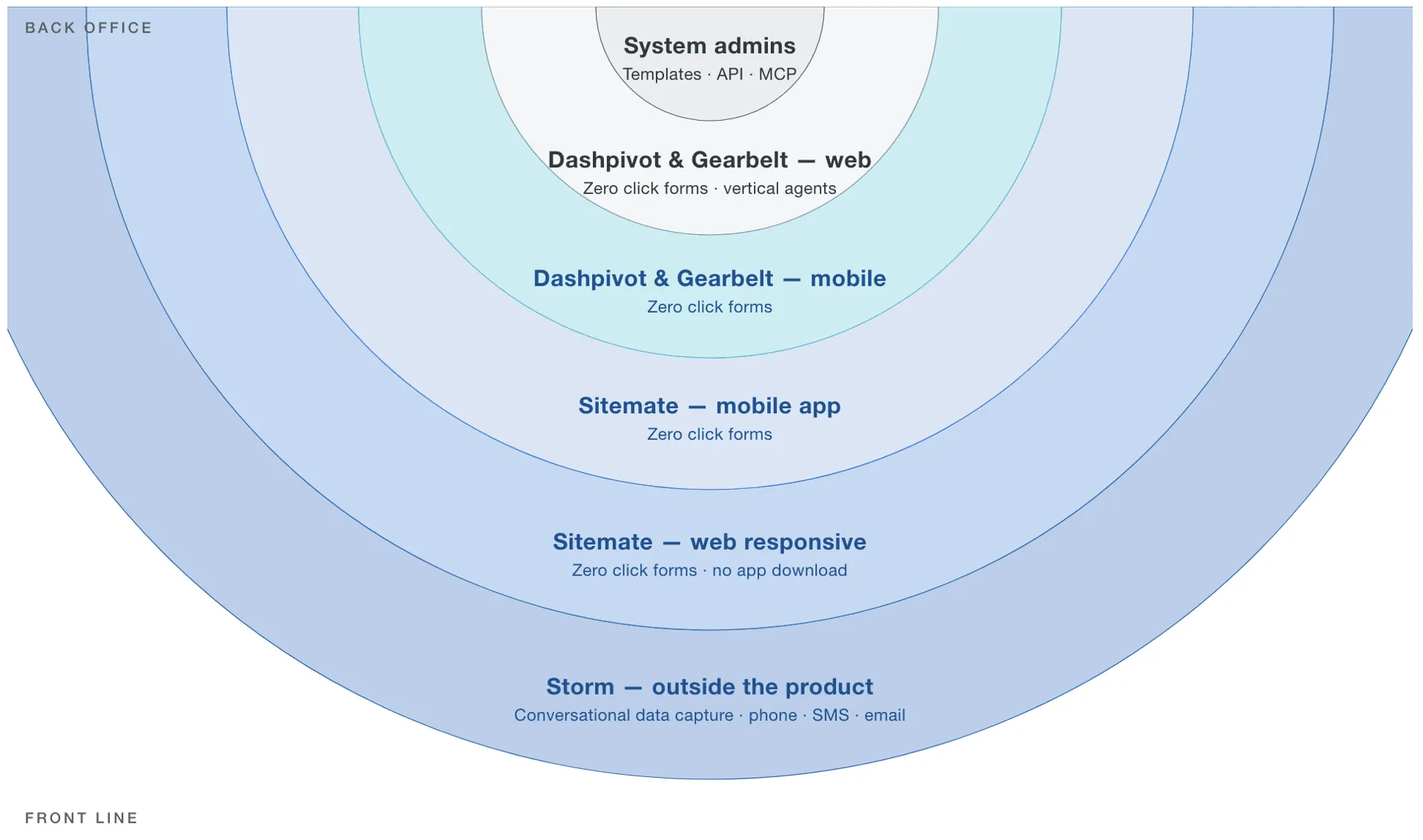
Conversational Data Capture removes it entirely - there's no interface to adopt, because the interface is the phone call, the text message, or the app they already open a hundred times a day.
For the first time, reaching the front line doesn't depend on the front line coming to us.
Bringing The Vision To Life Across Multiple Channels
The most important idea here is also the least obvious one: the channel is just a surface.
Whether someone is talking to Storm inside a Sitemate product, tapping out a reply over SMS, sending a voice note on WhatsApp, or talking on a phone call, it is the same conversation underneath, producing the same structured record. The medium changes to fit the person and the moment. What's being built does not.
Below are the modes we see this paradigm taking, roughly ordered from inside our products to out in the world.
Talking To The Form
The first mode is the simplest: you stop operating the form, and start directing an agent that operates it for you.
Instead of clicking through fields, dragging rows, and copy-pasting between sections, you just tell Storm what you want done - "move this data from the site notes into the delays table", "add five rows to the materials register", "copy yesterday's crew list across and update the hours", "clear that section and redo it from this photo instead".
Storm makes the change, right there on the form, and you watch it happen, or, it will come back and ask questions if necessary.
The form is still there underneath, fully auditable, every change logged. It's just no longer something you operate by hand - it's something you direct.
The Guided Voice Flow
For work that happens on your feet, the conversation goes hands-free - and this is where the shift from retrospective data entry to real-time thought partner stops being a vision and becomes reality.
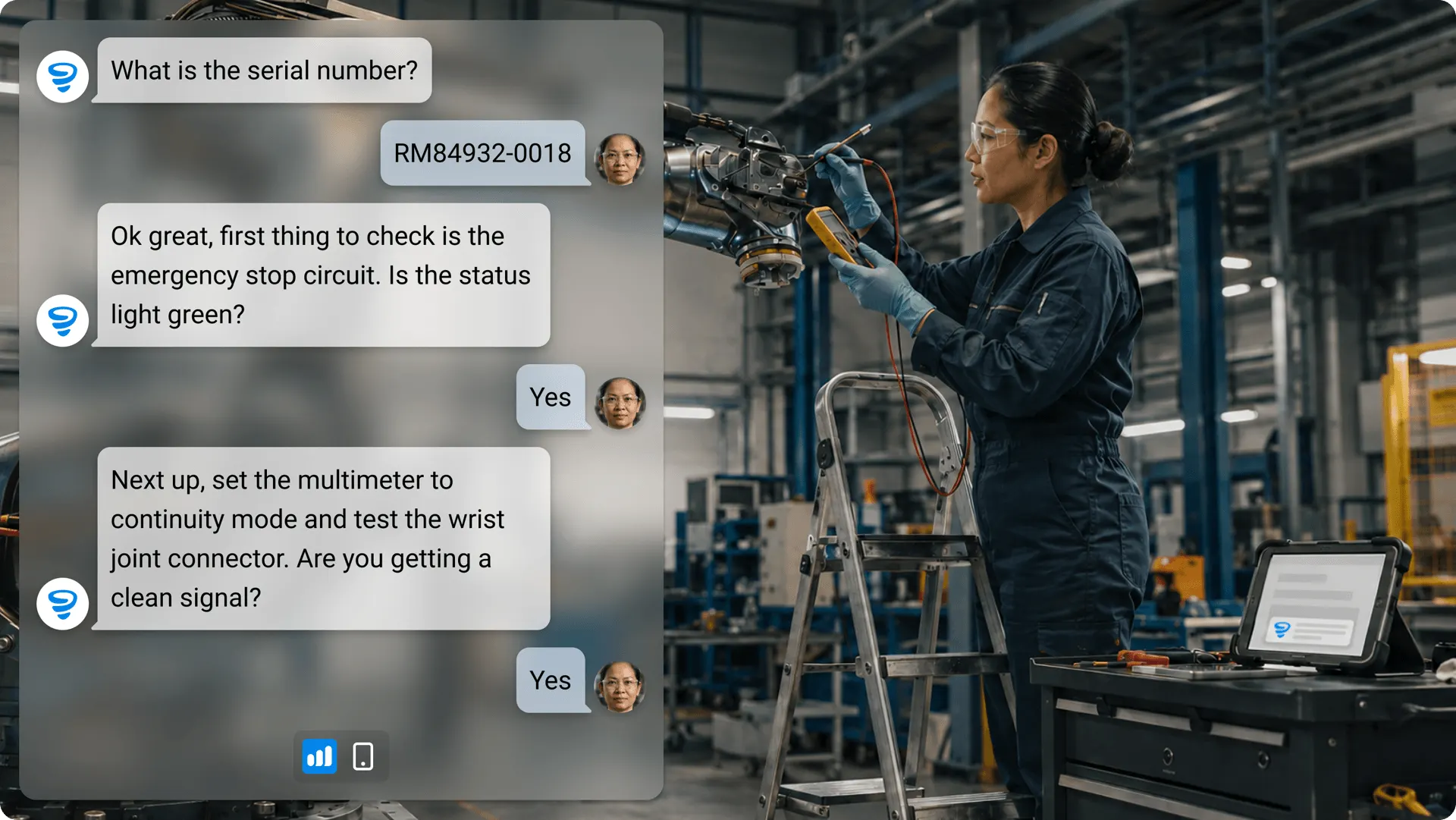
Take the technician above, on the ladder, multimeter in hand, working through a fault on a machine. Storm isn't waiting for them to dictate answers - it's leading them through the diagnostic, one step at a time. The expert knowledge of what to check, in what order, and what matters at each step is in the conversation itself.
This is the safety manager's dream from earlier, made real: an expert standing next to the worker, on this task, right now - except the expert never has to leave to go stand next to someone else.
The worker keeps their eyes on the work and their hands on the tools. They never stop to look down and tap, and yet every answer, reading and photo lands in the record in sequence as they go - the record and the thinking happening together, in the moment.
The structured inspection isn't a separate task performed after the work; it's the exhaust of the guided conversation that was the work.
This is tick and flick solved at the source. The worker isn't racing through a checklist from memory - they're being walked through the job by something that knows it, while Storm quietly writes the record for them.
SMS - Short And Surgical
If the outermost ring is about reaching people no product surface ever could, SMS is that ring at its most extreme. It's the lowest common denominator of the mobile era - no app, no data connection, no account, no smartphone even - which means it reaches literally every phone on every site in the world.
The trade-off is that it carries almost nothing: no voice notes, no photos, no attachments. Just text.
But that constraint is exactly what makes it useful, because not every interaction wants to be a session.
A form comes back with two fields missing - the labourer gets a text, thumbs a reply from the smoko shed, and the record completes itself.
A single acknowledgement is needed before the crew starts - it's one message and one word back. Ten seconds, one bar of reception, no login, done. Where the guided voice flow is an expert alongside the work, SMS is a tap on the shoulder - the smallest possible ask, at the exact moment it's needed.
And when the moment calls for something text can't carry - a signature, a photo, a document - SMS becomes the courier instead of the channel: the link lands in the thread, opens straight into a Sitemate App web responsive page with nothing to download, and the person is back in their day within the minute.
WhatsApp - Still Short, But With Richer Photo, Video, File And Voice Clip Options
We covered earlier why WhatsApp runs so deep in the built world's workforce - so the question here isn't whether the workers are on it. They are. The question is what becomes possible when Storm meets them there.
The answer: everything SMS can't carry.
Where SMS is a tap on the shoulder, WhatsApp is a full exchange - voice notes in the worker's own language, photos, videos, documents - all flowing into the same record, with nothing to install and no account to create.
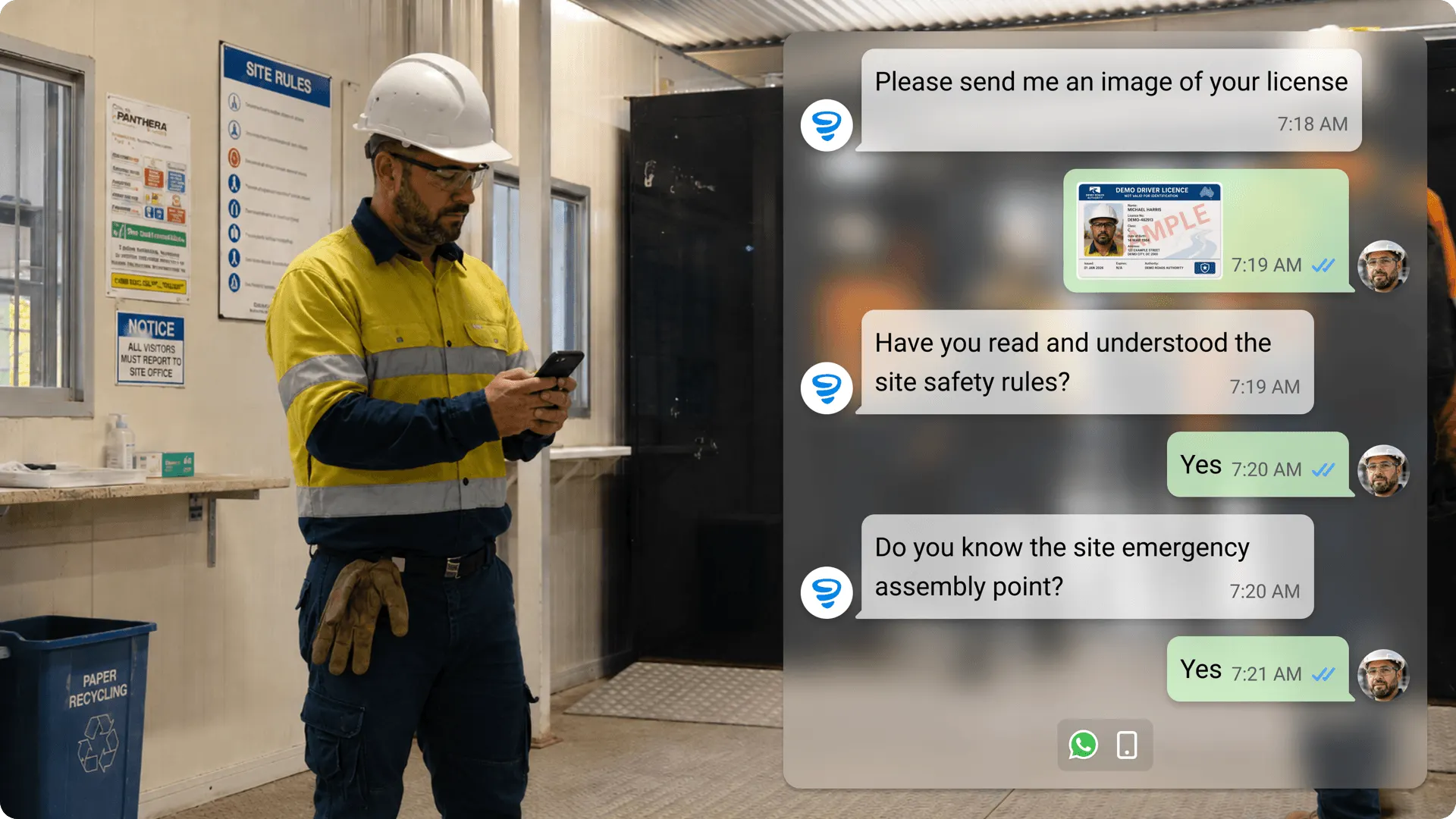
Take the worker above, standing at the site office.
Asked for his licence, he photographs it. Asked about the site rules and the emergency assembly point, he confirms.
And behind that thread, more than one thing is happening at once. The induction record is assembling itself, field by field. His licence is being written to his Sitemate Profile, and populating a Card in his Sitemate Wallet - automatically, in the background.
So a conversation that took three minutes in a doorway didn't just complete today's induction. The next site he walks onto already knows who he is, and what he holds.
The channel also opens up something forms never could: the group conversation. Storm can sit in a crew's thread as a participant, collecting from several people at once, the way a real coordinator would.
The Phone Call - The Debrief And The Induction
Then there's the highest-bandwidth surface of all: the human voice, back and forth.
Take the supervisor below, driving home after dark at the end of a long shift.
Instead of a blank diary waiting for him at the kitchen table tonight, the diary calls him.
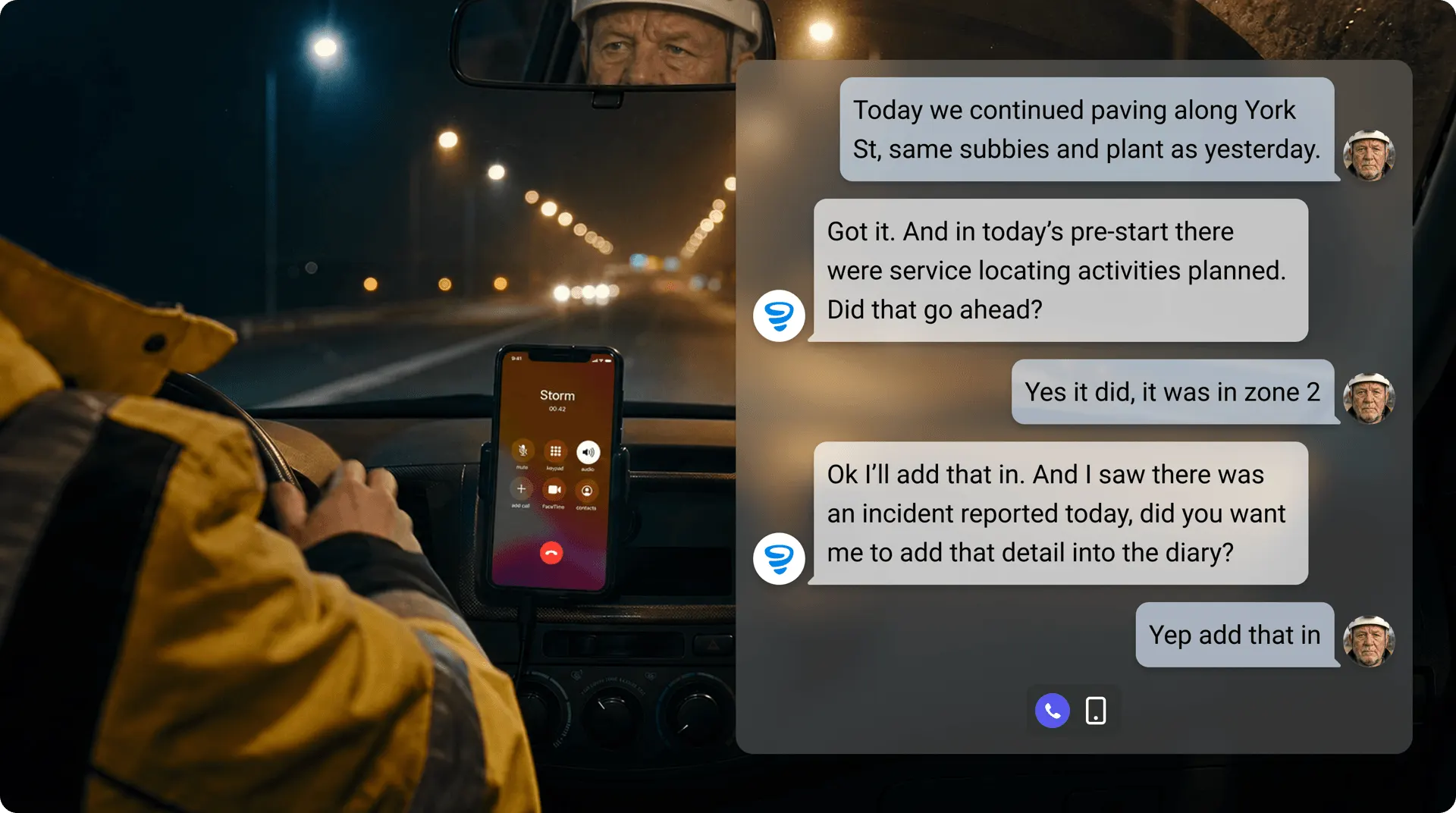
And notice what's happening on that call. Storm isn't just taking dictation - it already knows the day. It's cross-referencing the pre-start, picking up the incident report, asking the question a diligent project engineer would ask. The thought partner again - this time in the passenger seat.
By the time he pulls into the driveway, the site diary is done. Detail captured while it was still fresh, not reconstructed at 9pm from a tired memory.
The call can go the other way too: an induction run over the phone before a worker ever arrives on site, in their own language, details and competencies captured, and a signing link texted through to close it out while they're still on the line.
The phone call is the mode that most completely dissolves the form - because the person never sees one at all.
Email - Collection That Comes To You
Finally, the channel the office already lives in.
Every mode so far has been about reaching the worker in the field. Email reaches the other half of the problem: the back-and-forth between companies - the documents sent in, read, judged, and sent back that consume so much of the built world's admin.
Think about what that flow looks like today. A subcontractor emails through their SWMS. Someone opens it, checks it against the requirements, notices the insurance certificate is missing, writes back asking for it, waits, files the reply, chases again the following week.
Multiply that by every subcontractor, on every project.
Now give that inbox to Storm.
The submission arrives, gets read against the requirements, and the gap is picked up on the spot - the reply asking for the missing certificate goes out in minutes, not next week. The to-and-fro that used to be someone's Tuesday runs on its own, and a structured record assembles at the end of it.
No portal for the subcontractor to log into. No new system for them to learn. They just reply to an email, the way they always have.
The inbox stops being a place where information piles up, and becomes a place where it gets captured.
The Same Shift, Across Every System And Use Case
None of this is specific to one kind of record. Safety, quality, time and materials, field reporting on the Dashpivot side, fleet and assets on the Gearbelt side - the same conversational spine runs beneath all of them.
And in every one of them, the jump from Zero Click Forms to Conversational Data Capture is the same:
A record that assembles itself once the data arrives, becomes a conversation that goes and gets it.
The site induction that assembled itself once the worker showed up with their documents becomes a phone call before they ever arrive - in their own language, verified, signed.
The inspection built from the photos and voice notes of the walk becomes the walk itself - the expert questions asked at the work, in the moment, not captured after it.
The time card that no longer had to be typed still had to be submitted - now it's a one-line reply each afternoon, and it's logged.
The daily report that assembled from the day's evidence becomes a call to the supervisor on the drive home - asking about the things the evidence didn't show.
The plant pre-start that got faster to tick through becomes a talk-through while walking the machine - and an issue that would have gone unreported raises the record on the spot.
Different categories, different channels, different people - but the same jump every time.
The conversation becomes the system - used all of the time, by all of the people, in any language, anywhere.
What This Means For Storm
Now A Back And Forth, Not Single Shot
It looks subtle on the surface, as the Zero Click Forms vision we delivered with Storm 1.0 already accepts audio files.
However, the process of Storm going back and forth with you, over multiple possible channels, is a huge shift in the foundational UX.
When we launched Storm 1.0 on June 1st, 2026, I described it as the first wave of an attack on Sitemate, ourselves, the old way of doing things - the old user experience patterns of filling in forms, clicking buttons, picking from dropdowns.
This was of course, the Zero Click Forms vision coming to life.
Conversational Data Capture is the second wave of this attack.
Storm 1.0 could do the work a user would otherwise do by clicking and typing - but only for someone who had already come into a Sitemate product. And within the first month, users have been completing site diaries with photos, voice and weather data alone - zero typing, zero clicks - and cutting three-hour processes down to fifteen minutes.
Now that boundary comes off entirely.
Storm stops waiting inside a product for someone to come to it, and goes out to have the conversation instead - on the phone, in the thread, in the inbox, in whatever language and on whatever channel the moment calls for.
The work moves from something a person visits an app to do, to something that gets captured wherever, and however, the person already is.
What It Takes
A paradigm this natural-sounding is deceptively hard to do well, and it only works if the conversation is held to the same standard as the form it replaces.
Conversational Data Capture will only work if;
- The agent knows when to stop talking - asking good, targeted questions rather than reading out a checklist, and respecting that the person on the other end has a job to do.
- There's one shared conversational spine beneath every channel - so that canvas, SMS, WhatsApp, email and voice are just different doors into the same room, not five separate products.
- Outputs are auditable - who said what, when, and on what evidence the record was built. A conversation that can't be traced is worth less than the form it replaced, not more.
- There's a clean verification and signature path - so a record can be closed out and signed without ever leaving the conversation.
- It survives the real environment - accents, noise, dropped calls, low literacy, and languages we have to respond in fluently even when no one in the room speaks them.
None of these are reasons not to do it. They're the bar for doing it properly - and clearing that bar, over and over, is exactly how a company builds an applied AI muscle that others can't easily copy.
We Have A Head Start On The Hardest Part
Knowing who you're actually talking to is one of the hardest parts of capturing data outside a product - and for Sitemate, that piece is already built.
The Sitemate App and auth infrastructure is live and at scale, with phone number identification, one-time-password verification, and sign-ups already in place.
Every worker who has ever scanned onto a site exists as a verified, phone-number-based identity in the Sitemate network.
So the conversational rails don't have to invent an identity layer - they inherit a proven one. A text or a call can be tied to a known person. A brand-new worker can be signed up by phone number in the flow of a conversation. A signature can be captured and verified.
The leap to conversation is smaller than it looks, because the foundation it stands on is already load-bearing.
And because that identity is the same across every surface, conversation becomes more than a capture channel - it becomes an on-ramp.
The worker first reached by a WhatsApp message or a phone call is a known person the instant they reply - and from there, they can be drawn inward through the rings exactly as far as the work requires; from a message or a call, to the Sitemate App in the browser with nothing to download, to the Sitemate App itself, and, for those who need it, into the products.
Crucially, not every worker has to make that journey. Many will only ever exist at the outer ring, captured entirely through conversation, and never need anything more - and that's the point.
Meet people exactly where they already are. Move them inward only when there's a genuine reason to.
Closing - The Interface That Was Always There
Teaching Storm to converse - reliably, auditably, across channels and languages, under real conditions - is the foundation that everything more autonomous has to stand on.
An agent can't be trusted to act in the world until it can be trusted to talk in it.
So this is the chapter where we build that capability - what Storm does once it can both converse and act is a story for the next blog.
But the deeper point is the one The Sitemate Manifesto is built on; the built world creates its truth in conversation, then buries its people in the translation to paperwork.
For the first time, nothing has to be lost in that translation, because the system can finally just listen.
Not a better form. No form at all - just the conversation the form was always a poor substitute for, captured as it happens;
From everyone, in every language, anywhere the work is being done.
With Storm 1.0, I said you don't need to fill in digital forms anymore - you can just Storm it.
With Conversational Data Capture, you won't even need to open the app - Storm will meet you where you already are, and handle the paperwork while you handle the work.
More time with eyes on the job, not on the paperwork.
This is how we Multiply The Engineering Power Of The Built World - one worker, one conversation at a time.
About The Author

Hartley Pike
CEO & Co-founder ·  LinkedIn
Education
University of Technology Sydney - Master of Business Administration in Entrepreneurship (Dropped Out)
University of Technology Sydney - Bachelor of Engineering (BE), Diploma in Engineering Practice, Civil Structures
Bio
Hartley is the Founder and CEO of Sitemate, where he turns real-world construction and infrastructure experience into software products that site teams want to use. With a background in civil engineering across major transport infrastructure projects, manufacturing, and large-scale site operations, he brings experience to product strategy and development.
He applies lean principles to improve productivity and efficiency across complex, high-risk operational workflows. Today, he leads Sitemate's product strategy and growth, building platforms such as Dashpivot, Flowsite, Gearbelt and more that transform standard operating procedures into structured, data-driven workflows, helping teams deliver work more reliably, safely, and on time.
Past Projects
Major tunnel motorway infrastructure project (NorthConnex – $2.6B)Civil Engineer contributing to the delivery of a nationally significant nine-kilometre tunnel motorway, supporting construction of the Trelawney Street vertical shaft and the main tunnel alignment, which will form part of the National Highway route.
Highway upgrade and concrete pavement improvement project (Nambucca Heads to Urunga – $780M)Civil Engineer undertaking analysis and assessment of concrete paving processes for a large-scale highway upgrade, supporting the delivery of two new interchanges and performance outcomes across 22 kilometres of upgraded highway.
Large-scale precast concrete manufacturing operations (Australian Precast Solutions – APS)Engineering contributor supporting the manufacture of high-quality precast concrete elements, including Super-T girders and bridge planks, supplying major transport infrastructure projects across New South Wales.
Motorway widening and intelligent transport systems delivery (M5 West Widening – $350M)Civil Engineer involved in motorway widening works, including installation of IT systems within civil works, construction and commissioning of the M5 Control Centre, asphalt resurfacing, finishing works, and project handover.
Lean construction research and process improvement projectLead researcher investigating the application of lean principles to civil engineering processes, demonstrating up to 40% reductions in process durations through waste removal and improved workflow design across live construction and precast manufacturing environments.
Construction technology startup and product development initiativesCo-founder and product lead developing early-stage construction technology solutions through programs such as the 3P Business Plan Competition and the University Startup World Cup, including business plan development, international startup exposure, and investor-facing product positioning.
Construction cloud and digital workflow innovation programsEntrepreneur and technology advocate recognized through multiple international and academic awards for advancing cloud-based information systems aimed at improving productivity, safety, and quality in construction and infrastructure delivery.
OMRON (Industrial Automation)Led the upgrade of a legacy asset management system into a single digital platform (Gearbelt), bringing together work order management, QR-based access to asset information, and safety procedures. This resulted in a reduction of work order administration time by more than 30%.
Compass Energy Systems (Oil & Gas)Managed a multi-year transformation focused on consolidating quality assurance, field ticketing, and safety systems across Canadian and US operations. The outcome was a unified user experience with smooth integration into the Microsoft environment via Flowsite, including Power Platform, Power BI, Excel, and SharePoint.
Thrasher Engineering (Civil & Environmental Engineering)Oversaw the rollout of tailored daily reporting workflows supporting both DOT and private projects. Field teams working in demanding, online and offline conditions now generate large volumes of reports and photos each month across multiple US states, supporting timely, high-quality reporting to project stakeholders.


 English (United States)
  English (Australia)
  English (UK)
  English (New Zealand)
  English (South Africa)
  German