Conversational Data Capture – Introducing Storm 2.0
Storm 1.0 brought AI to the front line. You talked, dropped in photos, and Storm would start filling in inspections, timesheets, diaries and action items for you.
No more clicking, no typing, and no searching through long dropdown lists.
But workers on the front line, and managers on site, still had to come to Storm in order to use it. They still had to download and then open an app, log in and find the right form.
Today, I'm excited to announce the release of Storm 2.0, bringing Conversational Data Capture to the front line of the built world.
Storm 2.0 is where our Conversational Data Capture vision starts to come to life. Workers on the front line and managers on site can now start to work through safety, quality, field reporting, fleet and asset processes as a conversation, in their own language.
No long forms. No endless sections, tables and buttons. Just talking or texting, while the record takes shape in the background.
Put simply, these processes are going 'headless'. For some workers, that will mean never opening an app at all. For others, it will be a hybrid: the capture happens headless, over a call or a chat, and the app is where they review what Storm captured, sign it off and submit.
Below, I'll explain why both make sense on site.
With Storm 1.0, we gave Storm tools. With Storm 2.0, we're giving it a voice.
Why Storm Had To Leave The App
The workers who drive the built world forward come from every kind of background. Many are migrants. Many never had the chance at a higher education. Many have literacy challenges, and many can't speak English.
Yet every day, they arrive on sites all over the world and are expected to engage with all kinds of safety, quality, fleet and asset processes. Forms, workflows, reports, sign-offs. Almost all of it built around reading and writing.
Storm 1.0 took the clicking and typing out of those processes. But it still lived inside an app.
For a huge portion of the front line, even opening an app is too much to ask.
Meanwhile, the rest of us are watching the technology landscape shift right in front of our eyes.
Soon, every one of us will have one or more personal AI agents we can message over iMessage or WhatsApp, to get things done on our behalf.
It's time to take that shift to the front line. To meet workers where they already are: on the communication channels they already use, and in their own language; phone, SMS and Whatsapp.
I've gone deeper on this in my blog, Conversational Data Capture, the vision Storm 2.0 is built on.
Headless UX Has Arrived At The Front Line
Every step Sitemate has taken towards the front line has meant a new product surface: the Dashpivot mobile app, then the Sitemate App, then a browser version with nothing to download. Each one got us closer to where the work happens, but each one still asked the worker to download something, log in or learn a new screen.
Storm 2.0 moves the capture onto channels workers already use every day: a phone call, a text message or WhatsApp.
Conversation is the oldest interface in the built world.
On most sites, the real coordination already happens over the radio, on the phone and in the project WhatsApp group. More than three billion people use WhatsApp every month, and Storm can now have a conversation there, ask follow-up questions in the worker's own language and turn the answers into a structured record.
Some steps still work better on a screen, like reviewing a long inspection, checking photos or signing off. So for many workers, Storm 2.0 is a hybrid: they capture by talking or texting, then open the form on screen to review, sign and submit.
The goal isn't to get rid of the app entirely, but to make sure nobody needs it just to get started.
What Storm 2.0 Does
In the Storm 1.0 film, we told the story of Jane. For Storm 2.0, we followed three people starting their day on the same site: Rafa, Mei-Lin and Daniel. Each of them uses Storm in a different way, from fully headless to fully in-app.
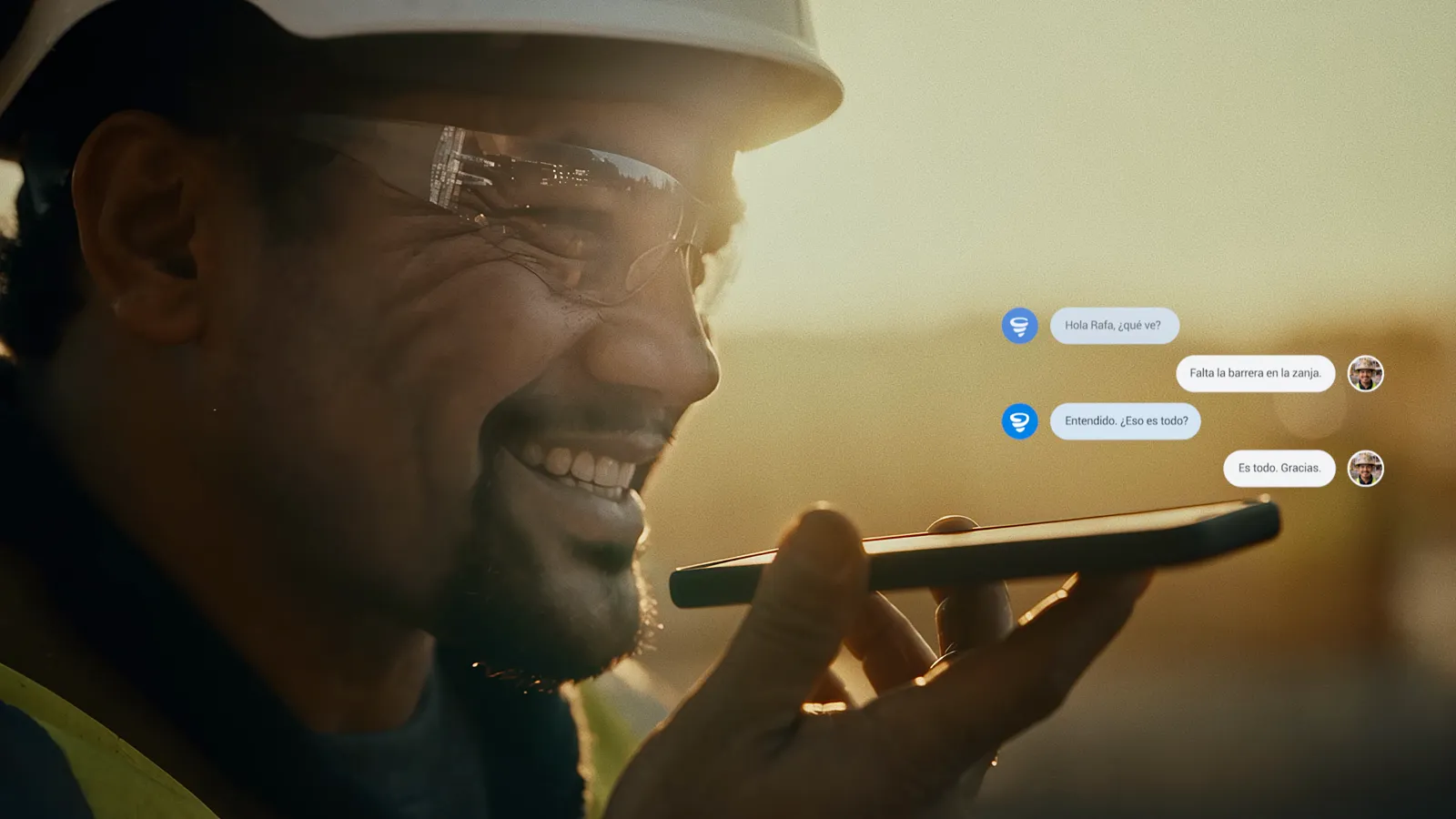
AI Call Fill. Rafa, the foreman, taps Call and Storm rings him. He speaks Spanish, so Storm replies in Spanish without him having to pick a language. He reports a missing barrier at the trench, and the safety observation is recorded without Rafa ever opening an app.
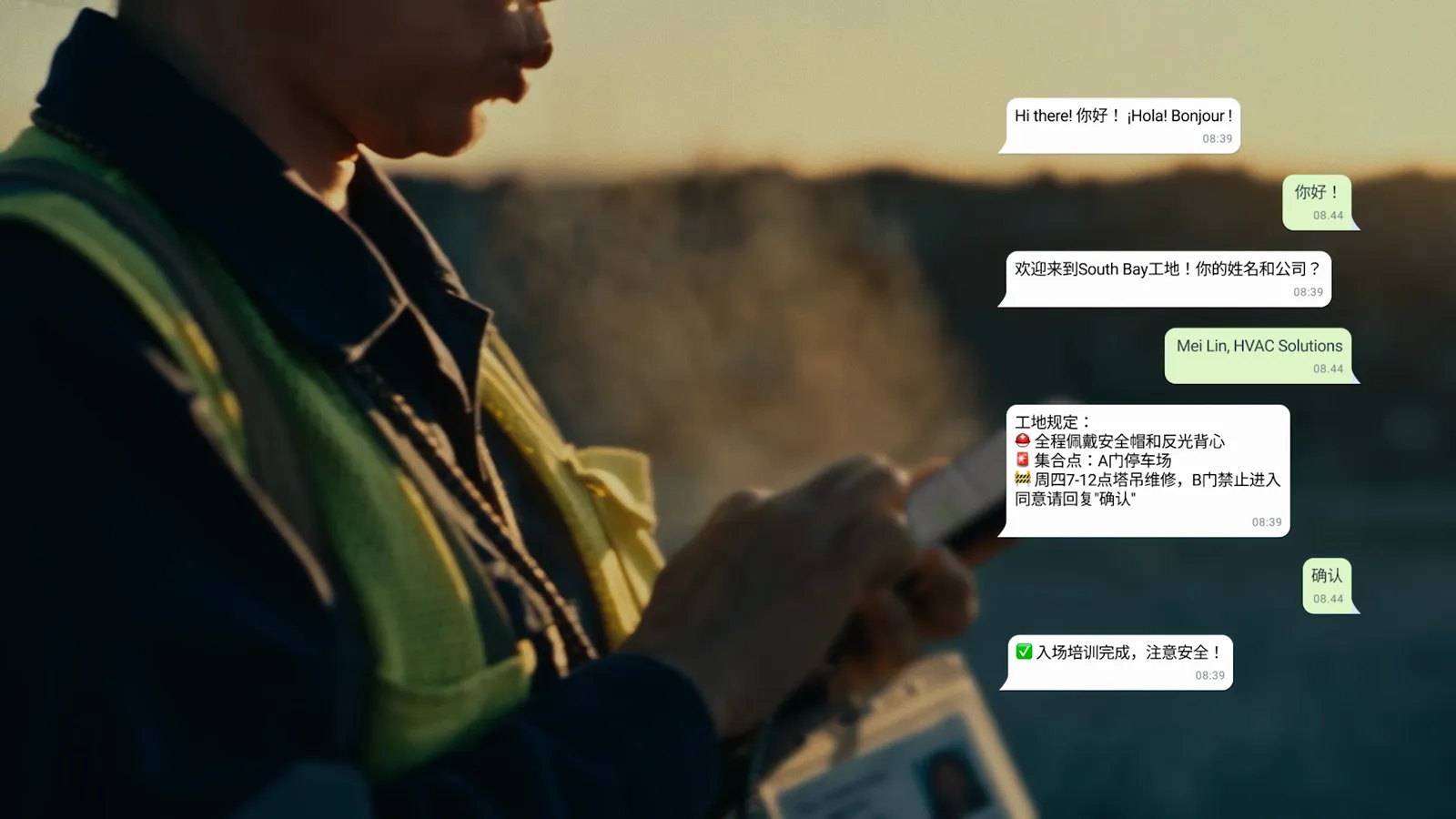
AI Text Fill. Mei-Lin, a commissioning technician, chooses WhatsApp. She answers in Mandarin, so Storm continues in Mandarin, asking the form's questions one message at a time. She can send photos straight into the chat, and when she's finished, she gets a link to review what Storm captured, sign and submit. The same flow works over SMS.
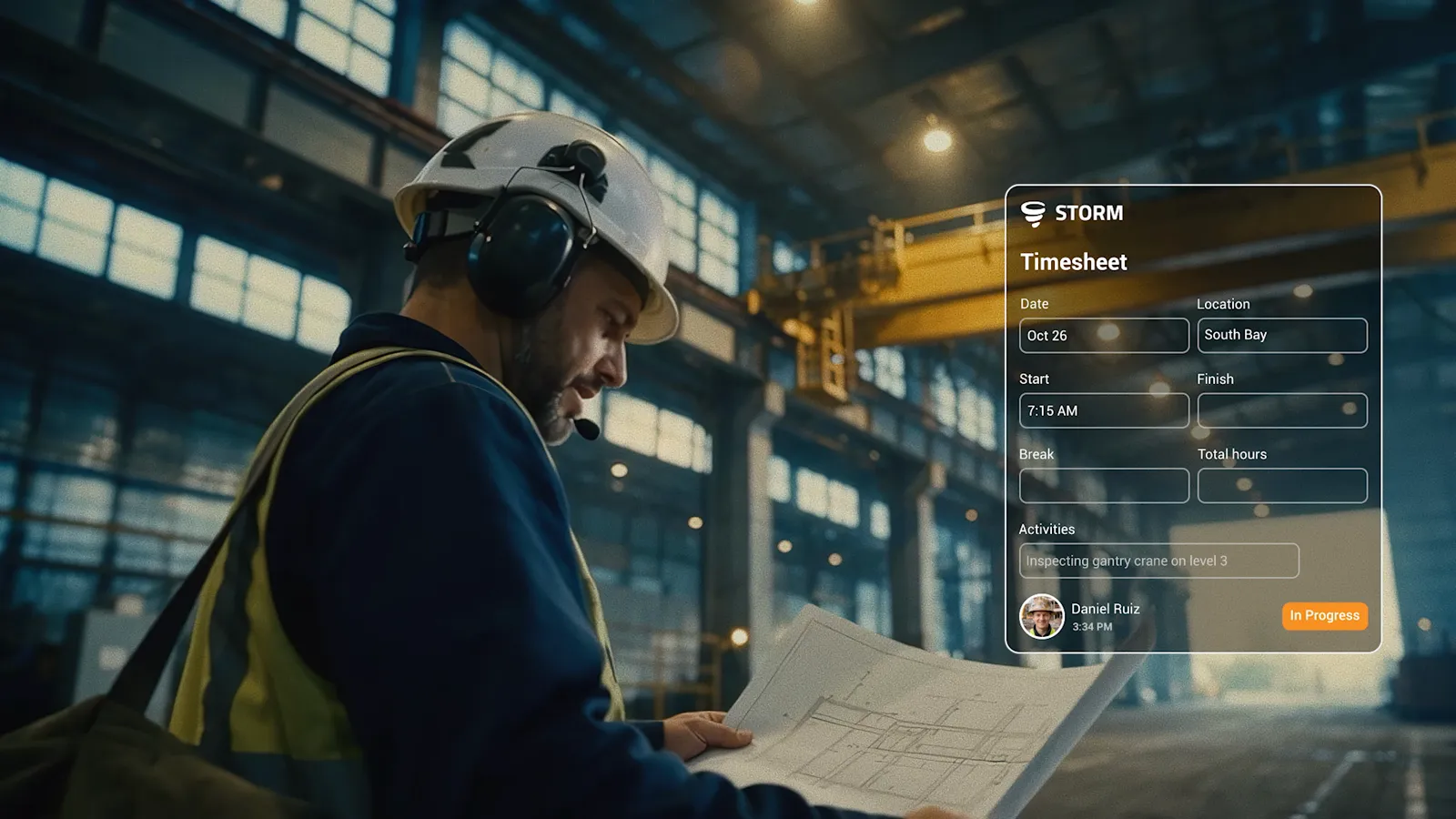
AI Form Fill. Daniel, a site engineer, already uses the Sitemate app, but his hands are full. He opens his timesheet, taps Storm and says, "Starting my timesheet, 7am, inspecting the gantry crane on level 3." Storm fills in what he's said and can prompt him for anything that's missing.
And past that, pretty much any process you build. If you've built a safety, quality, field reporting, fleet or asset process on the Sitemate rails, Storm can take it into a conversation.
In every case, the worker stays in control. With AI Text Fill and AI Form Fill, Storm prepares a draft for you to review, sign and submit. With AI Call Fill, the worker leads the conversation, and anything Storm can't capture comes back to them as a draft to finish.
These are the first entry points. Over the 2.1, 2.2 and 2.3 releases, we'll add more and bring AI Call Fill and AI Text Fill to more people via new entry points.
What This Means For The Built World
Storm 1.0 took the burden of the record off the worker. Within the first few days, people were completing site diaries without typing or clicking, and cutting three-hour processes down to fifteen minutes.
Storm 2.0 means workers no longer have to start inside an app to contribute.
A record that assembles itself once the data arrives becomes a conversation that goes and gets it.
Storm 1.0 made the people already using one of Sitemate's apps faster.
Storm 2.0 reaches the people who were never going to open an app, like the subcontractor who isn't in your system, the worker hired last night, or the operator whose first language is Spanish.
The front line keeps our built world turning, and with Storm 2.0 it can tell us what's happening in its own words and on its own terms.
Thank You
A big, big shout out once again to the team at Wonder Studios: Harry, Abby, Max, Helene and everyone involved, for fitting three people, three languages and three channels into a sixty-second film.
Thank you also to Sitemate's AI Platform and Applied AI teams, who shipped thousands of changes to get Storm out of the app and onto the phone.

About The Author

Hartley Pike
CEO & Co-founder ·  LinkedIn
Education
University of Technology Sydney - Master of Business Administration in Entrepreneurship (Dropped Out)
University of Technology Sydney - Bachelor of Engineering (BE), Diploma in Engineering Practice, Civil Structures
Bio
Hartley is the Founder and CEO of Sitemate, where he turns real-world construction and infrastructure experience into software products that site teams want to use. With a background in civil engineering across major transport infrastructure projects, manufacturing, and large-scale site operations, he brings experience to product strategy and development.
He applies lean principles to improve productivity and efficiency across complex, high-risk operational workflows. Today, he leads Sitemate's product strategy and growth, building platforms such as Dashpivot, Flowsite, Gearbelt and more that transform standard operating procedures into structured, data-driven workflows, helping teams deliver work more reliably, safely, and on time.
Past Projects
Major tunnel motorway infrastructure project (NorthConnex – $2.6B)Civil Engineer contributing to the delivery of a nationally significant nine-kilometre tunnel motorway, supporting construction of the Trelawney Street vertical shaft and the main tunnel alignment, which will form part of the National Highway route.
Highway upgrade and concrete pavement improvement project (Nambucca Heads to Urunga – $780M)Civil Engineer undertaking analysis and assessment of concrete paving processes for a large-scale highway upgrade, supporting the delivery of two new interchanges and performance outcomes across 22 kilometres of upgraded highway.
Large-scale precast concrete manufacturing operations (Australian Precast Solutions – APS)Engineering contributor supporting the manufacture of high-quality precast concrete elements, including Super-T girders and bridge planks, supplying major transport infrastructure projects across New South Wales.
Motorway widening and intelligent transport systems delivery (M5 West Widening – $350M)Civil Engineer involved in motorway widening works, including installation of IT systems within civil works, construction and commissioning of the M5 Control Centre, asphalt resurfacing, finishing works, and project handover.
Lean construction research and process improvement projectLead researcher investigating the application of lean principles to civil engineering processes, demonstrating up to 40% reductions in process durations through waste removal and improved workflow design across live construction and precast manufacturing environments.
Construction technology startup and product development initiativesCo-founder and product lead developing early-stage construction technology solutions through programs such as the 3P Business Plan Competition and the University Startup World Cup, including business plan development, international startup exposure, and investor-facing product positioning.
Construction cloud and digital workflow innovation programsEntrepreneur and technology advocate recognized through multiple international and academic awards for advancing cloud-based information systems aimed at improving productivity, safety, and quality in construction and infrastructure delivery.
OMRON (Industrial Automation)Led the upgrade of a legacy asset management system into a single digital platform (Gearbelt), bringing together work order management, QR-based access to asset information, and safety procedures. This resulted in a reduction of work order administration time by more than 30%.
Compass Energy Systems (Oil & Gas)Managed a multi-year transformation focused on consolidating quality assurance, field ticketing, and safety systems across Canadian and US operations. The outcome was a unified user experience with smooth integration into the Microsoft environment via Flowsite, including Power Platform, Power BI, Excel, and SharePoint.
Thrasher Engineering (Civil & Environmental Engineering)Oversaw the rollout of tailored daily reporting workflows supporting both DOT and private projects. Field teams working in demanding, online and offline conditions now generate large volumes of reports and photos each month across multiple US states, supporting timely, high-quality reporting to project stakeholders.
Version 26-10-v1 · Published 10/30/2026