Building Fire Risk Assessment Template

Start with a free 30-day trial. No credit card required.
Looking for a ready-to-use Building Fire Risk Assessment that still fits how your team works? This template comes pre-written with the essential elements of a comprehensive fire risk evaluation, including general building information, assessment scope and regulatory basis, fire hazard identification, fire strategy evaluation, and safety management protocols. You can edit any part of it to match your company's processes and the buildings you assess, and the document will still support compliance with Approved Document B of the Building Regulations in the UK.
This Building Fire Risk Assessment is an easy-to-use form that your workers can use to carry out thorough fire risk evaluations for buildings and projects, identify fire hazards, review the fire strategy in place, and document the safety management measures needed to keep occupants and workers safe.
 100% fully editable Building Fire Risk Assessment
Export your Building Fire Risk Assessment to PDF or CSV
Access your Building Fire Risk Assessment on mobile, tablet or computer
Trusted by companies, projects and teams of all sizes















What is Building Fire Risk Assessment?
A Building Fire Risk Assessment is a document that qualifies a building’s current state to be more or less susceptible to a fire. Usually, professionally trained risk assessors or risk engineers carry out these assessments. Further, their assessment would include information on the building itself, its safety features and systems, details on maintenance procedures, and fire hazards within the building.
In the modern world, fires are still one of the most common perils that buildings are exposed to. As a result, proper fire risk assessments must be done in order to plan, design, and perform “prophylactic” actions to deter or reduce the chances of fire. This is especially relevant to industries like construction, building operation and management, insurance, and risk engineering & management. Additionally, fire risk assessments are used as supporting documents or evidence packets to demonstrate compliance to fire safety requirements. In the UK, these requirements are issued in the Building Regulations Approved Document B Fire Safety packet.
Compare this Building Fire Risk Assessment with forms created on Word or PDF
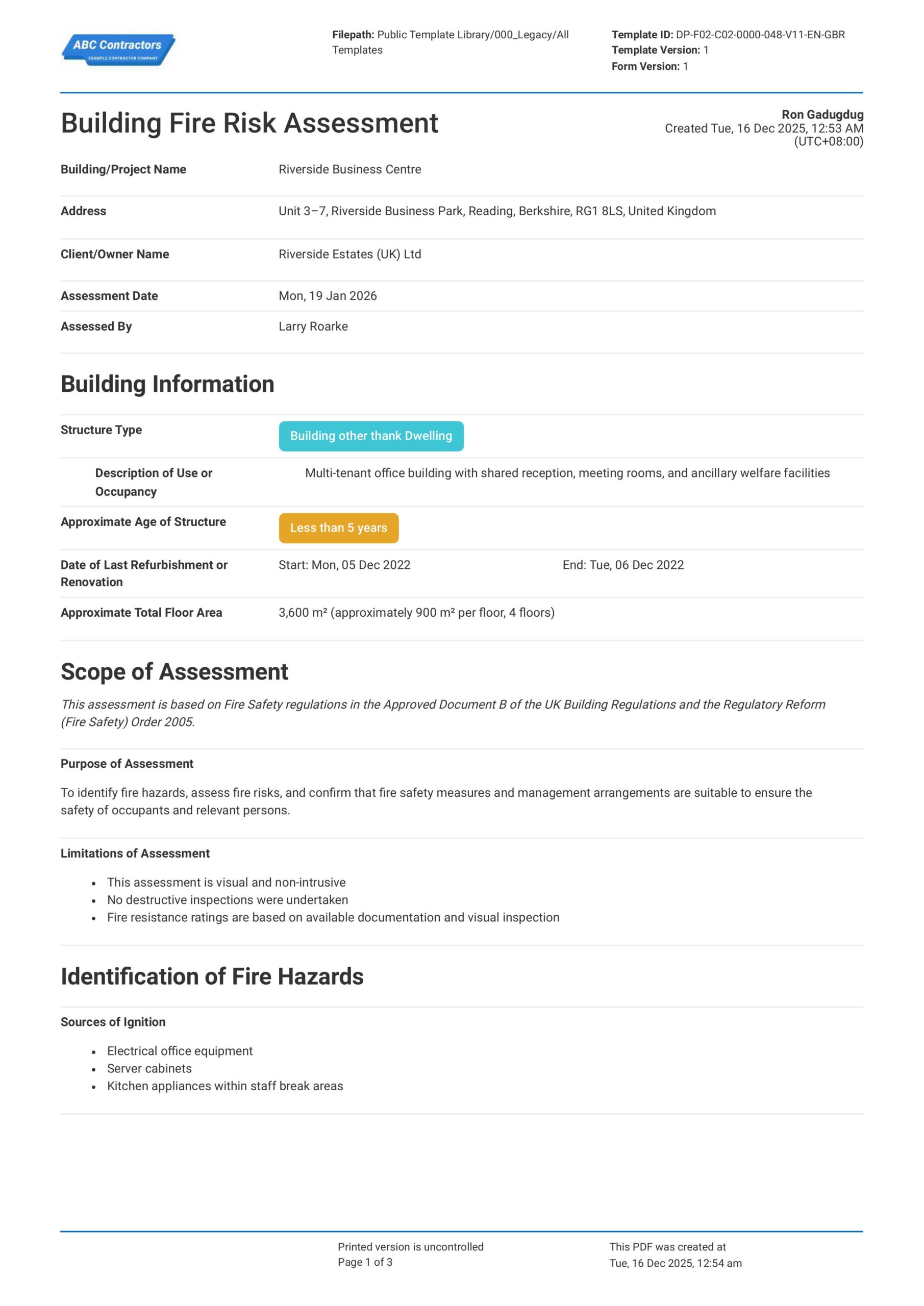
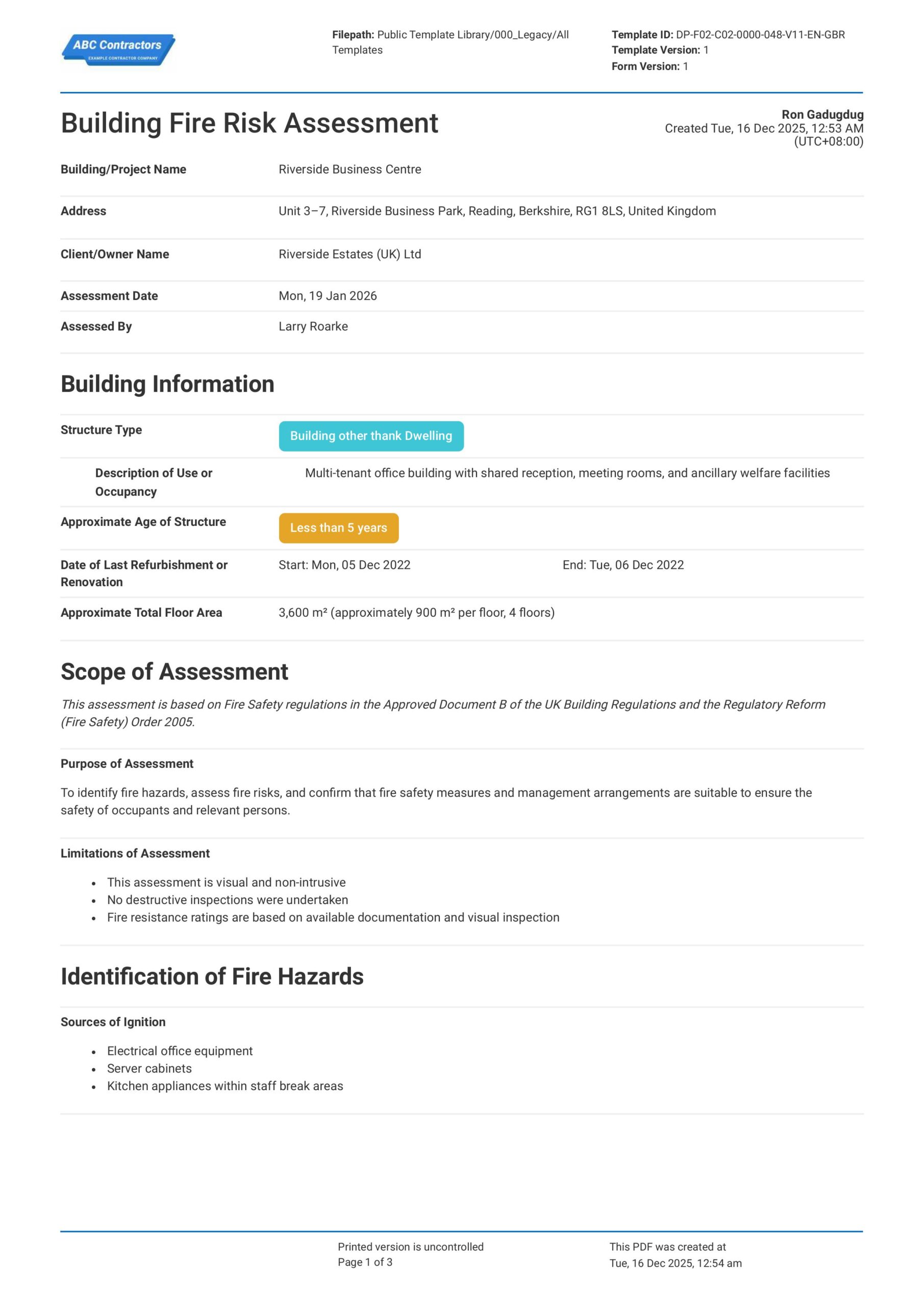
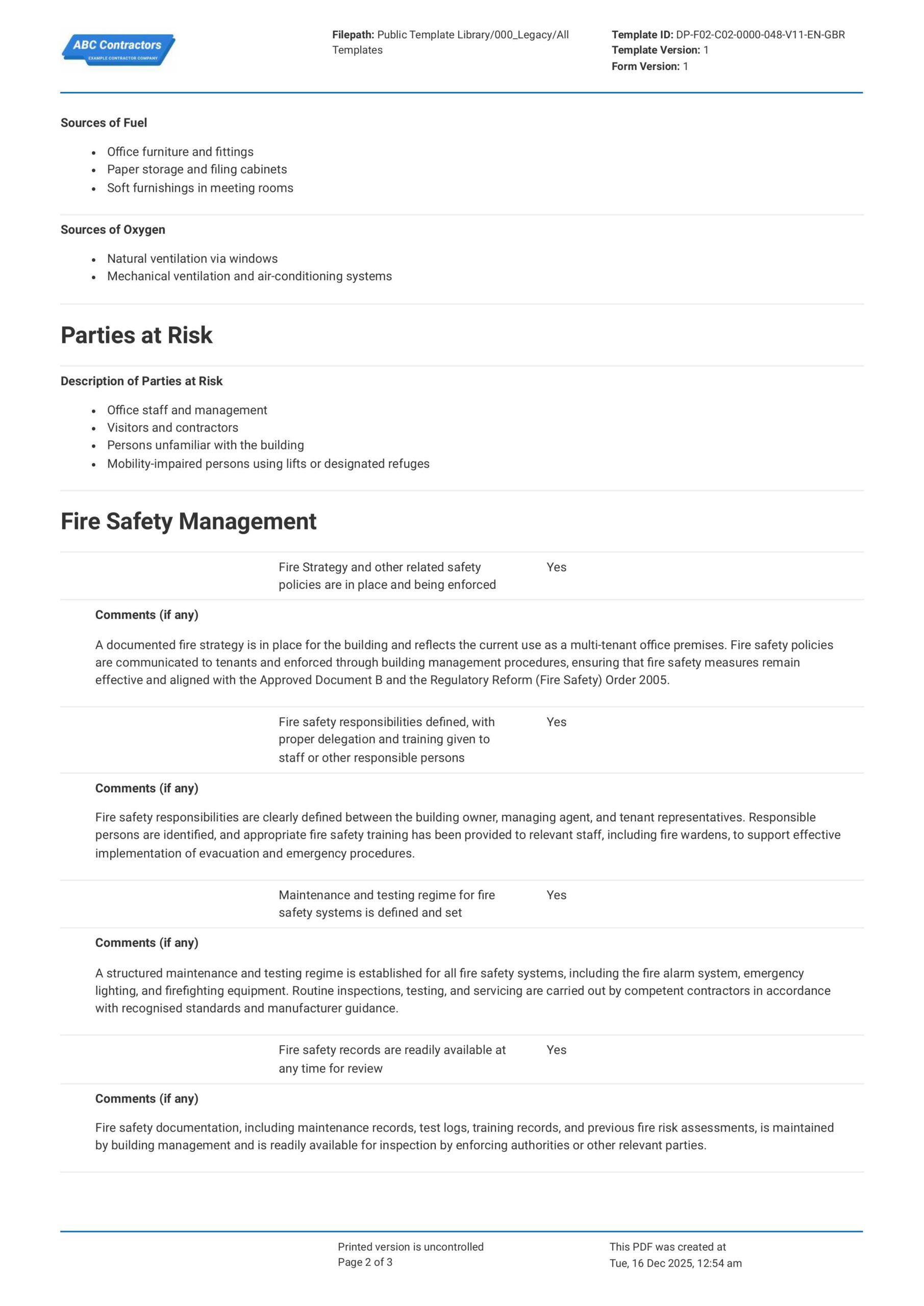
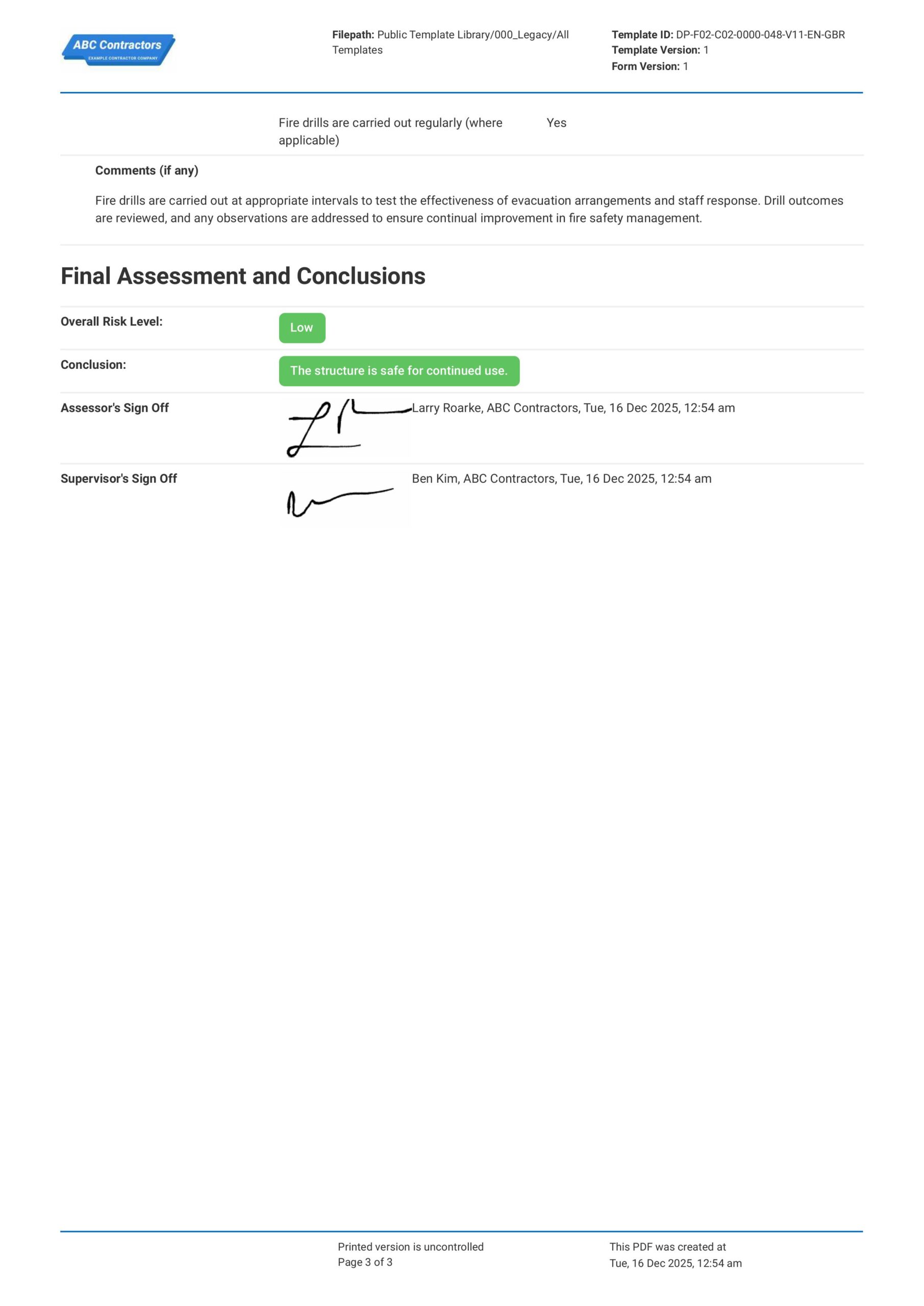
Curious how this Building Fire Risk Assessment works? Check out the example below to see what a completed assessment looks like, from general building information through to fire strategy and safety management. You can generate your own version, export it as a custom form with your company details, and fill in the relevant information to have a ready-to-use Building Fire Risk Assessment in minutes.
Use this Building Fire Risk Assessment template for free

Generate this template automatically with Storm
You don't have to build the Building Fire Risk Assessment field by field. Let Storm, the AI Data Capture Agent inside Dashpivot, build the template for you in seconds.
Describe what you need
Tell Storm the form you want in plain language and it builds a structured digital template from scratch, with fields, tables, and signatures in place.
Upload what you already use
Drop in your existing PDF, Word, Excel, or even a photo of a paper form. Storm rebuilds it as a smart digital template with the structure intact.
 Storm
Storm
Generate a Building Fire Risk Assessment form template that I can use for my business
Applicable Standards and Policies for Building Fire Risk Assessment
In the UK, a Building Fire Risk Assessment is covered by the Regulatory Reform (Fire Safety) Order 2005, which requires the “responsible person” to carry out and keep a suitable and sufficient fire risk assessment for most non-domestic premises and the common parts of multi-occupied residential buildings. Here are other important legislation and requirements you should know about:
- Fire Safety Act 2021 clarified that assessments for relevant multi-occupied residential buildings must consider structure, external walls, and flat entrance doors opening onto common parts. (NFCC)
- Fire Safety (England) Regulations 2022 add more specific duties for certain residential buildings, including information-sharing and checks. (GOV.UK)
- Building Safety Act 2022, including section 156 measures effective from October 1, 2023, increased requirements around cooperation, competence, and documentation. (London Fire Brigade)
- PAS 79 and BS 9999 are widely used supporting standards/guidance documents for carrying out and documenting assessments in a consistent way. (GOV.UK)
Staff Members and Parties that use Building Fire Risk Assessment
A Building Fire Risk Assessment is primarily used by the people who control, manage, assess, enforce, insure, and occupy a building. The central duty holder is usually the responsible person, but these parties also rely on proper assessments to verify the building’s safety and the adequacy of safety systems:
- Fire Safety Officers and Consultants
- Building or Property Managers
- Health & Safety Coordinators
- Facilities Management Teams
- Fire Risk Assessors or Building Control Inspectors
Business Risks Reduced by Building Fire Risk Assessment
Using a Building Fire Risk Assessment reduces the risk of fire-related injury or loss of life, enforcement action, prosecution, disruption to operations, and major financial loss. It also helps organizations demonstrate that fire hazards have been identified, evaluated, and managed systematically, which is critical for defending decisions, satisfying insurers, and maintaining lawful occupation and operation of premises.
- Lowers the likelihood of major losses to both life and property by identifying missing or inadequate controls.
- Reduces exposure to enforcement notices, prohibition notices, fines, and prosecution for non-compliance.
- Limits business interruption caused by fires, shutdowns, failed inspections, or unsafe premises conditions.
- Helps avoid property damage escalation by addressing compartmentation, alarms, escape routes, and maintenance gaps early.
Business Opportunities Created by Building Fire Risk Assessment
A well-executed Building Fire Risk Assessment improves asset safety, encourages stakeholder confidence in property management, and results in disciplined facilities management. In practice, organizations that embed fire risk assessment into routine building operations are better positioned to retain occupants, satisfy clients and investors, and plan improvements based on real risk rather than reactive spending.
- Improves tenant, resident, client, and investor confidence by showing active control of life-safety risks.
- Supports stronger bids where demonstrable safety governance is a selection factor.
- Enables more targeted capital planning by identifying priority upgrades for doors, alarms, signage, compartmentation, and evacuation measures.
- Encourages better cross-party coordination between owners, managers, contractors, and occupiers, improving operational discipline.
- Better documentation and demonstrable fire safety management is a big plus to the property’s insurability with insurance companies.
What Should a Building Fire Risk Assessment Example Include?
Engineers and inspectors all use different Fire Risk Assessment formats and elements in order to satisfy requirements in their respective regions or jurisdictions. However, there are some common elements that are critical to any fire risk assessment tool that you should consider:
- Building profile and documentation: construction, occupancy, capacity, and layout
- Fire safety system condition: age and maintenance status
- Fire hazard identification: ignition sources, combustibles, high-risk activities
- External risks: nearby exposures and environmental factors
- Detection and warning systems: alarms, lighting, and signage
- Suppression and evacuation: firefighting equipment and escape routes
Why are Building Fire Risk Assessments Important?
Building Fire Risk Assessments are important because they allow engineers and building management teams to effectively identify, evaluate, manage, and respond to fire risks in a building. Primarily, they are done to protect the life and property of the occupants in the building.
By identifying fire hazards or risks in a building, you are meeting legal requirements on fire safety and demonstrating compliance and due diligence. In the UK, this is an explicit requirement by law under the Regulatory Reform (Fire Safety) Order 2005 (FSO), which places responsibility on the “Responsible Person” (e.g., employer, building owner, landlord, or occupier) to perform and maintain a fire risk assessment for any building.
How to Create a Building Fire Risk Assessment
Creating a comprehensive Building Fire Risk Assessment requires systematic evaluation of fire hazards, safety measures, and regulatory compliance. Follow these steps to conduct a thorough assessment that meets fire risk assessment regulations.
Before Creating a Building Fire Risk Assessment, You Will Need the Following:
- Building plans and architectural drawings
- Previous fire risk assessments and inspection reports
- Fire safety system maintenance records
- Occupancy schedules and maximum capacity data
- Emergency evacuation procedures
- Fire safety equipment inventory
- Relevant fire risk assessment regulations and standards
- Building permits and fire safety certificates
-
Start with Generic Information
You always want to start your Building Fire Risk Assessment with general information, so users can easily trace and understand the context of the assessment. Here are some core elements that you should always include:
- Building Information
- Client / Owner Information
- Date of Assessment
-
Determine Scope and Limitations of the Assessment
It is important to clearly state the scope of your fire risk assessment so users can understand the context and conditions the assessment was made under. This helps avoids misunderstanding, blind spots, overlap of future work, and dangerous oversights. Here are some important information you should include in this section:
- Physical boundaries – areas included and excluded (buildings, floors, rooms)
- Activities/processes – operations covered and any not assessed
- People at risk – groups included (staff, visitors, contractors)
- Assumptions/conditions – key assumptions (e.g., systems working, normal occupancy)
- Exclusions/limitations – anything not inspected or assessed (e.g., inaccessible areas)
-
Identify Fire Hazards and Ignition Sources
Determining the specific fire hazards in your project or building site is critical to prevent breakouts of uncontrolled, dangerous fires. These tasks are important for your team to perform in order to complete a proper fire risk assessment:
- Locate all potential ignition sources (electrical, heating, cooking)
- Identify combustible materials and their storage locations
- Assess processes that may increase fire risk
- Evaluate external fire hazards and exposures
-
Evaluate Existing Fire Safety Measures
Next, you will need to determine whether the fire safety measures in your building are capable of dealing with fires that could start from the ignition sources you identified in the previous step. Here are some examples of tried-and-tested fire safety measures that you should include in your assessment:
- Fire detection systems – smoke/heat detectors with automatic alarms
- Fire suppression systems – sprinklers, gas suppression, fire extinguishers
- Fire-resistant materials – fire-rated walls, doors, and insulation
- Emergency lighting & signage – illuminated exit routes and backup lighting
- Evacuation systems – alarms, voice alerts, and clear escape routes
-
Finally, Develop Action Plan and Recommendations
A proper Building Fire Risk Assessment should always be ended with the analysis, action plan, and recommendations made as a result of the assessment. This section should clearly state whether or not the building is safe for further occupancy. Be sure to include the following elements:
- Overall risk rating – summary of fire risk level (low, medium, high)
- Key findings – main hazards and areas of concern identified
- Recommended actions – specific measures to reduce or eliminate risks
- Priority & timeline – urgency and deadlines for each action
- Conclusion on occupancy – clear statement if building is safe or requires improvements
Frequently asked questions
How to create your Building Fire Risk Assessment in an App or Software System
A proper Building Fire Risk Assessment process in the modern world takes full advantage of digital fire risk assessment tools that features real-time data collection, automated calculations, and instant report generation. Teams can access historical assessment data, track improvement progress, and maintain consistent documentation across multiple buildings and locations.
45 minutes
Medium difficulty
-
Begin your Building Fire Risk Assessment with General Information
Many apps and software feature fillable text fields you can use to improve your Building Fire Risk Assessment’s ease of use. Make sure to take advantage of these features so users of your form can quickly input the following information:
- Building Name and Location
- Building information such as the building’s structure type (dwelling or non-dwelling), approximate age, approximate floor area, and details on the last refurbishment/renovations done.
- Description of Building Use or Occupancy
- Client or owner information
-
Next, Add Text Fields for the Scope of the Assessment
Again, it is important for any Building Fire Risk Assessment to include the scope or limitations of the assessment. Be sure to include the following elements to this section on your form:
- Pre-filled text that should define the regulations/legislation the assessment is geared towards complying
- Multi-line text field to define the Purpose of the Assessment
- Multi-line text field to list the Limitations of the Assessment
-
Provide Sections for Fire Risk Identification and Analysis
Fire Risk Identification and Analysis is the next step to complete your Building Fire Risk Assessment. Depending on the types of fields your app or software features, ensure you include the following information:
- Multi-line text field to list Sources of Ignition (e.g. sparks, open flames, heat, etc.)
- Multi-line text field to list Sources of Fuel or Flammable Material
- Multi-line text field to list Sources of Oxygen (especially for enclosed spaces)
-
Use a Checklist Format for Fire System Management Analysis
Next, you will need to identify whether the existing Fire Detection and Alarm Systems and safety control measures are capable of handling any emergencies. We highly recommend using a checklist-style format for this section, so users are guided during assessments. Here are some examples of items you can add to your checklist:
- Fire strategy and policies are established and actively followed
- Roles and responsibilities for fire safety are clearly assigned and staff are trained
- Maintenance and testing schedules for fire systems are in place
- Fire safety records are up to date and easily accessible
- Regular fire drills are conducted where required
-
Complete the Building Fire Risk Assessment with Recommendations and Approvals
Finally, you should add a section where users can add recommendations, comments, and sign-off on the assessment. Here are some fields you can add to your Building Fire Risk Assessment:
- Drop-down box for Overall Risk Level (Low, Medium, High)
- Drop-down box for Final Recommendation/Conclusion
- Signature fields for sign-offs. Make use of e-signature fields if your app or software allows.
About the author

Ron Gadugdug
Content Engineer
 LinkedIn
Education
Cebu Institute of Technology - University - Civil Engineering
Bio
Ron is a Civil Engineer with 6 years of experience in the construction industry, primarily focused on quantity surveying, cost estimation, project management, quality control, contract administration, and property & engineering insurance. At Sitemate, he writes about practical applications of evolving technologies and digital solutions that support construction professionals in improving efficiency, compliance, and project delivery across the built world.
Past Projects
Quantity Surveying & Cost EngineeringPerformed quantity take-offs of several high-rise and horizontal structures using sheets and applications like Revit and Bluebeam Revu, and spearheaded trials with Building Information Modeling (BIM) software.
Project Management & ConsultancyCoordinated with project management teams during the construction of local projects such as a 4-tower hotel & resort, a 22 storey condominium project, and a school dormitory project.
Contract AdministrationAssisted during contract biddings and negotiations with general contractors and sub-contractors, and oversaw progress reporting, billings, and payment.
Property & Engineering InsuranceDedicated non-life claims handler, overseeing property and contractor all-risk insurance claims, risk management, and bonds.
Version History:
Related apps and templates
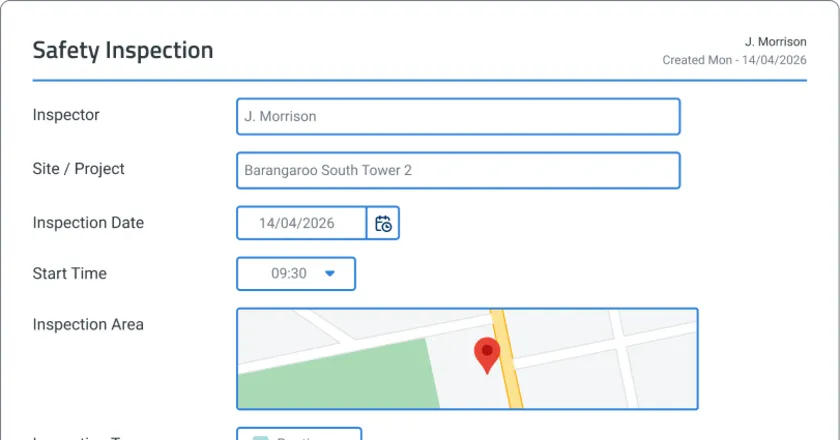
Safety Inspections App
Safety inspections app template that turns voice notes and photos into completed compliance reports on-site. GPS tagging, AI drafting, corrective
View app
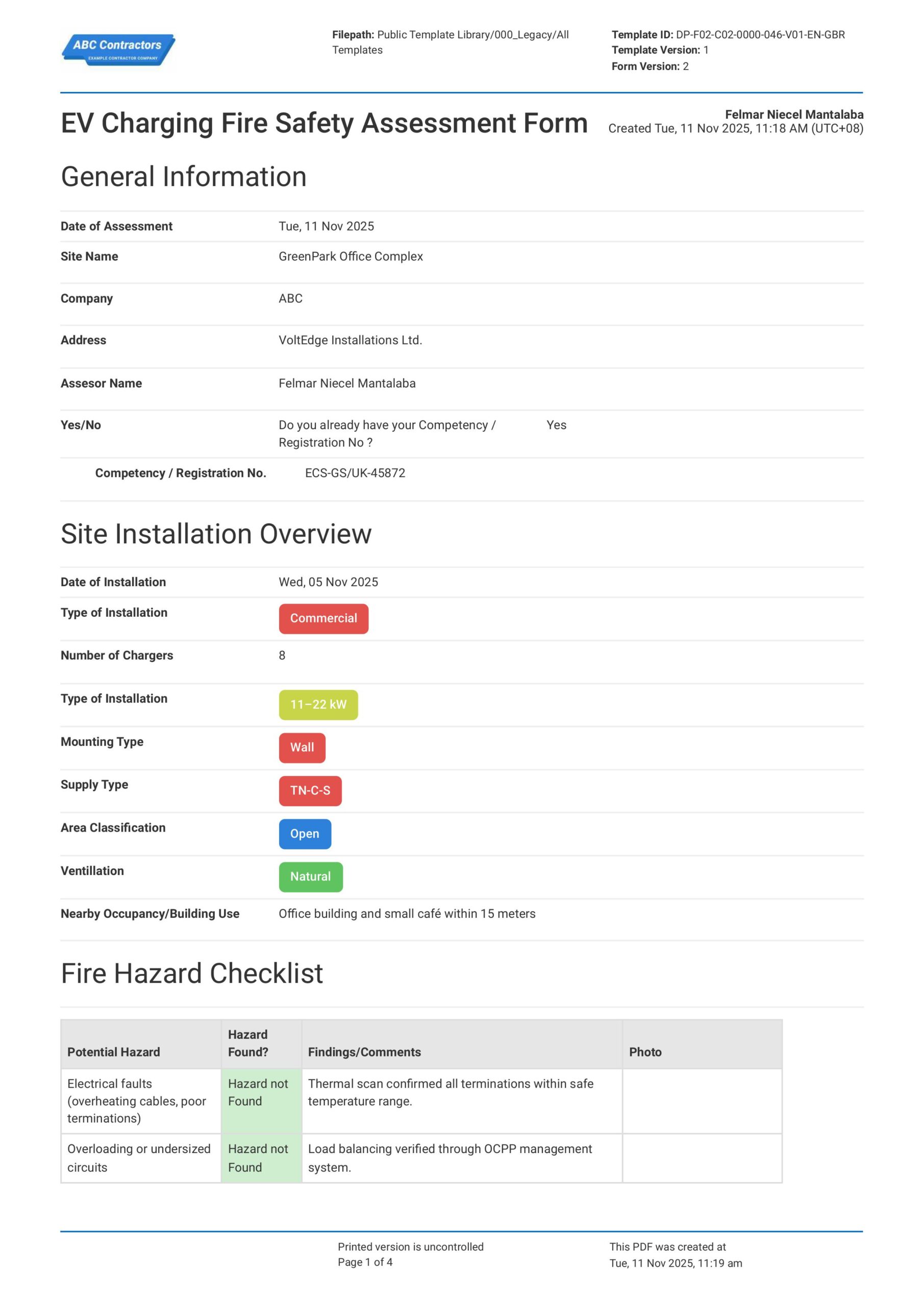
Electric Car Charging Fire Risk Assessment
This Electric Car Charging Fire Risk Assessment is used to streamline the fire assessment checks required by Part S regulations for installed EV charging points. It features comprehensive tables and checklists that can
View template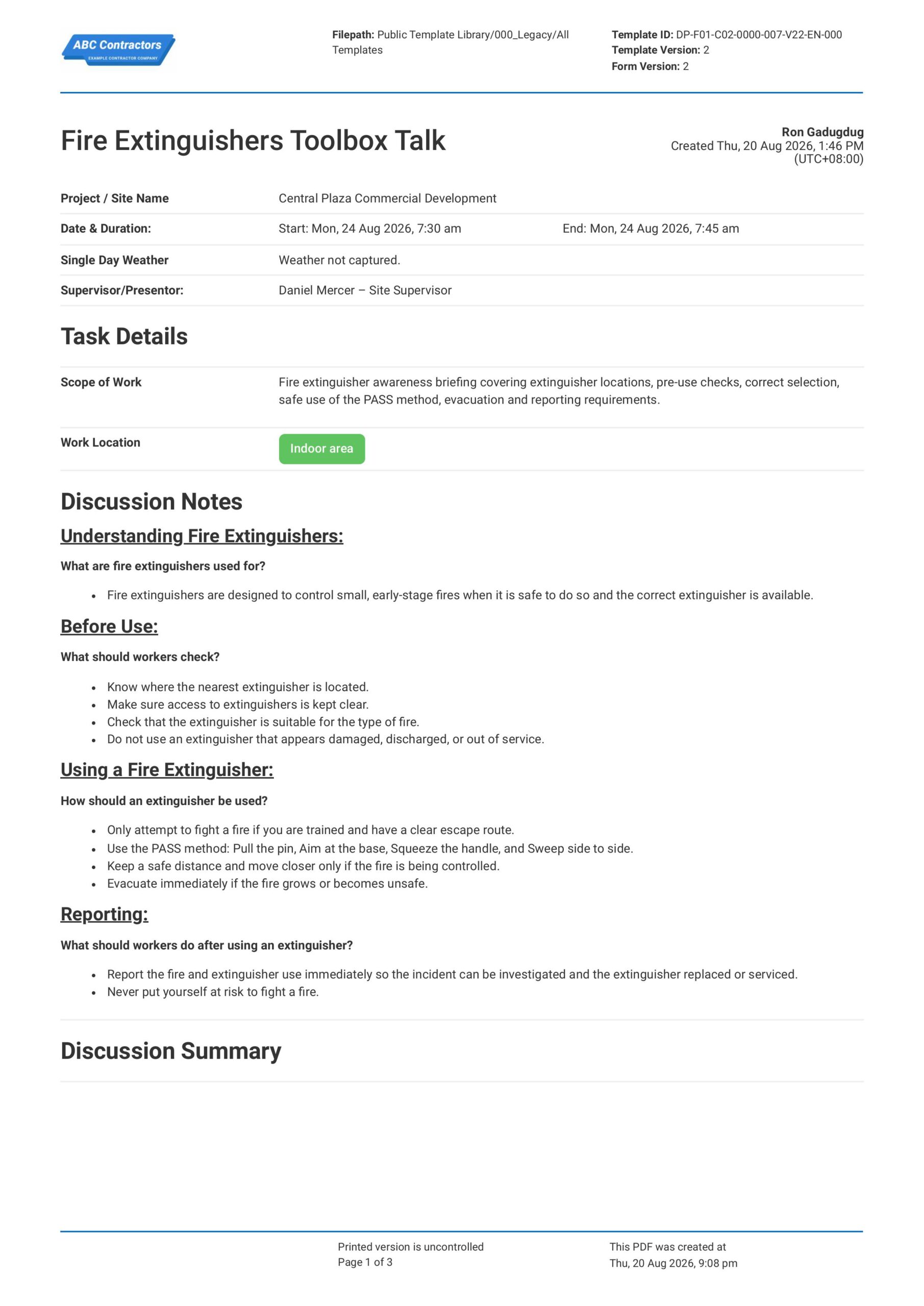
Fire Extinguishers Toolbox Talk
This Fire Extinguishers Toolbox Talk is an easy-to-use form that your workers can use to discuss fire extinguisher locations, basic use, inspection checks, and when to evacuate instead of trying to fight a fire. Record
View templateThis assessment was generated with Dashpivot software
- Access, edit and complete your Building Fire Risk Assessment from any device - mobile, tablet or computer.
- Print, download or send your Building Fire Risk Assessment as perfectly formatted PDF documents with your company logo.
- Store your Building Fire Risk Assessment securely online, where they can be searched and found in seconds
- Invite internal and external parties to see, edit and sign off on Building Fire Risk Assessment online.
