
Fire Strategy Report Template
Start with a free 30-day trial. No credit card required.
 100% editable Fire Strategy Report
Save and export your reports to PDF or CSV
Accessible reports on your phone, tablet, laptop, or computer
Check out hundreds of other safety assurance reports

~200 employees

~20 employees

~25,000 employees

~40 employees

~10,000 employees

~1,500 employees

~35,000 employees
What is a Fire Strategy Report?
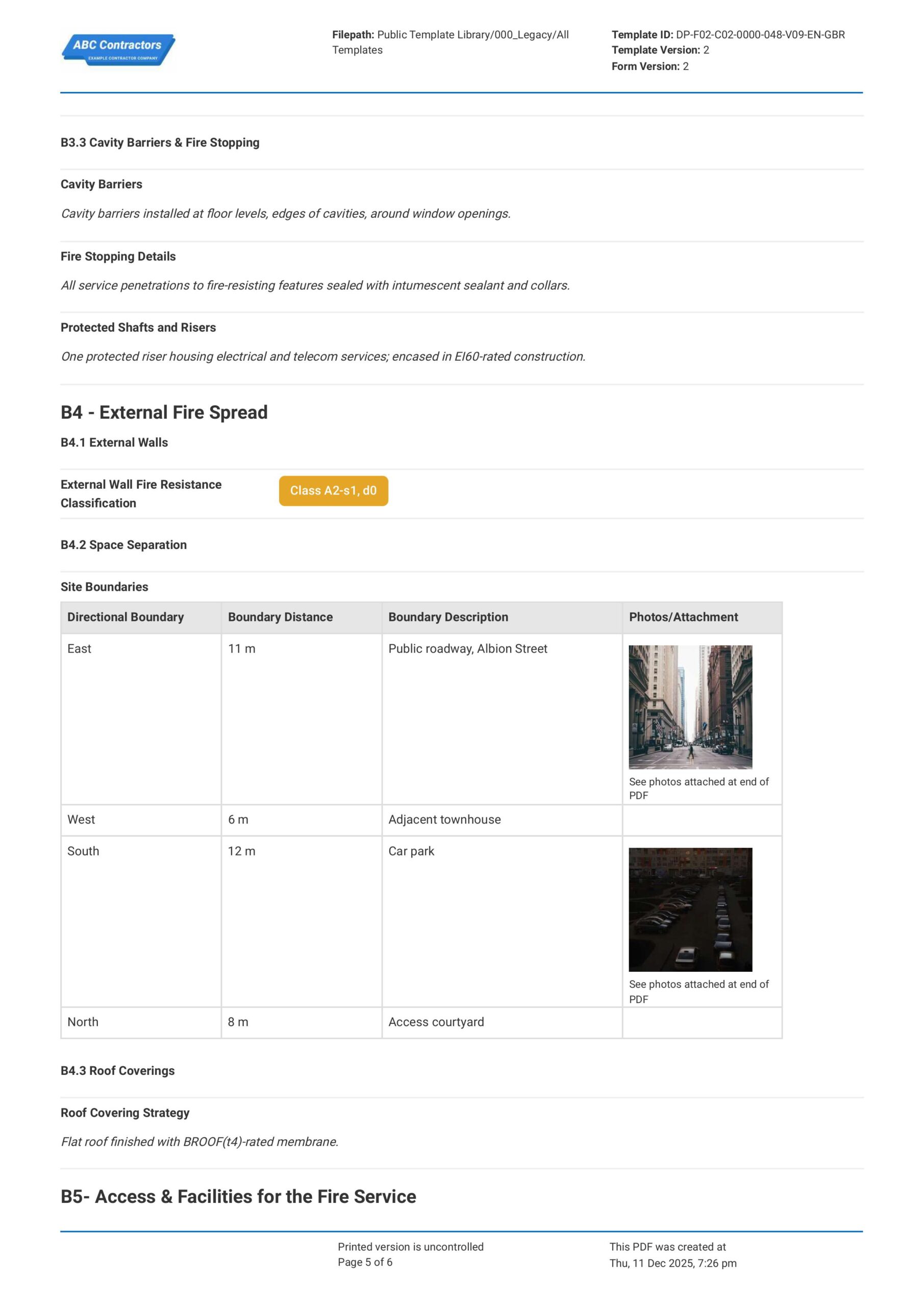
A Fire Strategy Report is a formal document used to demonstrate how a building complies with fire safety regulations. Specifically, it shows how building safety features such as escape routes, fire alarm and detection systems, fire suppression systems, smoke detection and ventilation, and overall structural design comply with building safety requirements.
In the UK, it is explicitly required that all buildings demonstrate compliance to fire safety regulations in the Building Regulations, (2010). Further, it is lawfully required under the Building Safety Act of 2022 that detailed fire safety design information is submitted to building control officials for review. A Fire Strategy Report is usually the recognized document to meet these regulatory requirements and will be expected of you during safety audits and inspections.
Compare this Fire Strategy Report with other pre-made forms on Word or PDF
Use this Fire Strategy Report template for free.
Understanding Building Fire Strategy
What is a Fire Safety Strategy Report?
A Fire Safety Strategy Report is a document used by engineers, architects, and property owners to show how a building complies with fire safety regulations. Essentially, this report contains all the design strategies and safety features a building has including escape routes, emergency response procedures, early warning systems, smoke and fire detection, etc. In the UK, the Building Regulations, 2010 (England & Wales) requires that all buildings must comply with functional fire safety requirements. Specifically, these requirements can be found in the official Building Regulations Approved Document B.
What is the Primary Aim of a Fire Strategy Report?
Primarily, the aim of a fire strategy report is to guide building control, safety auditors, and even building occupants on how safety and emergency response features of your building functions. Additionally, it is used by firefighters and fire departments to guide them before and during emergencies. Further, in the UK, it is used to compile and document compliance to the UK Approved document B regulations.
What Should a Fire Strategy Include?
A good Fire Strategy should include all the necessary requirements applicable to your specific region, and how your building design and its safety features comply with these requirements. In the UK Approved Doc. B, fire safety regulations are categorized as follows:
- B1 – Means of warning and escape
- B2 – Internal fire spread (linings)
- B3 – Internal fire spread (structure)
- B4 – External fire spread
- B5 – Fire service access and facilities
When is a Fire Strategy Report Required?
In the UK, it is important to note that a Fire Strategy Report is not explicitly required in the building regulations Approved Document B Fire Safety. However, you are required to comply with these building regulations, and submitting a building fire strategy report is the easiest way to demonstrate compliance. Typically, you will be expected to create and submit a report when you are constructing a new building, or performing alterations or refurbishments to escape routes or fire safety features, and whenever a change of use occurs to your building.
Common Fire Strategy and Tactics
Fire Strategy and firefighting tactics are an important aspect of building safety you should consider when designing safety and emergency response features. In the event of a fire, occupants of your building should be aware of appropriate safety and evacuation procedures, aside from being provided with ample firefighting protocol that could buy them precious seconds to react. With this, while fires and accidents can never be fully avoided, you can ensure the safety and wellbeing of the building occupants and fulfill your role as a “responsible person”
However, these strategies differ depending on a multitude of factors like your specific building design, available emergency firefighting measures, types of detectors and alarms installed, etc. It is critical that your team studies your specific building layout and safety features to devise correct fire safety strategies.
Fire Strategy Examples in the Real World
First, it is important to note that there is no one-size-fits-all strategy that you can apply to all building types. You must consider several factors such as building type, occupation, surrounding environment, in-building safety features, among others. Here are some common fire strategies and tactics that you should know:
- Total Evacuation
- Simultaneous Evacuation
Occupants evacuate the building all at the same time, typically at the sound of a fire alarm. This is common in smaller or less complex buildings where escape routes can accommodate all occupants moving together. - Phased Evacuation
Occupants evacuate in a controlled and expected sequence. As a result, this reduces congestion at escape routes and is common in larger or taller buildings that have more occupants. - Progressive Evacuation
Occupants initially move to a safer area within the building before continuing to a final place of safety, if necessary. - Progressive Horizontal Evacuation
People move into an adjacent, fire-resisting area on the same level rather than using stairs immediately. Typically, this is used in hospitals and care homes where occupants may have limited mobility. - Two-Stage Evacuation
Staff and responsible persons are alerted first, often via a silent alarm, to investigate the fire or prepare for evacuation before a full alarm is sounded. Used where immediate full, sudden evacuation could cause panic. - Defend in Place
Occupants remain where they are, and rely on fire resisting construction and fire fighting equipment until the fire is under control or further instruction is given. Typically, this is used in buildings or areas where evacuation is difficult. - Stay Put
Occupants remain in their individual dwellings unless the fire directly affects them or until they are instructed to evacuate. Specifically, this is common in blocks of flats such as village housing, or other buildings with robust compartmentation.
All occupants are moved to a predetermined safe space outside the building. This may happen either all at once or in stages, depending on the building and management plan.
Frequently Asked Questions
Why is this the best Fire Strategy Report?
This Fire Strategy Report was created to help streamline report creation. It has all the necessary information fields you need to create a comprehensive report, whether you’re working on a dwelling or non-dwelling. Plus, you can even record comments, take & attach photos, even perform sign offs - all on one form.
Does this report format comply with any relevant building regulations?
This Fire Strategy Report was built entirely based on the Approved Document B Building Regulations. This means if you’re in the UK region, you can easily create reports to help you comply with building safety regulations.
How do I edit the template to add or remove some fields?
You can add, remove, or edit any portion of the template using Dashpivot and its intuitive, drag-and-drop template builder. You can even add your company logo and letter head to the document to really make it tailor-fit to your company’s needs.
How do I share the reports I make?
Once you're finished creating your report on your phone, tablet, laptop, or computer, you can share your reports by saving and exporting them to PDF or CSV so it’s easily accessible to other stakeholders.

Other popular templates you can use and edit for free

Fire Escape Inspection Report
Record escape route inspections in a clear, professional format that supports safer evacuation planning and compliance reviews.

Fire Safety Compliance Report
Compile all building fire safety measures and checks into a single report and demonstrate accountability and compliance.
Building Fire Risk Assessment
Identify fire hazards and risk levels in your building using a comprehensive assessment that can support informed safety decisions.

This report was generated with Dashpivot software
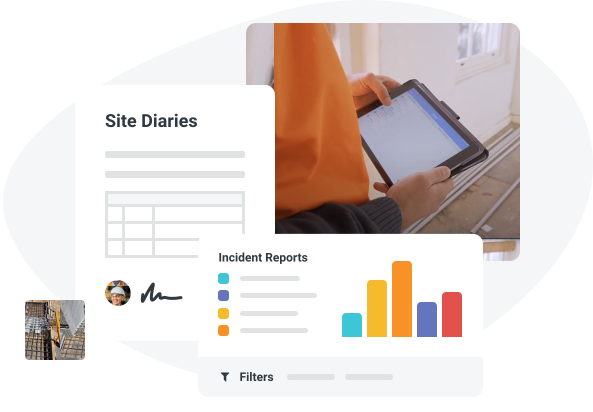
Go digital. Thousands of engineers and architects accross the world are using Dashpivot to streamline workflows and move away from traditional, labor-intensive paper work.
- Access, edit and complete fire strategy reports from any device - mobile, tablet or computer.
- Print, download or send your strategy reports as perfectly formatted PDF documents with your company logo.
- Store your reports securely online, where they can be searched and found in seconds
- Invite internal and external parties to see, edit and sign off on reports online.

Sitemate builds best-in-class software tools for built world companies.
 English (United States)
  English (Australia)
  English (UK)
  English (New Zealand)
  English (South Africa)
  German