Line of Fire Safety Toolbox Talk Template

Start with a free 30-day trial. No credit card required.
Need a Line of Fire Safety Toolbox Talk your crew can pick up and use straight away? This template comes pre-written with the key discussion points supervisors need to cover before a job or shift begins, including hazard identification, safe positioning around moving objects, sudden energy releases, and sharp equipment. You can edit any section to reflect your company's specific site conditions, equipment, or internal procedures, and the completed record will still hold up against the safety regulations and audit requirements your organisation is expected to meet.
This Line of Fire Safety Toolbox Talk, or LOFTT, is an easy-to-use form that your workers can use to record attendance at pre-shift safety briefings focused on line of fire hazards. It allows supervisors to document the topics discussed, capture employee sign-offs, and maintain a clear record that the team was briefed on the risks of being positioned in the direct path of a moving object, a sudden release of energy, or a sharp object before work began.
 100% fully editable Line of Fire Safety Toolbox Talk
Export your Line of Fire Safety Toolbox Talk to PDF or CSV
Access your Line of Fire Safety Toolbox Talk on mobile, tablet or computer

Trusted by companies, projects and teams of all sizes















What is Line of Fire Safety Toolbox Talk?
A Line of Fire Safety Toolbox Talk template is a record of the informal safety meetings that focus on topics related to the path where employees are directly exposed to a moving object, a sudden release of energy, or a sharp object. Also called tailgate meetings or safety briefings, these short meetings happen before the start of a job or work shift.
Compare this Line of Fire Safety Toolbox Talk template to paper-based forms created from Word, Excel or PDF
Curious how this Line of Fire Safety Toolbox Talk works? Check out the example below to see exactly what the form looks like when it is filled out. You can generate your own version in minutes, export it as a custom form that reflects your company's details, and have a complete, ready-to-use record of your line of fire safety briefing without starting from scratch.
Use this Line of Fire Safety Toolbox Talk template for free

Generate this template automatically with Storm
You don't have to build the Line of Fire Safety Toolbox Talk field by field. Let Storm, the AI Data Capture Agent inside Dashpivot, build the template for you in seconds.
Describe what you need
Tell Storm the form you want in plain language and it builds a structured digital template from scratch, with fields, tables, and signatures in place.
Upload what you already use
Drop in your existing PDF, Word, Excel, or even a photo of a paper form. Storm rebuilds it as a smart digital template with the structure intact.
 Storm
Storm
Generate a Line of Fire Safety Toolbox Talk form template that I can use for my business
Applicable Standards and Policies for Line of Fire Safety Toolbox Talk
Accidents often occur when workers remain too close to hazards, so maintaining a safe distance from them is essential for prevention. Companies need to establish this safe distance in their safety protocols and regularly remind employees of it. The best way to do that is to conduct toolbox talks on line of fire safety. The talk ensures that employees will always remember the safety protocol and the company will constantly abide by the following regulatory standards:
- OSHA 29 CFR 1926 (Construction Safety)
- OSHA 29 CFR 1910 (General Industry)
- ANSI/ASSP Z10.0
- ISO 45001:2018
- NFPA 1 (Fire Code) and NFPA 101 (Life Safety Code)
- Mine Safety and Health Administration (MSHA) 30 CFR Site-specific Work Health and Safety (WHS) management plans
Staff Members and Parties that use Line of Fire Safety Toolbox Talk
Making the Line of Fire Safety Toolbox Talk template is not a one-person job. It requires multiple inputs to ensure that all the hazards are identified and the proper measures are provided. To complete the toolbox talk form, the following personnel must contribute to it:
- Supervisors: They lead the team, which includes managing the workforce in the field. They are the personnel who verify that the workforce has completely understood the hazards involved in performing activities and has been provided with the proper and appropriate PPE before starting.
- Safety Officer: A safety officer’s major responsibility is to completely implement safe work practices in the workplace. They establish the criteria for what is safe and what is not. They evaluate the control systems for tasks that entail high-risk activities.
- Operators and Maintenance staff: These employees are the ones that could potentially be exposed to the line of fire when working. These people may provide various crucial inputs during the creation of a toolbox talk template because they are the ones who are exposed to the hazards while operating or working with the equipment.
Business Risks Reduced by Line of Fire Safety Toolbox Talk
Safety must always be the top priority, especially in industries that involve high-risk activities. Conducting a toolbox talk on line of fire safety would not only protect the employees and assets of the company but also shield the company from other risks that could harm it in various ways. To put it simply, the Line of Fire Safety Toolbox Talk also acts as a shield to the following business risks:
- Financial losses due to high costs related to accidents, property damage, and delays
- Legal liabilities due to non-compliance with safety regulations
- Damaged relationships due to poor reputation and trust
- High insurance costs and compensation claims
- Discontinuation or suspension of operations
- Poor employee morale
Business Opportunities Created by Line of Fire Safety Toolbox Talk
Choosing to commit to providing a safe and healthy environment has its merits. It not only shields employees and company property from hazards but also provides benefits and advantages for the company. Establishing concrete safety processes, such as the toolbox talk on line of fire safety, provides companies with business opportunities that help them gain more than what they have already established. These are the business opportunities that can appear naturally when conducting a Line of Fire Safety Toolbox Talk:
- Stable and solid client trust and relationship
- Greater competitive advantage on landing larger projects
- Achieving milestones on time or ahead of time
- Efficient operations
- Positive and a healthy workplace—both physical and mental
- Good reputational standing due to constant compliance with safety regulations
What to Cover in a Line of Fire Safety Toolbox Talk
- Common Hazards: Identifies specific line-of-fire-related risks, including crushing, electrocution, and exposure to extreme heat.
- Implementing Controls: Details protective measures like protective systems, equipment inspections, and safe work practices.
- Notes Raised by Attendees: Records unique safety concerns or observations shared during the talk.
- Actions Arising from the Meeting: Lists tasks and responsibilities assigned to address identified issues.
- Attendance Record: Logs attendees to keep all relevant personnel informed and involved.
How to Use This Free Safety Toolbox Talk Template on Site
Getting the most out of this Free Line of Fire Safety Toolbox Talk template comes down to consistency and specificity. The biggest mistake supervisors make with toolbox talks is running them as a generic, tick-the-box exercise that doesn’t reflect the actual hazards on site that day. This template is designed to prevent that — it prompts discussion across the key line of fire hazard categories while giving supervisors space to add site-specific issues relevant to the current task or work zone.
For best results, conduct the Line of Fire Safety Toolbox Talk at the start of the shift or immediately before a high-risk task begins, not at the end of the day. Keep the briefing focused — 10 to 15 minutes is sufficient for most line of fire topics. Encourage workers to raise hazards they’ve observed rather than treating it as a one-way lecture. Record everything raised in the discussion, not just the pre-populated prompts, and assign clear action items with named owners before the crew disperses. Completed forms should be submitted to the safety register the same day so records are current and accessible if needed.
For teams managing multiple crews or projects, using a digital version of this free safety toolbox talk template means completed records flow into a central register automatically, giving safety managers real-time visibility across all active sites without manually collecting paper forms.
How to make a Line of Fire Safety Toolbox Talk template
Creating and delivering a structured Line of Fire Safety Toolbox Talk is straightforward when you have the right template. Follow these steps to prepare, run, and record an effective briefing that keeps your crew safe and your records complete.
Prerequisites in creating a Line of Fire Safety Toolbox Talk template
- The day’s work plan, including tasks, locations, and equipment to be used
- A list of all workers who will be attending the briefing
- Any recent incident reports, near miss records, or hazard observations relevant to line of fire risks on this site
- The site’s safety management plan or SWMS for tasks involving line of fire hazards
- Access to the Free Line of Fire Safety Toolbox Talk template (digital or printed)
- Any updated permit to work or exclusion zone information for the work area
-
Add an information section
This section provides an overview of the details. The following fields must be present in this section:
- Toolbox title
- Date of activity
- Toolbox presenter
- Toolbox talk form number
-
Add a hazard information section
The hazard information section is part of the Line of Fire Safety Toolbox Talk template and should provide information on the hazards found when performing activities. It should contain the following:
- Identified hazards
- The risks involved in the hazard
- Potential effect of the hazards
-
Add a safety control information section
The safety information section is part of the Line of Fire Safety Toolbox Talk template that should provide details on the necessary safety measures. It should contain the following:
- Control measures
- Description of safety measures
-
Add a raised concerns section
This section should capture the concerns raised or notes added by the workers. The fields needed in this section are:
- Topic or concern
- Detail
- Person who raised the note or concern
-
Add a needed actions section
This section presents all the actions required to address the raised note or concern. The following fields must be present in this section:
- Description of needed action
- Responsible person
- Due date
- Status of action
-
Add an attendance section
This section should allow the supervisor to record all those who attended the toolbox meeting. It should have the following fields:
- Employee name
- Employee ID number
- Employee Signature
- Signature timestamp
- Provide a signature field for the supervisor who conducted the toolbox talk
Frequently asked questions
How to create your Line of Fire Safety Toolbox Talk in an App or Software System
A well-designed digital Line of Fire Safety Toolbox Talk template includes a process that is both faster to execute and more reliable as a compliance record. Supervisors should spend less time on paperwork and more time on the actual safety conversation. It also helps safety managers gain visibility across all sites and crews without chasing paper or manually compiling spreadsheets. And when an audit or incident investigation requires evidence that a line of fire safety toolbox talk was delivered to a specific crew on a specific date, the record is there, complete, signed, and searchable in seconds rather than hours.
15 minutes
Easy difficulty
-
How to create a Line of Fire Safety Toolbox Talk template in an app?
Using an app that uses digital forms instead of paper-based forms substantially improves the form by:
- Providing a single entry point for all completed toolbox talk forms
- Less manual data entry
- Simple reformatting to accommodate new protocols or updated standards
- Faster integration of relevant documents
- Creation of a more defined workflow
-
Formatting the Information section
- Add a date field to allow users to input toolbox talk date
- Provide a text field so users can input the safety toolbox presenter’s name
- Add a prefilled text field for the identified hazards information section. The purpose of this field is to ensure that all toolbox talks on line of fire safety already include the identified hazards’ information in the form. This field should provide information about the identified hazards, the risks involved in the hazard, and potential effects of the hazards.
- Add a prefilled text field for the safety control information. The purpose of this field is to ensure that all toolbox talks on line of fire safety already include the required safety control information in the form. This field should provide the following information about the control measures and a description of those measures.
-
Formatting the raised concerns section
- Add a field where users can select a yes or no answer from this question: Are there notes or concerns raised by attendees?
- Provide logic that when a user selects “yes,” a 3-column table appears. Format this table to enable users to freely add rows.
- Provide the following headers for each column of this table: concern/notes, detail, raised by
- Format each field in the table as text fields
-
Formatting the actions arising section
- Add a field where users can select a yes or no answer from this question: Did any actions arise as a result of the meeting?
- Provide logic that when a user selects “yes,” a 4-column table appears. Format this table to enable users to freely add rows.
- Provide the following headers for each column of this table: action description, responsible, due date, status
- Format the first 2 columns of the table as text fields to enable users to input action description and responsible person
- Format the third column as a date field
- Format the last column as a selection field for the status of the action. Each selection item can be integrated with colors to make the form more professional. Selection items: open, closed, transferred
-
Formatting the attendance section
- Add a section where employees can have their IDs scanned to record their attendance automatically.
- Add a signature field for the safety toolbox talk presenter.
About the author

Felmar Mantalaba
Content Engineer
 LinkedIn
Education
Cebu Institute of Technology - University - Mechanical Engineering with Mechatronics
Bio
Felmar is a mechanical engineer, whose four years of experience in the mining industry inspired him to write and share stories to progress the revolution of new technologies and create smarter, smoother ways of living.
Past Projects
Safety, Health, and Environment Management System (SHEMS) CoordinationSHEMS Coordinator at Atlas Consolidated Mining, ensuring organizational compliance with ISO 14001 and ISO 45001 standards, performing risk assessments, developing policies, and conducting audits and inspections to maintain a safe and environmentally responsible workplace.
Maintenance Management and OptimizationSenior Maintenance Manager (OIC) leading equipment maintenance and operational efficiency initiatives, reducing downtime by 10%, improving Mean Time Between Failure (MTBF) and Mean Time To Repair (MTTR) for major equipment, and managing maintenance schedules, manpower, and materials, while overseeing capital project optimization.
Inspection Engineering and Equipment ReliabilityInspection Engineer responsible for technical blueprint interpretation, vendor collaboration, preventive maintenance scheduling, and data collection for vibration and temperature readings, delivering actionable recommendations and comprehensive reports to improve equipment reliability and operational performance.
End-to-End Operational Oversight in Mining EngineeringContributed to multiple facets of operational management, including SHEMS compliance, maintenance optimization, inspections, and capital project evaluation, integrating safety, reliability, and efficiency improvements across all stages of copper production operations.
Version History:
Related apps and templates
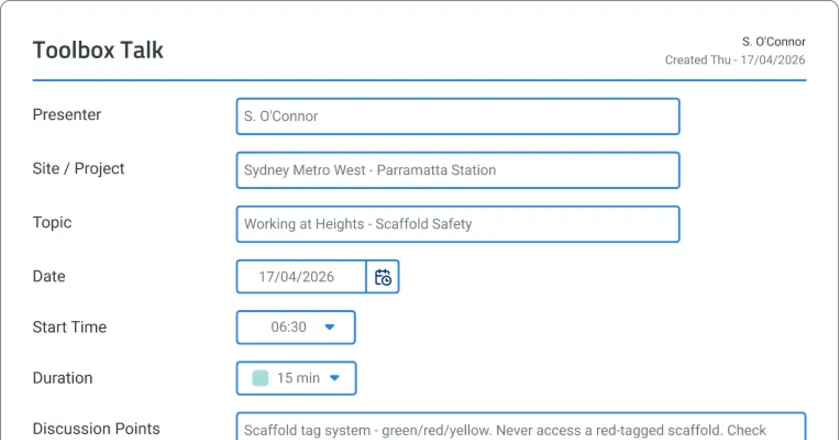
Toolbox Talk App
Toolbox Talk App by Sitemate captures digital attendance, voice-recorded safety discussions, and audit-ready records as the briefing happens. Try
View app
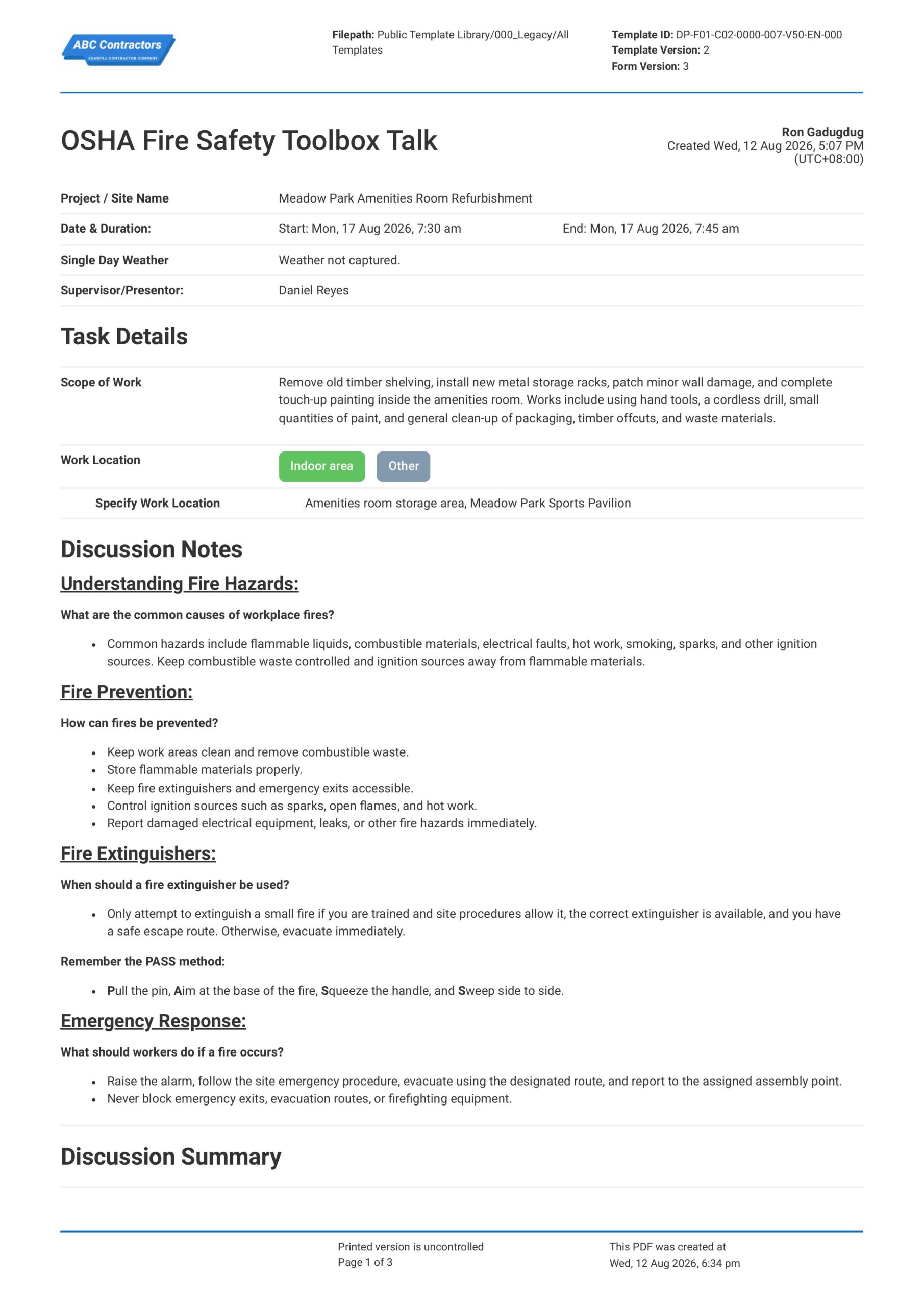
OSHA Fire Safety Toolbox Talk
This OSHA Fire Safety Toolbox Talk is an easy-to-use form that your workers can use to discuss fire hazards, ignition sources, fire prevention controls, and emergency procedures before starting work. Record important
View template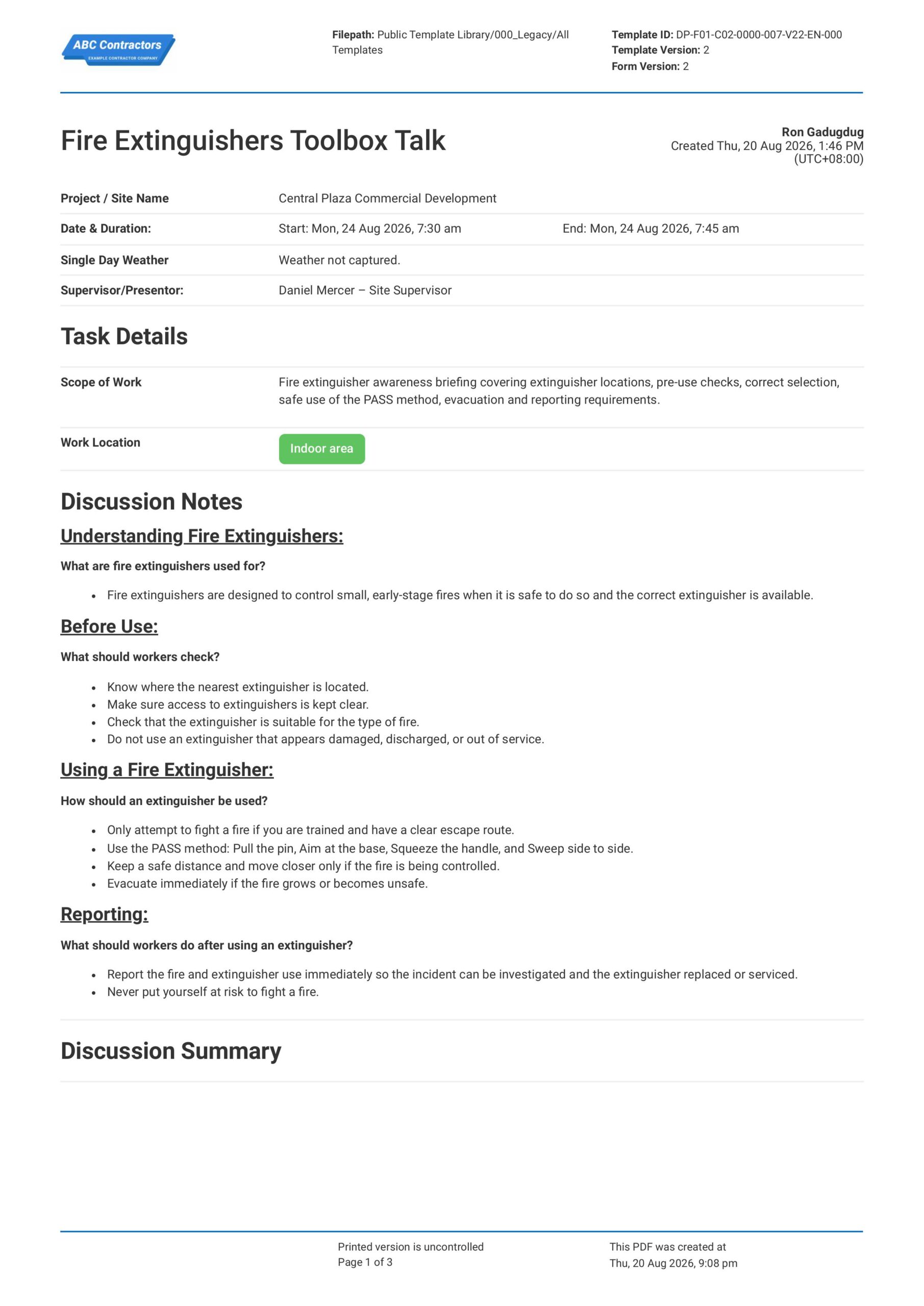
Fire Extinguishers Toolbox Talk
This Fire Extinguishers Toolbox Talk is an easy-to-use form that your workers can use to discuss fire extinguisher locations, basic use, inspection checks, and when to evacuate instead of trying to fight a fire. Record
View templateThis form was generated with Dashpivot software
- Access, edit and complete your Line of Fire Safety Toolbox Talk from any device - mobile, tablet or computer.
- Print, download or send your Line of Fire Safety Toolbox Talk as perfectly formatted PDF documents with your company logo.
- Store your Line of Fire Safety Toolbox Talk securely online, where they can be searched and found in seconds
- Invite internal and external parties to see, edit and sign off on Line of Fire Safety Toolbox Talk online.
