Toolbox Talk Template

Start with a free 30-day trial. No credit card required.
Need a Toolbox Talk your crew can pick up and use straight away? This template comes pre-written with the key sections supervisors need to run a short safety meeting, including space to record the safety topic covered, the date, and the attendance of everyone who took part. You can edit any section to reflect your company's specific safety protocols, local regulations, and the way your team actually runs these meetings, so the completed form holds up if you are ever audited or asked to demonstrate compliance.
This Toolbox Talk, sometimes referred to as a TBT, is an easy-to-use form that your workers can use to document each safety discussion held on site, capture who attended, and keep a clear record of the safety topics covered over time. Supervisors can work through the form in the same fifteen minutes it takes to run the talk itself, giving the whole team a consistent, reliable way to build and demonstrate a stronger safety culture across every shift and work area.
 100% fully editable Toolbox Talk
Export your Toolbox Talk to PDF or CSV
Access your Toolbox Talk on mobile, tablet or computer
Trusted by companies, projects and teams of all sizes















What is Toolbox Talk?
A Toolbox Talk Template is a form that records what happens during a toolbox talk. It is a free form that accommodates different safety topics that supervisors would discuss to help foster a stronger safety culture within the company. Toolbox Talks may be considered informal meetings, but these 15-minute talks help employees remember the safety protocols established by their companies, ensuring that all safety controls are always implemented and regularly followed.
Compare this Toolbox Talk Template to paper-based forms created from Word, Excel or PDF
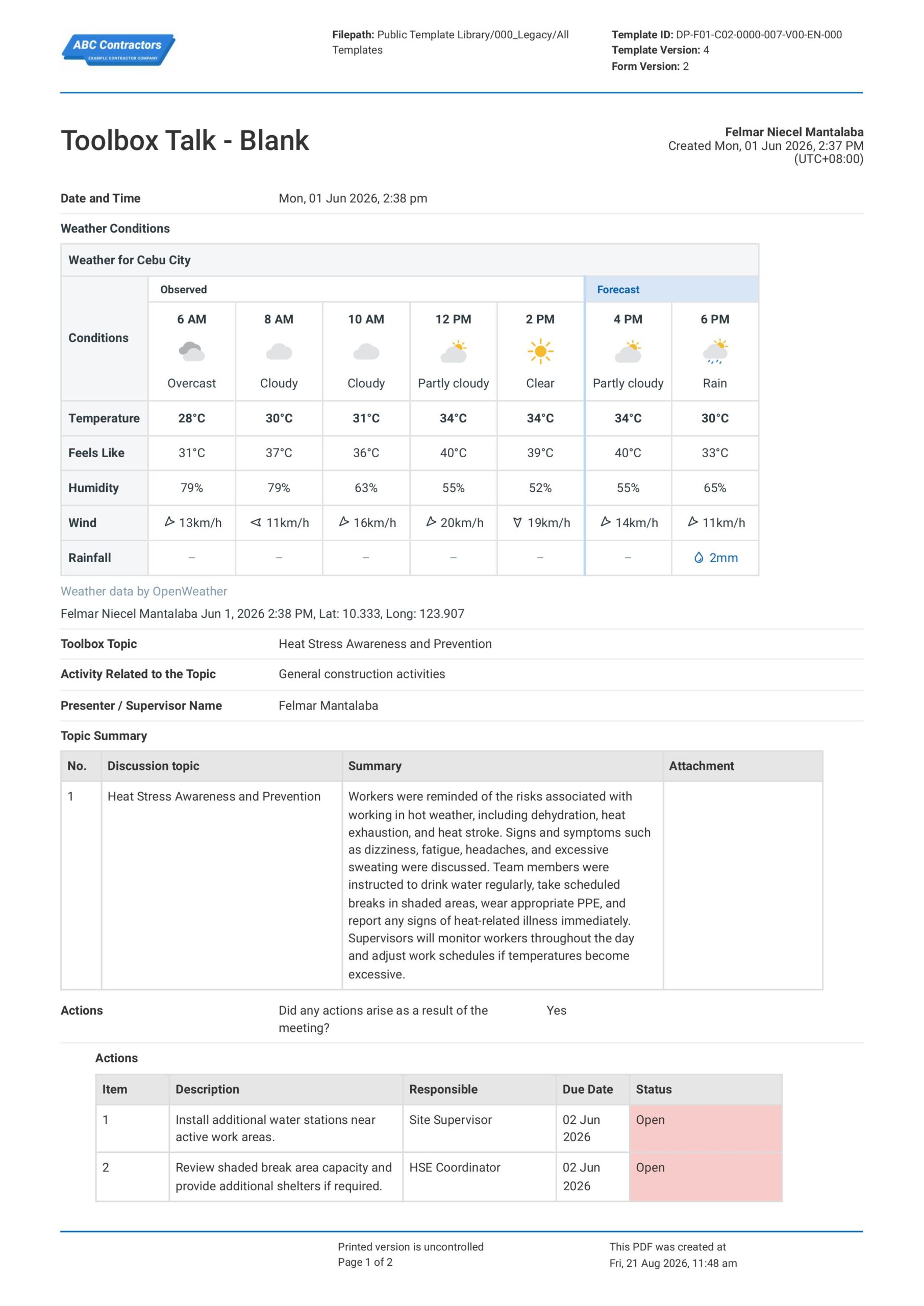
Curious how this Toolbox Talk works? Check out the example below to see exactly what the form looks like in practice. From there you can see how quickly you can generate one, export it as your own custom form, and fill in your site details, safety topic, and attendee list to have a ready-to-use document in minutes.
Use this Toolbox Talk template for free

Generate this template automatically with Storm
You don't have to build the Toolbox Talk field by field. Let Storm, the AI Data Capture Agent inside Dashpivot, build the template for you in seconds.
Describe what you need
Tell Storm the form you want in plain language and it builds a structured digital template from scratch, with fields, tables, and signatures in place.
Upload what you already use
Drop in your existing PDF, Word, Excel, or even a photo of a paper form. Storm rebuilds it as a smart digital template with the structure intact.
 Storm
Storm
Generate a Toolbox Talk form template that I can use for my business
Applicable Standards and Policies for Toolbox Talk
Providing safety control measures is always the best way to manage hazards in the workplace. This principle is true of all industries around the world, be it construction, manufacturing, or mining. However, these safety controls require continuous implementation to be effective, which is why conducting toolbox talks has become a best practice for maintaining the implementation of these safety measures. Furthermore, it also helps companies stay compliant with the following standards:
- OSHA 29 CFR 1926 (US Construction)
- OSHA 29 CFR 1910 (US General Industry)
- ANSI/ASSP Z10 (Occupational Health and Safety Management Systems)
- ISO 45001:2018 (Occupational Health and Safety Management)
- Safe Work Australia Model WHS Act and Regulations
- HSE (UK) Health and Safety at Work Act 1974
- NFPA 70E (Electrical Safety)
- Site-specific Safety Management Plans (SMPs)
- Construction (Design and Management) Regulations 2015 (CDM 2015, UK)
Staff Members and Parties that use Toolbox Talk
The Toolbox Talk would be much more efficient if relevant employees took part in the process. Each employee could assess each procedure of the activity they are assigned to, which would be thoroughly sorted out for hazards and provided with safety control measures, leaving no room for health and safety risks. Ideally, the following personnel are vitally needed to create a Toolbox Talk:
- Maintenance Crew: These personnel are responsible for the health of the equipment or machinery. They schedule the machinery for inspections, repairs, or overhauls. However, such activities include hazards that could potentially harm the employees. To fully identify hazards found in maintenance activities, the maintenance crew should be involved in the risk assessment process. They have full knowledge of the equipment or machinery, so identifying the parts that could potentially harm them would be effortless.
- Operators: These are the personnel who drive, operate, or manage the equipment or machinery. It is their responsibility to ensure that the machinery is operating based on their specified parameters and limits and adjust it safely based on data-driven decisions. Involving the operators in the creation of a Toolbox Talk would help streamline the process of identifying which procedures need to have safety control measures.
- Field managers and supervisors: Field managers and supervisors are the leaders in the field. They oversee and manage the teams conducting operation and maintenance activities on plant machinery and equipment. As leaders, it is their primary priority to ensure all conducted activities—from start to finish—are free from hazards. To achieve one hundred percent safety, they must spearhead the toolbox talk session and gather all involved personnel to contribute to identifying, evaluating, and providing controls for hazards.
- Safety Officers: Their primary responsibility is to properly implement safe work standards at the workplace. They establish the criteria for what is safe and what is not. They evaluate the control procedures for tasks involving high-risk plant machinery and equipment. Their knowledge of safety would be essential for the fields inside the toolbox form, especially in providing the best safety measures for the identified hazards.
Business Risks Reduced by Toolbox Talk
Conducting toolbox talks protects personnel from risk and damage. Additionally, these short meetings also safeguard the corporation against commercial hazards that may threaten its financial standing and reputation. Frequent toolbox talks can help avoid the following business risks:
- Increased risk of workplace injuries, resulting in a higher Lost Time Injury Rate (LTI)
- Financial instability caused by medical and non-compliance costs
- Disrupted operations resulting in output losses and missed targets
- Damaged reputation
- Deteriorated relationships between employees, employers, and stakeholders
- Loss of certifications and accreditations
Business Opportunities Created by Toolbox Talk
Regularly conducting toolbox talks is beneficial to businesses. It protects personnel and assets and improves the company’s general reputation. Companies that do regular toolbox talks perform better because they have fewer accidents and equipment downtime than those who do not take a proactive approach to hazard mitigation. Furthermore, it opens up the following business opportunities for the company:
- Competitive advantage in bidding
- Better cost savings
- Longer equipment and machinery life
- Better insurance terms
- Improved gains and output
What are the fields inside the Toolbox Talk Template?
- Meeting Details
- Safety Topic and Hazard Information
- Controls and Safe Work Procedures
- Discussion and Worker Engagement
- Actions and Follow-Up
- Attendance and Sign-Off
How to conduct a toolbox talk
Keep the session short—10 to 15 minutes is the standard. Begin by explaining why this topic is currently important on your site. Walk through the hazards and controls clearly, using plain language. Encourage workers to ask questions and share observations; record these in the template. Avoid reading directly from the sheet — use it as a guide, not a script. The goal is a genuine two-way conversation, not a one-way lecture.
Once the talk is complete, ensure that every worker in attendance signs the form. Complete any action items raised during the discussion, noting the responsible person and due date. File the signed form in your project safety register or upload it to your document management system. If you’re using Dashpivot, the completed record is automatically stored, searchable, and available for reporting, which means you can pull a full toolbox talk history for any site or crew in seconds. Whether you’re working from a printed sheet or a digital platform, the signed, completed download of the toolbox talk template is your proof that safety communication happened.
How to create a Toolbox Talk Template?
Creating an effective toolbox talk template takes less time than you might expect — the key is making sure it captures the right information consistently, every time. Follow these steps to build a template that works for your site, your team, and your compliance requirements.
Prerequisites before making a Toolbox Talk Template
- A clear list of the safety topics you need to cover (check your site safety plan, recent incident reports, and upcoming work phases)
- Your company’s logo and branding if required for professional presentation
- The names and roles of the people who will be running toolbox talks on site
- Any mandatory fields required by your principal contractor, client, or relevant safety standard (e.g., ISO 45001, OSHA)
- Examples of previous toolbox talk records to identify gaps or improvements
- Access to a PDF editor, Word processor, or a digital form builder like Dashpivot if you want a fully digital version
-
Add an information section
This section provides an overview of the details. The following fields must be present in this section:
- Toolbox title
- Date of activity
- Toolbox presenter
- Toolbox Talk number
-
Add a hazard information section
The hazard information section is part of the Toolbox Talk Template and should provide information on the hazards found when performing activities. It should contain the following:
- Identified hazards
- The risks involved in the hazard
- Potential effect of the hazards
-
Add a safety control information section
The safety information section is part of the Toolbox Talk Template that should provide details on the necessary safety measures. It should contain the following:
- Control measures
- Description of safety measures
-
Add a raised concerns section
This section should capture the concerns raised or notes added by the workers. The fields needed in this section are:
- Topic or concern
- Detail
- Person who raised the note or concern
-
Add a needed actions section
This section presents all the actions required to address the raised note or concern. The following fields must be present in this section:
- Description of needed action
- Responsible person
- Due date
- Status of action
-
Add an attendance section
This section should allow the supervisor to record all those who attended the toolbox meeting. It should have the following fields:
- Employee name
- Employee ID number
- Employee Signature
- Signature timestamp
- Provide a signature field for the supervisor who conducted the toolbox talk
Frequently asked questions
How to create your Toolbox Talk in an App or Software System
A well-designed Toolbox Talk Template helps supervisors educate workers on relevant safety protocols and reduce the risk of accidents by addressing safety hazards. A toolbox talk with a clear flow helps promote a safer work environment by reinforcing the importance of proper equipment use and protective measures.
15 minutes
Easy difficulty
-
How to create a Toolbox Talk Template in an App
Using an app that uses digital forms instead of paper-based forms substantially improves the form by:
- Providing a single entry point for all completed toolbox talk forms
- Less manual data entry
- Simple reformatting to accommodate new protocols or updated standards
- Faster integration of relevant documents
- Creation of a more defined workflow
-
Formatting the information section
- Add a date and time field so users can input the date and time of the toolbox talk.
- Add a weather conditions field so users can immediately provide the weather conditions for the day.
- Add three text fields so users can input the toolbox talk topic, activity related to the topic, and toolbox talk presenter.
-
Formatting the Topic Summary Section
- Add a three-column table where users can freely add rows.
- Format the top rows to the following headings: discussion topic, summary, and attachments.
- Format rows 2 and beyond in column 1 as text fields for users to input the discussion topic.
- Format rows 2 and beyond in column 2 as text fields for users to input the summary of the topic. This field also houses the identified hazards of the activity related to the topic.
- Format rows 2 and beyond in column 3 as attachment fields so users can attach relevant documents, like risk assessments and job hazard analyses.
-
Formatting the action section
- Provide a yes-or-no field to help users answer this question: Did any action arise as a result of the meeting?
- Provide logic where a 4-column table appears when the user selects a “Yes” on the question. The table should be formatted where users can freely add more rows.
- Provide the following headings on the topmost row of the table: description, responsible, due date, and status.
- For the remaining rows of columns 1 and 2, format these fields as text fields so users can provide a description of the action needed and the responsible person, respectively.
- Format the rest of column 3 as date fields so users can provide a deadline for the needed action.
- Format the rest of the rows of the last column as a selection field so users can select the status of the action item. Selection items in this field can be integrated with colors to make the form more professional. Here is a sample of the selection items: Open, Closed, Ongoing, Overdue
-
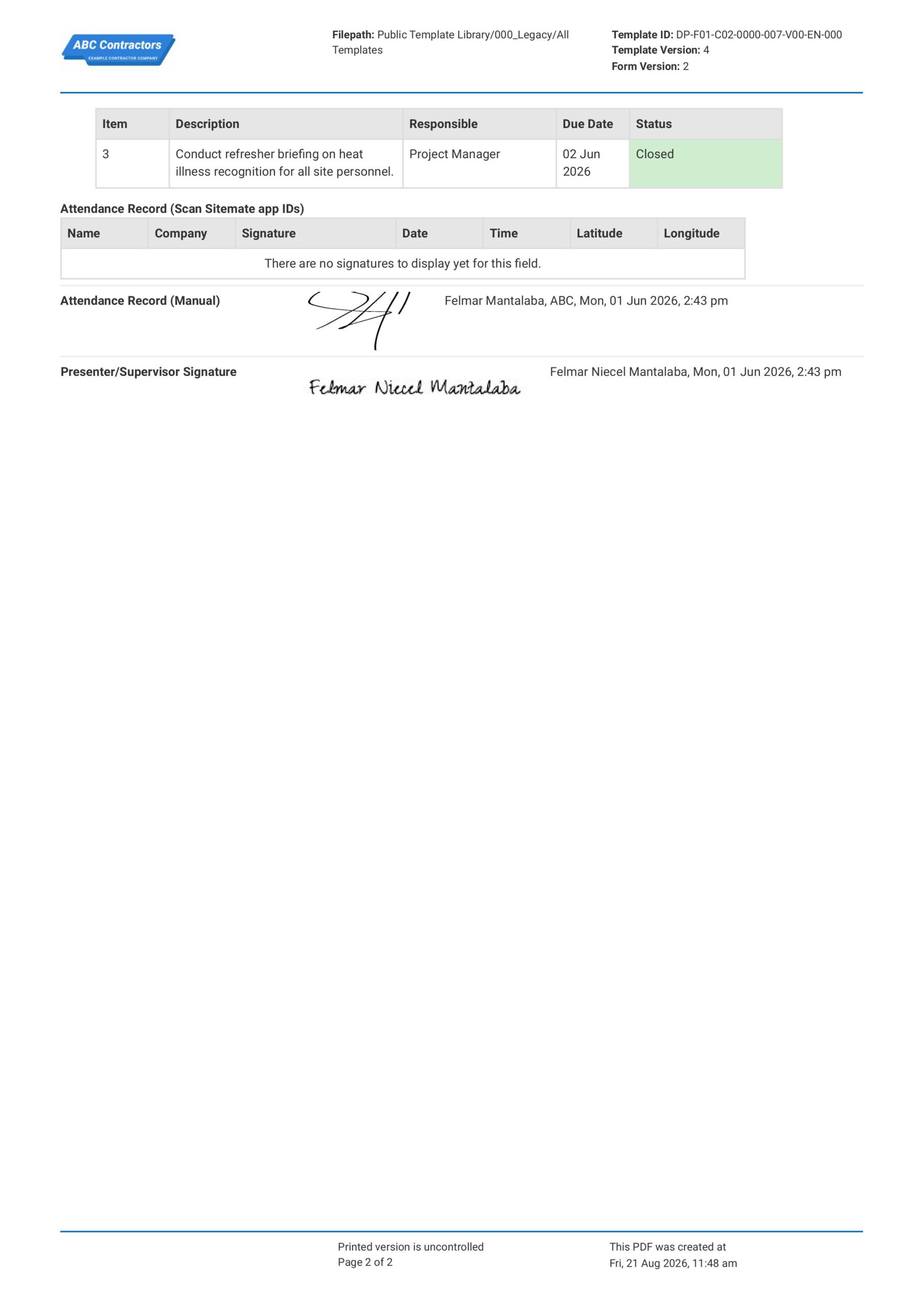
Formatting the attendance section
- Add a section where employees can have their IDs scanned to automatically record their attendance.
- Add a signature field for the toolbox talk presenter
About the author

Felmar Mantalaba
Content Engineer
 LinkedIn
Education
Cebu Institute of Technology - University - Mechanical Engineering with Mechatronics
Bio
Felmar is a mechanical engineer, whose four years of experience in the mining industry inspired him to write and share stories to progress the revolution of new technologies and create smarter, smoother ways of living.
Past Projects
Safety, Health, and Environment Management System (SHEMS) CoordinationSHEMS Coordinator at Atlas Consolidated Mining, ensuring organizational compliance with ISO 14001 and ISO 45001 standards, performing risk assessments, developing policies, and conducting audits and inspections to maintain a safe and environmentally responsible workplace.
Maintenance Management and OptimizationSenior Maintenance Manager (OIC) leading equipment maintenance and operational efficiency initiatives, reducing downtime by 10%, improving Mean Time Between Failure (MTBF) and Mean Time To Repair (MTTR) for major equipment, and managing maintenance schedules, manpower, and materials, while overseeing capital project optimization.
Inspection Engineering and Equipment ReliabilityInspection Engineer responsible for technical blueprint interpretation, vendor collaboration, preventive maintenance scheduling, and data collection for vibration and temperature readings, delivering actionable recommendations and comprehensive reports to improve equipment reliability and operational performance.
End-to-End Operational Oversight in Mining EngineeringContributed to multiple facets of operational management, including SHEMS compliance, maintenance optimization, inspections, and capital project evaluation, integrating safety, reliability, and efficiency improvements across all stages of copper production operations.
Version History:
Related apps and templates
Toolbox Talk App
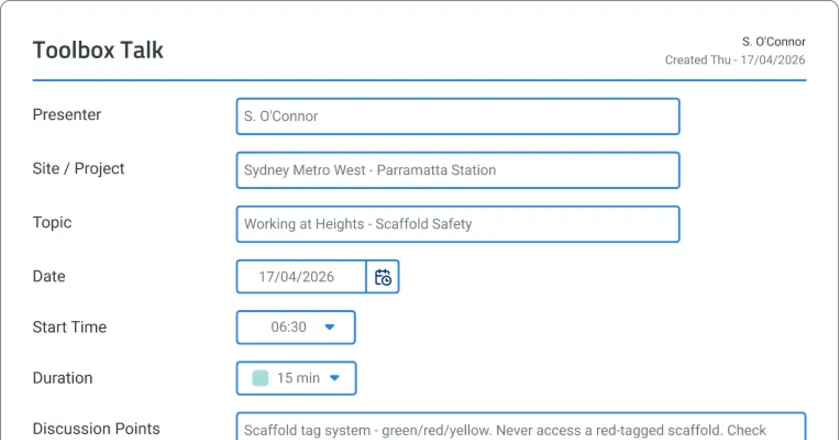
Toolbox Talk App by Sitemate captures digital attendance, voice-recorded safety discussions, and audit-ready records as the briefing happens. Try
View app
Environmental Toolbox Talk
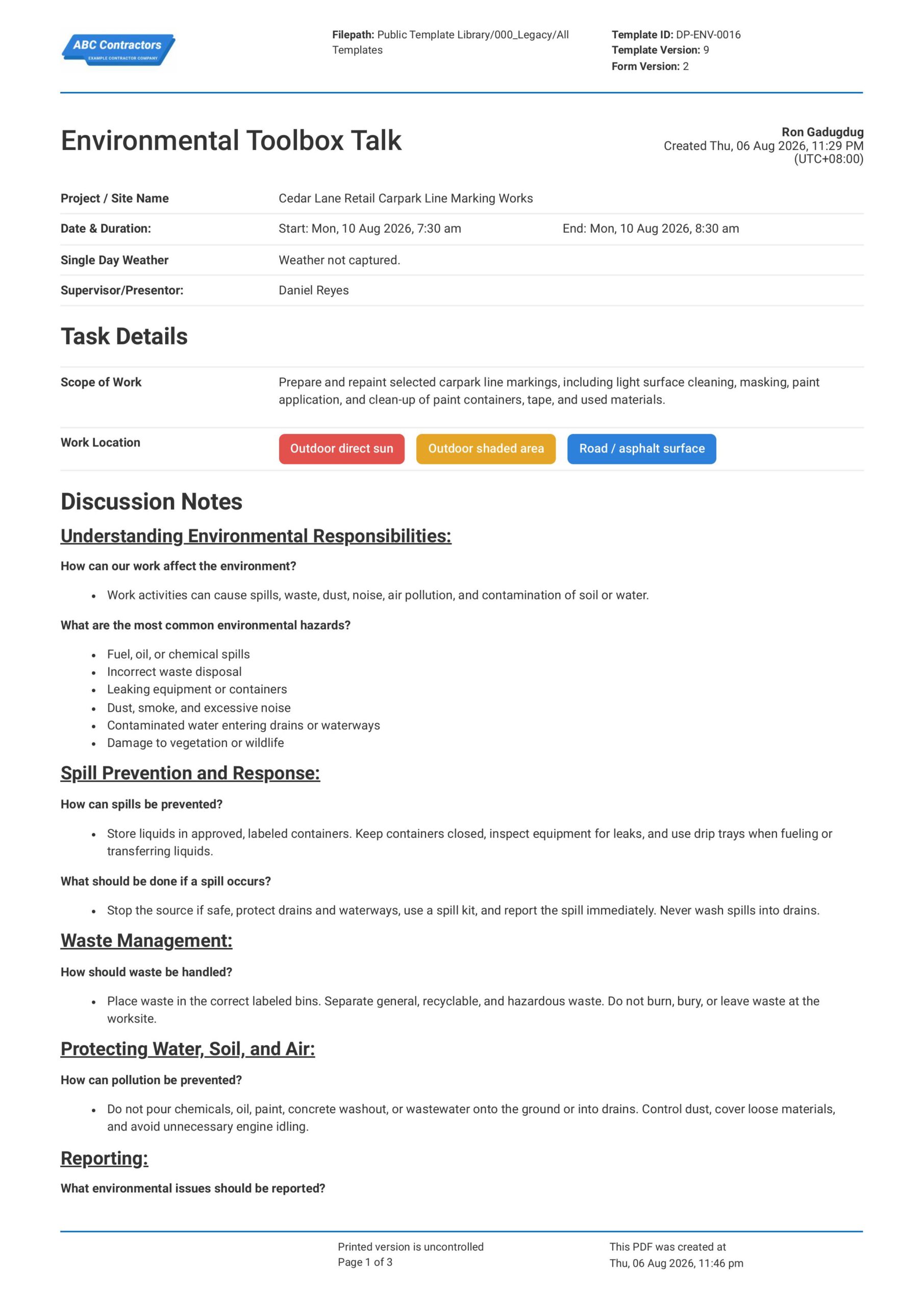
This Environmental Toolbox Talk is an easy-to-use form that your workers can use to discuss environmental hazards, site rules, and basic environmental controls before starting work. Record important toolbox talk details
View template
Toolbox Talk Welding Template
Sitemate's Toolbox Talk Welding Template is a complete and compliant format for a toolbox talk on welding safety. The toolbox talk form is free and easily downloadable to jumpstart the needed safety talk on welding
View templateThis form was generated with Dashpivot software
- Access, edit and complete your Toolbox Talk from any device - mobile, tablet or computer.
- Print, download or send your Toolbox Talk as perfectly formatted PDF documents with your company logo.
- Store your Toolbox Talk securely online, where they can be searched and found in seconds
- Invite internal and external parties to see, edit and sign off on Toolbox Talk online.
