Machine Guarding Risk Assessment Template

Start with a free 30-day trial. No credit card required.
Working with stationary or moving machinery and need a risk assessment that fits your site? This template comes pre-built with a task hazard analysis, a risk assessment section, and a review checklist, all with easy-to-fill fields based on global standard procedures. You can edit any part of it with the drag-and-drop builder to match how your company works, and the assessment will still hold up against the regulations you'd be audited on.
This Machine Guarding Risk Assessment is an easy-to-use form that your workers can use to identify hazards around stationary or moving machinery, assess the risks they present, record the controls needed to eliminate or reduce them, and complete signatures and approvals quickly.
 100% fully editable Machine Guarding Risk Assessment
Export your Machine Guarding Risk Assessment to PDF or CSV
Access your Machine Guarding Risk Assessment on mobile, tablet or computer
Trusted by companies, projects and teams of all sizes















What is Machine Guarding Risk Assessment?
A Machine Guarding Risk Assessment is a detailed document and examination of your operations involving moving equipment to identify any moving components, circumstances, procedures, or other factors that might cause damage, especially to the personnel involved in the activity.
Using a tool for assessing machine guarding risks, the operator or the site safety officer identifies the risks and hazards before starting the equipment. After identifying the hazards, the likelihood and severity of the potential damages or harm are assessed to decide on the necessary steps and controls to prevent or manage potential damage.
Check this free and downloadable Machine Guarding Risk Assessment template
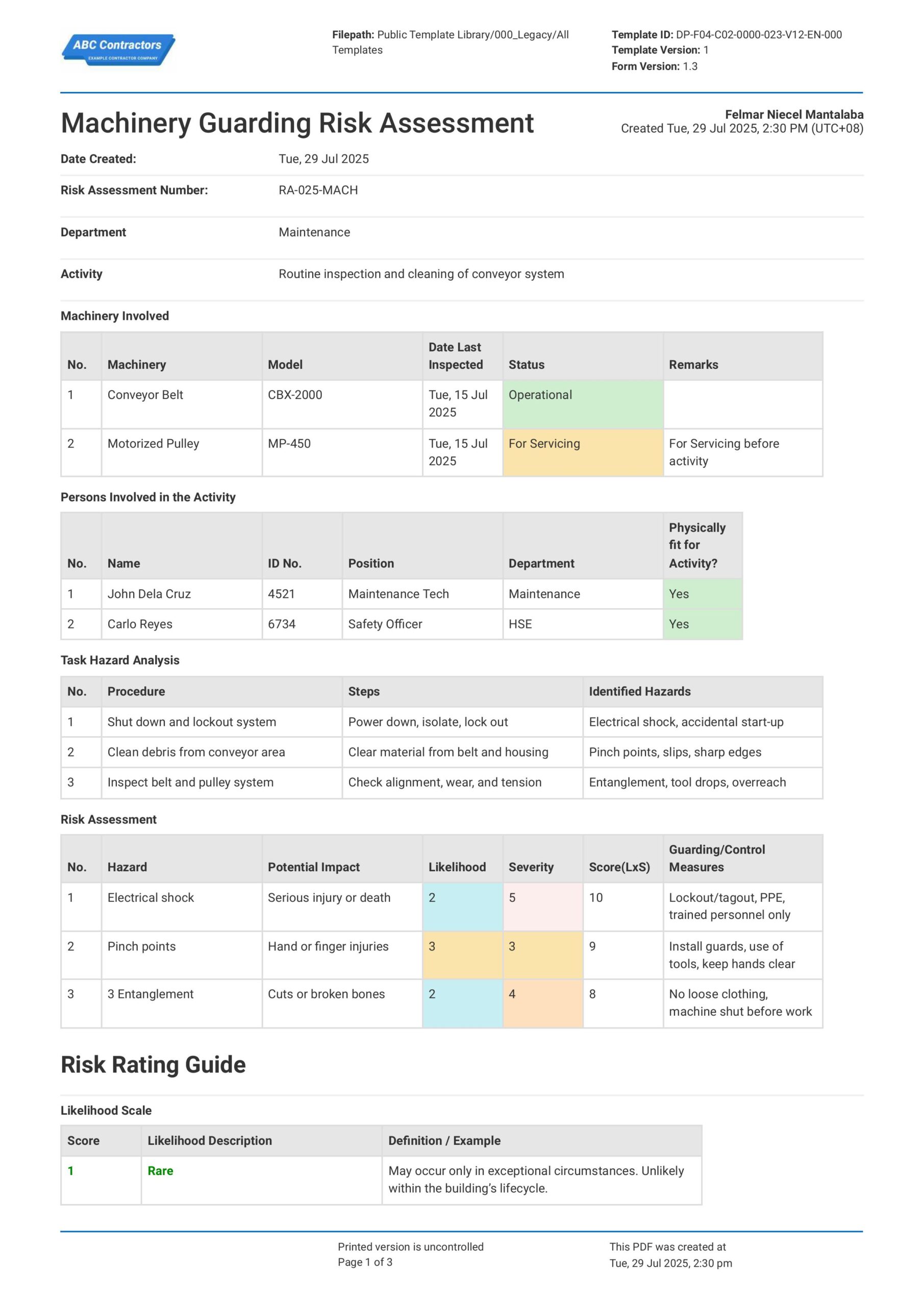
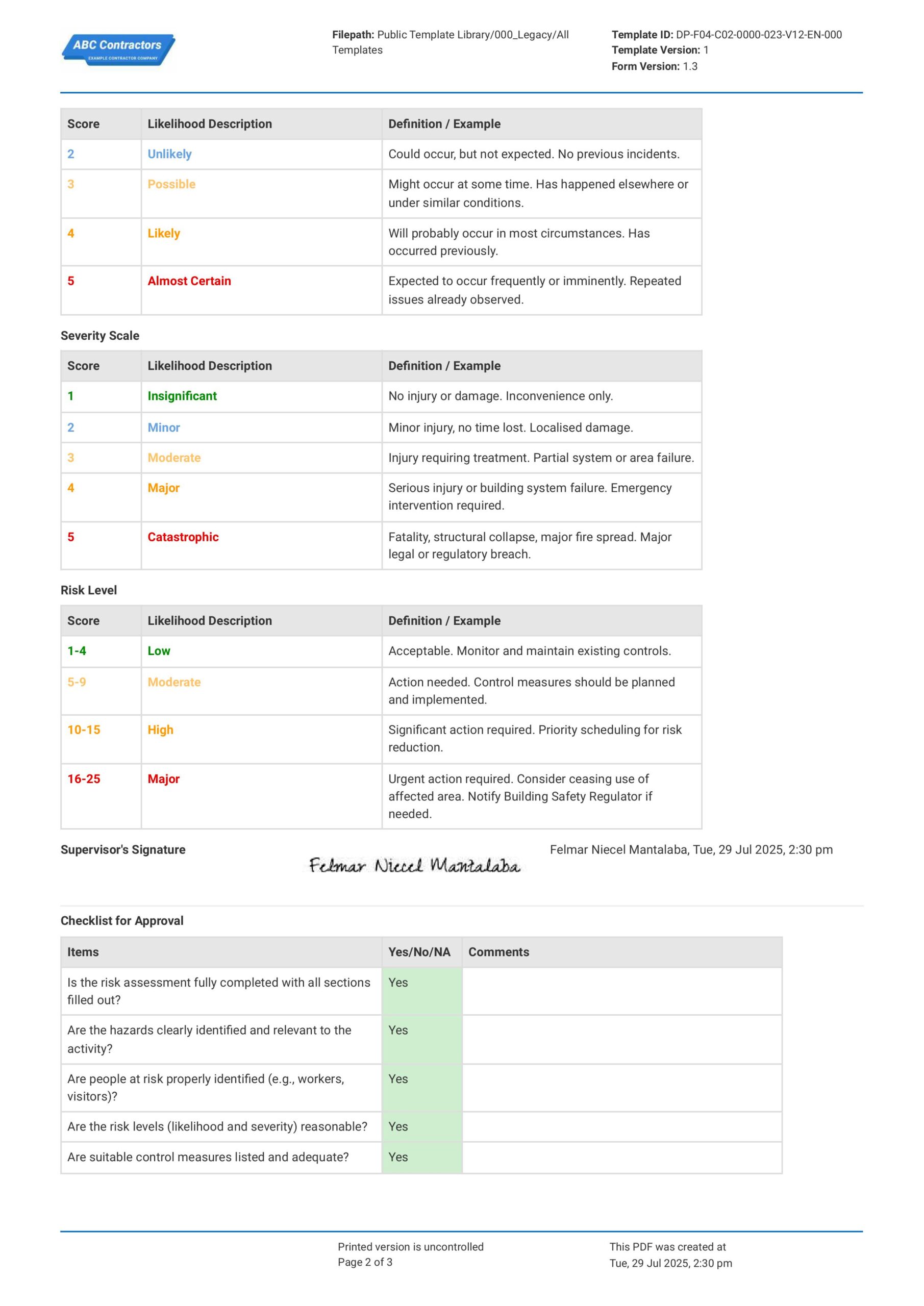
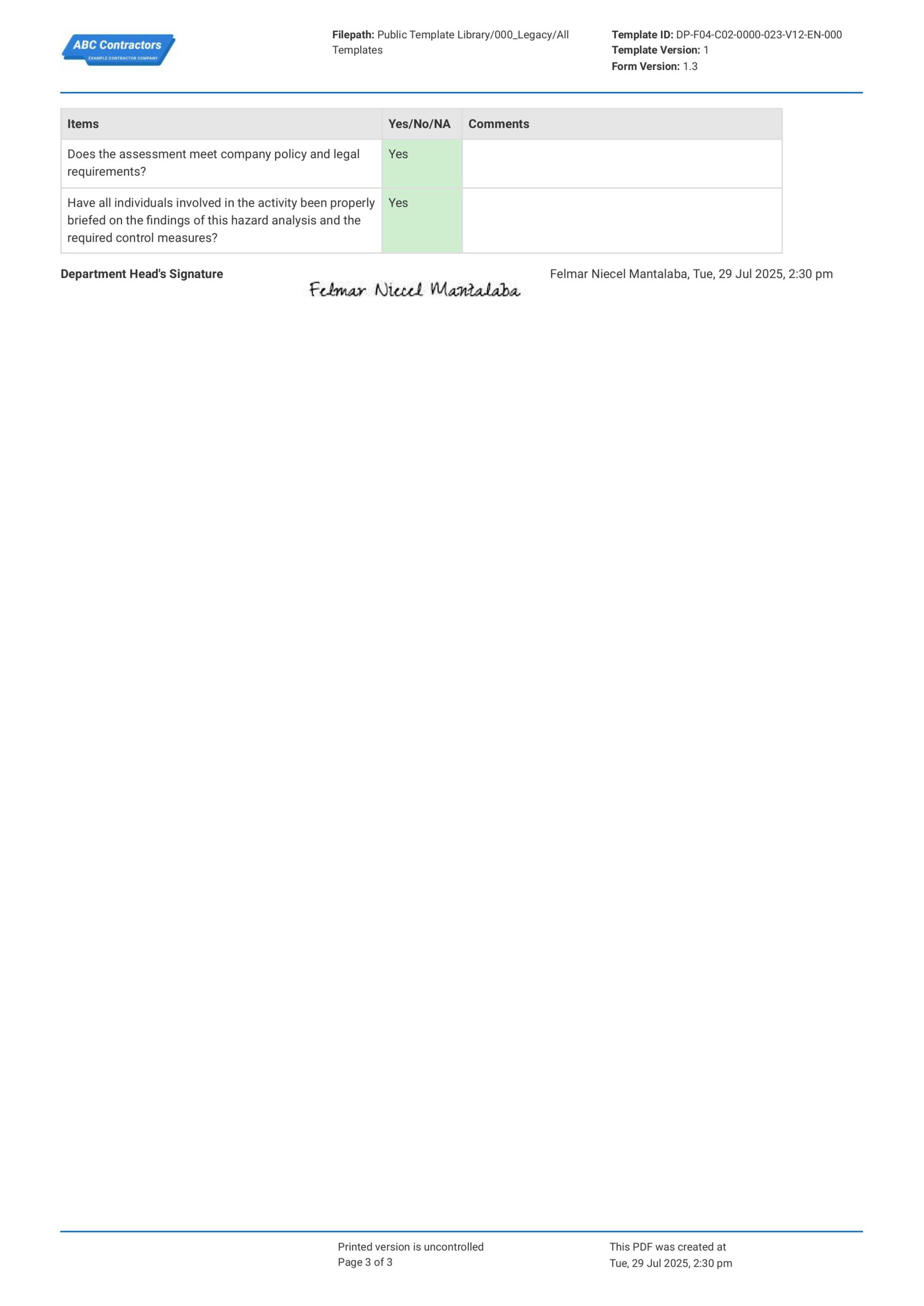
Curious how this Machine Guarding Risk Assessment works? Check out the example below to see how the task hazard analysis, risk assessment, and review checklist work together in one form. You can generate your own version, export it as a custom form with your company details, and fill in your information to have a ready-to-use Machine Guarding Risk Assessment in minutes.
Use this Machine Guarding Risk Assessment template for free

Generate this template automatically with Storm
You don't have to build the Machine Guarding Risk Assessment field by field. Let Storm, the AI Data Capture Agent inside Dashpivot, build the template for you in seconds.
Describe what you need
Tell Storm the form you want in plain language and it builds a structured digital template from scratch, with fields, tables, and signatures in place.
Upload what you already use
Drop in your existing PDF, Word, Excel, or even a photo of a paper form. Storm rebuilds it as a smart digital template with the structure intact.
 Storm
Storm
Generate a Machine Guarding Risk Assessment form template that I can use for my business
Applicable Standards and Policies for Machine Guarding Risk Assessment
Conducting a risk assessment for machine guarding is not just a company-wide obligation. It is also a requirement from safety regulatory bodies all around the world. Here are the applicable standards of some regions around the world and their relevant provisions on proper machine guarding.
USA
- OSH Act of 1970 (General Duty Clause): The mandate requires employers to provide a safe and healthy environment for the employees.
- 29 CFR 1910.212—General Requirements for Machine Guarding: This standard provides the obligation of employers to provide adequate machine guarding to all working machines.
- 29 CFR 1910 Subpart O—Machinery and Machine Guarding: This standard covers the specific requirements for machine guarding.
Canada
- Canada Labour Code Part II: This legislation establishes a primary duty of employers to keep employees safe and protected.
- CSA Z432—Safeguarding of Machinery: This provision serves as a guide for conducting proper machine guarding risk assessments and implementing necessary controls.
Australia
- Work Health and Safety (WHS) Act: A standard that provides the definition of duties to health and safety, which includes risk management.
- Managing Risks of Plants in the Workplace Code of Practice: This standard provides regulations on appropriate machine guarding controls.
New Zealand
- Health and Safety Work Act 2015: This provision has requirements regarding eliminating workplace hazards.
- Code of Practice for Machine Guarding: This provision also outlines the correct procedure for identifying machine hazards and implementing appropriate machine guarding controls.
UK
- Health and Safety at Work, etc. Act 1974: This standard establishes duties and responsibilities for maintaining a safe workplace.
- Provision and Use of Work Equipment Regulations (PUWER) 1998: This provision requires that all equipment be used for the correct task, be safe, be properly maintained, and be operated by trained personnel.
- Supply of Machinery (Safety) Regulations 2008: This standard has provisions on the proper design of manufactured machinery before it is sold to the market.
Ireland
- Safety, Health, and Welfare at Work Act 2005: This is a mandate that requires employers to effectively manage workplace hazards and risks.
Staff Members and Parties that use Machine Guarding Risk Assessment
The risk assessment for the machine guarding process is ideally conducted by multiple personnel to fully address potential hazards when working with either static or moving machinery. The staff members who are required to be part of the machine guarding process are the following:
- Shift supervisors: These are the employees who manage the workforce that does the activities for each shift. They are responsible for ensuring adherence to safety procedures and protocols throughout the shift, including the risk assessment process for machine guarding. They are also the personnel who need to ensure that all safety measures and controls are already in place before each of the activities in the shift has started.
- Operators: Operators are the primary controllers of the machines involved in every shift activity. Part of their jobs is to ensure that the machine runs smoothly and safely throughout each activity, which is why their involvement in the risk assessment process is vital. The exposure and first-hand experience that they have with the machinery also allows them to contribute multiple inputs on the observable hazards found when operating machines.
- Safety Officer: These are the personnel who evaluate the effectiveness and efficiency of controls provided in every activity, especially involving machinery. It is their job to ensure that safety control measures are adequate and satisfactory enough to protect every worker involved in an activity with machines.
- Plant or Field managers: They completely oversee the entire operation. This responsibility also includes managing safety and health in the entire work environment, which is part of the crossroads between planning and actual execution of activities. They will convert data from a form into actual measures for field implementation.
Business Risks Reduced by Machine Guarding Risk Assessment
Keeping everyone safe also means keeping the business safe. Safety procedures, such as the Machine Guarding Risk Assessment is a moral and legal obligation that employers need to comply with. This duty is to safeguard the business from other risks, not just the employees, who are the lifeblood of the company. Committing to the practice of conducting risk assessments for machinery reduces the following business risks:
- Heightened cost due to unplanned downtime
- Heightened cost due to accidents and injuries
- Heightened cost due to non-conformance to regulations
- Increased rate in lost time incidents (LTI)
- Delayed schedules and deadlines
- Company reputation damage
Business Opportunities Created by Machine Guarding Risk Assessment
The Machine Guarding Risk Assessment can provide all the required safety measures to fully protect employees from the potential hazards found in activities where machines are involved. However, complying with this assessment offers more than just protection. Businesses and establishments can gain so much from this simple yet handy tool. The following are the business opportunities created when complying with this assessment:
- More costs saved over time
- Longer machine life
- Lower insurance premiums
- Stronger relationships between employer, employee, and stakeholders
- Better output quality
- Enhances company reputation
When do you need a Machine Guarding Risk Assessment Tool?
One of the important roles of a machine guarding assessment tool is to inform all workers of all the related hazards when working with moving machinery. Giving them awareness can prepare them and necessitate the implementation of appropriate control measures. Employers must also educate their personnel about when to use and look for this handy safety tool. Here are situations where a risk assessment for machine guards is needed:
- Before new procedures or activities are implemented.
- Before altering existing processes or operations, like swapping out items, machines, tools, or equipment, conduct a risk assessment.
- When fresh evidence of damage becomes available.
- When new hazards are detected.
- Prior to commencing work in a new environment
- When fresh knowledge about hazard control or best practices becomes accessible.
- Prior to carrying out equipment maintenance or commissioning
- Before doing ordinary or non-routine duties.
- When the law requires a risk assessment to be conducted.
Machine guarding risk assessment form best practices
The machine guarding risk assessment effectivity highly relies on how it is made. Here are effective methods for creating a risk assessment that helps maintain and improve safety across all machinery-related activities.
A collaborative effort
A risk assessment shouldn’t be a one-man job. When multiple heads work together, more potential hazards can be identified, better evaluations of risk scores can be made, and accurate safety controls can be provided.
Integrate regulatory requirements
Regulations dictate the requirements for a risk assessment form. The provisions can serve as a guide on how to structure your form to be compliant. That being said, it is also vital to study these regulations to help avoid any non-compliance with them, which can result in hefty fines, legal action, and damage to reputation.
Review forms prior to implementation
Risk assessment forms for machine guarding should be reviewed before their implementation. This is to ensure that all information—including personnel involved, task hazard analysis, and risk assessment—is correct and sufficient enough to effectively control the hazards in activities that involve moving machinery.
Internal audits
Audits can help review if the existing safety controls in the machine guarding risk assessment are still effective. These can help provide insights if there are gaps in the existing controls, which can be corrected to further strengthen the safety measures in a certain activity. Audits enhance safety measures, promoting a safe and healthy work environment.
Steps in creating a Machine Guarding Risk Assessment
A complete risk assessment for machine guarding requires a thorough review of all possible hazards, evaluation of the risk score of each hazard, and provision of the appropriate safety control measure to eliminate the hazard or mitigate its effects. Here is the complete step-by-step procedure to make a Machine Guarding Risk Assessment:
Prerequisites in making a Machine Guarding Risk Assessment
- Drawings, manuals, and machine specifications
- Documents including latest incident reports and maintenance records of machines
- Established operational or maintenance procedures
- A record of the personnel involved in the activity and their competencies
-
Conduct a machine inspection
- Using the manual, check all the operational functionality of the machine.
- Do a physical exam of the machine.
- Ask operators about existing operational and safety concerns.
- Encode all vital information about the machine.
- Check all the energy sources in the machine.
-
Identify Hazards
- Gather all personnel involved.
- Review both the operational and maintenance procedures and map out potential hazards.
- Identify the possible impacts of hazards.
- Make sure to thoroughly investigate all the procedures and sub-procedures of the activity.
-
Score and Control Hazards
- Score the hazards based on likelihood.
- Score the hazards based on severity.
- Get Risk Score by multiplying likelihood and severity.
- Choose appropriate control measures based on the hierarchy of controls.
- Make sure to evaluate all found hazards and provide them with the correct controls.
-
Implementation, review, and monitoring
- Review for any missing data on the risk assessment
- Have the manager review and approve the risk assessment
- Implement all the agreed-upon safety control measure
- Monitor the safety control measures
- Update the risk assessment for any new findings or improvements
Frequently asked questions
How to create your Machine Guarding Risk Assessment in an App or Software System
Digital machine safety risk assessment tools transform traditional paper-based evaluations into dynamic, collaborative processes that improve accuracy and follow-through. Dashpivot’s platform enables real-time data capture, automatic risk calculations, and integrated corrective action tracking that ensures identified hazards receive prompt attention. The system’s mobile capabilities allow assessments to be completed directly at equipment locations with immediate photo documentation, while cloud-based storage ensures that critical safety information is accessible to all relevant personnel regardless of their physical location. This digital approach also facilitates trend analysis across multiple machines and facilities, helping organizations identify systemic safety issues and implement enterprise-wide improvements to their machine guarding programs.
45 minutes
Medium difficulty
-
How to create a Machine Guarding Risk Assessment in an app?
Using an app that employs digital forms instead of paper-based ones could help improve the process by:
- Having fewer manual data entry
- There is a single access cloud for all created forms.
- Reformatting is simple to match with new protocols or updated standards.
- Formula integration is much more simpler
- Workflows and notifications can be automated and scheduled
- Better template design and aesthetic
-
Creating the information section.
Forms for Machine Guarding Risk Assessment must include the following information fields:
- Date created
- Risk assessment number
- Machine registration number
- Maximum load capacity
- Department
-
Adding the individuals participating in the activity section
This section provides information for all personnel involved in the activity. The table’s column headers should be as follows:
- Name
- ID Number
- Position
- Department.
- Proof of physical fitness
- The confirmation column can be combined with a yes-or-no list and be color-coded for improved visual aesthetics.
-
Creating the section for task hazard analysis.
This section assists users in identifying hazards by analyzing the potential risks for each procedure in an activity.
- Create a 4-column table that allows users to add rows indefinitely.
- The first column should show the numerical order of each row.
- The second column should allow users to specify the processes for the activity using a forklift.
- The third column should allow users to enter the stages for each procedure.
- The fourth column includes all of the procedure’s identified dangers.
-
Creating the risk assessment section
Developing the risk assessment section, where we evaluate hazards and implement suitable control measures, is the most important aspect of the form.
- Create a 7-column table that allows users to add rows indefinitely.
- The first column should show the numerical order of each row.
- The second column should allow users to enter the indicated hazard.
- The third column should allow users to specify the potential impact of the threat.
- The fourth column should allow users to indicate the likelihood of the hazard. This column could be combined with a list containing the digits 1–5. Each selection can be allocated a color to aid in the rapid recognition of the likelihood of the hazard occurring.
- The fifth column should let users specify the intensity of the hazard. This column could potentially be integrated with a list containing the digits 1–5. Each selection can be allocated a color to aid in the rapid identification of the hazard’s severity.
- The sixth column should show the hazard’s corresponding risk score. The column can be automated to determine the risk score using the following formula: Risk Score = Likelihood x Severity.
- The final column should allow users to specify the appropriate control measure to manage the hazard.
- Provide a guide or legend to help users in scoring
-
Creating the checklist for approval
This part validates that all risk assessment processes are accurate and complete.
- Create a table with three columns.
- The first column should include all of the checklist elements.
- The second column should be a yes-or-no list in which users can indicate whether or not they have completed the checklist items. This column can also be color-coded to make affirmations easier to recognize.
- The third column should allow the form reviewer to leave comments.
-
Adding the signature fields
This field ensures the form is reviewed and valid. The following signatures are needed:
- Signature of competent individual filling the form
- Signature of competent individual reviewing the form
About the author

Felmar Mantalaba
Content Engineer
 LinkedIn
Education
Cebu Institute of Technology - University - Mechanical Engineering with Mechatronics
Bio
Felmar is a mechanical engineer, whose four years of experience in the mining industry inspired him to write and share stories to progress the revolution of new technologies and create smarter, smoother ways of living.
Past Projects
Safety, Health, and Environment Management System (SHEMS) CoordinationSHEMS Coordinator at Atlas Consolidated Mining, ensuring organizational compliance with ISO 14001 and ISO 45001 standards, performing risk assessments, developing policies, and conducting audits and inspections to maintain a safe and environmentally responsible workplace.
Maintenance Management and OptimizationSenior Maintenance Manager (OIC) leading equipment maintenance and operational efficiency initiatives, reducing downtime by 10%, improving Mean Time Between Failure (MTBF) and Mean Time To Repair (MTTR) for major equipment, and managing maintenance schedules, manpower, and materials, while overseeing capital project optimization.
Inspection Engineering and Equipment ReliabilityInspection Engineer responsible for technical blueprint interpretation, vendor collaboration, preventive maintenance scheduling, and data collection for vibration and temperature readings, delivering actionable recommendations and comprehensive reports to improve equipment reliability and operational performance.
End-to-End Operational Oversight in Mining EngineeringContributed to multiple facets of operational management, including SHEMS compliance, maintenance optimization, inspections, and capital project evaluation, integrating safety, reliability, and efficiency improvements across all stages of copper production operations.
Version History:
Related apps and templates
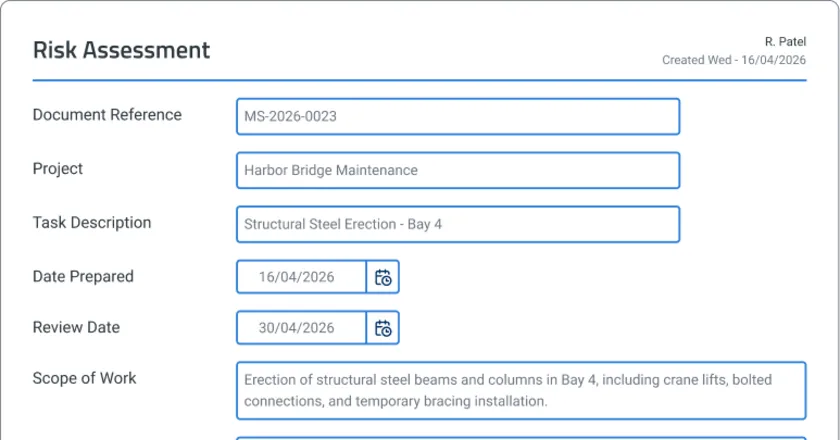
Risk Assessment App
This risk assessment app makes documenting, organising and analysing risk assessments quick and easy on site and in the office. Try the app for free
View app

Nail Gun Safety Toolbox Talk
A nail gun safety toolbox talk aims to educate workers on proper nail gun use and to highlight potential hazards. It helps create a safer work environment by promoting best practices for nail gun safety and reducing the
View template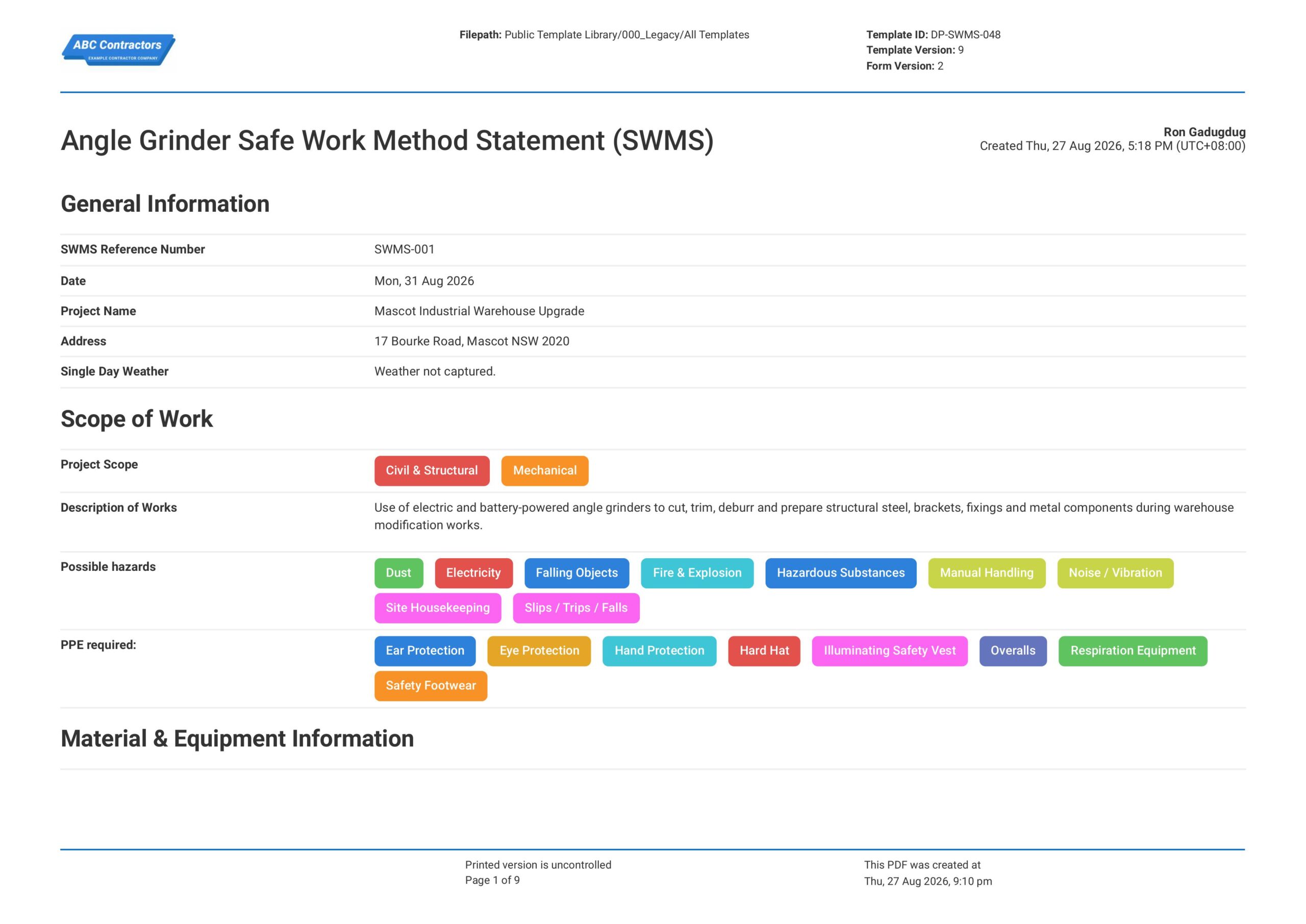
Angle Grinder Safe Work Method Statement (SWMS)
This Angle Grinder Safe Work Method Statement, or Angle Grinder SWMS, is an easy-to-use form that your workers can use to plan and manage angle grinder risks before cutting, grinding, sanding, or surface preparation
View templateThis risk assessment was generated with Dashpivot software
- Access, edit and complete your Machine Guarding Risk Assessment from any device - mobile, tablet or computer.
- Print, download or send your Machine Guarding Risk Assessment as perfectly formatted PDF documents with your company logo.
- Store your Machine Guarding Risk Assessment securely online, where they can be searched and found in seconds
- Invite internal and external parties to see, edit and sign off on Machine Guarding Risk Assessment online.
