
Article Page – Approved Document B Fire Safety
Approved Document B Fire Safety
Short punchy sentence or two max. e.g In this article, we cover the best Site Visit Report format for a number of industries, as well as provide an example Site Visit Report for you to view and use as you see fit.
Table of Contents
Article Summary
- The Approved Document B contains all the fire safety regulations applicable in the UK region, with requirements divided into two volumes.
- Volume 1 contains regulations for dwellings, while Volume 2 contains regulations for Buildings other than dwellings.
- Digital tools are available to assist with documentation of these fire safety works, which is essential to demonstrating compliance to Part B.
Why is the Approved Document B: Fire Safety Important
The Building Regulations Approved Document B Fire Safety is important because it lays out legal fire safety requirements of the building regulations into a structured and practical guidance. Designers, architects, engineers, and project managers all rely on the Part B or the Approved Document B PDF file for guidance on fire safety requirements and compliance.
Approved Document B traces its roots back to the London Building Acts of the late 1800s, which were introduced after devastating fires in densely built Victorian London and gradually evolved into national fire safety guidance
More importantly, the Approved Document B building regulations ensure that your building is ultimately capable of safeguarding the life and property of the occupants of your building. While it is not totally unavoidable, fires and the risk of starting destructive fires in your buildings can be greatly decreased with safe building design and well designed fire safety systems. In turn, you increase the chances of isolating and controlling fire breakouts and ensure the wellbeing of your occupants and decrease the chances of losses or, at least, lessen the amount lost.
How are Fire Safety Compliance Reports Formatted?
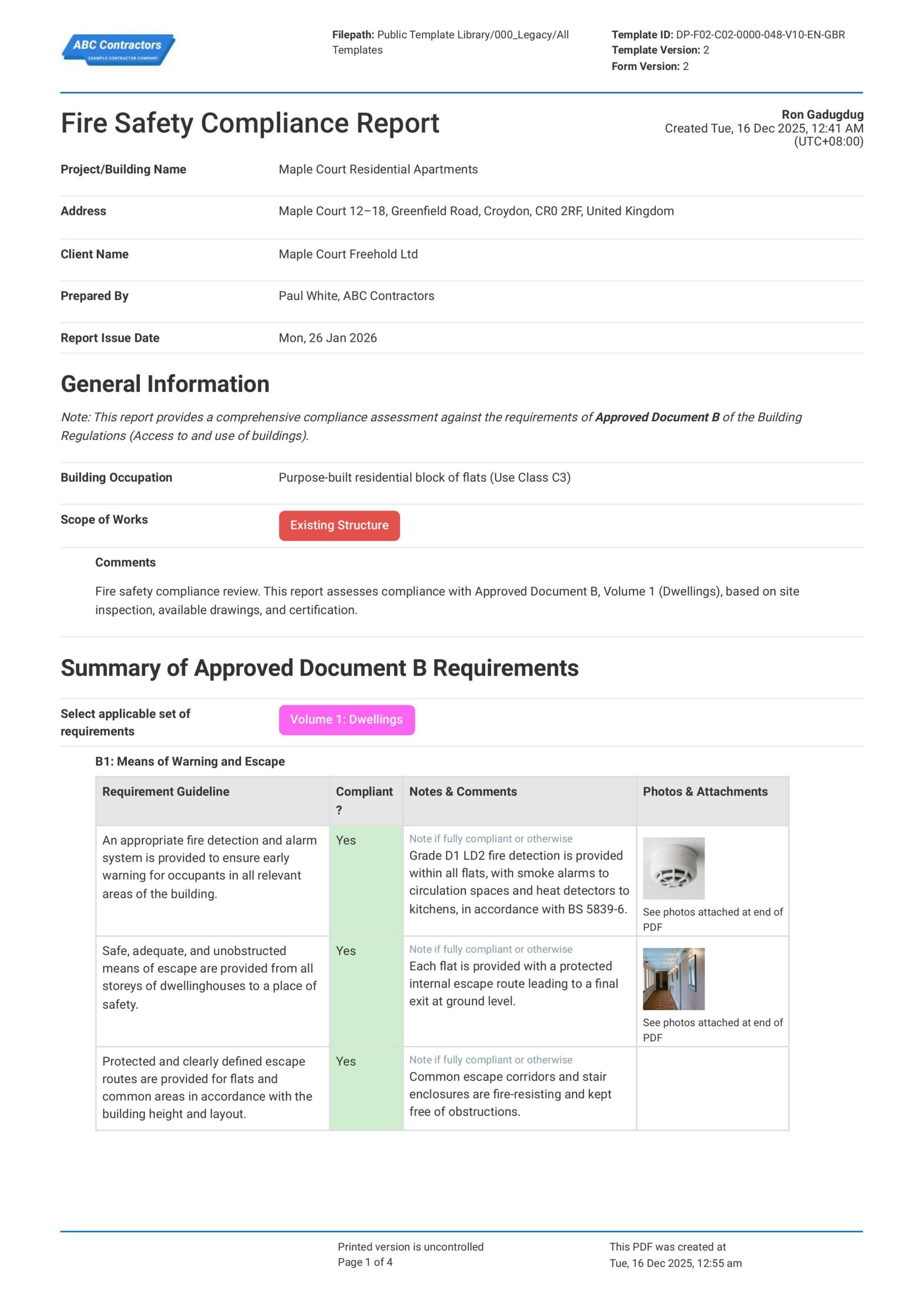
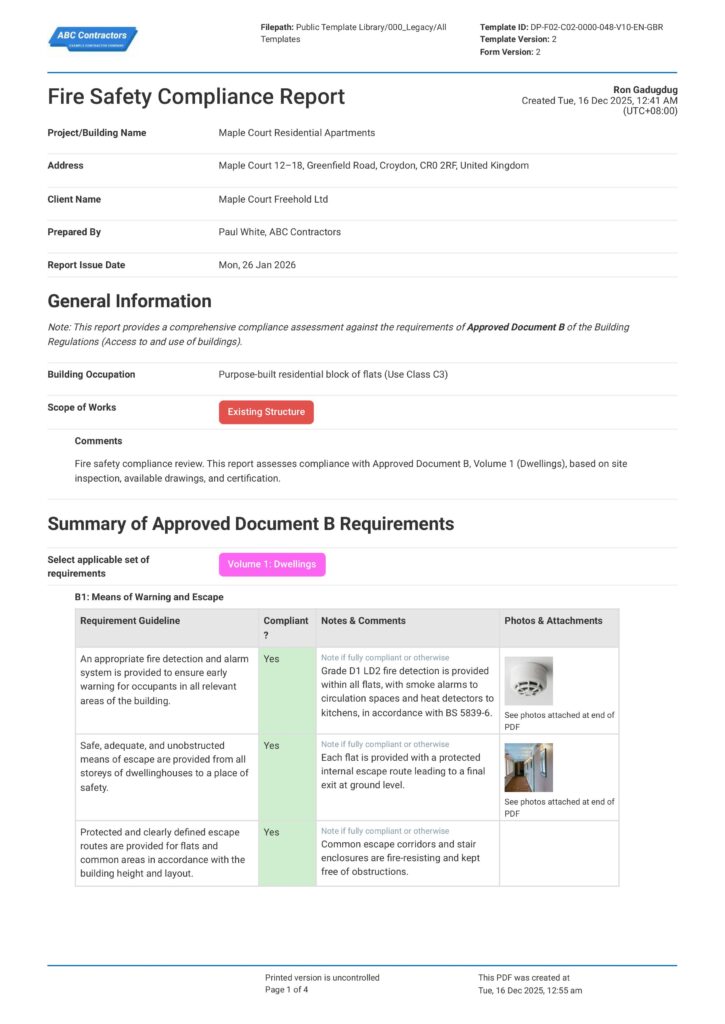
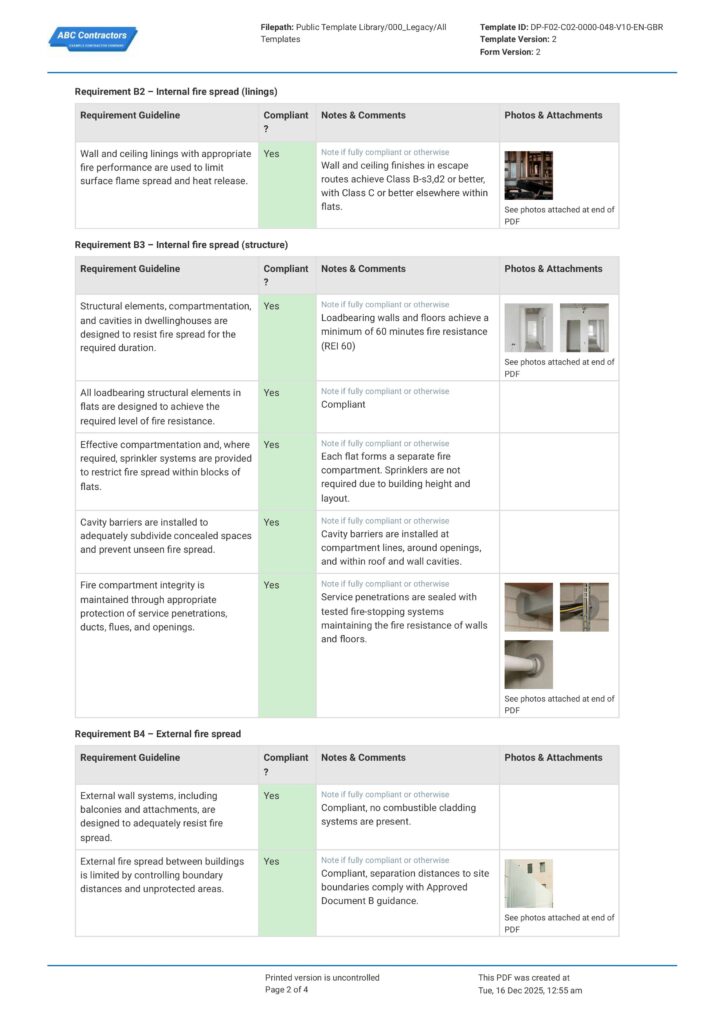
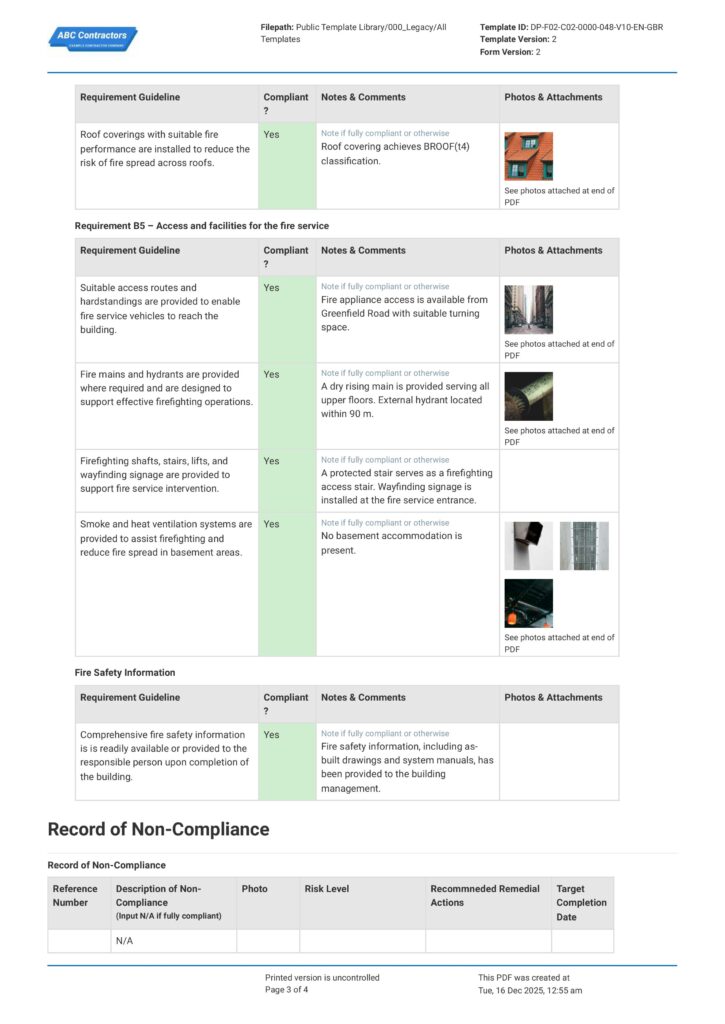
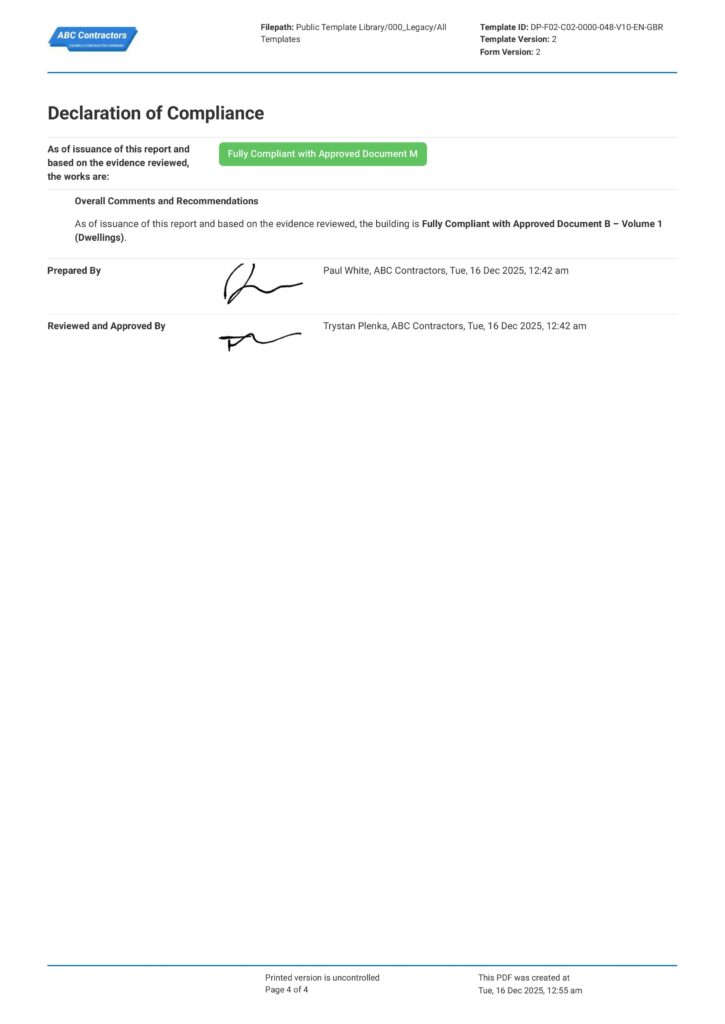
Ideally, a proper Fire Safety Compliance Report should include general information on your building, descriptions of the applicable regulations or standards, lists of fire safety requirements that are specific to dwellings or buildings other than dwellings, a record of non-compliance issues, etc. Additionally, you will also want to be able to take down your own comments, attach photos and files, and certify whether or not a building was found to be compliant or otherwise.
All in all, a well crafted Fire Safety Compliance Report should enable you to directly cross reference actual, as-built conditions with the relevant regulatory requirements. In this way, assessing whether or not fire safety features are compliant with the relevant standards. Additionally, your Fire Safety Compliance Report should also act as a medium of transparency, and enable you to identify, document, and track areas found to be non-compliant.
Feel free to review the sample of a Fire Safety Compliance Report below.
Free Fire Safety Compliance Report Template
Use this Fire Safety Compliance Report for free
What is the Approved Document B Volume 2 About?
The Approved Document B Vol. 2 discusses fire safety regulations specific to Buildings other than dwellings that are built and located in England. It applies to non-residential buildings such as offices, shops, factories, warehouses, schools, hospitals, etc. Additionally, it is important to note that the Approved Document B addresses fire safety primarily through building design, construction, and layout, not day-to-day operational fire safety.
The Approved Document B, or Part B, document contains regulations which can be identified as requirements on means of warning and escape, internal fire spread for linings, internal fire spread for the structure itself, external fire spread, access and facilities for fire service, and other Fire Safety requirements in the Approved Document B explained in clear terms. Further, tools like Fire Safety Compliance Reports are commonly used by engineers and architects to help track compliance with fire safety requirements.
Modern building design makes use of various fire safety features that are all covered by Approved Document B. Tools like Fire Detection System Compliance Checklists, Fire Escape Inspection Report, and Fire Stopping Inspection Report template all help track requirements for specific fire safety features.
What is the Approved Document B Volume 1 About?
Conversely, the Approved Document B Vol. 1 is all about fire safety regulations specific to Dwellings. This includes all types of simple housing and residential spaces. However, it is important to note that common parts of dwellings, such as hallways and corridors within a building with a block of flats, are covered by Volume 2, while individual flats are covered by Volume 1.
Further, it is also important to note that Volume 1 and Volume 2 share much of the same structure, in the sense that all requirements are more or less divided into the same categories. In volume 1, requirements are less strict, as factors such as occupant familiarity with the structure are considered and given fire risks, and fire spread are much lesser in residential buildings when compared to commercial or industrial buildings.
Architects and designers usually use forms like a Fire Safety Pre Plan to help ensure their dwelling designs are up to standard.
Important Approved Document Part B Regulations
Below, we highlight some important regulations and requirements that you should know:
Approved Document B Dwellings Requirements
One distinction of the Approved Document B inner rooms and dwellings requirements is that they heavily rely on passive fire protection and built-in fire resistance rather than active management and emergency response. Approved Document B assumes that people in their homes may be asleep, distracted, or slow to react, and that there is usually no trained staff or fire safety management on site. Because of this, the guidance places heavy emphasis on built-in fire resistance—such as fire-resisting floors and walls, protected stairways, and separation between dwellings—to contain a fire long enough for occupants to react to the fire.
Approved Document B Travel Distances
The Approved Document B issues requirements on maximum travel distances between areas of a building to reduce the time occupants are exposed to smoke or heat when escaping to a safe place. Typically, Volume 1 requirements for travel distances in dwellings focus more on creating simple and intuitive means of escape. While in Volume 2, there is much more emphasis placed on protecting these escape routes, as travel distances can be quite farther due to more complex building design.
In summary, Part B requirements for dwellings rely on simple escape routes and shorter travel distances to compensate for slower reaction times. On the other hand, requirements for non-dwellings rely on protected routes, visibility, and redundancy to compensate for longer travel distances.
Approved Document B Mezzanine Floors
Mezzanine Floors are an important aspect of building design that could potentially increase risks during the event of a fire. They can trap smoke and heat in the area below, which could greatly affect occupants located in the lower floor. Thus, for the purpose of fire safety and identification of risks, mezzanines are typically considered an additional storey to the building with escape routes, fire safety features, and protection specific to it.
To this point, mezzanines are usually given special attention when performing smoke tests. Tools like this Smoke Test Checklist are available to help engineering teams keep track of all the test procedures and findings.
Fire Safety Approved Document B Requirements for Additional Features
Approved Document B Fire Doors Requirements
Fire doors are specially constructed doors that resist the spread of fire and are heat-resistant up to a certain period of time. These doors help buy occupants a bit more time to escape by keeping fires, smoke, and heat isolated. Typically, they are found in large commercial and industrial buildings. Thus, you can find fire door requirements in the Approved Document B Fire Safety Volume 2. However, some residential spaces, especially large houses, may also include fire doors. As a result, you can also find dwelling-specific regulations for fire doors in the Approved Document B Fire Safety Volume 1 as well.
Additionally, aside from being fire and heat resistant for a period of time, fire doors are required to be self closing. This is to ensure that fires are not able to spread through the doorway during an evacuation. Fire doors are also expected to be effective throughout a building’s useful life, thus making maintenance essential and required by Approved Doc B.
Approved Document B Sprinklers Requirements
Approved Document B of the Building Regulations also cover requirements for sprinklers as a part of the containing fire spread and as an emergency fire fighting response. Specifically, sprinkler systems must be designed and installed in accordance with an appropriate British or European Standard (commonly BS EN 12845 for commercial systems and BS 9251 for residential systems).
Sprinklers make up a significant portion of modern day emergency response to fires. It is important to include details and specifics on your sprinklers in documents like Fire Strategy Reports for proper documentation.
Approved Document B Wales Edition
The Approved Document B (Wales Edition) provides guidance on fire safety for guidance and compliance, according to Welsh building regulations, reflecting Welsh policy priorities and risk tolerance. One main distinction between the Approved Document B regulations applied in Wales from that in England is that they are generally considered to be more conservative, with a stronger emphasis on early fire detection, suppression and control.
What are Approved Document B Purpose Groups?
Approved Document B purpose groups are a way of classifying buildings by their use and fire-risk characteristics so that appropriate fire safety measures can be applied consistently across different building types. Typically, these purpose groups help Approved Document B match fire safety design to real-world risk, improving clarity and consistency without limiting design flexibility.
Tools like this Building Fire Risk Assessment are used to ensure your building is properly profiled risk-wise.
Latest Approved Document B Updates
As of this writing, the most recent update that introduced changes to Approved Document B was a set of regulations that took effect on March 2, 2025. This update included enhanced Fire Safety Information requirements, requirements on sprinklers in care homes, and the removal of National Fire Test classes.
Simplify Documentation and Demonstration of Compliance with Digital Tools
With the multitude of requirements and regulations on fire safety, not only in the UK, but across the world as well, staying on top of design requirements and staying compliant can get overwhelming. On top of that, creating documentation to demonstrate compliance with these regulations can result in a mountain of paper work, especially if done manually.

Good news is that we now live in a time where technology evolves everyday. Modern engineers and architects now have digital solutions and tools like this WTF App to help alleviate some of these manual work loads. This allows site personnel to redirect more focus on actual construction, design, and field work, rather than office and paper work.
Summary of Approved Document B Fire Safety
The UK Approved Document B covers regulations on fire safety, detection, and emergency response systems, within a building Further, Approved Document B is subdivided into two volumes: Volume 1 (dwellings) and Volume 2 (buildings other than dwellings). While these volumes differ in the level of scrutiny required for fire safety, they both are structured the same and focus on requirements on means of warning and escape, internal and external fire spread, and access and facilities for fire service.
Frequently Asked Questions
Are Fire Safety Compliance Reports required for submission to Building Control?
While the Approved Document B does not explicitly require you to submit any reports to Building Control, the documentation of fire safety compliance is still important to demonstrating that your building is up to standard. In practice, Building Control will most likely ask for documents like inspection and compliance reports to determine compliance.
How are digital tools improving current Fire Safety Compliance processes?
Digital tools allow engineers, architects, and site personnel to alleviate one of the most work intensive aspects of the construction industry: paper work. Now, there are digital templates of reports, checklists, and forms that were once all manually created for each task. This allows site personnel to focus more on actual site work.
Does Sitemate offer templates related to Fire Safety Compliance?
Yes, Sitemate offers a range of templates for Fire Safety to help you stay compliant with Approved Document B. Additionally, there are hundreds of other safety and quality assurance templates to help you document other aspects of your project as well.
Related resources

Fire Safety Compliance Report
Compile all building fire safety measures and checks into a single report and demonstrate accountability and compliance.

Fire Strategy Report
Clearly outline the building’s fire safety approach in one structured report that supports your building Fire Safety Information.
Building Fire Risk Assessment
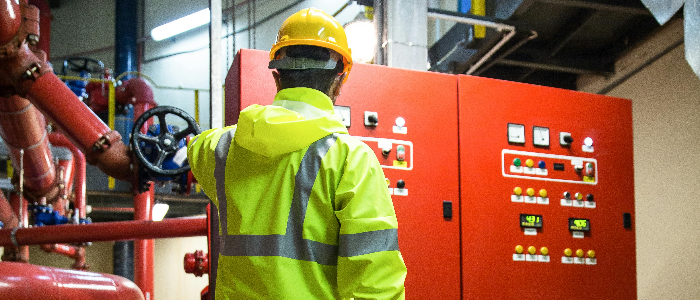
Identify fire hazards and risk levels in your building using a comprehensive assessment that can support informed safety decisions.
Sitemate builds best in class tools for built world companies.


 English (United States)
  English (Australia)
  English (UK)
  English (New Zealand)
  English (South Africa)
  German