Toolbox Talk Noise Pollution Template

Start with a free 30-day trial. No credit card required.
Looking for a ready-to-use Toolbox Talk Noise Pollution that still fits how your team works? This template comes pre-written with the key hazards linked to noise-generating activities, the safety control measures supervisors need to walk through, and fields to record attendance and any issues raised during the talk, so you are not starting from scratch before every session. Every section can be edited to reflect your site conditions, your company procedures, and the specific equipment or tasks your crew is working with, while the structure keeps the document audit-ready and consistent with noise pollution safety requirements.
This Toolbox Talk Noise Pollution form is an easy-to-use form that your workers can use to guide and record toolbox talk sessions covering noise pollution on site. Supervisors can work through the pre-built list of noise-related hazards and control measures during the talk, note any concerns raised by the crew, and capture a full attendance record, all in one document that doubles as a compliance record your team can refer back to.
 100% fully editable Toolbox Talk Noise Pollution
Export your Toolbox Talk Noise Pollution to PDF or CSV
Access your Toolbox Talk Noise Pollution on mobile, tablet or computer

Trusted by companies, projects and teams of all sizes















What is Toolbox Talk Noise Pollution?
A Toolbox Talk Noise Pollution template is a document that acts as both a guide and a record while giving toolbox talks on noise pollution. The form contains a list of all potential dangers and necessary safety control measures for noise-generating activities, which is used as a guide for the supervisor. The toolbox talk form will also keep track of any issues mentioned and the number of employees who attended the toolbox talk.
Compare this Toolbox Talk Noise Pollution template to paper-based forms created from Word, Excel or PDF
Curious how this Toolbox Talk Noise Pollution works? Check out the example below to see exactly what comes included, from the hazard and control measure sections through to the attendance and issues fields. You can generate your own version, export it as a custom form, and fill in your site details to have a complete, ready-to-use Toolbox Talk Noise Pollution document in just a few minutes.
Use this Toolbox Talk Noise Pollution template for free

Generate this template automatically with Storm
You don't have to build the Toolbox Talk Noise Pollution field by field. Let Storm, the AI Data Capture Agent inside Dashpivot, build the template for you in seconds.
Describe what you need
Tell Storm the form you want in plain language and it builds a structured digital template from scratch, with fields, tables, and signatures in place.
Upload what you already use
Drop in your existing PDF, Word, Excel, or even a photo of a paper form. Storm rebuilds it as a smart digital template with the structure intact.
 Storm
Storm
Generate a Toolbox Talk Noise Pollution form template that I can use for my business
Applicable Standards and Policies for Toolbox Talk Noise Pollution
Presentations on noise pollution are not just used to refresh employees’ understanding about the effects of noise pollution. The toolbox talk also provides proof that high-risk companies are taking proactive steps to create a safe and healthy environment, as required by regulatory bodies around the world. The following are the applicable standards that necessitate a noise pollution toolbox talk:
- Control of Noise at Work Regulations 2005
- Health and Safety at Work etc. Act 1974
- Management of Health and Safety at Work Regulations 1999
- HSE Guidance: Noise at Work — A Brief Guide (INDG362)
- ISO 9612:2009
- BS EN ISO 4869
- Construction Design and Management (CDM) Regulations 2015
Staff Members and Parties that use Toolbox Talk Noise Pollution
Making the Toolbox Talk Noise Pollution template is not a one-person job. Multiple inputs are needed to identify all hazards and provide the proper measures. To complete the toolbox talk form, the following personnel must contribute to it:
- Supervisors: They lead the team, which includes managing the workforce in the field. They are the personnel who verify that the workforce has completely understood the effects of noise pollution and has been provided with the proper and appropriate PPE before starting any noise-generating activity.
- Safety Officer: A safety officer’s major responsibility is to completely implement safe work practices in the workplace. They establish the criteria for what is safe and what is not. They evaluate the control systems for tasks that entail high-risk activities, such as those that generate noise pollution.
- Operators and Maintenance staff: These employees face the dangers of noise pollution directly. These people may provide various crucial inputs during the creation of a Toolbox Talk Noise Pollution template because they are the ones who are exposed to the hazards while operating the equipment.
Business Risks Reduced by Toolbox Talk Noise Pollution
Safety must always be the top priority, especially in industries that involve high noise-generating activities, such as working with jackhammers. Conducting a toolbox talk on noise pollution would not only protect employees but also guard against other risks that could damage the company in various ways. To put it simply, the toolbox talk also acts as a shield to the following business risks:
- Financial losses due to high costs related to accidents, injuries, and delays
- Legal liabilities due to non-compliance with safety regulations
- Damaged relationships due to poor reputation and trust
- High insurance costs and compensation claims
- Discontinuation or suspension of operations
- Poor employee work morale
Business Opportunities Created by Toolbox Talk Noise Pollution
Choosing to commit to providing a safe and healthy environment has its merits. It not only shields employees and company property from hazards but also provides benefits and advantages for the company. Establishing concrete safety processes, like the toolbox talk on noise pollution, provides companies with business opportunities that help them gain more than what they have established. These are the business opportunities that can appear naturally when conducting a noise pollution toolbox talk:
- Stable and solid client trust and relationship
- Greater competitive advantage on landing larger projects
- Achieving milestones on time or ahead of time
- Efficient operations
- Positive and a healthy workplace—both physical and mental
- Good reputational standing due to constant compliance with safety regulations
What to cover in a noise pollution toolbox talk
- Common Hazards: Identifies specific noise pollution risks such as hearing loss and flora and fauna deterioration.
- Implementing Controls: Details protective measures like protective systems, noise generation assessments, and safe work practices.
- Notes Raised by Attendees: Records unique safety concerns or observations shared during the talk.
- Actions Arising from the Meeting: Lists tasks and responsibilities assigned to address identified issues.
- Attendance Record: Logs attendees to keep all relevant personnel informed and involved.
What to cover in a toolbox talk on noise exposure
A toolbox talk on noise does not need to be a lengthy classroom session to be effective—a well-structured 5-minute toolbox talk on noise safety, delivered consistently at the start of relevant tasks, is often more impactful than an infrequent hour-long training course. The key is to keep the content focused and directly relevant to what workers will be doing that day. Start by identifying the specific noise sources workers will encounter in the task or site area, then quickly cover exposure limits, the hearing protection available to them, and how to use it correctly. Close with a brief opportunity for questions, then collect signatures.
How to create a Toolbox Talk Noise Pollution template
Follow these steps to set up, customise, and deliver your noise toolbox talk using the free template — whether you need a quick PDF for a one-off briefing or a reusable digital form for ongoing use across multiple sites.
Prerequisites before making a Toolbox Talk Noise Pollution template
- A completed or in-progress noise risk assessment for the site or task in question
- Details of the specific noise sources workers will be exposed to (machinery types, measured or estimated dB(A) levels)
- Confirmation of which hearing protection types are available on site and their SNR/HML ratings
- A list of attendees expected at the briefing (name and role)
- The name and role of the supervisor or safety officer who will deliver the talk
- Any site-specific or task-specific noise control measures already in place
- Access to a Dashpivot account (free) to use the digital template, or a printer if using the PDF version
-
Add an information section
This section provides an overview of the details. The following fields must be present in this section:
- Toolbox title
- Date of activity
- Toolbox presenter
- Toolbox talk form number
-
Add a hazard information section
The hazard information section is part of the Toolbox Talk Noise Pollution template and should provide information on the hazards found when performing noise-generating activities. It should contain the following:
- Identified hazards
- The risks involved in the hazard
- Potential effect of the hazards
-
Add a safety control information section
The safety information section is part of the Toolbox Talk Noise Pollution template that should provide details on the necessary safety measures. It should contain the following:
- Control measures
- Description of safety measures
-
Add a raised concerns section
This section should capture the concerns raised or notes added by the workers. The fields needed in this section are:
- Topic or concern
- Detail
- Person who raised the note or concern
-
Add a needed actions section
This section presents all the actions required to address the raised note or concern. The following fields must be present in this section:
- Description of needed action
- Responsible person
- Due date
- Status of action
-
Add an attendance section
This section should allow the supervisor to record all those who attended the toolbox meeting. It should have the following fields:
- Employee name
- Employee ID number
- Employee Signature
- Signature timestamp
- Provide a signature field for the supervisor who conducted the toolbox talk
Frequently asked questions
How to create your Toolbox Talk Noise Pollution in an App or Software System
A well-designed digital Toolbox Talk Noise Pollution template includes a process that is both faster to execute and more reliable as a compliance record. Supervisors should spend less time on paperwork and more time on the actual safety conversation. It also helps safety managers gain visibility across all sites and crews without chasing paper or manually compiling spreadsheets. And when an audit or incident investigation requires evidence that a noise pollution toolbox talk was delivered to a specific crew on a specific date, the record is there, complete, signed, and searchable in seconds rather than hours.
15 minutes
Easy difficulty
-
How to create a Toolbox Talk Noise Pollution template in an app?
Using an app that uses digital forms instead of paper-based forms substantially improves the form by:
- Providing a single entry point for all completed toolbox talk forms
- Less manual data entry
- Simple reformatting to accommodate new protocols or updated standards
- Faster integration of relevant documents
- Creation of a more defined workflow
-
Formatting the Information section
- Add a date field to allow users to input toolbox talk date
- Provide a text field so users can input the safety toolbox presenter’s name
- Add a prefilled text field for the identified hazards information section. The purpose of this field is to ensure that all toolbox talks on noise pollution already include the identified hazards’ information in the form. This field should provide the following information about the hazard: identified hazards, the risks involved in the hazard, and potential effects of the hazards.
- Add a prefilled text field for the safety control information. The purpose of this field is to ensure that all toolbox talks on noise pollution already include the required safety control information in the form. This field should provide the following information about the control measures and a description of those measures.
-
Formatting the raised concerns section
- Add a field where users can select a yes or no answer from this question: Are there notes or concerns raised by attendees?
- Provide logic that when a user selects “yes,” a 3-column table appears. Format this table to enable users to freely add rows.
- Provide the following headers for each column of this table: concern/notes, detail, raised by
- Format each field in the table as text fields
-
Formatting the actions arising section
- Add a field where users can select a yes or no answer from this question: Did any actions arise as a result of the meeting?
- Provide logic that when a user selects “yes,” a 4-column table appears. Format this table to enable users to freely add rows.
- Provide the following headers for each column of this table: action description, responsible, due date, status
- Format the first 2 columns of the table as text fields to enable users to input action description and responsible person
- Format the third column as a date field
- Format the last column as a selection field for the status of the action. Each selection item can be integrated with colors to make the form more professional. Selection items: open, closed, transferred
-
Formatting the attendance section
- Add a section where employees can have their IDs scanned to automatically record their attendance.
- Add a signature field for the safety toolbox talk presenter
About the author

Felmar Mantalaba
Content Engineer
 LinkedIn
Education
Cebu Institute of Technology - University - Mechanical Engineering with Mechatronics
Bio
Felmar is a mechanical engineer, whose four years of experience in the mining industry inspired him to write and share stories to progress the revolution of new technologies and create smarter, smoother ways of living.
Past Projects
Safety, Health, and Environment Management System (SHEMS) CoordinationSHEMS Coordinator at Atlas Consolidated Mining, ensuring organizational compliance with ISO 14001 and ISO 45001 standards, performing risk assessments, developing policies, and conducting audits and inspections to maintain a safe and environmentally responsible workplace.
Maintenance Management and OptimizationSenior Maintenance Manager (OIC) leading equipment maintenance and operational efficiency initiatives, reducing downtime by 10%, improving Mean Time Between Failure (MTBF) and Mean Time To Repair (MTTR) for major equipment, and managing maintenance schedules, manpower, and materials, while overseeing capital project optimization.
Inspection Engineering and Equipment ReliabilityInspection Engineer responsible for technical blueprint interpretation, vendor collaboration, preventive maintenance scheduling, and data collection for vibration and temperature readings, delivering actionable recommendations and comprehensive reports to improve equipment reliability and operational performance.
End-to-End Operational Oversight in Mining EngineeringContributed to multiple facets of operational management, including SHEMS compliance, maintenance optimization, inspections, and capital project evaluation, integrating safety, reliability, and efficiency improvements across all stages of copper production operations.
Version History:
Related apps and templates
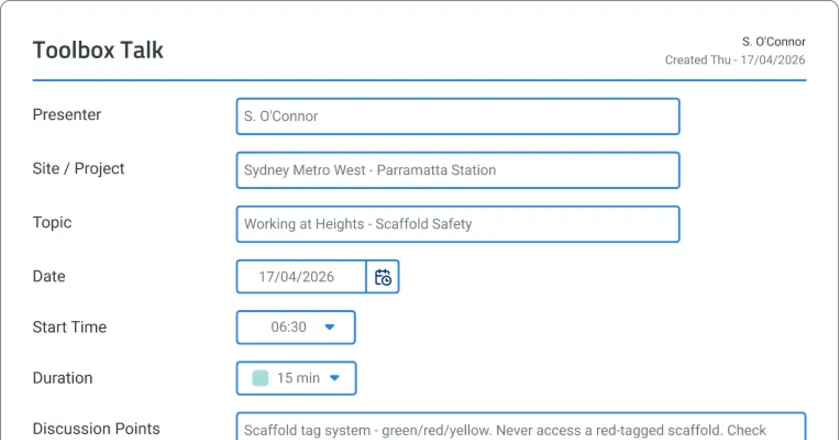
Toolbox Talk App
Toolbox Talk App by Sitemate captures digital attendance, voice-recorded safety discussions, and audit-ready records as the briefing happens. Try
View app
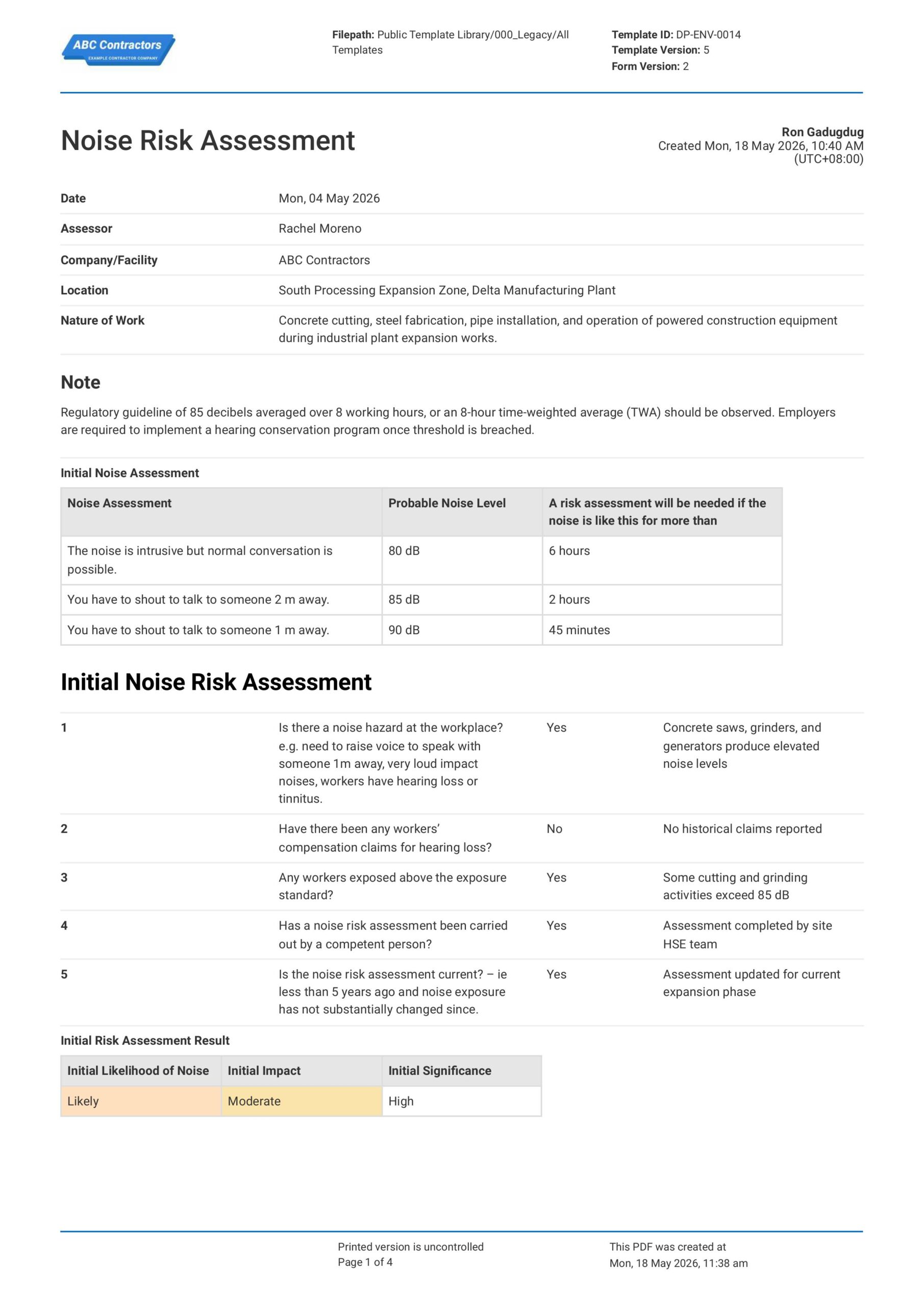
Noise Risk Assessment
This Noise Risk Assessment is a form that can help your team protect workers, adjacent properties, and the environment by mitigating the effect of disruptive noise that comes from construction works. With this form,
View template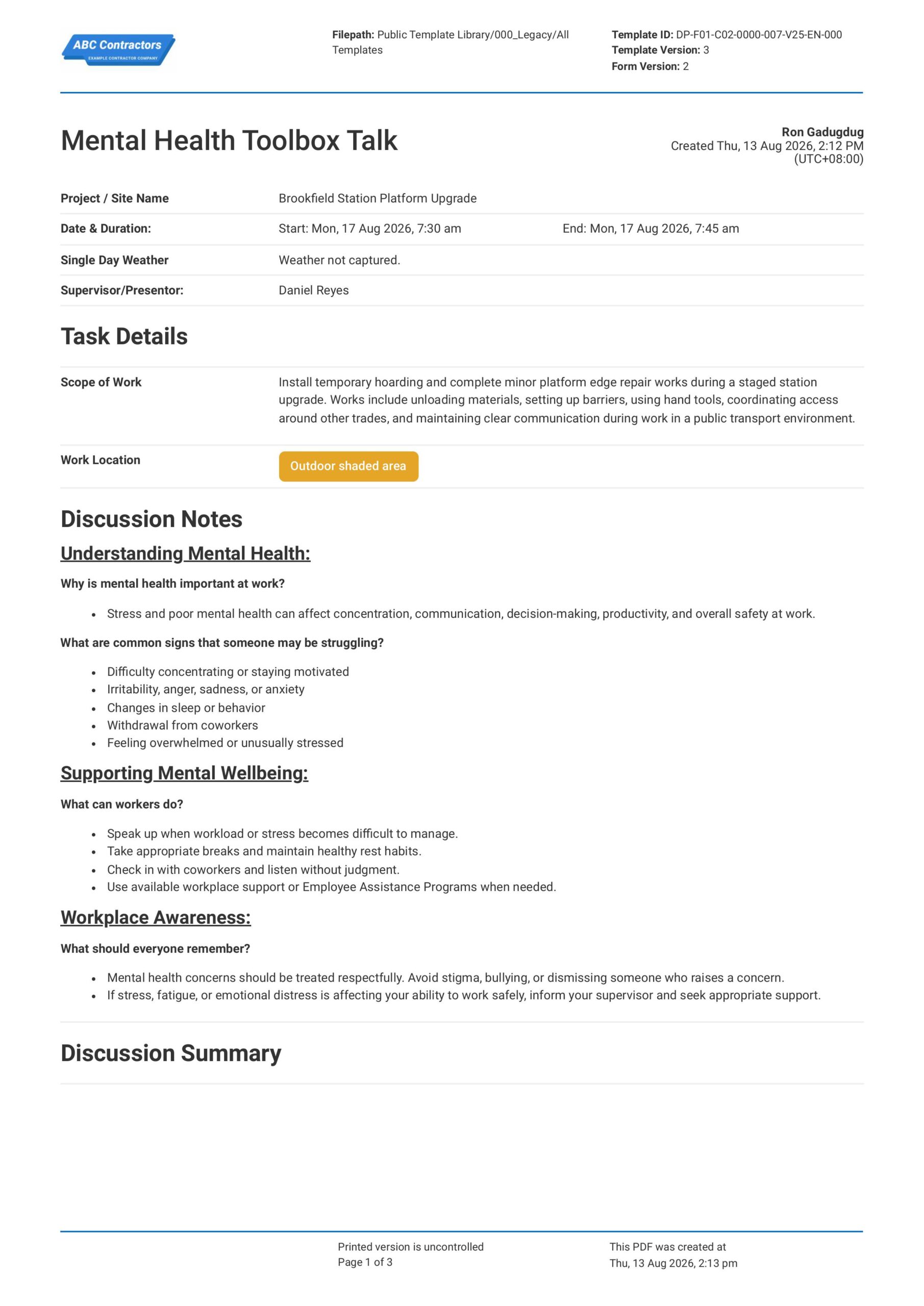
Mental Health Toolbox Talk
This Mental Health Toolbox Talk is an easy-to-use form that your workers can use to discuss mental health, workplace stress, fatigue, support channels, and early warning signs in a clear and respectful way. Record
View templateThis form was generated with Dashpivot software
- Access, edit and complete your Toolbox Talk Noise Pollution from any device - mobile, tablet or computer.
- Print, download or send your Toolbox Talk Noise Pollution as perfectly formatted PDF documents with your company logo.
- Store your Toolbox Talk Noise Pollution securely online, where they can be searched and found in seconds
- Invite internal and external parties to see, edit and sign off on Toolbox Talk Noise Pollution online.
